Collaborative Filtering vs Content-Based Filtering


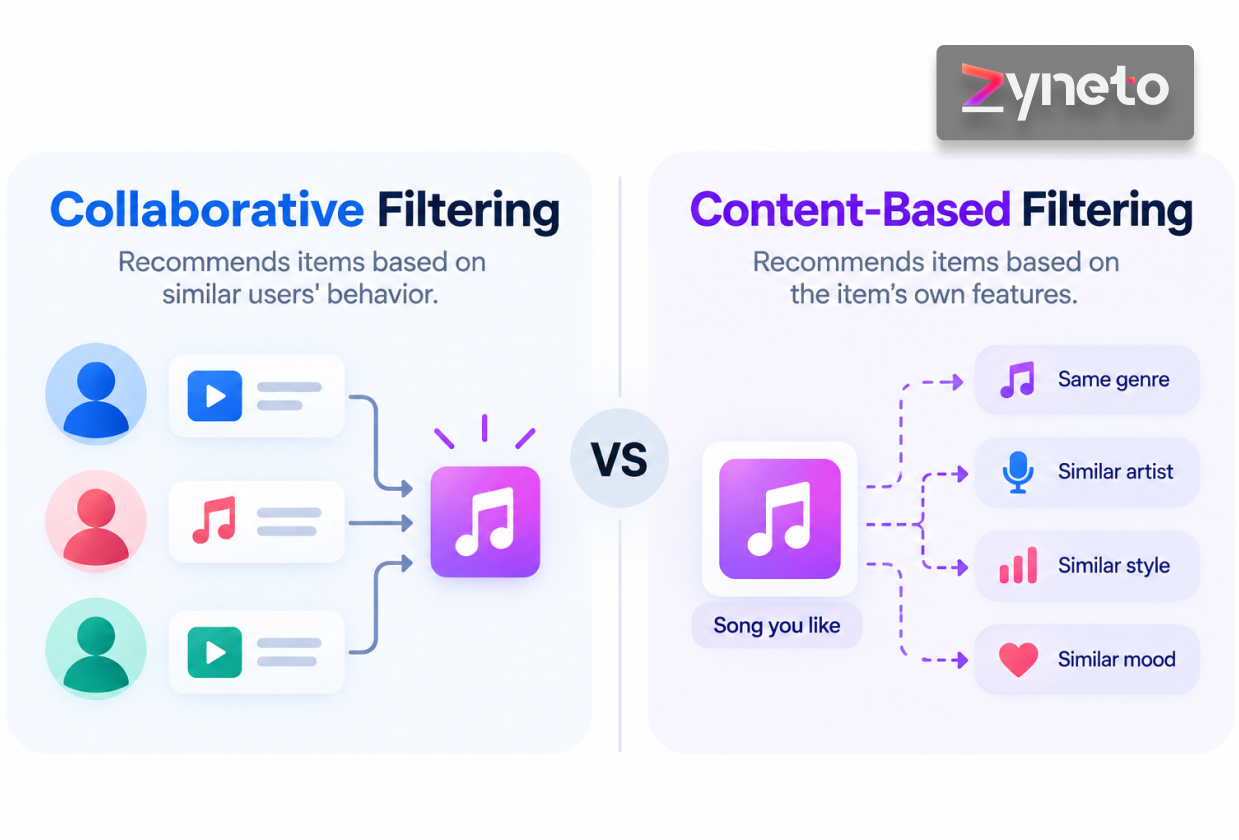
Two approaches, endlessly compared, and the comparison is nearly always framed as a choice. In production it is not one. They fail in opposite places, which is the useful fact about them and the reason serious systems run both.
The real question is which one carries the load on your catalogue, and what the other is there to cover. That depends on 2 numbers: your median interactions per item, and how many days an item lives.
Collaborative filtering ignores what an item is. It learns from the pattern of who interacted with what, and recommends on the basis that people who behaved like you went on to engage with something you have not seen. The item could be a song, a lathe or a job advert and the method does not look.
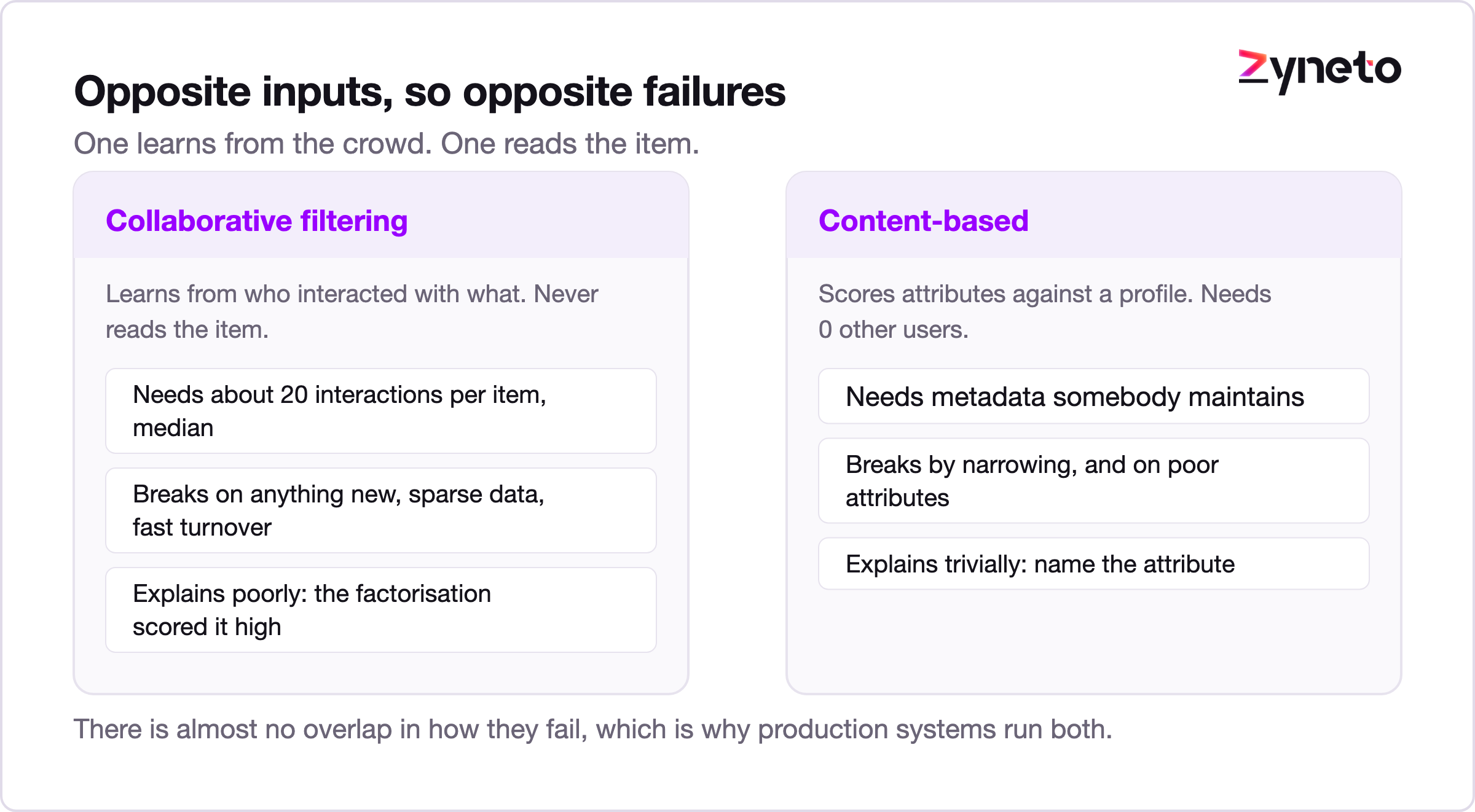
That indifference is the strength. It finds associations nobody catalogued, because the signal sits in behaviour rather than metadata. The classic implementations are matrix factorisation and its implicit-feedback variants, ALS and BPR, plus the older item-based and user-based neighbourhood methods.
Content-based filtering does the opposite. It scores items by their attributes against a profile built from what this user engaged with before. Category, tags, text, price band, author, duration. It needs 0 other users.
That independence is its strength. A new item can be recommended the moment it is catalogued, and a new user can be served after 1 interaction.
So 1 learns from the crowd and knows nothing about the items. The other reads the items and knows nothing about the crowd. Nearly everything below comes from that single asymmetry.
Anything new. A new item has 0 interactions, so it cannot be recommended, so it accumulates 0 interactions. Left alone this is permanent. Every working collaborative system has something else handling new stock.
Sparse interaction data. The method needs overlap. Below roughly 20 interactions per item at the median, almost no 2 users share an item and the output is noise. A catalogue of 200,000 items against 5,000 active users is the classic case: the totals look healthy and the matrix is empty.
Popularity collapse. Left to optimise engagement it converges on the top 1 or 2 per cent of items, because those carry the most data and therefore the most confident predictions. The long tail starves.
Explaining itself. The honest explanation is that the factorisation produced a high score. Under GDPR Article 22, where a decision is solely automated and has legal or similarly significant effects, that is a weak position. Lending, hiring and insurance pricing all sit there.
Fast catalogue turnover. Classifieds, ticketing, short-run stock. If the median item sells in 5 days and your retrain cycle is 7, the item is gone before it is recommendable. The mismatch is structural and tuning does not fix it.
It narrows. Recommending things similar to what someone already engaged with tightens the loop. 2 articles about Kubernetes and the feed is Kubernetes for a month. Collaborative signal is what breaks that, because other people's behaviour introduces what your own history never would.
It is only as good as your metadata. And metadata decays. Categories applied inconsistently, tags added by whoever uploaded the item, free-text fields used for 3 different purposes. In a marketplace where 2,000 sellers enter their own attributes, this is the constraint rather than the algorithm.
Attributes are not preferences. 2 products can share every tag and feel completely different to a buyer. How something sounds, how well it is made, whether it suits a particular room: frequently not in the catalogue at all. That is exactly the signal collaborative filtering picks up for nothing.
It cannot find the surprising connection. By construction it recommends what resembles what came before, so it will never discover that buyers of 1 thing reliably want an apparently unrelated other thing.
Set them side by side and the design follows. Collaborative cannot handle new items; content-based handles them from minute 1. Content-based narrows; collaborative broadens. Collaborative cannot explain itself; content-based explanations are 1 attribute long. Content-based depends on metadata quality; collaborative never reads it.
There is almost no overlap in how they fail, which is why the production answer is nearly always both, and why the interesting question is how they combine.

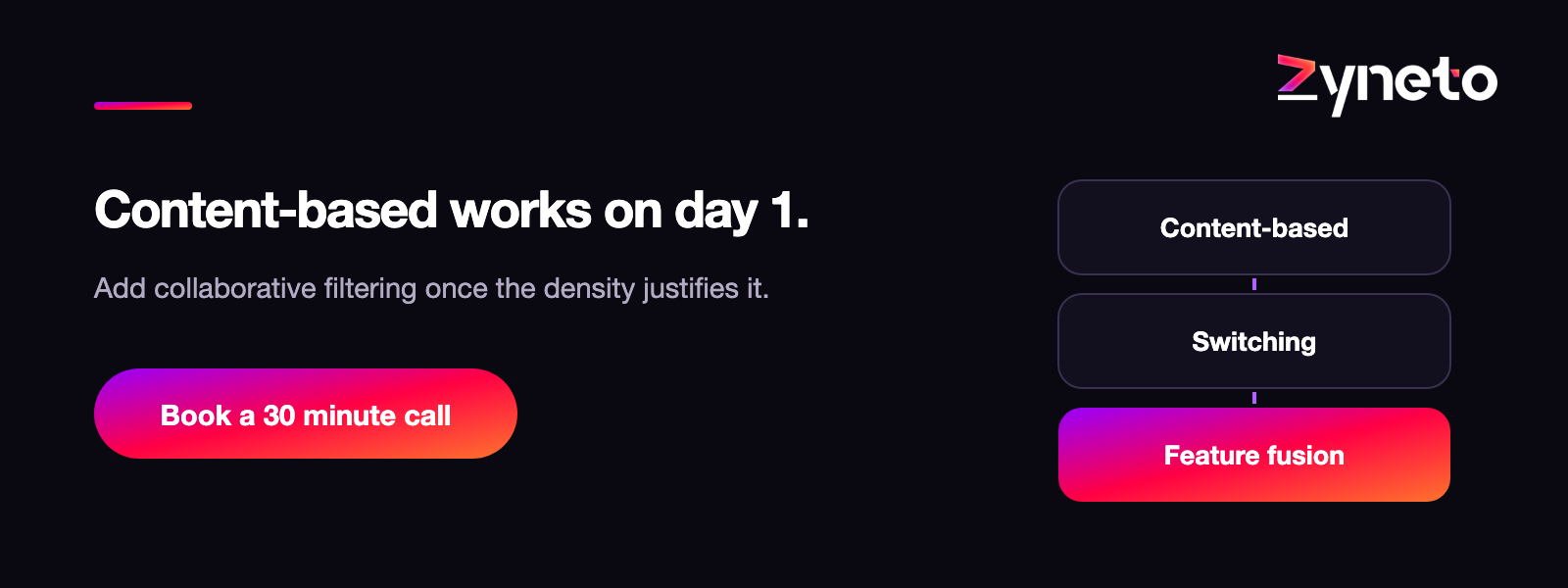
Switching. Pick 1 per request based on how much is known. New user or new item, content-based; established user and established item, collaborative. Crude, easy to reason about, and the right starting point for most teams. It degrades predictably, which matters more than it sounds.
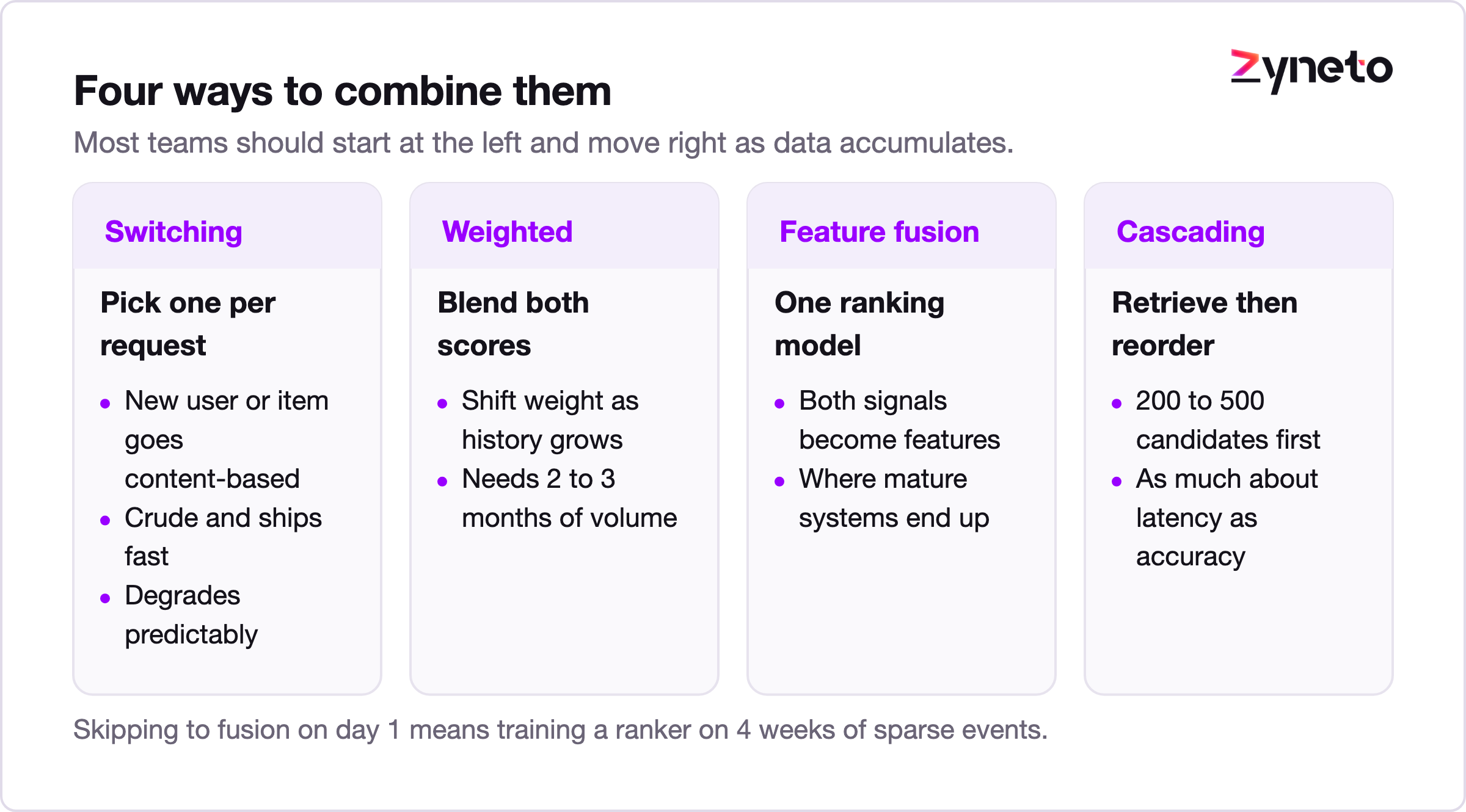
Weighted blending. Score with both and combine, shifting weight towards collaborative as a user accumulates history. Smoother than switching. Needs enough traffic to tune the curve, realistically 2 to 3 months of steady volume.
Feature-level fusion. Feed both signals into 1 ranking model as features: collaborative similarity, attribute matches, recency, availability. Most mature systems end here, because the ranker decides how much each signal is worth per context rather than being told in advance.
Cascading. One method retrieves 200 to 500 candidates cheaply, the other reorders them. Usually embedding retrieval first, then content and business rules on the shortlist. As much about latency as accuracy.
A reasonable sequence is switching first, because it ships, then feature-level fusion once there is data to train a ranker worth having. Skipping to fusion on day 1 means training a ranker on 4 weeks of sparse events.
Reasonable question, because the modern literature talks about embeddings rather than this distinction.
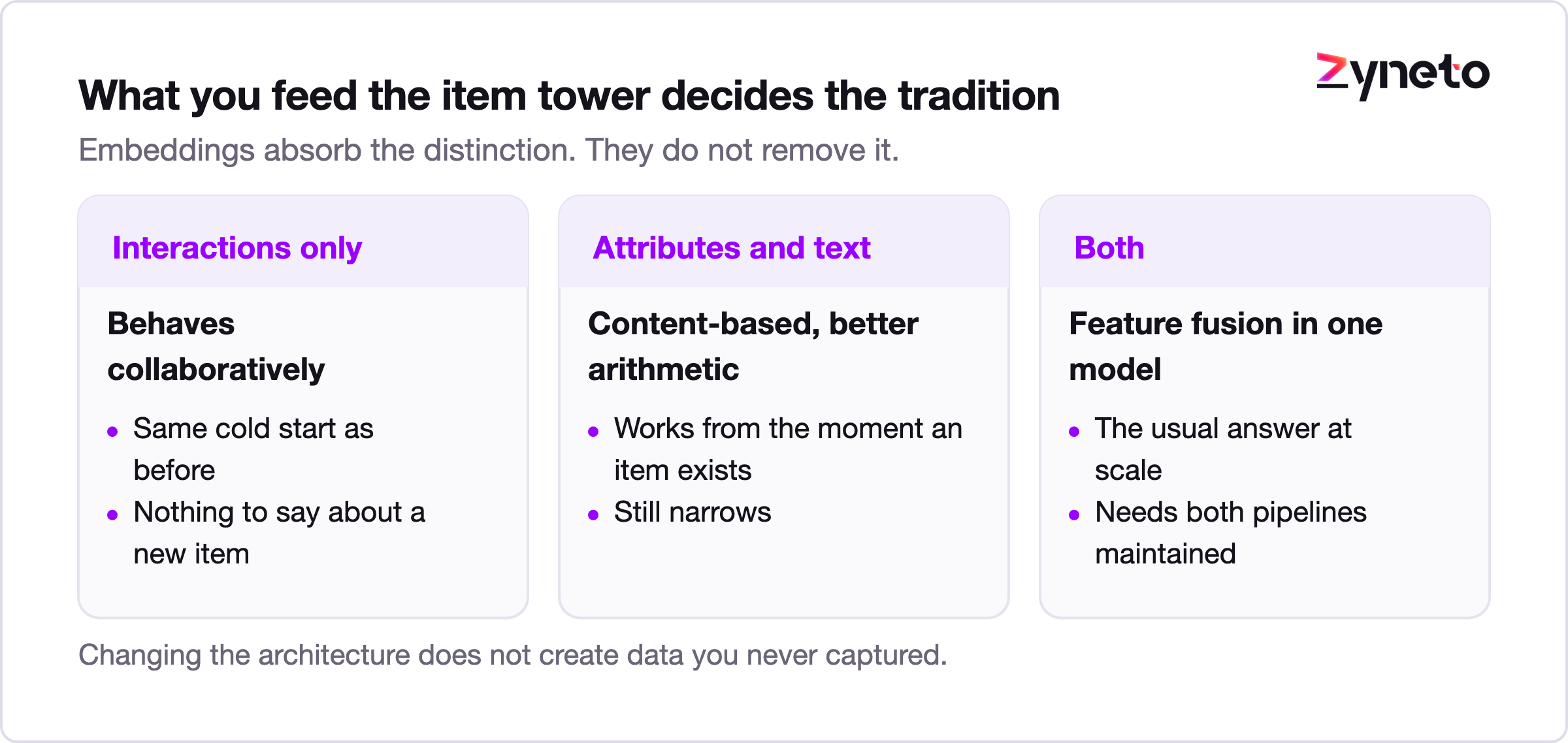
Embedding approaches absorb the distinction rather than replacing it. A two-tower model learns a vector for the user and a vector for the item, and what goes into the item tower decides which tradition it inherits. Build that vector from interaction history and it behaves collaboratively, with the same cold start. Build it from attributes and text and it is content-based with better arithmetic. Build it from both, which is the usual answer, and you have feature-level fusion expressed as 1 model.
Cold start does not disappear because the architecture changed. An item tower fed only by interactions still has nothing to say about an item with 0 interactions.
The plumbing questions are the same either way: where the vectors live, how often they refresh, and whether training and serving read the same values. An HNSW index will return the top 500 from 10 million vectors in single-digit milliseconds, which solves retrieval speed and solves none of the data questions. Those sit with our database development work.
Where the item is mostly text, such as descriptions, CVs or listings, the quality of the attribute side depends on the language work rather than the recommender, which is our NLP development practice.
How many interactions per item do you actually have? The median, not the total. Below about 20 the collaborative side has nothing to work with, however large the headline.
How fast does the catalogue turn over? If 30 per cent of stock is new each week, content-based carries the load and collaborative is an enhancement.
Is your metadata maintained by someone whose job it is? If attributes arrive from sellers with no validation, content-based scoring fails quietly rather than obviously, which is harder to debug.
Does a recommendation ever have to be explained? To a user, a regulator or an internal reviewer. If yes, content-based or an explicit ranker needs to be in the path, because that is where the reasons live.
Who maintains this in 12 months? Collaborative filtering needs retraining and monitoring. Unowned, it decays while every dashboard stays green.
Those 5 answers settle it more reliably than any benchmark, because they describe your situation rather than someone else's dataset.
A B2B parts catalogue. 80,000 items, 3,000 trade accounts, orders not browsing. Density looks adequate and is not: orders run perhaps 2 per cent of the volume of views, and most items have been ordered by under 10 accounts. Content-based carries this, on the technical attributes that already exist because the business cannot operate without them. Collaborative earns 1 job, the frequently-bought-together association, which finds pairings nobody catalogued.
A consumer media library. 300,000 items, millions of sessions, heavy repeat use. Collaborative filtering's home ground and the only 1 of the 3 where it should lead. The density is there and the associations are genuinely not predictable from metadata. Content-based still has to exist for day 1 of a new release. The real work is diversity and exploration controls, because engagement-optimised ranking on a dense catalogue narrows within weeks.
A classified app development case, or ticketing. Items live 3 to 10 days. Collaborative filtering is structurally wrong and no tuning fixes it. By the time an item has the interactions to be recommended confidently it has sold. Content-based plus recency plus availability does the job, and the effort is better spent on search. Capture collaborative signal at the category level, which persists, rather than the item level, which does not.
3 catalogues, 3 different answers, and in 2 of them the method the literature favours is the wrong lead. The distinguishing variable is not catalogue size. It is interaction density per item and how long an item lives.
Collaborative filtering splits into 2 older neighbourhood methods before you reach matrix factorisation, and the distinction still decides how the thing behaves.
User-based. Find the 50 users most similar to this one, recommend what they engaged with. Intuitive, and it is how most people describe the method when asked.
Item-based. Find the items most similar to the ones this user already touched, where similarity means the same people touched both. Recommend those.
Item-based won in practice, for 2 operational reasons rather than any accuracy argument.
Item similarity is stable and user taste is not. The relationship between 2 products barely moves week to week, so the similarity matrix can be computed nightly and served from cache. A user's neighbourhood changes with every session, so user-based wants recomputing far more often.
The matrix is smaller where it matters. A catalogue of 80,000 items against 2 million users means the item-item matrix is a fraction of the user-user one, and it grows with the catalogue rather than with signups. Most businesses add users faster than products.
The practical consequence: if you are building neighbourhood collaborative filtering rather than a factorisation, build it item-based and precompute. If you are already at the scale where a nightly job will not finish, that is the signal to move to matrix factorisation or a two-tower model rather than to tune the neighbourhood.
Both still cold-start. Neither reads the item.
What actually changes when you add the second method. Teams expect accuracy to jump. It usually does not, and the things that do improve are easier to miss.
Catalogue coverage rises first. The share of the catalogue appearing in any recommendation across a week is the clearest early signal. A content-based system bolted onto a collaborative one typically surfaces items that previously appeared 0 times, which is the point of adding it.
New item time-to-first-impression collapses. Measure the days between an item being catalogued and its first recommendation impression. Under a purely collaborative system that number is effectively infinite for the tail. It should fall to under 1 day.
Headline click-through moves little. Because the head of the catalogue was already being served well, and the head is where most clicks were. A flat click-through with rising coverage is a success, not a failure, and it is worth agreeing that before the test rather than after.
Operational cost rises. 2 systems, 2 refresh cycles, 2 ways to be wrong. Budget for the second one in the running cost rather than treating it as a one-off build.
A reasonable first read is 6 to 8 weeks after the second method goes live, long enough for a full catalogue refresh cycle and short enough that nobody has rebuilt anything in the meantime. Compare coverage, time-to-first-impression and long-tail share of clicks against the baseline, and treat a flat headline rate as neutral rather than as evidence the work failed.
One warning on the comparison itself. If the second method ships at the same time as a redesign of the slot it sits in, the test is void and no amount of analysis will separate the 2 effects. Ship them 3 or 4 weeks apart, in either order, and the reading stays clean.
Rates are $40 to $100 per hour by role. Catalogue and data work sits near the floor. Retrieval architecture, evaluation design and latency-sensitive serving sit near the ceiling. A mixed team blends to $60 to $70.
A content-based scorer over a catalogue with clean attributes is usually 120 to 200 hours. The same system where attributes must be cleaned, normalised and backfilled first runs 350 to 600, and the difference is entirely catalogue work. Collaborative filtering is cheap to implement and expensive to operate, because the cost lives in retraining, monitoring and the experiment tooling that tells you whether a change helped.
We do not quote a fixed price before discovery. A number given before anyone has looked at your interaction density and metadata quality is padded for our uncertainty. You will get an hour band on the first call, and if your data cannot yet support a learned model you will hear that instead.
For the wider decision about which of the 5 model families to start with, and why cold start is a design problem, see which ML model to use for a recommendation system.
The short version. Stop treating it as a choice. Collaborative filtering cannot start and content-based cannot broaden, and those 2 sentences determine nearly every sensible architecture in this space. Start content-based because it works on day 1. Add collaborative once density justifies it. Combine by switching first and by fusion later. And check the 5 questions against your own data rather than against a benchmark.
Neither, and the comparison is framed wrongly. They fail in opposite places: collaborative cannot handle anything new, content-based narrows and depends on metadata. Production systems run both and the design question is which carries the load. Forced to ship 1 first, ship content-based, because it works on day 1.
Cold start is having nothing to learn from: a new user, a new item, or a new system with 0 interaction history. Content-based handles the first 2 because it reads attributes rather than behaviour. Nothing solves the third except rules, popularity and instrumentation for the first 3 to 6 months.
Enough overlap that 2 users have touched some of the same items. Look at median interactions per item rather than totals; below roughly 20 the matrix is too sparse to be useful. A catalogue far larger than the active user base is the classic case where the method cannot work yet.
They absorb it. What feeds the item tower decides the tradition: interaction history behaves collaboratively and still cold-starts, attributes and text behave content-based, both together is fusion in 1 model. Changing architecture does not create data you never captured.
Content-based, with event capture running from day 1. It produces recommendations immediately, gives you a baseline, and the instrumentation it forces is what makes a collaborative model possible 6 months later. Combine by switching at first.
Not well, and it fails quietly. Inconsistent categories and misused free-text fields produce recommendations that are plausible and wrong, which is harder to diagnose than obvious breakage. Treat catalogue hygiene as a standing job with an owner.
Repetition is content-based filtering working as designed, so the fix is structural. Add collaborative signal, apply a diversity step after ranking rather than asking the model for variety, and reserve 5 to 10 per cent of slots for exploration so new items can earn their interactions.

Vikas has around fifteen years of experience building software and now builds generative AI systems at Zyneto. His work covers retrieval augmented generation, agentic AI, knowledge graphs, AI memory, and the evaluation and guardrails that decide whether any of it is safe to put in front of customers. He has shipped enterprise copilots, document AI, chatbots and predictive analytics for e-commerce, fintech and marketing teams, and works day to day in Python, JavaScript and SQL. He follows multimodal models, business process automation and enterprise AI security closely, and mentors engineers moving into AI. He writes about architecture, inference cost and the failure modes that only show up at production scale.
Share your details and we will talk soon.
Be the first to access expert strategies, actionable tips, and the trends actually shaping the digital world. No fluff - just practical insights delivered straight to your inbox.
Dive into our blog and stay ahead of the curve with expert perspectives, future-ready trends, and tech tips written for decision-makers and doers alike.