Warehouse Management System Cost: The Unit of Measure Problem


Published estimates for a custom warehouse management system run from $30,000 to $600,000. PerfectionGeeks publishes $30,000 to $200,000+ for a custom build. ScienceSoft publishes $200,000 to $400,000 for average complexity and $400,000 to $600,000+ for a large-scale system with IoT connectivity and advanced analytics. Those ranges are so wide they carry no information, because every one of them is pricing a feature list.
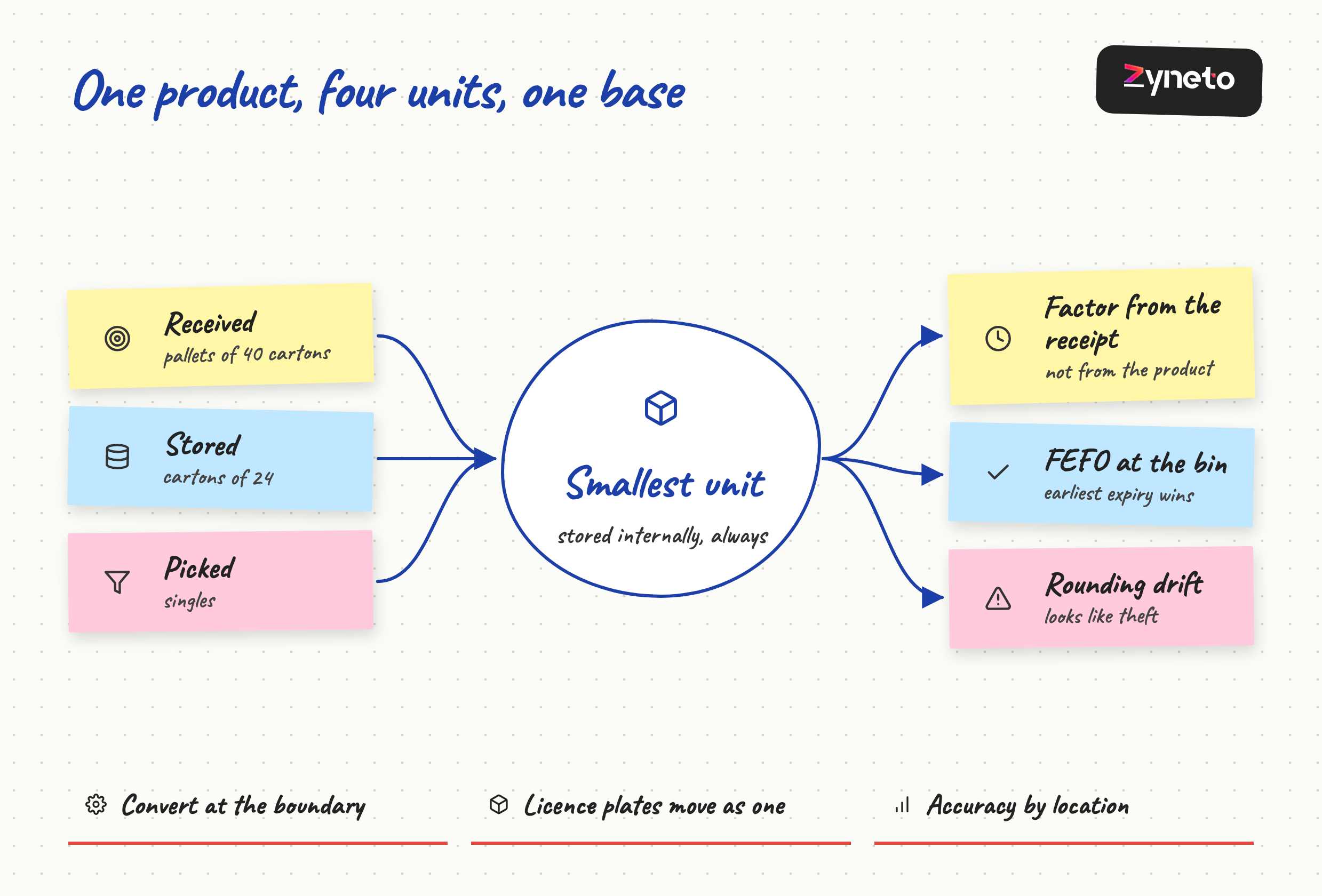
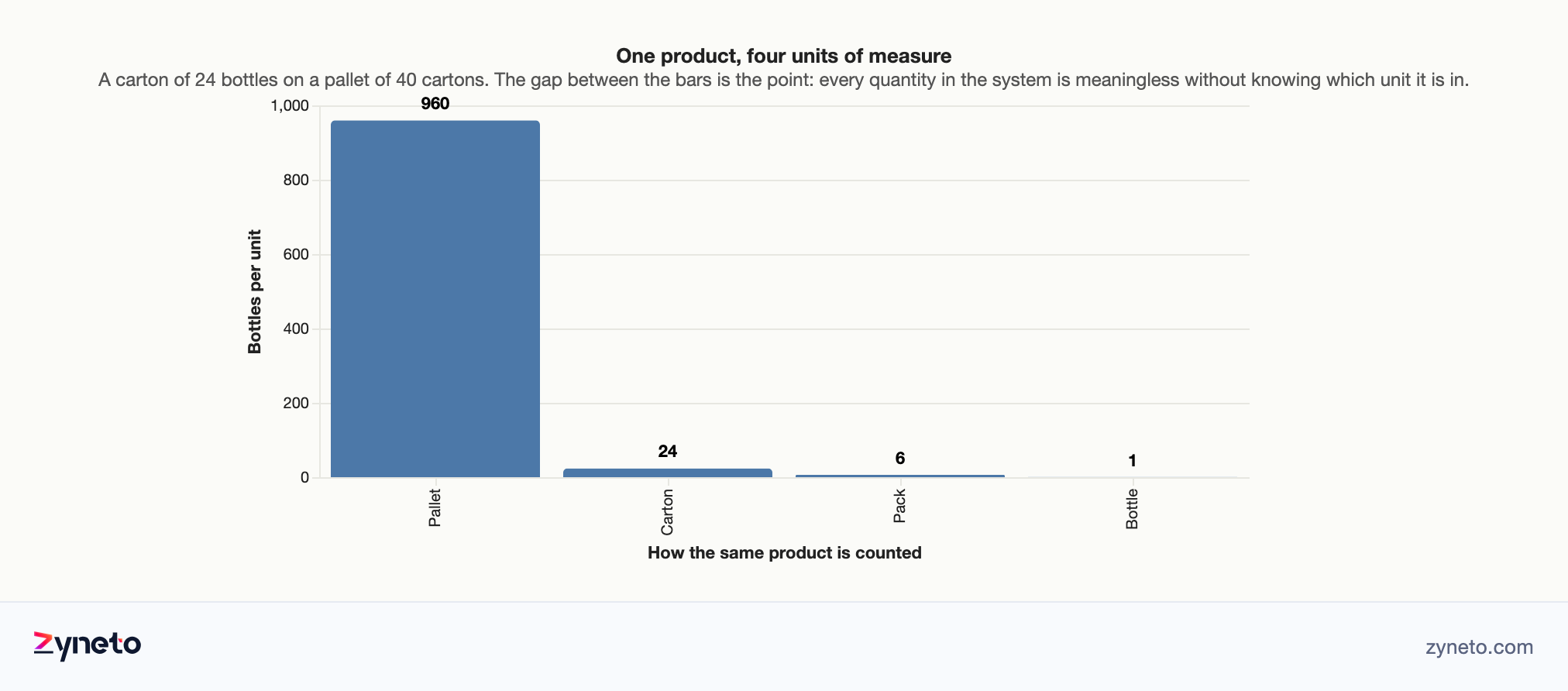
The cost of a WMS is set by how many ways you count the same thing. A carton of 24 bottles arrives on a pallet of 40 cartons. It is received as pallets, stored as cartons, picked as bottles, and sold in packs of six. That is four units for one product, and every quantity in the system (on hand, allocated, picked, in transit, counted) is meaningless without knowing which one it is in.
Get the unit model wrong and every number in the warehouse is wrong, quietly, in a way that looks like theft. Our own manufacturing software work publishes "unit of measure is where the numbers go wrong" as a named failure mode on the factory side. The warehouse version is worse, because a warehouse converts between units dozens of times a day and a factory mostly does not.
The second cost driver is whether the system directs work or records it. A system that records what happened is a database with scanners. A system that tells a picker where to go next, in what order, is an optimisation problem that touches slotting, pick paths, replenishment and labour. The gap between those two is most of the money.
Three questions set the price. How many units per product, and do they convert cleanly? Does the system direct work or record it? And does inventory need to be accurate to the bin, or to the warehouse? Everything else (goods in, goods out, reports) is ordinary.
What is the unit of measure problem in a WMS?
The conversion itself is arithmetic. The difficulty is that the arithmetic is not always exact, not always constant, and not always reversible. A supplier changes a carton quantity, a pallet is broken into loose units that never go back, and rounding differs by product. That is the work the price is actually buying.
Conversions change over time. A supplier changes the carton quantity from 24 to 20. Stock received last month is in 24s and stock arriving next week is in 20s, both sitting in the same location under the same product code. A system holding one conversion factor per product has just made every historical quantity wrong.
So the conversion belongs to the receipt, not to the product. Each inbound line records the units it arrived in and the factors that applied, and those travel with the stock. This is a schema decision, it costs nothing at the start, and it cannot be retrofitted without reprocessing history.
Some conversions do not divide cleanly. Catch-weight goods, meaning meat, cheese, produce and metal, are ordered by the case and sold by the kilogram, and no two cases weigh the same. The system has to carry two quantities for one line, and the invoice reconciles against the weighed one. Products that assume one quantity per line cannot do this at all.
Rounding destroys inventory slowly. Convert 100 bottles to cartons of 24 and you have four cartons and four bottles. Do that in both directions a few thousand times with rounding at each step and the on-hand figure drifts from reality without a single error anyone can point at.
Decide the base unit and never leave it. Store everything internally in the smallest unit, convert only for display and for documents, and make the conversion explicit at the boundary. It is the single most valuable architectural rule in this product and it is routinely ignored.
Locations, and what "where is it" actually means
A warehouse management system's core claim is that it knows where things are. That claim is more specific than it sounds.
A location is a physical place with a capacity and a type. A pallet rack position, a shelf bin, a floor space, a staging area, a quarantine cage. It has dimensions, a weight limit, and rules about what may go in it.
Mixing is the first policy decision. Can two products share a bin? Can two batches of the same product? Can two receipts? Each "yes" makes storage denser and picking more error-prone, and each "no" costs space. There is no universally right answer, which is why it has to be configuration rather than code.
Licence plates are the concept most first builds miss. A pallet with an identifier, holding known contents, that can be moved as one object. Without them every movement is a quantity transaction against a product, and moving a pallet of 40 mixed cartons becomes 40 transactions that can partially fail.
Zones and travel distance are what make directed work possible. If the system does not know that aisle A is far from aisle Z, it cannot sequence a pick, and the picker walks the warehouse twice. Capturing the physical layout is unglamorous data entry that everything downstream depends on.
Capacity is usually modelled too simply. A location that holds two pallets of one product may hold three of another, and the constraint is volume or weight rather than count. Systems that model capacity as a number of units mis-plan putaway from day one.
Picking strategy is the difference between a database and a WMS
The cheapest system tells a picker the order and lets them find it. Everything above that is engineering.
Batch picking collects several orders in one walk, which is a large efficiency gain and introduces the problem of keeping them separate at the end. Zone picking splits an order across people, which is faster and needs consolidation. Wave picking groups by despatch time, which keeps the loading dock sane and requires the system to understand carrier cut-offs.
Each strategy changes the data model, not just the screen. Batch picking needs a pick container concept. Zone picking needs partial-order state and a consolidation step with its own exceptions. Wave picking needs cut-off times, carrier rules and a planning run. Choosing a strategy late means rebuilding.
FEFO is not FIFO and the difference is regulatory for some goods. First expired, first out requires the system to know expiry at the bin, and to refuse a pick from a later-expiring batch when an earlier one is available. First in, first out only needs receipt order. For food, pharmaceuticals and chemicals, FEFO is the requirement and FIFO is a bug.
Short picks are the test of a real system. The picker arrives and the stock is not there. What happens next, whether that is reallocating from another location, splitting the order, flagging a count or telling the customer, is a decision tree that separates products that work in a real warehouse from demonstrations.
Pick-path sequencing is worth more than most automation. Ordering a pick list by physical route rather than by product code is cheap to build, needs only the location data you already captured, and routinely saves more labour than the fancy features that get quoted.
Cycle counting, because you will never stop the warehouse
The annual stock-take where everything halts is a practice most operations cannot afford any more.
Cycle counting counts a slice continuously while the warehouse keeps running, which means counting a location while stock might be moving through it. The system has to freeze a location, or reconcile a count against movements that happened during it, and getting that wrong produces corrections that are themselves errors.
What you count is a policy. By value, so the expensive items are counted often. By velocity, so the fast movers are counted often. By exception, so anything that short-picked gets counted next. Most operations want a blend, which means the count scheduler is a rules engine rather than a rota.
Variances need a workflow, not a number. A count that disagrees with the system is the start of an investigation: recount, check adjacent bins, check recent movements, then adjust with a reason code and an approval above a threshold. Products that let a counter simply overwrite the quantity have built a shrinkage laundering tool.
Reason codes are where the operational value is. Damage, theft, miscount, mis-pick, supplier shortfall, conversion error. Six months of coded variances tells the business where it is losing money, and an uncoded adjustment tells it nothing.
Accuracy is measured by location, not by total. A warehouse whose total on-hand is right but whose bins are wrong will short-pick constantly. The metric that matters is the percentage of locations whose contents exactly match the record.
Returns are a second warehouse hiding inside the first
Outbound is a solved shape. Returns are the part that gets a single screen in the quote and then consumes the operations team.
A returned item has unknown condition and unknown provenance. It may be resaleable, repackable, repairable, scrap, or not actually yours. Until someone inspects it, it cannot be put back into sellable stock, which means a receiving flow with a grading step and a holding area that is not the main inventory.
Returns arrive without paperwork. The customer posts the box back with nothing in it, or with a reference that does not match any order, or three orders combined into one carton. Matching a physical return to an order is a reconciliation problem, and a system that requires a valid return authorisation before accepting anything simply pushes the mess onto a desk.
Grading has to be configurable per business. A clothing retailer regrades and resells. An electronics business tests and refurbishes. A food business destroys. The grades, the rules and the destinations differ completely, and hard-coding one business's grades makes the product unsellable to the next.
Refunds depend on the grade, which means finance is waiting on the warehouse. The time between arrival and grading is money the customer has not been refunded, and it is the thing they complain about. Measuring that interval is usually more valuable than optimising it.
Scope returns deliberately as their own phase. Crammed into the outbound build they get a status field and a cupboard. Given their own design pass they are a genuine competitive advantage in any business where customers send things back.
How much of a WMS project is integration?
A WMS sits in the middle of a stack and almost nothing it does is useful alone.
The ERP or accounting system owns the product master and the financial picture, and the two systems will disagree. Deciding which is authoritative for each field, and what happens when they diverge, is a day of conversation that prevents months of reconciliation.
Orders arrive from somewhere: an online store, a marketplace, an ERP, a customer's own system. Each source has its own shape, its own identifiers and its own idea of what an order line is. Each is an integration with its own error handling.

Carriers are the integration everyone underestimates. Rates, labels, manifests, tracking, cut-off times and collection bookings, each carrier different, several of them with APIs designed in another decade. Buying a multi-carrier aggregator is almost always cheaper than integrating three carriers directly.
Scanners and printers are hardware integration. Label printers that must produce a compliant barcode at the right size, handheld devices that need to work with gloves, and the reality that the warehouse will buy whatever hardware is on offer next year.
Budget integration as a third of the build. That is a planning judgement rather than a measured figure, and on this product it is a realistic one rather than a pessimistic one. Quotes that treat integration as glue are the ones that overrun.
Labour is the number the business actually watches
The operations director does not ask about inventory accuracy first. They ask how many lines an hour the team is picking, and whether it is improving.
Lines per hour, by person, by zone, by shift is the metric a warehouse runs on, and it falls out of data the system already has if movements carry a timestamp and an actor. Capture that from the start; retrofitting it means the first six months have no baseline.
Measurement changes behaviour, including badly. A team measured on lines per hour will pick the easy lines and leave the awkward ones, and a team measured on accuracy will slow down. Publishing one number without the other produces exactly the distortion you would expect, which is a product design question rather than a management one.
Travel is most of a picker's time and none of their output. The improvement available from sequencing a pick list by physical route is usually larger than anything automation delivers at small scale, and it costs a sort order.
Engineered standards are a trap at this size. Setting a target time per task requires time-and-motion work that only pays back in very large operations, and getting it wrong creates targets nobody believes.
The report that earns its place is the exception list, not the league table: which tasks took far longer than similar tasks, which locations generate repeated short picks, which products are always counted wrong. That list is where the operational money is, and it is cheap to produce.
Should I build or buy a warehouse management system?
This is a mature category with capable products at every size, and building is the wrong answer more often than it is the right one.
Buy when your operation is ordinary, meaning standard units, standard picking, standard carriers. The off-the-shelf products encode decades of warehouse practice you would otherwise rediscover expensively.
Build when the operation is the business. A third-party logistics provider whose service model is its differentiator, a catch-weight operation nobody serves properly, a warehouse embedded in a product you sell to others. Then the WMS is not overhead, it is the thing customers are paying for.
The honest middle is a hybrid, and it is underused: buy the core, build the differentiator against its API, and accept the integration cost. A bought WMS with a custom receiving flow is usually a better outcome than either extreme.
Beware the three-year number. A build quote is not a three-year cost. Integration, customisation and training carry on after go-live, and whatever the build quote says, that ongoing obligation is real and it is yours.
The question to ask any vendor, including us, is which parts of your operation they intend to change to fit the software. Some change is healthy. A list with nothing on it means they have not understood the warehouse.
What we would build first
The data model first: products, units with receipt-level conversion factors, locations with real capacity, and licence plates. No screens. This is the part that cannot be corrected later.
Receiving second, because stock that enters wrong is wrong forever and every downstream process inherits it.
Picking third, with one strategy chosen deliberately and the short-pick decision tree designed before the happy path is built.
Cycle counting fourth, early rather than late, because it is how you find out whether the first three are working.
Reporting last, and thinner than requested. The reports that matter are location accuracy, variance by reason code, and lines picked per hour.
Our rate band is published: $40 to $100 an hour by role, blending to $60 to $70 for a mixed team, with the unit and location model at the top of it. We do not quote a fixed total before a discovery that establishes your unit structure, your picking strategy and your integration surface. What we will say free is that if you cannot describe how your products convert between units in one sentence, that conversation is the project.
FAQs
Published vendor estimates range from $30,000 to $600,000. PerfectionGeeks publishes $30,000 to $200,000+ for a custom build; ScienceSoft publishes $200,000 to $400,000 for average complexity and $400,000 to $600,000+ for a large-scale system with IoT and advanced analytics. Our published rate band is $40 to $100 an hour by role, blending to $60 to $70. The genuine cost drivers are how many units each product converts between, whether the system directs work or merely records it, and how many external systems it integrates with.
The same product is handled in different units at different stages: received as pallets, stored as cartons, picked as singles, sold in packs. Every quantity in the system is meaningless without knowing which unit it is in. Conversions also change over time, so the factor belongs to the receipt rather than to the product, and some goods are catch-weight, carrying two quantities per line. Store everything internally in the smallest unit and convert only at the boundary.
FIFO issues stock in the order it was received. FEFO issues the earliest-expiring stock first, which requires the system to know expiry dates at bin level and to block a pick from a later-expiring batch when an earlier one is available. For food, pharmaceuticals and chemicals, FEFO is a requirement rather than a preference, and a system that only implements FIFO is not merely less capable but incorrect for those goods.
Buy, if your operation uses standard units, standard picking and standard carriers, because off-the-shelf products encode warehouse practice you would otherwise rediscover expensively. Build when the warehouse operation is the business itself, such as a third-party logistics provider whose service model is its differentiator or a catch-weight operation nobody serves well. The underused middle option is to buy the core and build only the differentiator against its API.
Cycle counting counts a slice of locations continuously while the warehouse keeps operating, rather than halting for an annual stock-take. The system must freeze a location during its count or reconcile against movements that occurred during it. Counts are scheduled by a rules engine blending value, velocity and exception triggers, and variances need an investigation workflow with reason codes and approval thresholds rather than letting a counter overwrite the quantity.
A licence plate is an identifier for a physical unit of handling, typically a pallet, that holds known contents and can be moved as a single object. Without the concept, moving a pallet of forty mixed cartons becomes forty separate quantity transactions that can partially fail. It is one of the most commonly missed concepts in first builds and is painful to add later, because every movement record has to be reinterpreted.
Realistically about a third. A WMS sits between an ERP or accounting system that owns the product master, order sources such as online stores and marketplaces that each have their own shape, carriers with rate, label, manifest and tracking interfaces, and hardware including scanners and label printers. Using a multi-carrier aggregator is almost always cheaper than integrating several carriers directly.

Vikas Choudhary
Vikas has around fifteen years of experience building software and now builds generative AI systems at Zyneto. His work covers retrieval augmented generation, agentic AI, knowledge graphs, AI memory, and the evaluation and guardrails that decide whether any of it is safe to put in front of customers. He has shipped enterprise copilots, document AI, chatbots and predictive analytics for e-commerce, fintech and marketing teams, and works day to day in Python, JavaScript and SQL. He follows multimodal models, business process automation and enterprise AI security closely, and mentors engineers moving into AI. He writes about architecture, inference cost and the failure modes that only show up at production scale.
Let's make the next big thing together!
Share your details and we will talk soon.