Construction Management Software Cost: The Payment Clock Nobody Builds For



Agency blogs price construction management software from $8,000, which tells you they are quoting a task list with photos attached. A task list is not what fails on site.
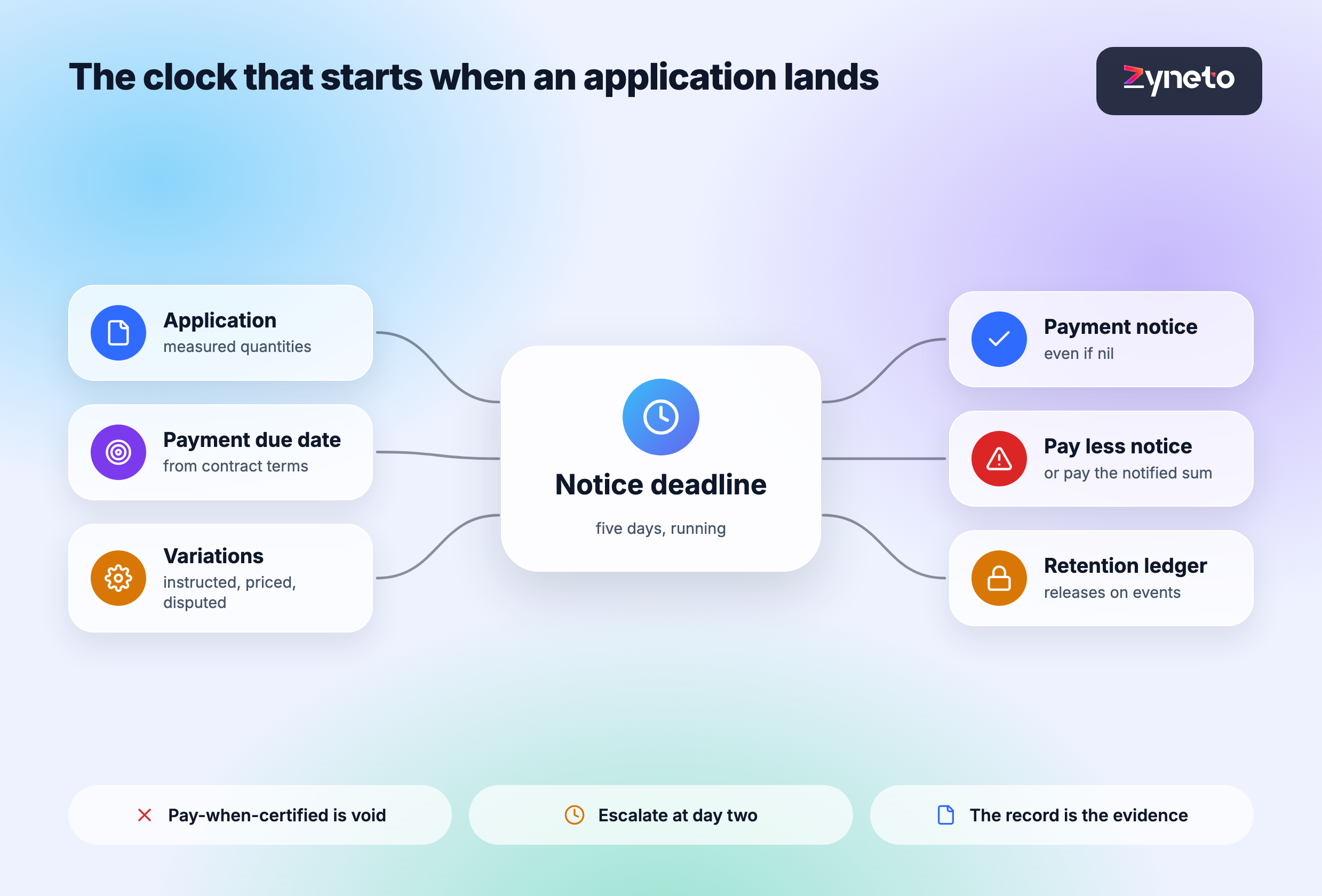
Construction software fails on payment, and payment in construction is a statutory clock. Under the UK's Housing Grants, Construction and Regeneration Act, every construction contract has to require a payment notice within five days of the payment due date, even if the amount due is nil. Whether that notice comes from the payer or from the payee is set by the contract rather than by the Act, so the product has to handle both directions. If the payer wants to pay less than the notified sum, they must issue a separate pay less notice setting out the basis of their calculation. Miss the pay less notice and the notified sum becomes payable in full, whatever the work was actually worth.
That is not a workflow preference. It is a deadline with a number attached, and the number is whatever the subcontractor claimed. Software that treats a payment application as a document to be reviewed when someone gets to it has built a liability generator.
The second thing generic tools cannot do is measure. Construction does not pay for tasks completed. It pays for work measured (60% of the blockwork, 340 linear metres of ducting) against a bill of quantities, with a percentage of each payment withheld as retention and released in stages, typically half at practical completion and half at the end of the defects period, often a year later.
So the money model has three features no project tool has: valuation of partial progress against measured quantities, a withholding that accrues across the project and releases on events rather than dates, and a notice regime with legal deadlines.
Three questions set the price. Does the product issue payment notices, or only record them? Does it handle variations, which is where margin is won and lost? And is it for the main contractor, the subcontractor, or the client, because those are three different products.
What is a payment notice and why does it matter for software?
A payment notice is the notice a construction contract must require no later than five days after the payment due date, stating the sum due even when that sum is nil. Most construction software records a payment application and routes it for approval. That is the wrong shape, because approval has no deadline and the notice does.
Model the clock explicitly. When an application arrives, the system computes the payment due date from the contract terms, derives the notice deadline from it, and starts counting. The deadline is not a reminder; it is a state the record is in, and the record's state changes whether or not anyone logs in.
Escalate before the deadline, not at it. A notice that must be issued within five days needs the quantity surveyor alerted on day two and the commercial manager on day four, because the consequence of silence is paying a number somebody else chose.
Pay-when-certified clauses do not survive in the UK, and how they fail matters to the build. Making payment conditional on the performance of obligations under another contract, or on somebody's decision about whether those obligations were performed, does not count as an adequate payment mechanism under the Act. That catches retention release geared to the main contract as surely as it catches the payment. And the clause is not simply struck out: the Scheme for Construction Contracts supplies terms in its place, so the dates your software has to honour become the Scheme's rather than the ones in the signed document. Pay-when-paid is dealt with separately and more bluntly, ineffective outright unless the party upstream is insolvent. A system that models subcontractor payment as contingent on the main contract's certification has encoded dates that will not govern.
Build the notice as a generated document with a timestamp and an audit trail, because its existence and its date are the facts that matter in a dispute. "We sent an email" is a weaker position than a system record showing what was issued, when, and what it said.
The application itself needs a state machine, not a status field. Received, assessed, notified, paid less, paid, disputed. Each transition has an actor, a timestamp and often a document, and the valid transitions differ depending on which notices were issued and when. A status dropdown that anyone can set to anything cannot reconstruct what happened, which is exactly what a dispute asks it to do.
None of this is optional in the UK and the shape recurs elsewhere. Other jurisdictions have their own prompt-payment regimes with their own deadlines. The architecture (contract terms produce dates, dates produce obligations, obligations produce documents) transfers even where the specific periods do not.
Variations are where the margin is, and where the arguments are
A variation is work that was not in the contract and now is. It is also, on most projects, the difference between a profitable job and a loss.
The lifecycle is longer than people expect and every stage has to be captured. Something changes on site. Someone instructs it, sometimes verbally. The contractor prices it. The client disputes the price. Work proceeds anyway because the programme will not wait. The valuation happens later, against a price nobody agreed.
Software that only records approved variations is recording the easy half. The instructed-but-unpriced and the priced-but-disputed are where the money sits, and they need to be visible as a value at risk rather than invisible until resolved.
Capture the instruction at the point it happens, on a phone, with a photo. A verbal instruction written down the same day with a picture of the condition that prompted it is worth considerably more in a dispute than a reconstruction three months later.
Link variations to the valuation. A variation that has been instructed and executed but not yet agreed still represents work done that should appear in a payment application, usually as a separate line. Keeping variations in their own module, disconnected from the money, is the commonest design mistake in this category.
Measured progress is not percentage complete
A generic project tool asks for percentage complete and takes whatever the user types. Construction measures.
The bill of quantities is the spine. Items with quantities, units and rates: cubic metres of concrete, square metres of plasterboard, numbers of doors. Progress is a quantity of each item done this period, and the valuation is arithmetic over that, not a judgement.
Units matter and conversions bite. Material is bought in one unit, measured in another and paid in a third. The same item can be priced per square metre and delivered in sheets. A system without an explicit unit model produces valuations that are wrong in ways nobody notices until a cost report does not reconcile.
Remeasurement is normal. On many contracts the quantities in the bill are estimates and the final account is based on what was actually built. That means quantities are versioned, and the valuation has to be reproducible at the version that applied when it was issued.
Dayworks sit outside measurement entirely. Some work cannot be measured sensibly and is paid on time and materials against signed dayworks sheets, at agreed rates, with the sheet signed on site by someone from the other party. That is a different valuation path through the same system, and products that model only measured work push dayworks into a spreadsheet where the margin quietly disappears.
Provisional sums and prime cost sums are their own category (allowances in the contract for work not yet defined) and they convert into real priced work partway through the job. A data model with only fixed items cannot represent the contract it is supposed to be managing.
Site data arrives offline, late, and from people who hate forms
The people generating your data are standing in a half-built structure holding a phone in one hand.
Assume no connectivity and design for reconciliation. Daily records, progress quantities, photographs, delivery notes and safety checks are captured offline and sync when the device finds signal, which may be hours later and may be after someone else has edited the same record.
Photographs are the bulk of your storage and the most valuable thing you hold. They are the evidence in a variation dispute and in a defect claim years later. They need to carry the date, the location and the item they relate to, and they need to be retained long past practical completion, which is a retention-policy decision somebody has to make deliberately.
Forms have to be shorter than you think is possible. A site manager completing a daily record at the end of a twelve-hour shift will fill in the fields that are required and skip everything else, and a form with thirty fields produces thirty fields of noise. Three fields filled honestly beat thirty filled to clear a validation.
How does retention work in construction software?
Retention is a percentage withheld from every payment, held against defects, and released in stages. It is simple to describe and routinely modelled wrong.
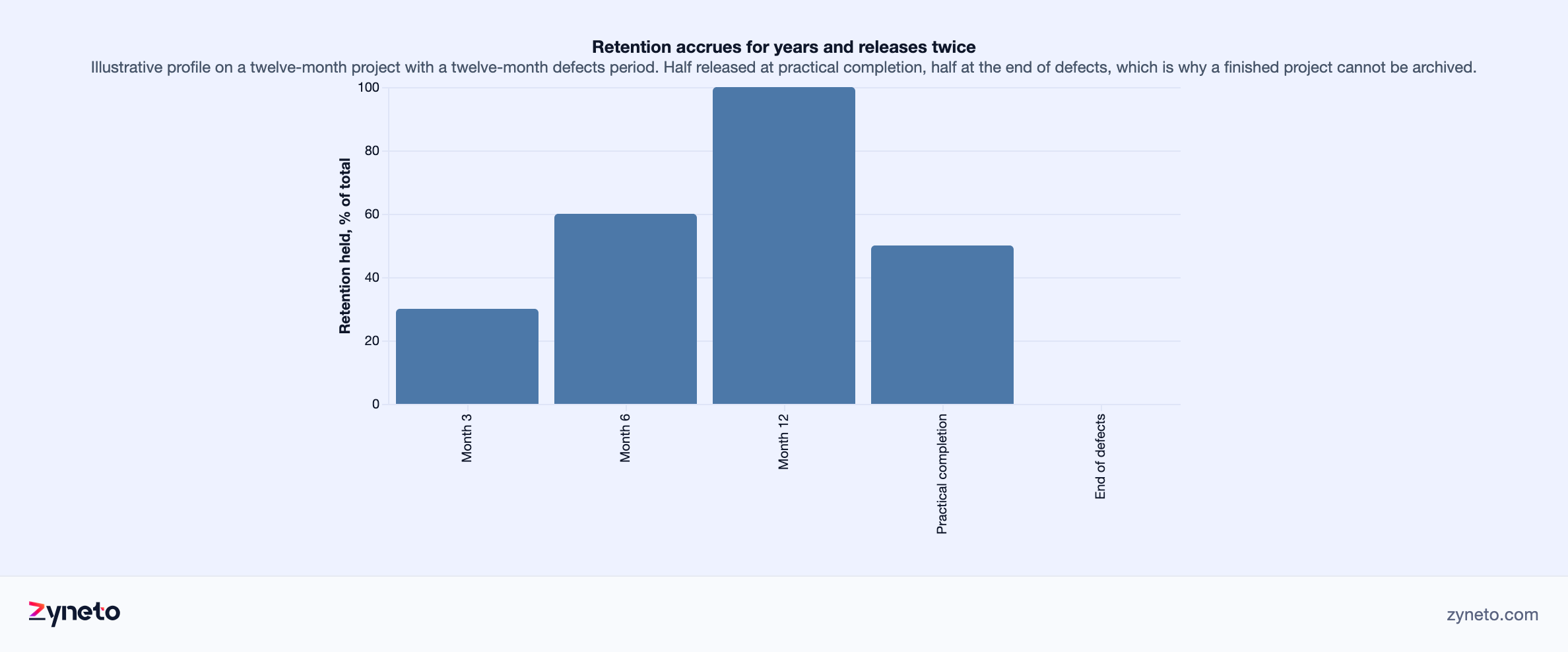
It accrues across the whole project and releases on events, not dates. Typically half at practical completion and half at the end of the defects liability period, which may be twelve months later. By then the project is closed, the team has moved on, and the money is still owed.
So the system has to keep a project alive after it has finished. A product that archives completed projects loses track of the retention owed on them, and the contractor discovers this when a subcontractor asks for money the system no longer knows about.
Retention is also under active legislative pressure, and it is further along than most people commissioning in this market realise. The Construction (Retention Deposit Schemes) Bill, which would have required retentions to be held in trust, did not proceed. What followed is more direct. The Commercial Payments Bill [HL], a government bill, was introduced in the Lords on 19 May 2026 and would insert new sections 113A to 113E into the Housing Grants, Construction and Regeneration Act 1996. A retention clause agreed after a two-year transition period would be void, and a retention debt arising after that period carries a fixed sum of either 40 pounds or 50 per cent of the debt, whichever is higher. The Bill completed its Lords stages on 20 October 2026 and had its first Commons reading on 21 October 2026, with second reading not yet scheduled, so it is not law and may never be. But a system that treats retention as a fixed feature rather than a configurable term is betting against it.
Model retention as a ledger, not a field. Amounts withheld, amounts released, against which certificate, on which event. The balance is derived. A single retention-held number on a project record cannot answer the question a subcontractor will eventually ask.
Safety and quality records are a legal archive, not a checklist
Every construction product ships inspection forms. Few treat them as what they actually are, which is evidence that may be read years later by someone trying to establish who was responsible.
The retention period is longer than the project by an order of magnitude. Structural defects surface years after completion, and limitation periods for construction claims run long. A safety or quality record created in year one may be the document that settles a claim in year ten, which makes retention and immutability design decisions rather than operational ones.
Immutability matters more than editability. An inspection signed off on a Tuesday and quietly edited on a Friday is worthless as evidence and worse than no record, because its existence implies a check that may not have happened as recorded. Corrections belong as new entries referencing the old, with both visible.
Sign-offs need to identify a person, not an account. "Approved by [email protected]" establishes nothing. The record needs the individual, their role at the time, and ideally their qualification where the inspection requires one, because roles change and the question is always who was responsible on the day.

Non-conformances have a lifecycle and a cost. Something is wrong, it is raised, someone is responsible for fixing it, it is re-inspected, and if it is not fixed it becomes a defect at handover and then a retention dispute. That chain connects the quality module to the money module, and products that keep them apart cannot answer why retention is being withheld.
Photographs carry this entire layer. Date, location, the item inspected, and enough resolution to show what the inspector saw. Compressing them to save storage destroys the only thing that made them worth keeping.
Whose product is it: contractor, subcontractor, or client
These are three different products and the quote you get rarely says which one it is pricing.
The main contractor's product is about managing downwards. Many subcontract packages, applications arriving from all of them, notices going out, retention held against each, and a consolidated cost position against the client contract.
The subcontractor's product is about getting paid. Applications going up, notices coming in, chasing, and knowing what is owed and overdue. It is a smaller build and a genuinely underserved market, because most tools are written for the party with more money.
The client's product is about certainty. Cost against budget, programme against plan, and whether the thing will be finished when they said it would.
Being all three at once is how a build becomes a platform. Pick one, ship it, and add the counterparty view when the first one is working. The commonest failure in this category is a product that does a mediocre version of all three.
Does it integrate with the accounting software they already run?
Construction companies already run accounting software, probably run scheduling software, and may run estimating software. Your product is arriving into a stack, not into a vacuum.
Accounting is the integration that matters most and is scoped last. Valuations become invoices, retention becomes a balance sheet item, subcontractor payments become ledger entries, and the finance team will not re-key any of it. Which package you integrate with is a market decision as much as a technical one, and in practice it narrows your addressable customers to whoever uses it.
Scheduling is usually better left alone. Planners have tools they know and programmes that took weeks to build, and a worse Gantt chart inside your product is a reason to reject it. Reading the programme and showing progress against it is valuable; replacing it is not.
Estimating connects to the bill of quantities and is frequently a spreadsheet. Accept that. An import that reliably handles the specific shape of spreadsheet a given customer uses is worth more than an elegant estimating module they will not switch to.

Drawing revisions deserve their own mention. Issuing work against a superseded drawing is one of the most expensive ordinary mistakes in construction, and the fix is unglamorous: every drawing carries a revision, every issue records which revision went to whom, and superseded revisions are visibly marked rather than deleted.
Budget integration work as a first-class line, not as glue. On this product it is commonly a third of the build, and quotes that treat it as an afterthought are the ones that overrun.
What this costs, and what we would build first
Our rate band is published: $40 to $100 an hour by role, blending to $60 to $70 for a mixed team. On this product the valuation and notice engine sits near the ceiling and the document library and dashboards sit near the floor.
The contract and money model comes first: bill items, quantities, valuations, variations, retention ledger and the notice clock. It is unglamorous, it produces almost nothing to demonstrate, and every other feature derives from it.
The site capture app second, offline-first, with a deliberately small set of fields.
Document management third, because drawings carry revisions and issuing the wrong revision is the most expensive ordinary mistake in construction. Revision control is the whole feature; a file store is not it.
Programme and scheduling last, if at all. Most contractors already use dedicated scheduling tools and will not move. Integrating with what they have beats replacing it, and a mediocre Gantt chart is a reason not to buy your product.
We do not quote a fixed total before a discovery that establishes which party the product serves, whether it issues notices or only records them, and which jurisdictions' payment regimes are in scope. What we will say now is that if the software does not know what day it is and what that means for the money, it is a photo album with a schedule attached.
FAQs
Our published rate band is $40 to $100 an hour by role, blending to $60 to $70 for a mixed team, with the valuation and payment-notice engine needing senior time at the top of that band and document management and dashboards near the floor. Agency blogs quoting from $8,000 are pricing a task list with photo upload. The variable that moves the total most is whether the product issues statutory payment notices or merely records applications.
Because construction does not pay for tasks completed, it pays for work measured against a bill of quantities, with a percentage withheld as retention and released on events up to a year after the project ends. Generic tools have no concept of measured valuation, no retention ledger, and no notion that a payment notice carries a legal deadline. They ask for percentage complete and accept whatever is typed.
Under the UK's Housing Grants, Construction and Regeneration Act, a construction contract must require a payment notice no later than five days after the payment due date, and it is immaterial that the sum may be zero. The contract decides whether that notice comes from the payer or from the payee. To pay less than the notified sum, the payer must issue a separate pay less notice; if none is issued, the notified sum becomes payable in full. That makes the deadline a state your software must track and escalate on, not a reminder, because silence costs the full claimed amount.
Capture the instruction at the moment it happens, on site, with a photograph, because a contemporaneous record is worth far more in a dispute than a later reconstruction. Then track the full lifecycle, including instructed-but-unpriced and priced-but-disputed work, as a visible value at risk rather than as invisible until resolved. Link variations to the valuation so executed-but-unagreed work appears in payment applications as its own line.
Retention is a percentage withheld from each payment and released in stages, typically half at practical completion and half at the end of the defects liability period, often twelve months later. Model it as a ledger of amounts withheld and released against specific certificates and events, not as a single field on the project record. The system must keep finished projects alive, because the money is still owed after the team has moved on.
Pick one. The main contractor's product manages many subcontract packages, incoming applications, outgoing notices and a consolidated cost position. The subcontractor's product is about getting paid and is a smaller build in a genuinely underserved market, because most tools are written for the party with more money. The client's product is about cost and programme certainty. Products that try to serve all three at launch do a mediocre job of each.
Yes, and it should be designed offline-first rather than having offline added later. Site data is captured by people standing in half-built structures with no reliable signal, and records sync hours later, sometimes after someone else has edited the same record, so conflict reconciliation is a core requirement. Keep forms very short; a site manager at the end of a long shift fills the required fields and skips the rest.

Vikas Choudhary
Vikas has around fifteen years of experience building software and now builds generative AI systems at Zyneto. His work covers retrieval augmented generation, agentic AI, knowledge graphs, AI memory, and the evaluation and guardrails that decide whether any of it is safe to put in front of customers. He has shipped enterprise copilots, document AI, chatbots and predictive analytics for e-commerce, fintech and marketing teams, and works day to day in Python, JavaScript and SQL. He follows multimodal models, business process automation and enterprise AI security closely, and mentors engineers moving into AI. He writes about architecture, inference cost and the failure modes that only show up at production scale.
Let's make the next big thing together!
Share your details and we will talk soon.