MVP Development Cost in 2026: Price the Question, Not the App


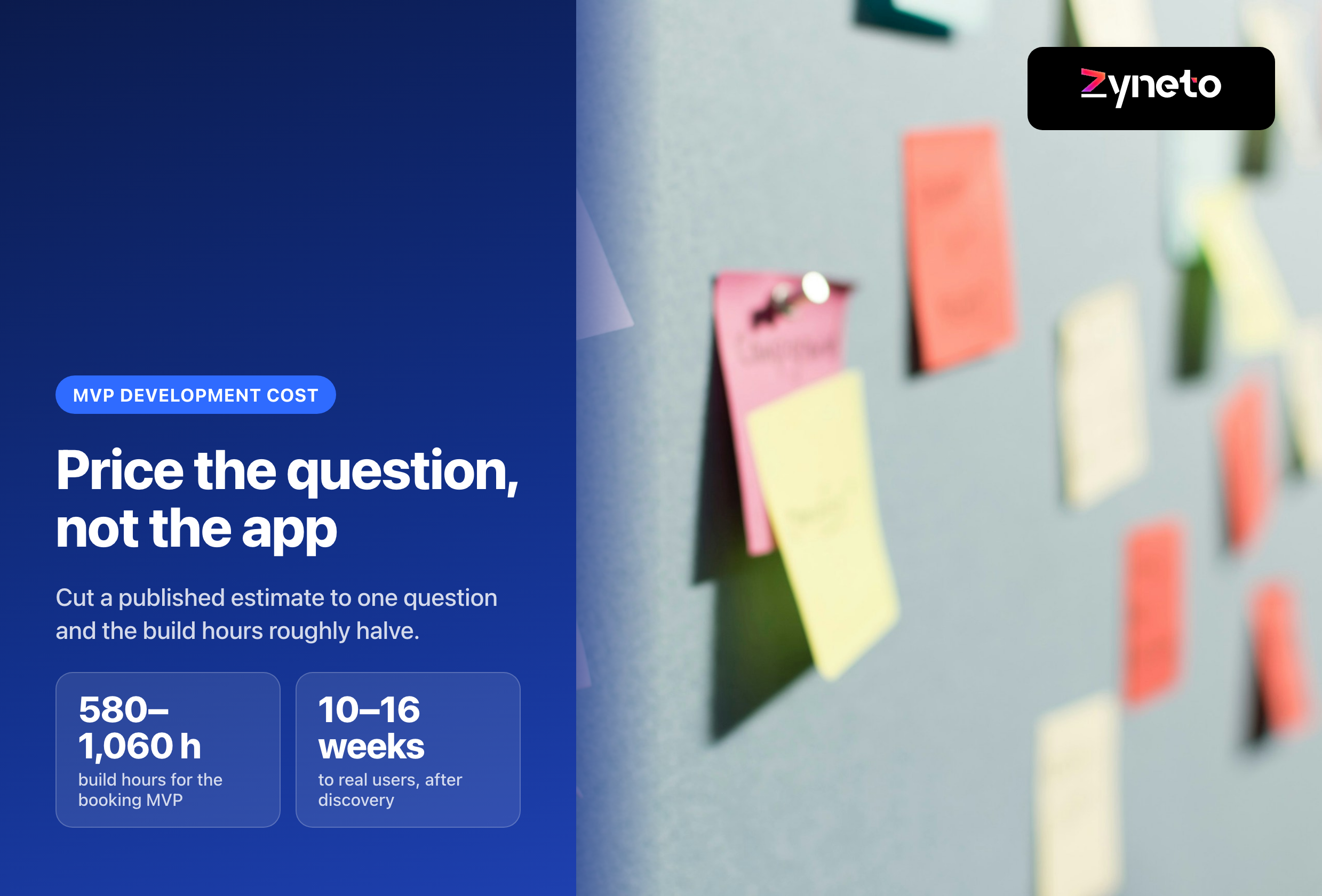
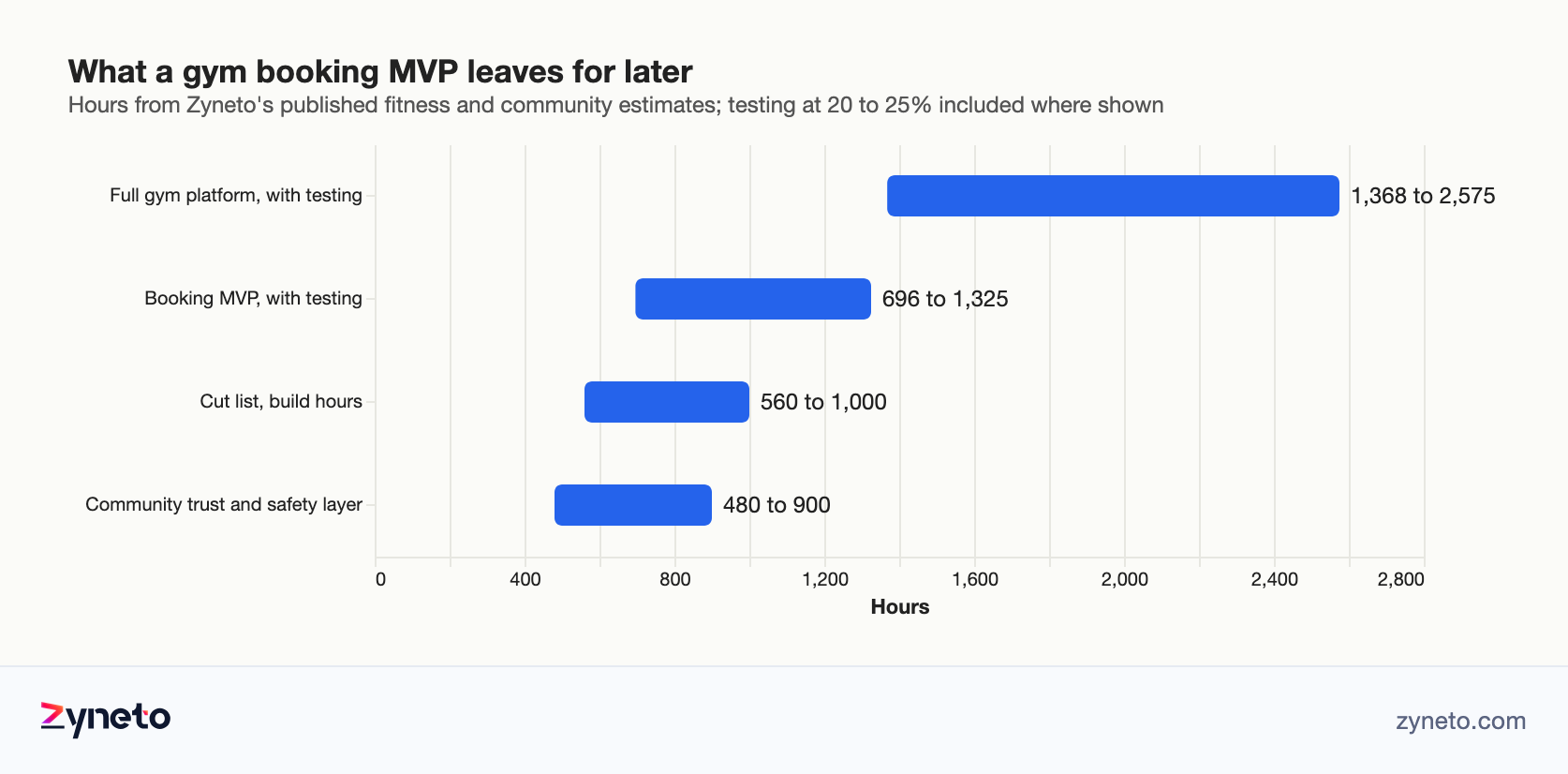
An MVP costs whatever it takes to answer one question. It does not cost what the full product costs. Zyneto bills $40 to $100 an hour and a mixed team averages $60 to $70, so the gap between the two is large. Take our published estimate for a gym and studio platform. Its full module set, with 1 payment provider, is 1,140 to 2,060 build hours. Cut to one question, "will members book and pay for classes in an app?", it drops to 580 to 1,060 build hours. Add testing and that is about $45,000 to $86,000 at a $65 blend, against about $89,000 to $167,000 for everything. Most MVPs reach real users 10 to 16 weeks after a 2 to 4 week discovery.
So the price follows 3 answers: what one question the MVP tests, which user type it serves, and which single path through the product has to work end to end.
Most founders ask what an MVP of their idea costs. That question has no fixed answer. The same idea can be tested for $25 a month with a no-code tool, or with $80,000 of engineering, and the right choice depends on the question, not the idea. Quotes go wrong the same way: 3 firms price the same brief, each one quietly decides a different question, and the 3 totals cannot be compared.
Startups rarely fail because the code was bad. CB Insights analysed 431 venture-backed shutdowns since 2023 in a report published on 5 March 2026. Running out of capital was the most cited reason, at 70%, but the report calls it "almost always the final cause of death, not the root problem". Poor product-market fit came next at 43%, then wrong timing at 29% and unsustainable unit economics at 19%. Two-thirds of the product-market-fit failures were early-stage companies that never found a market.
Money does not buy your way out of that. The same 431 companies raised $17.5 billion between them, with a median of $11 million. An MVP exists to find out whether the market is there before most of that money is spent.
That is why a good MVP scope is narrow. Zyneto's MVP development page sets the scope as "one question, one user type, one path through the product that works properly end to end". Each extra question adds modules, and modules are where the hours are.
Write the question so it can fail. "Will members book and pay for classes in an app?" can be answered no by real usage. "Will people like our fitness platform?" cannot, so it cannot be scoped or priced.
Zyneto publishes its fitness app development estimate module by module. The full multi-site gym and studio platform has 7 modules, plus 80 to 200 hours for each payment provider. Its worked example is 1,260 hours, about $81,900 at a $65 blend, over 14 to 22 weeks. That is the product. The MVP is a subset of it, chosen by the question.
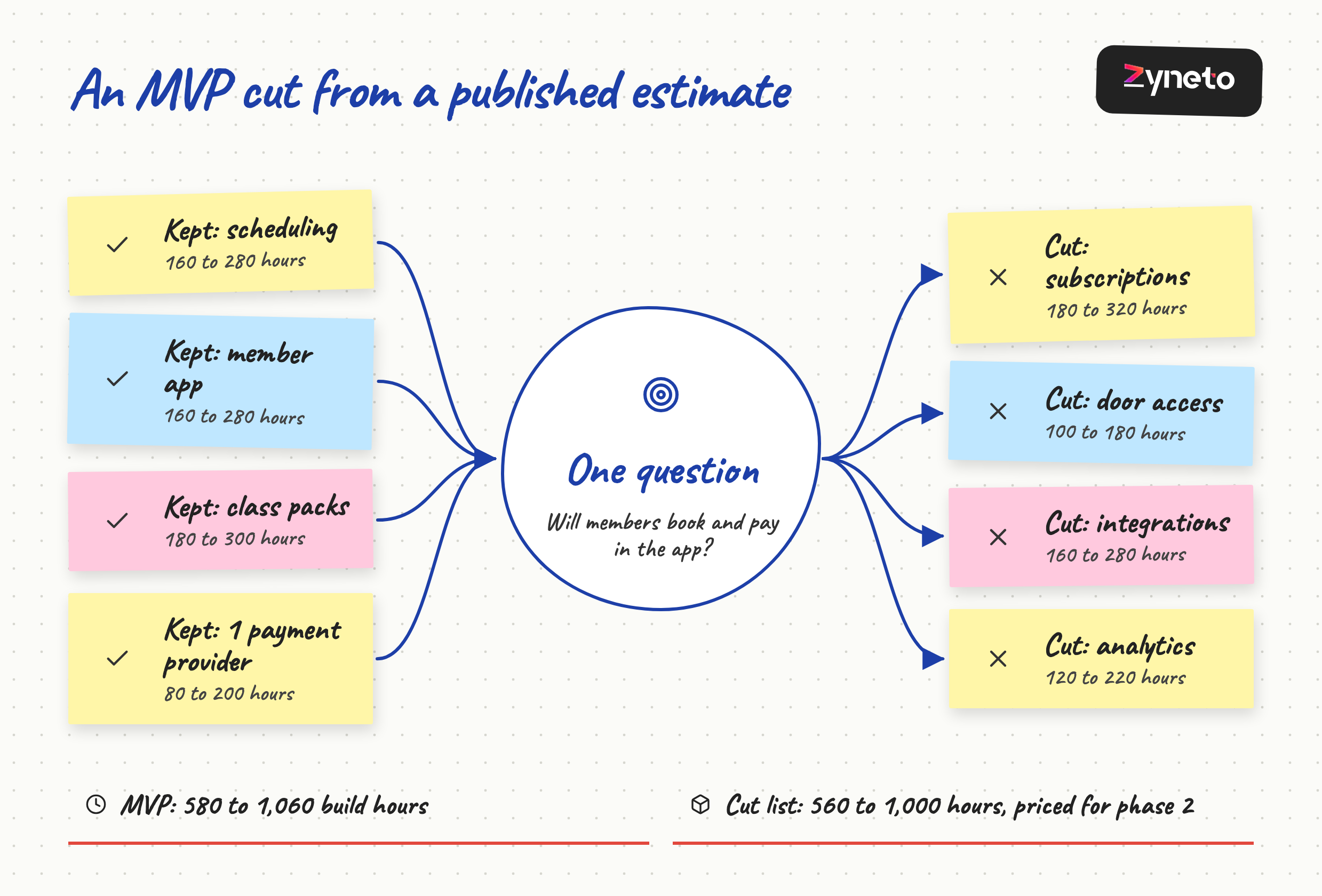
For the question "will members book and pay for classes in an app?", 3 modules and 1 payment provider stay. Members need a schedule to book from, an app to book in, and a way to buy a class pack. Everything else can wait for the answer.
Module (published hours) | Full platform | MVP for the booking question |
Scheduling, capacity, credits and waitlists | 160 to 280 | Kept, 160 to 280 |
Member app and self service | 160 to 280 | Kept, 160 to 280 |
Membership, contract and entitlement | 180 to 300 | Kept, 180 to 300 (class packs and credits) |
Payment provider, first one | 80 to 200 | Kept, 80 to 200 |
Recurring billing and the dunning ladder | 180 to 320 | Cut: sell paid-up class packs, no subscriptions yet |
Access control and check-in | 100 to 180 | Cut: the front desk checks the booking list |
Integrations | 160 to 280 | Cut: a weekly export to the accounting package |
Retention analytics | 120 to 220 | Cut: track the booking events only |
Build hours | 1,140 to 2,060 | 580 to 1,060 |
Testing at 20 to 25% of build | 228 to 515 | 116 to 265 |
Total hours | 1,368 to 2,575 | 696 to 1,325 |
At a $65 blend | about $88,900 to $167,400 | about $45,200 to $86,100 |
The cut list is worth 560 to 1,000 hours. That is recurring billing, door access, integrations and analytics. Each one is real work the business will need, but only if the answer to the booking question is yes.
This is an illustration built from published module hours, not a quote. Your modules will differ. The method does not: list the modules, mark each one kept or cut against the question, and add up the kept column.
Testing stays at 20 to 25% of build hours. An MVP that crashes answers nothing, because users leave before they reach the question. Zyneto prices quality assurance as its own line so it cannot be cut quietly when a date gets close.
Some features are store requirements, not features. If your MVP lets users post anything other people can see, Apple's App Review Guideline 1.2 requires a way to filter objectionable material, a way to report it with timely responses, a way to block abusive users, and published contact details. On the community app development page, Zyneto's estimate for that moderation work is 480 to 900 hours. Its worked example is 680 hours, about $44,200 at a $65 blend. Budget a social or dating MVP on its visible screens and you will be short by exactly the part App Review checks.
Money logic is the one shortcut that costs more later. Taking a payment, refunding it and reconciling it has to be right from the first transaction. The MVP above sells class packs through 1 provider instead of subscriptions, and that is the correct cut: it makes the money logic smaller instead of skipping it.
Real sign-in and real data, not a demo. Zyneto's MVP page defines the build as a working product on real infrastructure with real authentication and real data. A demo cannot produce usage data, and usage data is the only thing an MVP is for.
Instrumentation is part of the build. The events that answer the question, such as a booking started, a booking paid and a booking abandoned, are defined on day 1. Without them, the MVP launches and nobody can say whether the answer was yes.
Each answer to the question adds a known amount. Zyneto's industry pages publish the drivers behind their estimates, so you can see what one more of each thing costs before anyone writes a proposal:
What you add | Published hours | Where it is published |
Another distinct user role, with its own screens, permissions and audit trail | 40 to 90 each | |
Another integration with an outside system | 60 to 160 each | Logistics and education pages |
Another payment provider or region | 80 to 200 each | Fitness page |
Real-time tracking | 120 to 240 | Logistics page |
Offline capability in an app | adds 40 to 60% to that app's hours | Logistics page |
User roles are the multiplier founders miss. An MVP for customers only is 1 role. Add staff who fulfil the order and an admin who manages both, and the product has 3 roles. Each role brings its own screens and permissions. An MVP that needs a staff side to work at all has not dropped the staff side. It has priced the staff side at a smaller size.
Integrations are cheapest as a file at first. The low end of the 60 to 160 hours is a documented API. The high end is a reverse-engineered CSV drop. In an MVP, a weekly export that someone imports by hand answers the same question for a fraction of either.
Offline and real-time belong to the question or to phase 2. If the question is whether drivers will use the app on the road, offline is part of the answer and stays. If it is whether customers will order, real-time tracking can be a status that refreshes when the page reloads.
Some questions can be answered for less than $100 a month. If the question is "will anyone sign up?", a landing page with a waiting list answers it. If it is "can people find their way through the booking flow?", a clickable prototype does. Zyneto's MVP page makes the same point: if a cheaper test settles your question sooner, a development team is the wrong purchase, and an honest first call tells you so.
List prices on 7 October 2026, from each vendor's own pricing page:
Tool | What it is for | Entry paid plan |
Figma Professional | Clickable prototypes to test a flow | $16 a month billed annually, $20 monthly |
Softr | Simple portals and internal tools on a database | $19 a month, billed yearly |
Glide | Data-driven apps from a spreadsheet or table | $25 a month (Basic) |
Bubble, Web | Web apps without code | $29 a month billed annually, $32 monthly |
FlutterFlow | Visual builder that exports Flutter code | $29.25 a month billed annually, $39 monthly |
Bubble, Web and Mobile | Web plus native mobile builds | $59 a month billed annually, $69 monthly |
No-code answers demand questions, not engineering ones. It cannot tell you whether door hardware, a payment provider's retry rules or 2 years of member data will behave. If the risky part of your idea is technical, a coded MVP is the cheaper test even though the bill is larger.
Plan for the switch either way. If a no-code test succeeds, the product you build next is a coded one. Keep the data exportable and the users' accounts portable from day 1, so success does not lock you in.
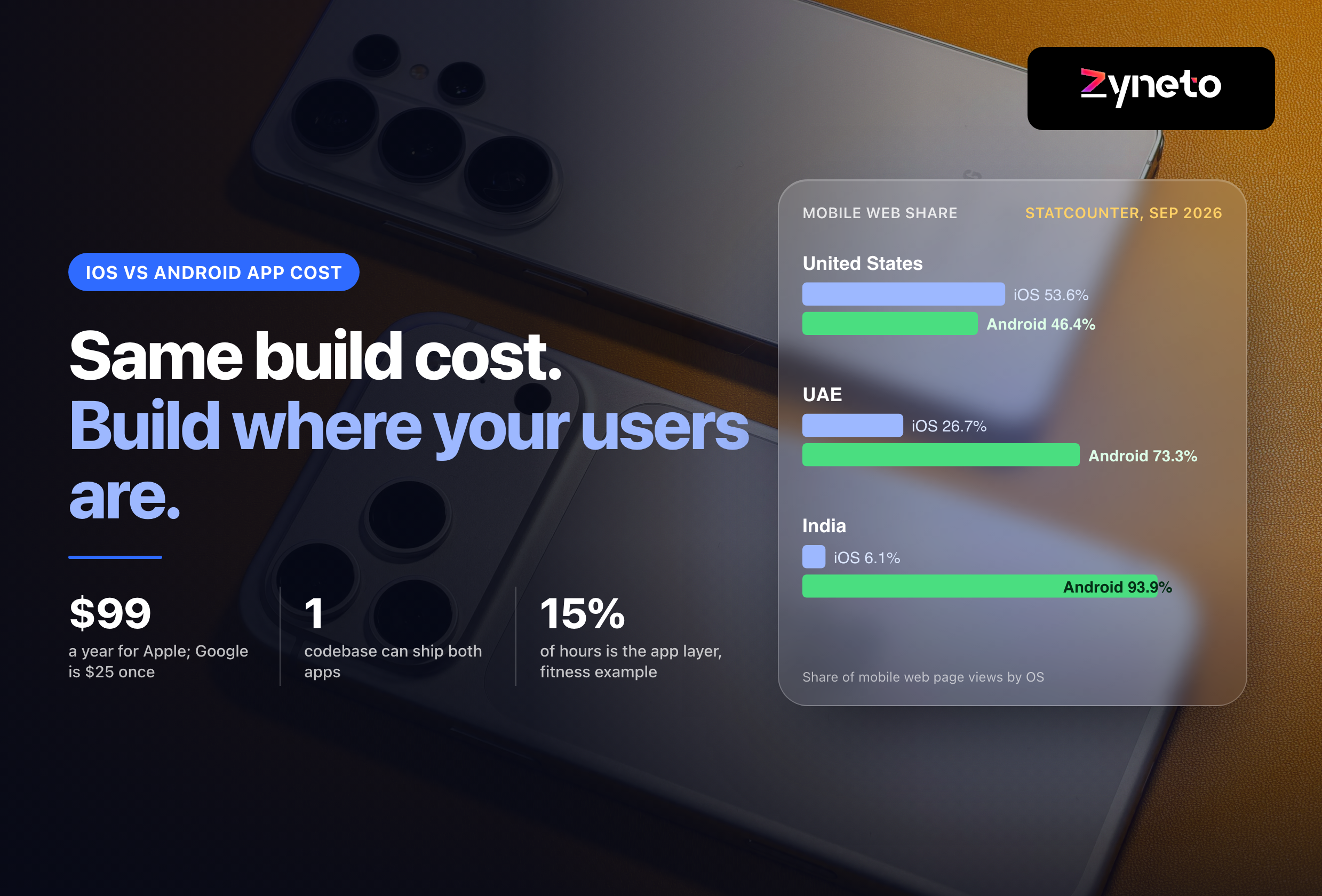
The stores charge a small fee and a larger amount of time. Publishing on iPhone means a $99 Apple membership every year; Google Play takes a single $25 payment. For a personal Google Play account created after 13 November 2023, Google requires 12 or more testers opted in to a closed test for 14 days in a row before you can even request production access. Google says that review usually takes 7 days or less. An organisation account avoids the closed test but needs its own paperwork. Either way, start in week 1, not in launch week.
Free hosting tiers are not for a live MVP. Vercel's Hobby plan is restricted to non-commercial, personal use. Supabase pauses free projects after 1 week of inactivity. Plan on paid tiers from launch: Vercel Pro is $20 a month per developer seat, and Supabase Pro starts at $25 a month. Firebase's Spark plan has no fee, and its pay-as-you-go Blaze plan includes the same free allowances.
Put the accounts in your company's name. Zyneto's MVP page commits to 3 things: the code lives in your repository from the first commit, the infrastructure is written as code, and the hosting, analytics and payment logins are registered to you. An MVP whose accounts belong to the agency is an MVP you have to buy back.
Most builds put an MVP in real users' hands within 10 to 16 weeks. The clock starts after a 2 to 4 week discovery. A much shorter plan is usually a prototype, and that is fine when a prototype settles the question. Much slower usually means the scope was never cut, so it was never an MVP.
The hours set the calendar; a date cannot shrink the hours. A deadline shorter than the hours allow is met by moving modules to the cut list, not by working faster. If launch has to be in 10 weeks, the question is which kept module moves out.
Store review adds days, not weeks, once the account is ready. Apple says it reviews at least 50% of submissions in under 24 hours and 90% in under 48. Google's closed test is the longer wait: 14 days plus production review for a new personal account. Both waits fit inside the build if they start early, and both push the launch if they start at the end.
An MVP ends with a decision, so plan for all 3 answers. Zyneto's MVP page commits to a written assessment at the end. It reads the usage data against the question, states how much load and change the code can take, and prices any rebuild in hours. With that in hand you choose: keep going, rebuild, or shut it down.
Shutting it down is a valid result. Finding that out cheaply was the point. A founder who stops after a $45,000 test has spent far less than one who builds the full $167,000 platform and learns the same thing.
Rebuilding is cheaper when it was planned. An MVP built to answer a question is sometimes built to be thrown away, and that should be decided in week 1, not discovered in month 6. If the code is meant to survive, the cut modules get added on a foundation that expected them. If it is not, the assessment says so, with hours, and you budget the rebuild from real usage instead of a guess.
The cut list becomes the next estimate. Recurring billing, door access, integrations and analytics from the example are already scoped and priced. If the answer is yes, phase 2 is the cut list in order of what the data says matters.
Ask which question it answers. If the quote does not name one, it has priced a product, not an MVP. Ask for the cut list too: the features deliberately left out of version 1. A quote with no cut list has either cut nothing or cut things without telling you.
Divide the price by the hours. Multiply the hours by a mixed-team rate and you should get roughly the quoted total. A quote with no hours gives you nothing to multiply. Zyneto puts an hour range on the table in the first conversation and fixes the price once discovery has produced the cut list, since any firm number before that point is a guess.
Check that testing, sign-in and the store accounts are lines, not assumptions. Testing at 20 to 25% of build, real authentication, and store accounts in your name are the 3 lines to check first in a low quote. A line that is missing comes back as a change request after launch.
Compare the shape, then the total. 2 quotes for the same question and the same kept modules can be compared on price. 2 quotes that answer different questions cannot, however close the totals look.
The cheapest MVP is the one that answers its question soonest, whether that takes a $25 no-code app or 1,000 hours of engineering. Price the question first. The app is whatever the answer needs, and nothing the answer can wait for.
It depends on the question the MVP tests, not on the idea. Zyneto's published gym example shows the scale, at $40 to $100 an hour and a $60 to $70 team average. An MVP with 3 core modules, 1 payment provider and testing comes to about 700 to 1,300 hours, roughly $45,000 to $86,000 at a $65 blend. A no-code test or a clickable prototype can answer some questions for under $100 a month.
Most MVPs reach real users 10 to 16 weeks after a 2 to 4 week discovery. A plan much shorter than that is usually a prototype. One much longer usually has an uncut scope. On a new personal Google Play account, add a 14-day closed test with 12 testers and a production review that Google says usually takes 7 days or less.
A single question, a single type of user, and one route through the product that works completely. It should include real sign-in, real data, testing at 20 to 25% of build hours, and the events that measure the answer. Anything the question does not need goes on a written cut list, such as subscriptions, integrations or analytics dashboards.
For questions about demand, yes. Paid plans on Softr, Glide, Bubble and FlutterFlow start between $19 and $69 a month, and Figma Professional for clickable prototypes is $16 to $20. For questions about engineering, such as payment rules, hardware or data migration, a coded MVP is the cheaper test, because no-code cannot tell you whether those parts will work.
Apple's Developer Program is $99 a year and Google Play is $25 once. Free hosting tiers do not suit a live product: Vercel's Hobby plan is non-commercial only, and Supabase pauses free projects after a week of inactivity. Budget paid tiers from launch, such as Vercel Pro at $20 a month per developer seat and Supabase Pro from $25 a month.
Cut anything the question does not depend on. In a gym booking MVP, that is recurring billing, door access, integrations and retention analytics, worth 560 to 1,000 hours in Zyneto's published estimate. Do not cut testing, real sign-in, the events that measure the answer, or features a store requires. Apple requires filtering, reporting and blocking for apps where users post content.
You decide to continue, rebuild or stop, based on what the usage data says. A good team writes up what the usage shows, how far the code can stretch, and what a rebuild would cost in hours. If the answer is yes, the cut list becomes the next phase, already scoped and priced.

Vikas has around fifteen years of experience building software and now builds generative AI systems at Zyneto. His work covers retrieval augmented generation, agentic AI, knowledge graphs, AI memory, and the evaluation and guardrails that decide whether any of it is safe to put in front of customers. He has shipped enterprise copilots, document AI, chatbots and predictive analytics for e-commerce, fintech and marketing teams, and works day to day in Python, JavaScript and SQL. He follows multimodal models, business process automation and enterprise AI security closely, and mentors engineers moving into AI. He writes about architecture, inference cost and the failure modes that only show up at production scale.
Share your details and we will talk soon.
Be the first to access expert strategies, actionable tips, and the trends actually shaping the digital world. No fluff - just practical insights delivered straight to your inbox.
Dive into our blog and stay ahead of the curve with expert perspectives, future-ready trends, and tech tips written for decision-makers and doers alike.