Telemedicine App Development Cost: The Build, and What Every Consultation Costs to Run


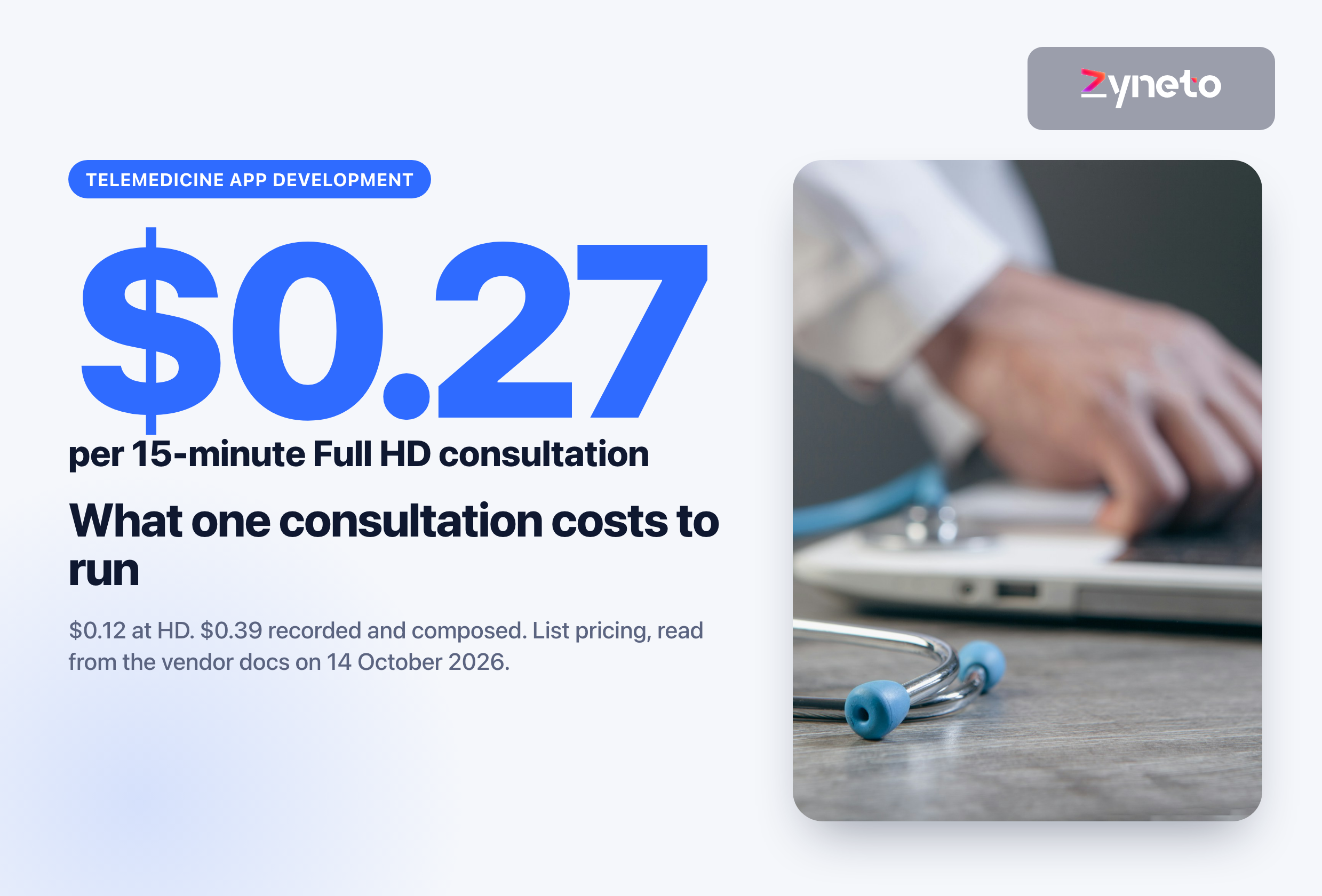
A 15-minute video consultation between a patient and a clinician costs $0.12 to $0.39 in media fees, depending on resolution and whether you record it. That figure is almost never in a telemedicine quote, and it is the one number that keeps charging you after the build is paid for.
The build itself splits into two parts, and only one of them has a published price. The modules a telemedicine app shares with any clinical system — identity and audit, the patient master, scheduling, the compliance layer and the discovery that determines regulated scope — run 680 to 1,310 hours on our published ranges, which is $44,200 to $85,150 at a $65 blended rate. The telehealth-specific modules on top of that — the video session itself, the waiting room, consent capture, prescribing — we do not have a published figure for, and this post will not invent one.
Most quotes for this work do the opposite. They give you one number for the whole thing, no hours behind it, and no running cost at all. Then the monthly vendor bill arrives and nobody budgeted for it, because the question asked at the start was "what does the app cost" rather than "what does a consultation cost, every time, forever".
The ordinary failure is not a blown build budget. It is a clinic that launched on recorded Full HD consultations because the default settings said so, is running 2,000 consultations a month, and is paying roughly $780 a month in media and storage fees it never modelled — while also, without realising it, having acquired a regulatory obligation it has not papered.
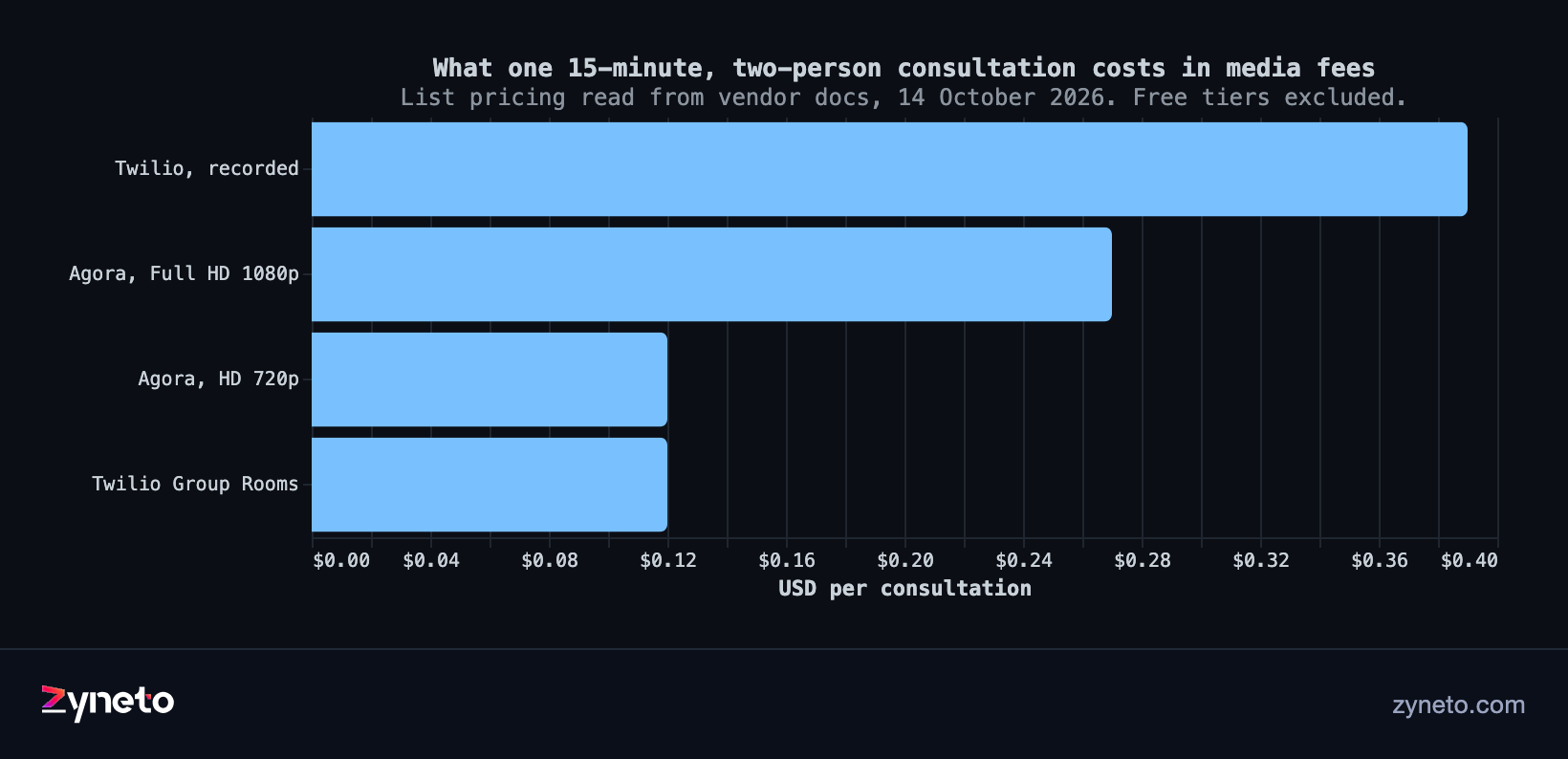
Two people on a call for 15 minutes is 30 participant-minutes. Here is what the two most common vendors charge for that, at list price, read from their own documentation on 14 October 2026.
Agora bills by aggregate resolution per user, at $3.99 per 1,000 minutes for HD and $8.99 for Full HD. HD means up to 921,600 pixels, which is 1280 × 720. Full HD is anything above that up to 2,073,600 pixels, which is where 1920 × 1080 lands. So 30 participant-minutes costs $0.12 at HD and $0.27 at Full HD. Audio is $0.99 per 1,000 minutes, but if a user subscribes to both audio and video at once, Agora counts the usage as video only.
Twilio bills per participant per minute, at $0.004 for Group Rooms. The same 30 participant-minutes costs $0.12. At HD, the two vendors land on the same number.
The resolution decision is therefore worth more than the vendor decision. Moving from 720p to 1080p more than doubles the media line. For a dermatology or wound-care consultation that may be clinically necessary. For a medication review it is a default nobody chose.
Turn on recording and two things happen at once, which is why it deserves a decision rather than a default.
The bill roughly triples. On Twilio, participant recording adds $0.004 per participant per minute on top of the call itself, which takes 30 participant-minutes from $0.12 to $0.24. Composing those tracks into a single MP4 adds $0.01 per composed minute, so a 15-minute consultation adds $0.15, reaching $0.39. Media storage is then $0.00167 per GB per day, with the first 10 GB free, and that one accrues forever rather than per call.
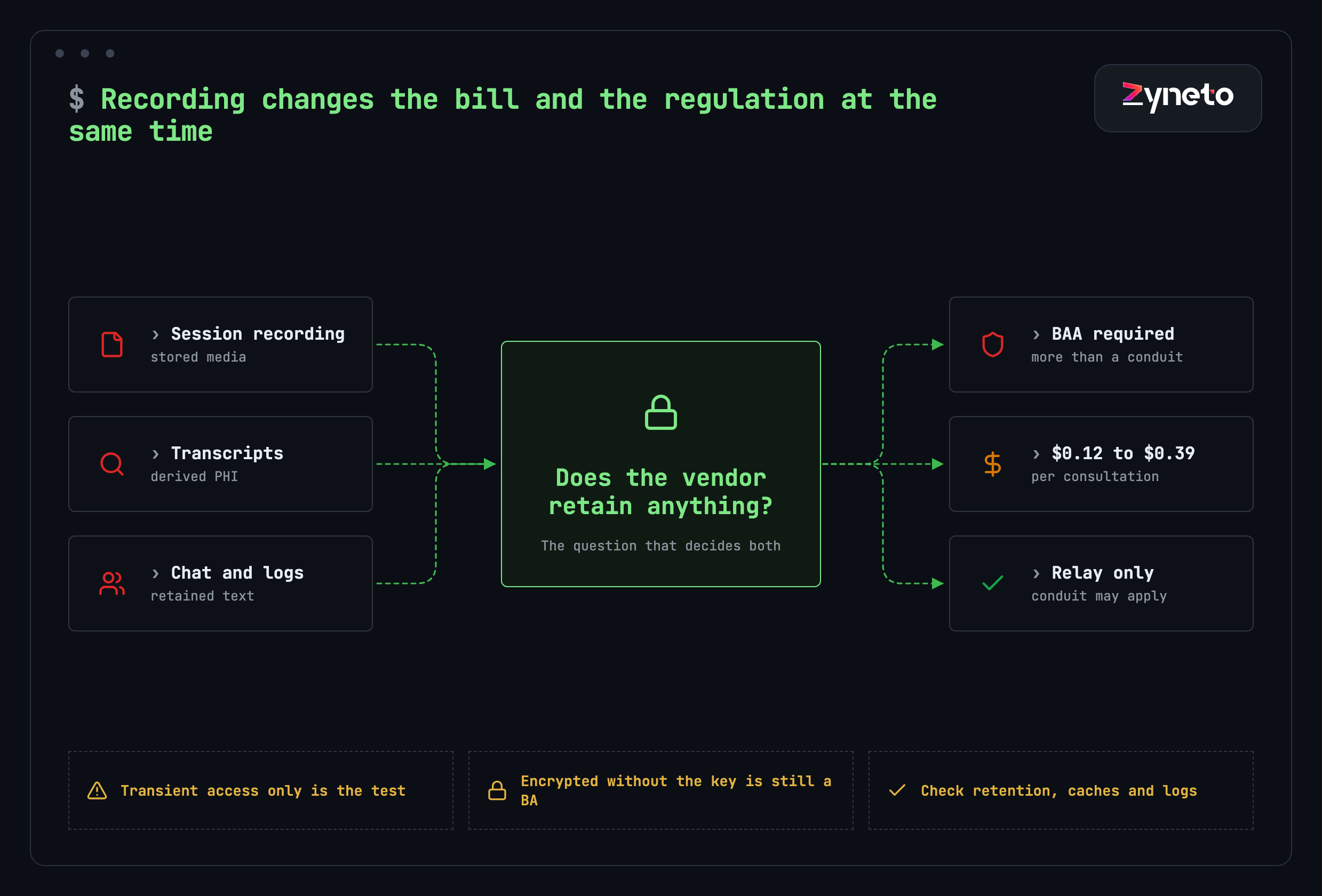
The regulatory position changes too. HHS treats the conduit exception narrowly: it covers transmission-only services where any access to protected health information is transient. A vendor that maintains PHI — stores it, processes it, keeps transcripts — is a business associate rather than a conduit, and a business associate agreement is required before PHI flows through it. HHS is explicit that lacking the encryption key for data it holds does not exempt a provider from business associate status.
So the same switch that triples your per-consultation cost also converts your video vendor from something that might sit outside a BAA into something that certainly does not. Recording is not a feature toggle. It is a procurement decision and a compliance decision wearing the costume of a feature toggle.
If you do not record, do not generate transcripts and do not retain chat, the conduit analysis may apply — but only if the vendor truly keeps nothing, caches and logs included. That is a question for the vendor's data-flow documentation, in writing, not for its marketing page.
This is worth knowing before you pick a vendor, because the internet still carries the original announcement.
In March 2024 Twilio announced that Programmable Video would reach end of life on 5 December 2026. In a changelog entry dated 21 October 2024, Twilio reversed that decision, said Video will remain a standalone product, and stated that current customers "can continue to use Video as they always have; there's no action or change needed."
The reversal is real and the product is not being retired. But the episode is the argument for keeping your video provider behind an interface you control. A platform that put an EOL date on a core product once can do it again, and the clinics that spent 2024 planning a migration spent that effort because of a decision that was later unwound. Treat the video layer as replaceable from the first sprint and this stops being your problem.
One practical trap. Agora's public pricing page advertises RTC as starting at $0.59 per 1,000 minutes. That figure does not correspond to any tier in the current documentation, where the cheapest line is audio at $0.99 and the cheapest video line is HD at $3.99.
Price your model from the documentation table, not the marketing page. The gap between $0.59 and $3.99 is a factor of nearly seven, and at 10,000 consultations a month it is the difference between a line item you ignore and one you notice.
The free allowance is also narrower than it looks. The default free package includes 10,000 standard minutes a month, which at 30 participant-minutes a consultation is about 333 consultations — and those free minutes stop applying once you buy a paid package.
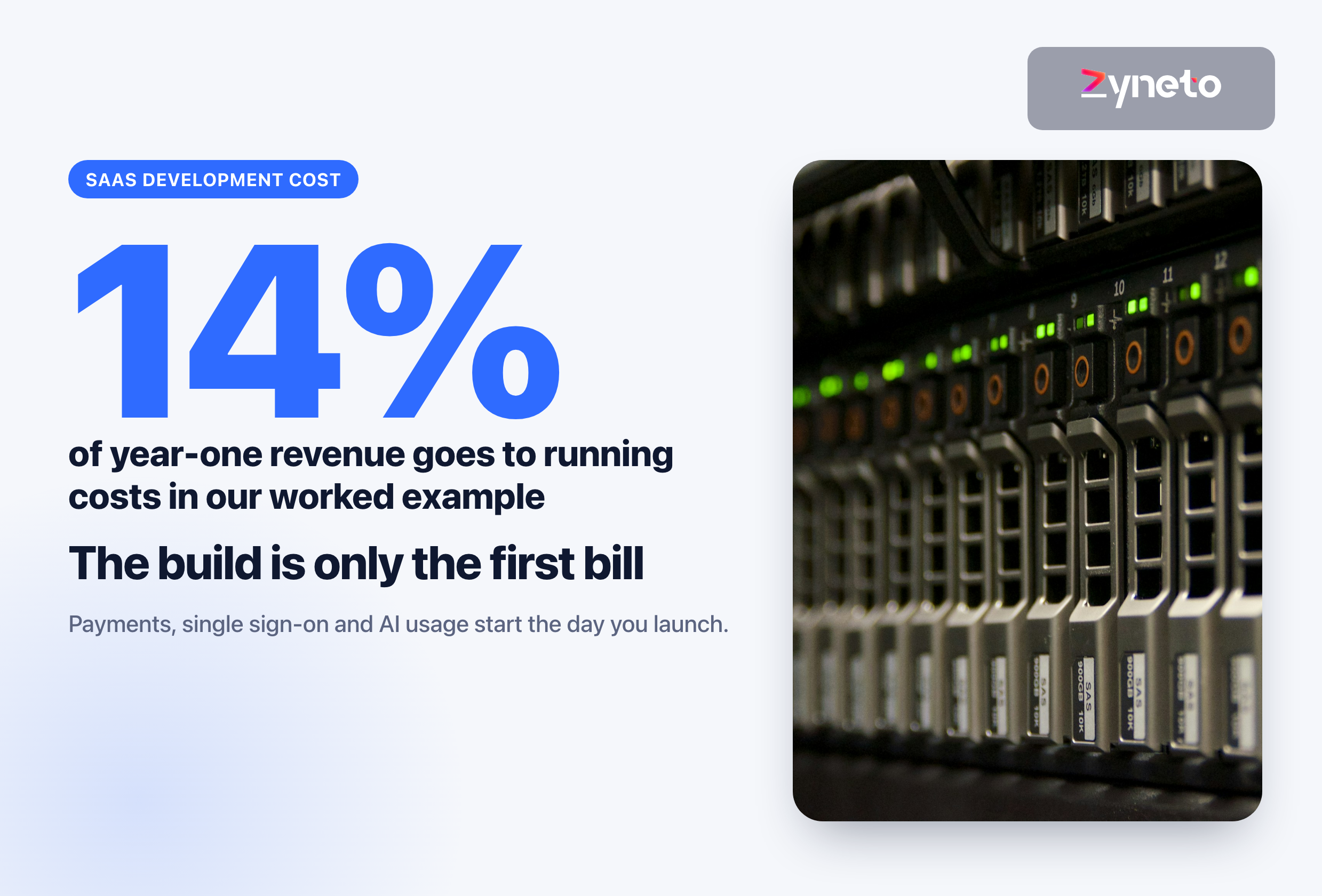
The per-consultation figures are small enough to dismiss and large enough to matter once multiplied. At 2,000 consultations a month, media fees alone run $240 at HD, $540 at Full HD, and about $780 recorded and composed, before storage. At 10,000 a month those become $1,200, $2,700 and $3,900.
Annualised, that is $2,880 at HD and about $9,360 recorded at 2,000 consultations a month, rising to $14,400 and $46,800 at 10,000. The free allowance barely touches it: 10,000 standard minutes covers about 333 consultations once, and on Agora it stops applying the moment you move onto a paid package, so it is a trial subsidy rather than a permanent discount.
None of those numbers will decide whether the business works. All of them should appear in the model before launch, because the resolution and recording defaults that produce the highest of them are exactly the defaults a development team will ship if nobody asks.
Here is the part of the build that does have published hours, because a telemedicine app needs most of what any clinical system needs.
Module | Published range |
Discovery and regulated-scope determination | 60 to 120 h |
Identity, access model and audit log | 180 to 320 h |
Patient master with MRN merge | 120 to 220 h |
Scheduling with provider and room rules | 200 to 400 h |
Compliance layer, retention and legal hold | 120 to 250 h |
Subtotal | 680 to 1,310 h |
At $40 per hour that is $27,200 to $52,400. At a $65 blended rate, $44,200 to $85,150. At $100 per hour, $68,000 to $131,000.
Scheduling is the line that surprises people, at 200 to 400 hours. A telemedicine scheduler is not a calendar. It has to respect provider availability, licensure by jurisdiction, appointment types with different durations, buffers, no-show policy and cancellation windows, and it has to do that across time zones without ever double-booking a clinician. The upper end of that range is multi-site, multi-speciality scheduling. What pushes it there is rarely the calendar logic itself: it is licensure, group appointments, interpreter booking as a second resource on the same slot, and the rule that a cancelled slot inside a notice window behaves differently from one outside it.
Three further modules from the same published set are scope decisions rather than givens: clinical documentation and charge capture at 250 to 500 hours, HL7 v2 interfaces at 80 to 160 for the first two feeds, and eligibility and prior authorisation at 150 to 300. A pure consultation product may need none of them. One that writes back to an EMR needs the interfaces at minimum.
This is the honest gap in this post, and you should treat any supplier who does not have one with suspicion.
Our published healthcare costing deliberately excludes telehealth from its number. The video session lifecycle, the virtual waiting room, in-consultation consent capture, e-prescribing and the clinical workflow around a remote encounter are real engineering with a real price, and we do not have a published hours figure for them. An SME who has delivered that work needs to supply it.
What we will not do is produce a plausible-looking range by analogy, because a number invented to fill a gap in a cost post is worse than an acknowledged gap. It gets quoted back, planned against, and discovered to be wrong at the point it is most expensive to be wrong.
What can be said without a figure: the video session work is bounded and well-understood, the waiting room is mostly state management, consent capture is small but regulated, and e-prescribing is the one that is not bounded, because it depends entirely on which prescribing network and which jurisdiction. If e-prescribing is in scope, it should be scoped on its own before the rest of the project is priced.
The waiting room deserves one specific warning, because it looks trivial and is where patient experience is actually won or lost. It has to hold a patient who arrives early, tell them truthfully where they are in a queue that moves unpredictably, survive the patient closing the tab and returning, and hand off cleanly when the clinician is running 20 minutes late. Each of those is a state the system has to hold and recover, and a waiting room that loses a patient on a dropped connection produces a no-show in the record and a complaint in the inbox.
HIPAA is not a module. It is a multiplier on several modules, and it mostly lands on identity, audit and retention.
The audit log stops being a developer convenience and becomes a product feature with a retention period and a query interface, because someone will have to answer who accessed which record and when. Access control has to be role-based and minimum-necessary rather than convenient. Retention and legal hold have to be enforced by the system rather than by a policy document. That is why identity, access model and audit log carries 180 to 320 hours and the compliance layer another 120 to 250 — those ranges already contain the regulated work.
The BAA chain is the part teams forget. Every vendor that touches PHI needs one: the video provider if it retains anything, the cloud provider, the transcription service, the analytics tool, the error-tracking service that might capture a patient identifier in a stack trace. HHS has said plainly that using a cloud provider to maintain ePHI without a BAA in place violates the rules. That inventory is discovery work, and it is cheaper than discovering a gap during an audit.
If you operate outside the United States, replace HIPAA with the local equivalent and redo this section with the local regulator's text. The structure holds; the specifics do not travel.
Three routes, and the right one depends on whether the consultation is your product or a feature of it.
Embed a platform if telemedicine is one feature of a clinic that mostly operates in person. The video vendor plus a scheduling integration gets you running in weeks, and the per-consultation cost above is most of your marginal cost. You give up control of the patient experience and you inherit the vendor's roadmap.
Build the clinical layer and embed the video is where most clinic groups land, and it is what the module table above prices. You own identity, scheduling, the patient master and the audit trail; the video provider stays behind an interface you can swap. This is the configuration that makes the Twilio episode survivable.
Build everything including media is almost never right. Running your own SFU means operating media servers, handling NAT traversal and network adaptation, and carrying the on-call burden for real-time infrastructure during live clinical consultations. The vendor fees above are small compared with the engineering salary required to do that properly.
Not on the video. The video is the solved part, which is why it is also the part every quote talks about.
They fail when scheduling meets licensure, and it turns out a clinician may only consult with patients in jurisdictions where they are licensed — a rule that belongs in the scheduler, not in a policy document, and that nobody specified. They fail when the recording decision was made by a default setting, and the organisation discovers both a tripled bill and an unpapered BAA at the same time. They fail when the audit log was built as logging, gets rotated after 30 days, and cannot answer a question about an encounter from last year. And they fail when e-prescribing was assumed to be a module rather than an integration programme with its own network and its own jurisdiction rules.
They fail, finally, on data residency: a clinic operating in more than one country discovers that consultation media and patient records may not leave a given jurisdiction, and that its video vendor routes media through whichever region is nearest. That is a vendor configuration question with a contractual answer, and it is cheap to settle before launch and expensive afterwards.
Every one of those is a discovery question. None of them is visible in a feature list, which is why a feature list is the wrong artefact to price from and an integration inventory is the right one.
The modules a telemedicine app shares with any clinical system — discovery and regulated-scope determination, identity and audit, the patient master, scheduling, and the compliance layer — run 680 to 1,310 hours on our published ranges. That is $27,200 to $52,400 at $40 per hour, $44,200 to $85,150 at a $65 blended rate, or $68,000 to $131,000 at $100. The telehealth-specific modules sit on top of that and we publish no figure for them, because our healthcare costing deliberately excludes telehealth. Ask any supplier for hours by module rather than a single total.
A 15-minute call between two people is 30 participant-minutes. At Agora's list pricing that is $0.12 at HD or $0.27 at Full HD. At Twilio's $0.004 per participant per minute it is $0.12. Recording on Twilio adds the same again, and composing the recording into one file adds $0.01 per composed minute, taking a 15-minute consultation to about $0.39. Storage accrues separately at $0.00167 per GB per day with the first 10 GB free. All figures are list prices read from vendor documentation on 14 October 2026.
If the provider retains anything, yes. HHS treats the conduit exception narrowly, covering transmission-only services where access to PHI is transient. A vendor that records sessions, generates transcripts, stores chat or keeps logs containing PHI is maintaining it, which makes it a business associate, and HHS has stated that lacking the encryption key does not exempt a provider from that status. If the vendor purely relays live streams and genuinely keeps nothing, the conduit analysis may apply — verify that against its data-flow documentation rather than its marketing.
No. Twilio announced in March 2024 that Programmable Video would end of life on 5 December 2026, then reversed that decision in a changelog entry dated 21 October 2024, confirming Video remains a standalone product and that existing customers need take no action. The original announcement is still widely cited, which is why it keeps surfacing. The sensible response is not to avoid Twilio but to keep any video provider behind an interface you can swap.
Default to HD unless a clinical reason says otherwise, because Full HD more than doubles the media cost per consultation and the difference is rarely diagnostic. Dermatology, wound care and anything where visual detail carries clinical weight may justify the higher tier. A medication review or a follow-up conversation does not. Make it a per-appointment-type setting rather than a global one, so the decision is clinical rather than accidental.
Our published healthcare costing puts a 1,640-hour phase one at roughly three to five months with five to six people at 600 to 700 useful hours a month. A telemedicine scope built on the shared modules above is smaller than that, but the calendar depends on the telehealth-specific work we do not yet have hours for, so we are not giving a timeline until an SME supplies them. What reliably extends these projects is not development: it is BAA negotiation with every vendor in the chain, and getting licensure and scheduling rules decided.
The structure of this post holds and the specifics do not. The module hours, the video vendor economics and the recording trade-off are the same anywhere. HIPAA is not: replace it with the local regime and redo the compliance section against the local regulator's own text. Licensure rules for remote consultation also vary sharply by jurisdiction, and they belong in the scheduler wherever you operate.

Vikas has around fifteen years of experience building software and now builds generative AI systems at Zyneto. His work covers retrieval augmented generation, agentic AI, knowledge graphs, AI memory, and the evaluation and guardrails that decide whether any of it is safe to put in front of customers. He has shipped enterprise copilots, document AI, chatbots and predictive analytics for e-commerce, fintech and marketing teams, and works day to day in Python, JavaScript and SQL. He follows multimodal models, business process automation and enterprise AI security closely, and mentors engineers moving into AI. He writes about architecture, inference cost and the failure modes that only show up at production scale.
Share your details and we will talk soon.
Be the first to access expert strategies, actionable tips, and the trends actually shaping the digital world. No fluff - just practical insights delivered straight to your inbox.
Dive into our blog and stay ahead of the curve with expert perspectives, future-ready trends, and tech tips written for decision-makers and doers alike.