SaaS Development Cost in 2026: The Build and Year One


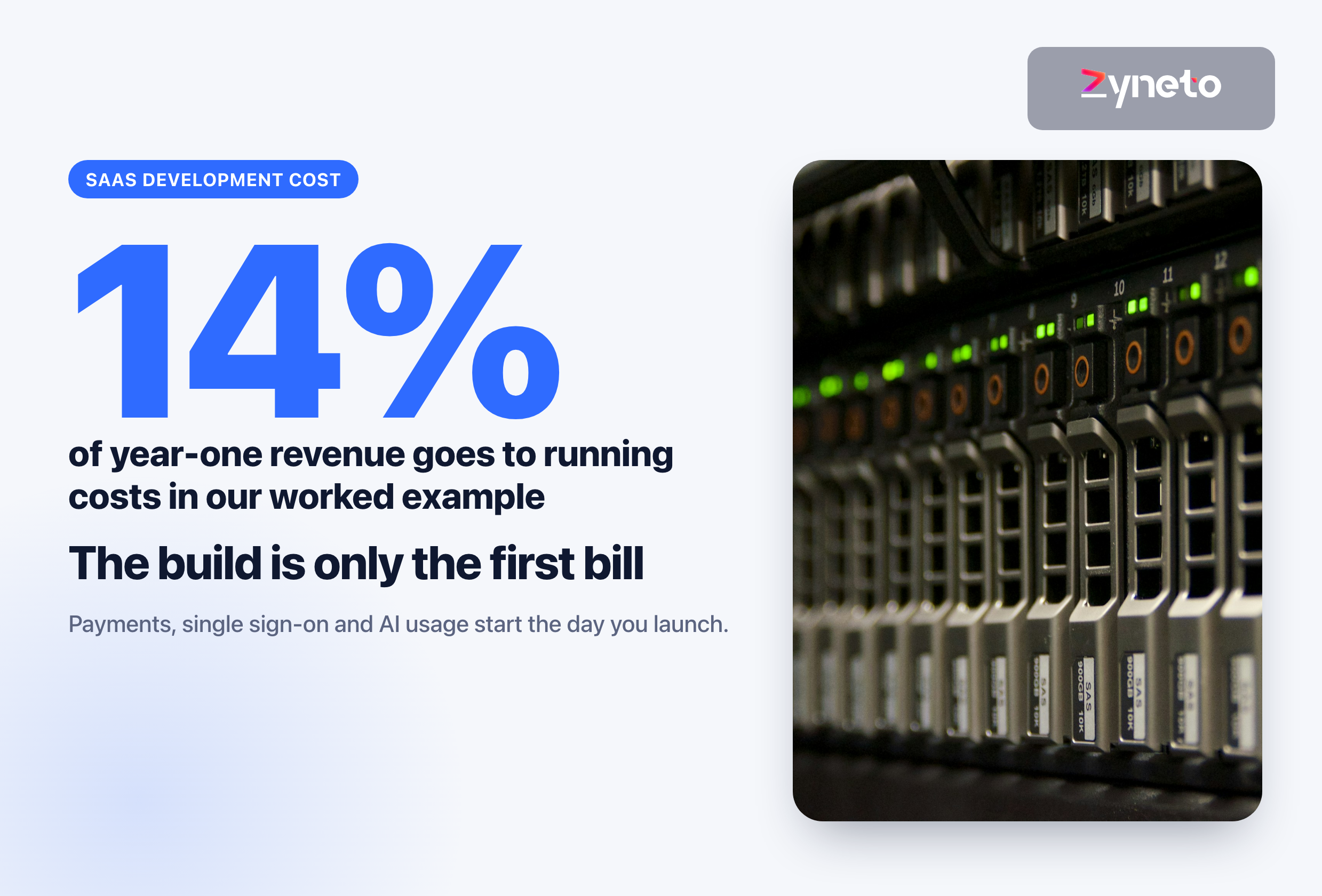
A B2B SaaS costs 2 separate things: the build, and what it costs to run each year after launch. Zyneto's published estimate puts a phase one at 1,120 to 1,400 hours. Billed at $40 to $100 an hour, that is $44,800 to $140,000. Our worked example is 1,240 hours, about $80,600 at a $65 blended rate, delivered in 16 to 24 weeks. The running cost is the part most quotes leave out. On $20,000 a month of subscription revenue, with 5 enterprise customers on single sign-on and an AI feature on a mid-tier model, the list prices in this post add up to about $33,800 in year one. That is before SOC 2, which no compliance vendor prices publicly.
3 decisions move both numbers more than any feature list: how tenants are separated, how enterprise customers sign in, and how AI usage is metered.
Most founders price a SaaS from its screens. That is the wrong end. The screens are the cheapest part, while tenant isolation, identity and billing are what an enterprise buyer checks before signing, and what you pay for every month afterwards.
Zyneto publishes its SaaS estimate line by line. The SaaS platform development page builds a 1,240-hour phase one from 5 lines: tenancy, identity and permissions; the core object model, views and search; billing, entitlements and reporting; connectors and data migration; and the admin console, onboarding and hardening. At $40 an hour that is $49,600, at $100 it is $124,000, and at a $65 blend about $80,600.
Read the band, not the example. Real scopes land between 1,120 and 1,400 hours. The example only shows the method: change any of its 5 lines and the total moves with it.
Some work is left out of that number on purpose, because each item is its own decision. An AI layer adds 120 to 280 hours. Real-time collaboration adds 180 to 350. An automation engine adds 150 to 300. Enterprise sign-in adds 100 to 200 hours through an identity provider, or 250 to 400 hand-rolled. A mobile app that matches the web product is priced separately.
The rate depends on who does the hour. Rates run from $40 to $100 by seniority. Testers and junior developers bill at the low end; the people designing tenancy and identity bill at the top. Plan on the $60 to $70 that a mixed squad averages, not on either end.
What you are budgeting | Hours | At $40 | At $65 | At $100 |
Phase one, published band | 1,120 to 1,400 | $44,800 to $56,000 | $72,800 to $91,000 | $112,000 to $140,000 |
Worked example | 1,240 | $49,600 | about $80,600 | $124,000 |
Enterprise sign-in with a provider | 100 to 200 | $4,000 to $8,000 | $6,500 to $13,000 | $10,000 to $20,000 |
Enterprise sign-in hand-rolled | 250 to 400 | $10,000 to $16,000 | $16,250 to $26,000 | $25,000 to $40,000 |
AI layer with a per-tenant token ledger | 120 to 280 | $4,800 to $11,200 | $7,800 to $18,200 | $12,000 to $28,000 |
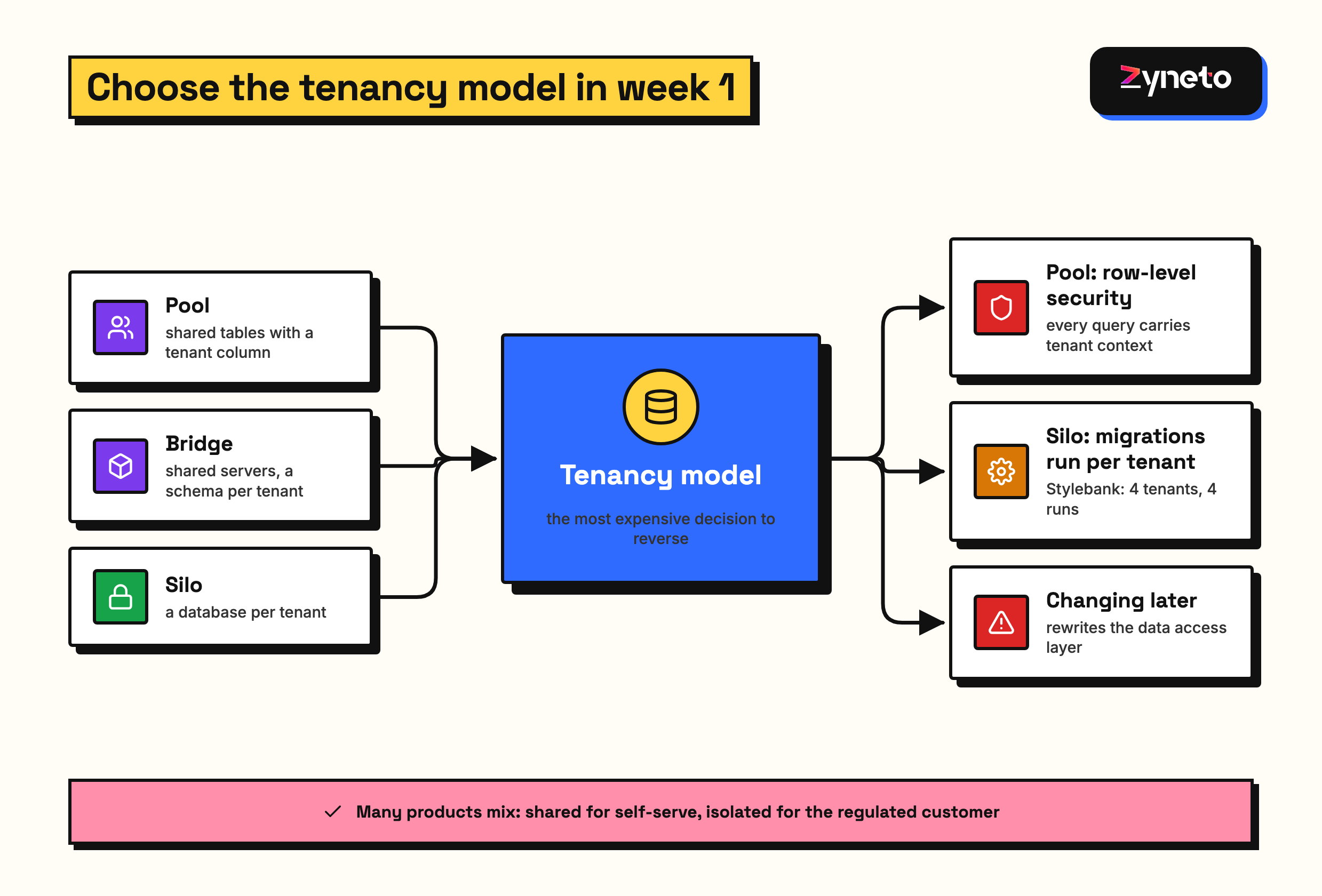
Tenancy means how one customer's data is kept apart from another's. There are 3 models, usually called pool, silo and bridge. Pool keeps every tenant in shared tables with a tenant column. Silo gives each tenant its own database or infrastructure. Bridge is the middle option: tenants share the servers but each gets its own schema or database.
Silo is easier to defend to an auditor and harder to run. Stylebank, a multi-tenant apparel platform Zyneto built on Django, runs 4 tenants, and each one has a separate database, a separate S3 bucket and a separate Redis database. Around 35 scheduled jobs run inside those boundaries. The trade-off is written into the case study: every migration runs 4 times, and connection pools multiply.
Pool is cheaper per tenant and puts the burden on the code. Shared tables need row-level security, and every query has to carry tenant context. A missed filter is a data leak, not a bug. Zyneto's rule on the SaaS page: choose the model in week 1, and make the build pipeline reject any query that runs without a tenant attached.
Changing later costs more than either choice. Moving from pool to silo after launch means rewriting the data access layer. Many products settle on a mix: self-serve customers share tables, and the single regulated customer who pays for isolation gets its own. That hybrid is cheaper to design in phase one than to retrofit in year 2.
The build estimate stops at launch, and so do most quotes. Zyneto's SaaS page states the rule: hosting, per-tenant backups and model usage recur every month, so they go into what you charge customers rather than into what you pay to build. The table below is year one, at list prices read on the vendors' own pages on 7 October 2026.
The example business is deliberately small. It has 20 customer companies paying $20,000 a month in total ($240,000 a year), billed monthly by card. 5 of them want single sign-on, and 3 of those also want user provisioning (SCIM). The product has 500 users and one AI feature.
Year-one line | Choice in the example | List price | Year one |
Card processing | Stripe, US cards | 2.9% + 30¢ per payment | about $7,030 |
Subscription billing | Stripe Billing, pay as you go | 0.7% of billing volume | $1,680 |
Single sign-on, 5 customers | WorkOS SSO | $125 per connection a month | $7,500 |
User provisioning, 3 customers | WorkOS Directory Sync | $125 per connection a month | $4,500 |
Database | AWS RDS PostgreSQL, db.t4g.medium, Multi-AZ, us-east-1 | $0.129 an hour | about $1,130 |
Database storage, 100 GB | RDS gp3, Multi-AZ | $0.23 per GB-month | $276 |
Error tracking | Sentry Team | $26 a month, billed annually | $312 |
Infrastructure monitoring, 3 hosts | Datadog Pro | $15 per host a month, billed annually | $540 |
AI feature | Claude Sonnet 5.5 (see the AI section) | $2 in, $10 out per 1M tokens | $10,800 |
Total | about $33,770 |
Application servers are not in the table. Their cost depends on traffic and architecture, so price them from your own load test, not from a template. The total also leaves out SOC 2, covered below.
Payment fees and SSO are the 2 largest fixed lines. Payments take about 3.6% of revenue in this example. SSO costs $1,500 a year for each enterprise customer who asks for it, and $3,000 if they want provisioning too. Price SSO into the plan those customers buy, not into your base price.
Stripe Billing charges on top of card processing, not instead of it. In the US, card payments cost 2.9% plus 30 cents, with 1.5% more for international cards and 1% more when currency is converted. Stripe Billing adds 0.7% of billing volume on pay as you go. Annual Billing plans start at $620 a month for up to $100,000 of monthly volume. That only beats 0.7% once you bill more than about $88,600 a month.
A merchant of record charges more and handles sales tax for you. Paddle charges 5% plus 50 cents per transaction. That covers payments, billing, global tax, fraud and chargebacks, because Paddle is the legal seller. Stripe's own merchant-of-record product, Managed Payments, adds 3.5% on top of normal Stripe fees. On $240,000 a year, Paddle comes to about $12,100 against about $8,700 for Stripe plus Billing. The difference of about $3,400 buys you out of registering for and filing sales tax and VAT yourself.
Selling in India or Saudi Arabia changes the gateway. Stripe's documentation says Stripe in India is available by invite only, so Indian businesses cannot sign up through its website. Stripe's country list does not include Saudi Arabia or Oman. To process mada cards as mada inside Saudi Arabia, you need a merchant ID from a Saudi acquirer. Co-badged mada cards can still clear as Visa or Mastercard debit through an international gateway. Plan the gateway per market in phase one, because billing logic written for one provider does not move cleanly to another.
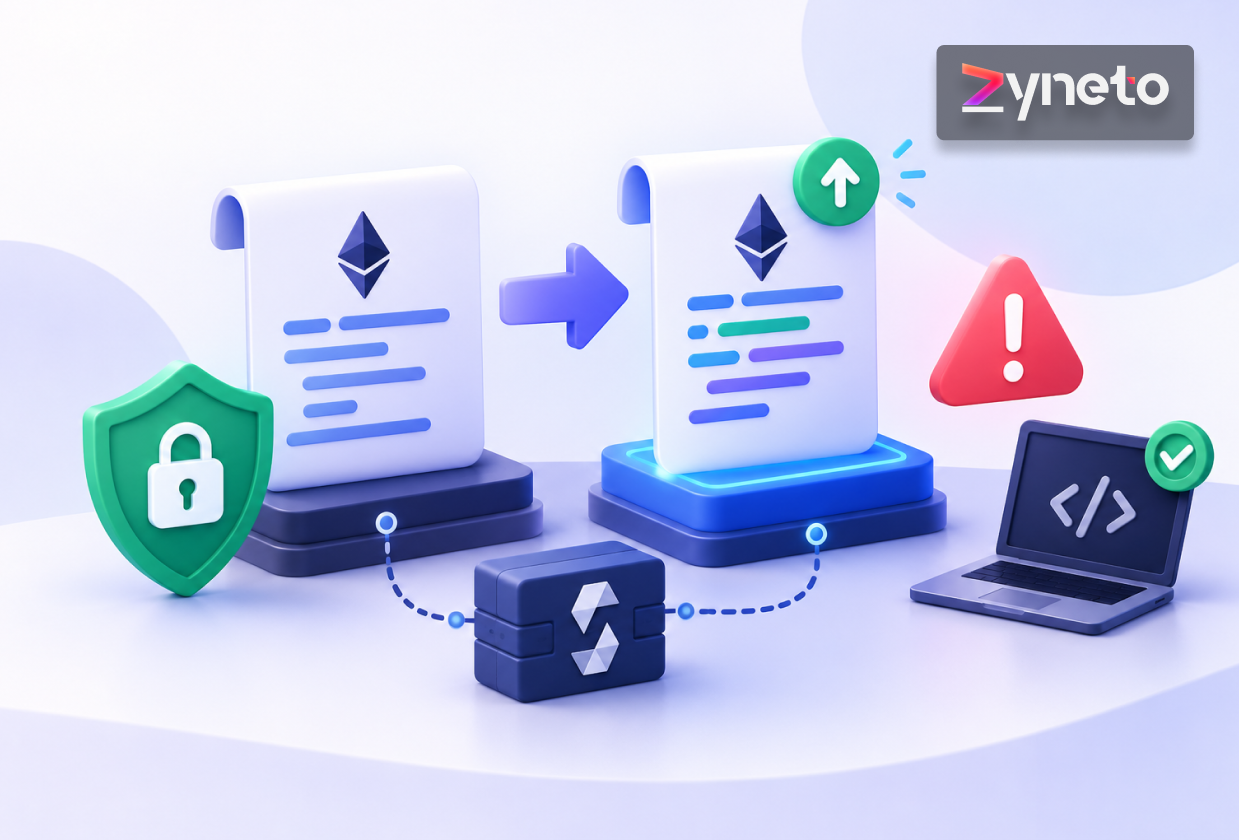
Enterprise buyers ask for SSO, then SCIM, in their security questionnaire. The SaaS page sets the order: role-based access, then audit logs, then SSO, then SCIM. Building it through an identity provider costs 100 to 200 hours. Hand-rolling it costs 250 to 400, and the Entra ID and Okta certification problems it causes tend to appear while a deal is still open.
Providers charge by connection, and 1 enterprise customer is 1 connection. List prices on 7 October 2026:
Provider | What you pay | Notes from the pricing page |
WorkOS | $125 per SSO connection, falling to $65 at 51 to 100 connections; Directory Sync priced the same | User management free up to 1 million monthly active users |
Auth0 B2B Essentials | $150 a month, or $1,650 a year | Up to 500 monthly active users and 3 enterprise connections |
Auth0 B2B Professional | $800 a month, or $8,800 a year | Up to 500 monthly active users and 5 enterprise connections |
Clerk | 1 SSO connection on Pro ($25 a month), then $75 each for 2 to 15 | The B2B add-on, needed for organisations, is $100 a month |
Stytch B2B | Free up to 5 SSO or SCIM connections and 10,000 monthly active users, then $125 per connection | Pay as you go |
Cheapest at 5 customers is not cheapest at 50. A flat plan with a connection cap suits a product with a handful of enterprise customers. Per-connection pricing with volume tiers suits one that expects dozens. Whichever you pick, key accounts on the identity provider's immutable user ID, never on email. Changing provider later then means a migration, not a rebuild.
Inference grows with usage, while your seat price stays flat. Your happiest customers use the AI feature most, so they cost you the most to serve. The SaaS page's fix is a per-tenant token ledger from day 1. It defaults to a small model, routes to a larger one only when needed, uses prompt caching and hard caps, and sells the expensive actions as credits.
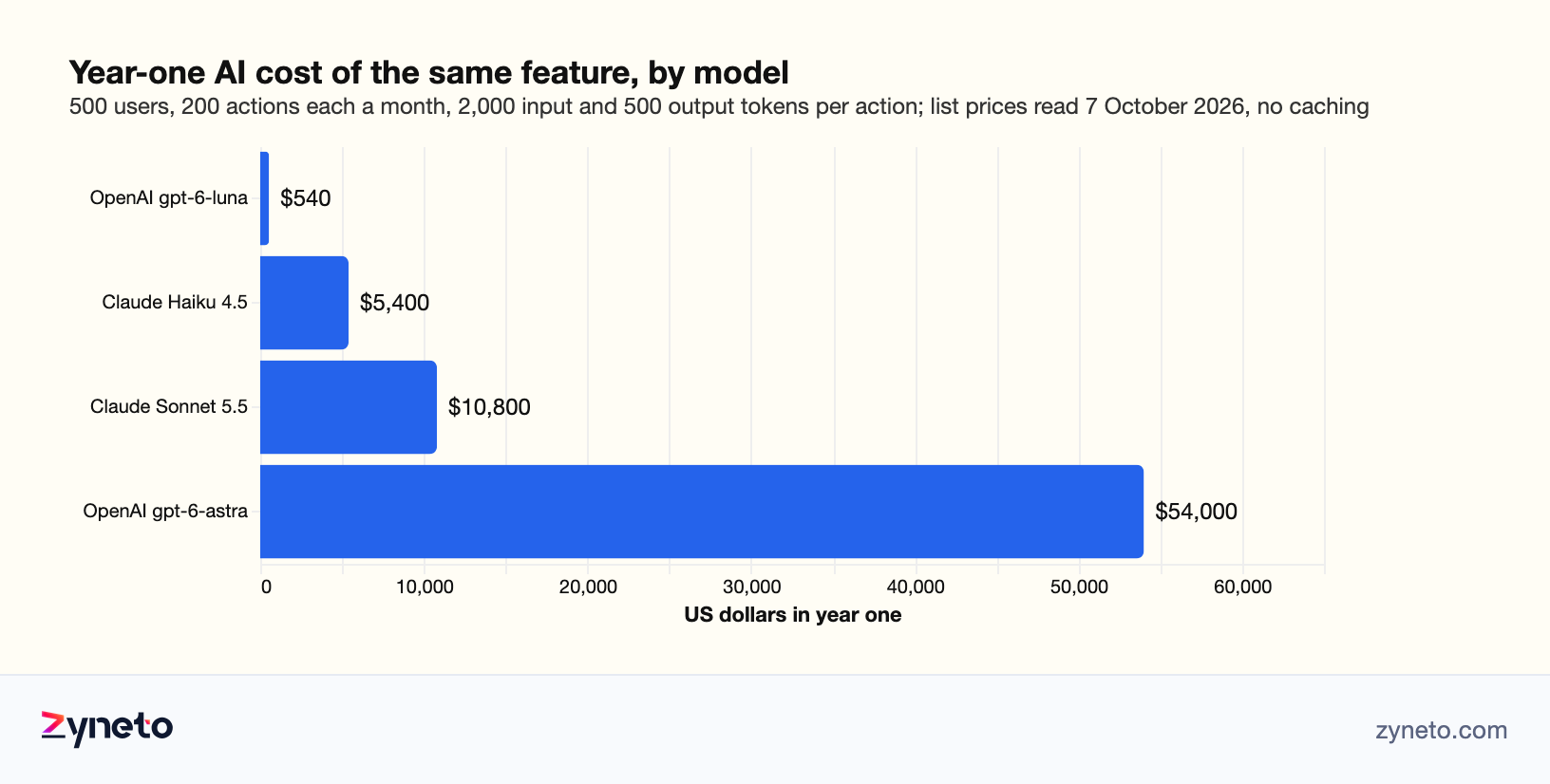
The same feature costs 100 times more on a flagship model. In the example, each of the 500 users runs 200 AI actions a month. Each action sends 2,000 tokens and receives 500. That is 200 million input and 50 million output tokens a month. At list prices on 7 October 2026:
Model | Input / output per 1M tokens | Per month | Year one |
OpenAI gpt-6-luna | $0.10 / $0.50 | $45 | $540 |
Claude Haiku 4.5 | $1 / $5 | $450 | $5,400 |
Claude Sonnet 5.5 | $2 / $10 | $900 | $10,800 |
OpenAI gpt-6-astra | $10 / $50 | $4,500 | $54,000 |
Pick the model per action, not per product. Classifying a ticket does not need the model that drafts a contract. Batch processing halves the price at both OpenAI and Anthropic for work that can wait. The 3 tactics that keep this line flat are routing, caching and caps per tenant. All 3 sit inside the 120 to 280 hours priced for the AI layer.
Kroolo shows what an AI layer carries. On Kroolo, an AI work OS, Zyneto built the AI layer: more than 40 agents in the catalogue, and project generation from a prompt in around 10 seconds, on web, iOS and Android. Each workspace is its own tenant. A catalogue that size needs per-tenant metering. Without it, the AI line in the table above has no ceiling.
Enterprise buyers ask for a SOC 2 report, and it has 3 costs. The audit fee goes to a licensed CPA firm. The compliance tooling is a subscription. The engineering is the largest line for most products. Zyneto's SOC 2 cost guide prices the readiness build at 540 to 1,130 hours, about $35,000 to $73,000 at a $65 blend. That covers audit logging, SSO, SCIM, role granularity, access reviews, tested backup and restore, and change management.
Neither Vanta nor Drata publishes a price. Vanta's pricing page asks for a demo to get personalised pricing. Drata's plans page does the same. Get 3 quotes for the audit and the tooling. Treat any blog figure for either as a guess, because the vendors themselves do not publish one.
Much of the readiness build overlaps the SaaS build. SSO, SCIM, audit logs and roles appear in both lists. Building them once, in phase one, is cheaper than building a product first and adding them for an auditor later. A report also takes time: the observation window alone runs 3 to 12 months. A buyer who needs the report in 90 days cannot have it.
Add the build and the first year together before you set a price. For the example business:
Item | Amount |
Phase one build, worked example (1,240 hours at $65) | about $80,600 |
Enterprise sign-in through a provider, if not in phase one (100 to 200 hours) | $6,500 to $13,000 |
AI layer with token ledger, if not in phase one (120 to 280 hours) | $7,800 to $18,200 |
Year-one running costs from the table above | about $33,800 |
SOC 2 readiness build, if enterprise customers need the report (540 to 1,130 hours) | about $35,000 to $73,000 |
SOC 2 audit fee and compliance tooling | quote only, not published |
The running costs are a share of revenue, so model them that way. In the example, the year-one running costs come to about 14% of the $240,000 billed. Payment fees, SSO and inference make up nearly all of that. Each scales with something you can see: revenue, enterprise customers and AI actions. Put each one into your pricing as its own line.
Famepilot shows a cost that never goes away. Famepilot, a multi-location reputation platform Zyneto built on Django and PostgreSQL, pulls reviews from more than 25 review and listing sources. Every one of those sources can change its API. The case study treats those changes as running cost rather than defects. Any SaaS built on connectors should budget the same way.
16 to 24 weeks from discovery to a hardened phase one. 4 engineers at roughly 30 working hours a week each get through the 1,240-hour example in 10 to 11 weeks. Discovery and hardening make up the rest.
You should see running software early, not at the end. The SaaS page sets the first milestone as a walking skeleton. It is deployed and tenant-aware, with sign-in working end to end, 1 core object, 1 connector and per-tenant tracing live. That is the first thing you can show a customer.
Enterprise readiness has a cost that does not show on the roadmap. SSO, SCIM and audit logs unblock procurement. None of it is visible to customers, so for 6 to 8 weeks the product looks frozen to anyone not working on the deal. Warn your board first.
Write down your first 3 enterprise customers' identity providers. Entra ID and Okta behave differently even inside the same standard. A quote that does not ask which ones you need has not priced SSO.
Decide where AI is allowed to spend. List the AI actions, which model each needs, and whether customers pay per action. That one page decides whether the AI line in year one is $540 or $54,000.
Pick the payment route per market. The US, the EU, India and Saudi Arabia each point to a different provider or a merchant of record. Billing logic is cheaper to write once for the right provider than to port later.
Ask every quote for hours by line. Zyneto gives a band on the first call and a fixed price only after a 2 to 3 week fixed-fee discovery, with the fee credited against phase one. Any quote you receive should let you divide the price by the hours and get a rate you recognise.
A SaaS budget that stops at launch is half a budget. The build buys the product once. The tenancy model, the sign-in route and the AI meter decide what every customer costs you afterwards, and those 3 choices are cheapest to make before the first line of code.
A B2B SaaS phase one takes 1,120 to 1,400 hours in Zyneto's published estimate. Billed at $40 to $100 an hour, that is $44,800 to $140,000. Zyneto's worked example is 1,240 hours, about $80,600 at a $65 blended rate, covering tenancy and permissions, the core data model and search, billing, connectors, and the admin console. An AI layer, real-time collaboration and enterprise sign-in are priced on top, because each is its own decision.
Plan on 16 to 24 weeks for a hardened phase one, including discovery. The build itself is about 10 to 11 weeks for a 1,240-hour scope with a 4-person squad. A good team shows you a deployed, tenant-aware walking skeleton well before the end, with sign-in, 1 core object and 1 connector working.
It depends on revenue, enterprise customers and AI usage, not on the build. For a business billing $240,000 a year with 5 SSO customers and an AI feature on a mid-tier model, list prices add up to about $33,800. The largest lines are card fees, SSO connections and model inference. Application servers and SOC 2 come on top.
Identity providers charge per enterprise connection, and each enterprise customer counts as 1 connection. WorkOS lists $125 per SSO connection a month, falling to $65 at volume. Auth0's B2B Essentials plan is $150 a month with 3 enterprise connections. Clerk charges $75 a month for each connection after the first. Building SSO through a provider takes about 100 to 200 hours; hand-rolling it takes 250 to 400.
Stripe is cheaper and leaves sales tax to you. In the US it costs 2.9% plus 30 cents per card payment, plus 0.7% for Stripe Billing. Paddle charges 5% plus 50 cents and acts as the legal seller, handling global tax, fraud and chargebacks. On $240,000 a year the difference is about $3,400, which is the price of not registering for and filing sales tax yourself.
Meter AI usage per tenant from day 1. Default to a small model, route to a larger one only when an action needs it, cache prompts, and cap each tenant. Charge for the expensive actions as credits. The same feature can cost $540 a year on a small model and $54,000 on a flagship one, so the model choice per action matters more than any other AI decision.
Multi-tenancy is cheaper per customer to run and needs more care to build. Pooled tables need row-level security and a test that fails any query without tenant context. Siloed tenants, with a database each, are easier to prove to an auditor, but every migration runs once per tenant. Most products end up hybrid. Deciding the model in week 1 is far cheaper than changing it after launch, which means rewriting the data access layer.

Vikas has around fifteen years of experience building software and now builds generative AI systems at Zyneto. His work covers retrieval augmented generation, agentic AI, knowledge graphs, AI memory, and the evaluation and guardrails that decide whether any of it is safe to put in front of customers. He has shipped enterprise copilots, document AI, chatbots and predictive analytics for e-commerce, fintech and marketing teams, and works day to day in Python, JavaScript and SQL. He follows multimodal models, business process automation and enterprise AI security closely, and mentors engineers moving into AI. He writes about architecture, inference cost and the failure modes that only show up at production scale.
Share your details and we will talk soon.
Be the first to access expert strategies, actionable tips, and the trends actually shaping the digital world. No fluff - just practical insights delivered straight to your inbox.
Dive into our blog and stay ahead of the curve with expert perspectives, future-ready trends, and tech tips written for decision-makers and doers alike.