Mobile App Development Cost in 2026, With the Hours Shown


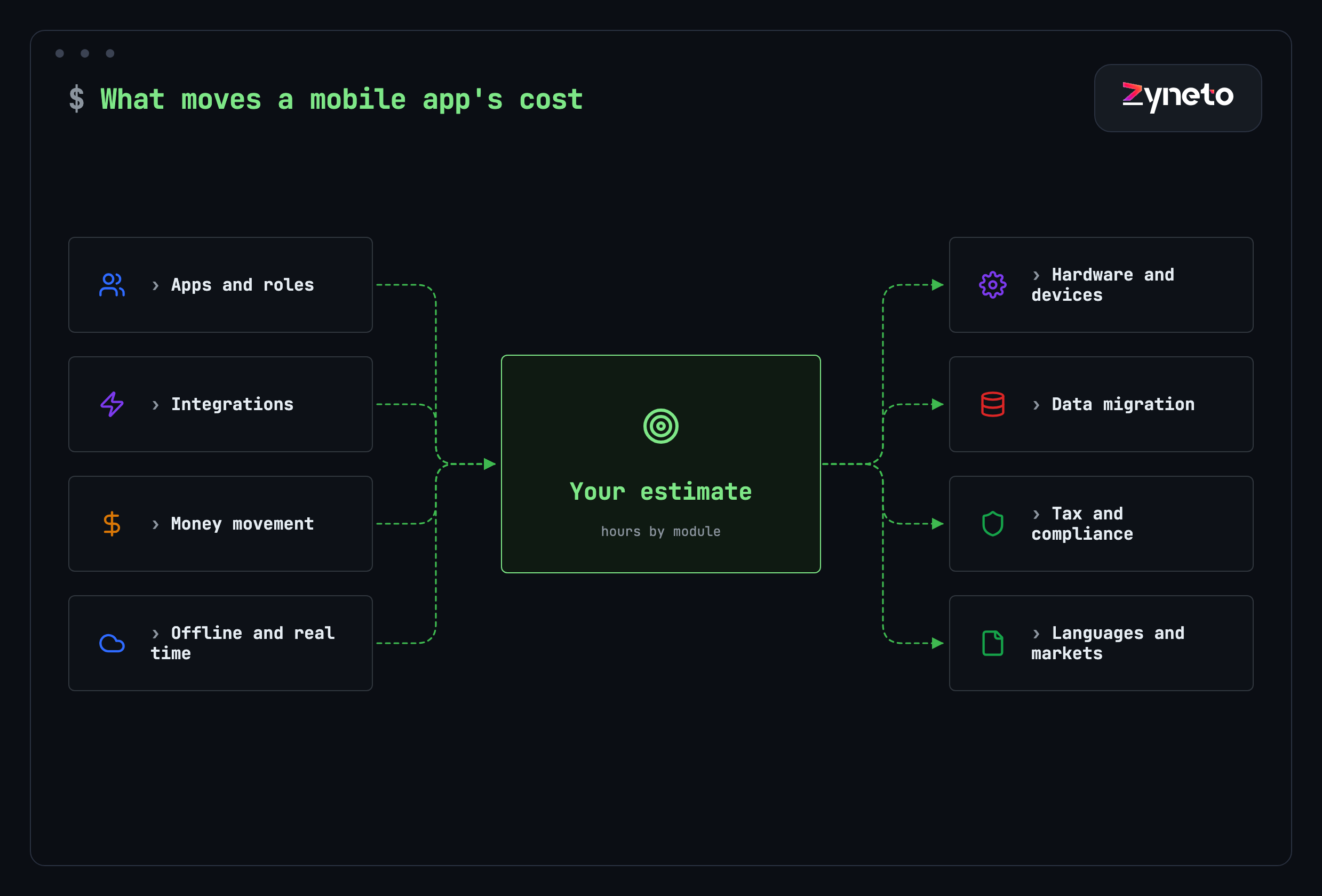
A mobile app costs its hours multiplied by a rate, and nothing else. At Zyneto's published rates of $40 to $100 an hour, which blend to $60 to $70 for a mixed team, the first releases we publish worked examples for run from 700 hours to 1,745 hours: roughly $42,000 to $122,000. A direct-to-consumer shopping app launch is 700 to 1,400 hours. A gym membership platform with its member app is 1,260 hours, about $81,900. 4 decisions move the total more than anything on a feature list: how many apps you are really building, how many outside systems they talk to, whether money moves through them, and what must keep working offline or in real time.
Most founders start by asking what "an app like Uber" costs. That question has no answer, because the visible app is the smallest part of what gets built. The ordinary failure is 3 quotes for the same brief that differ by a factor of 3, none with hours behind them, so there is no way to tell which one priced the staff app, the admin panel and the payment refunds, and which one left them out.
Every honest estimate is a sum of hours by module. Discovery lists the modules the app needs, each module gets an hour range, and the ranges add up to a band. Multiply the band by a rate and you have a price you can argue with line by line. A single total with no hours behind it cannot be checked, compared or cut.
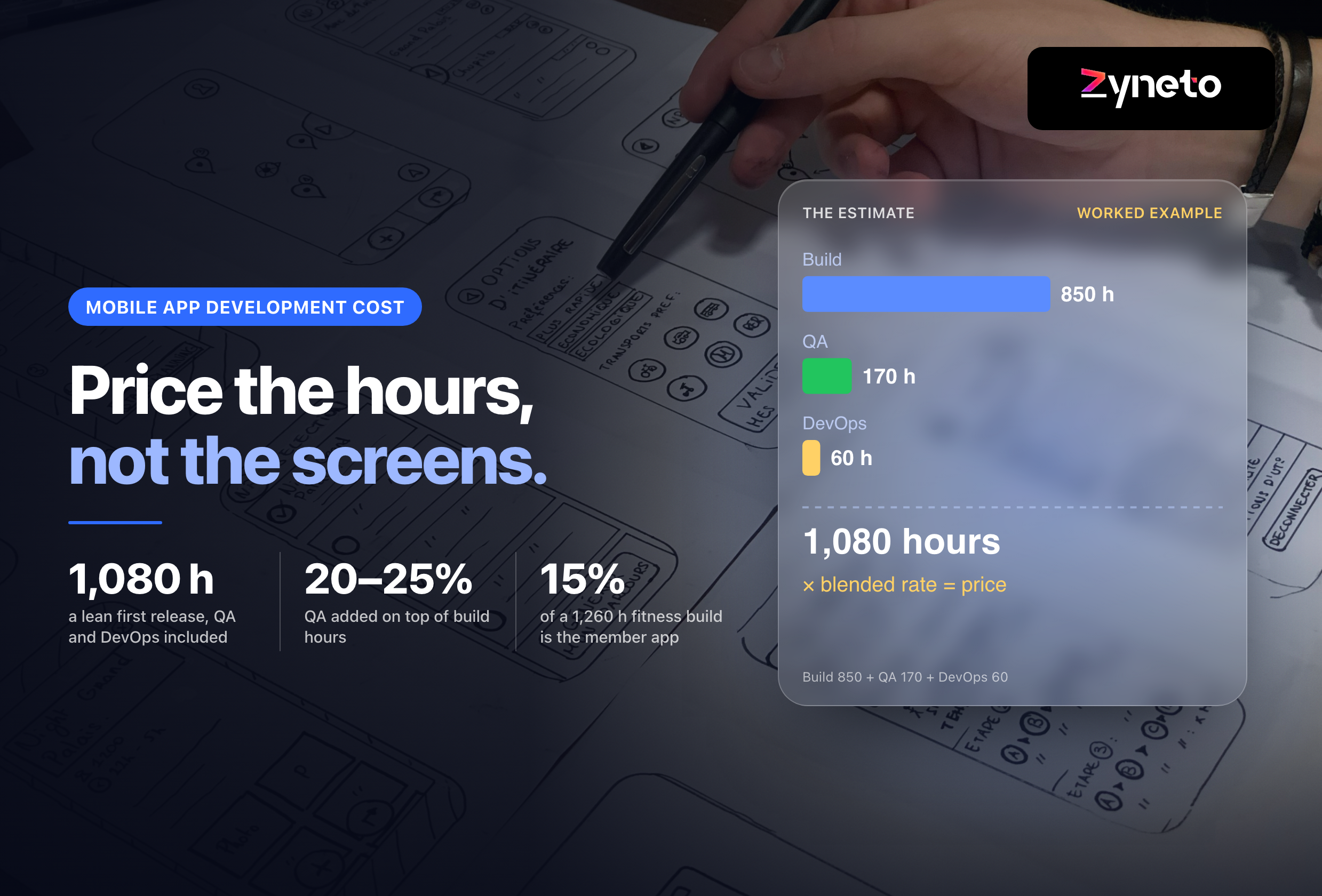
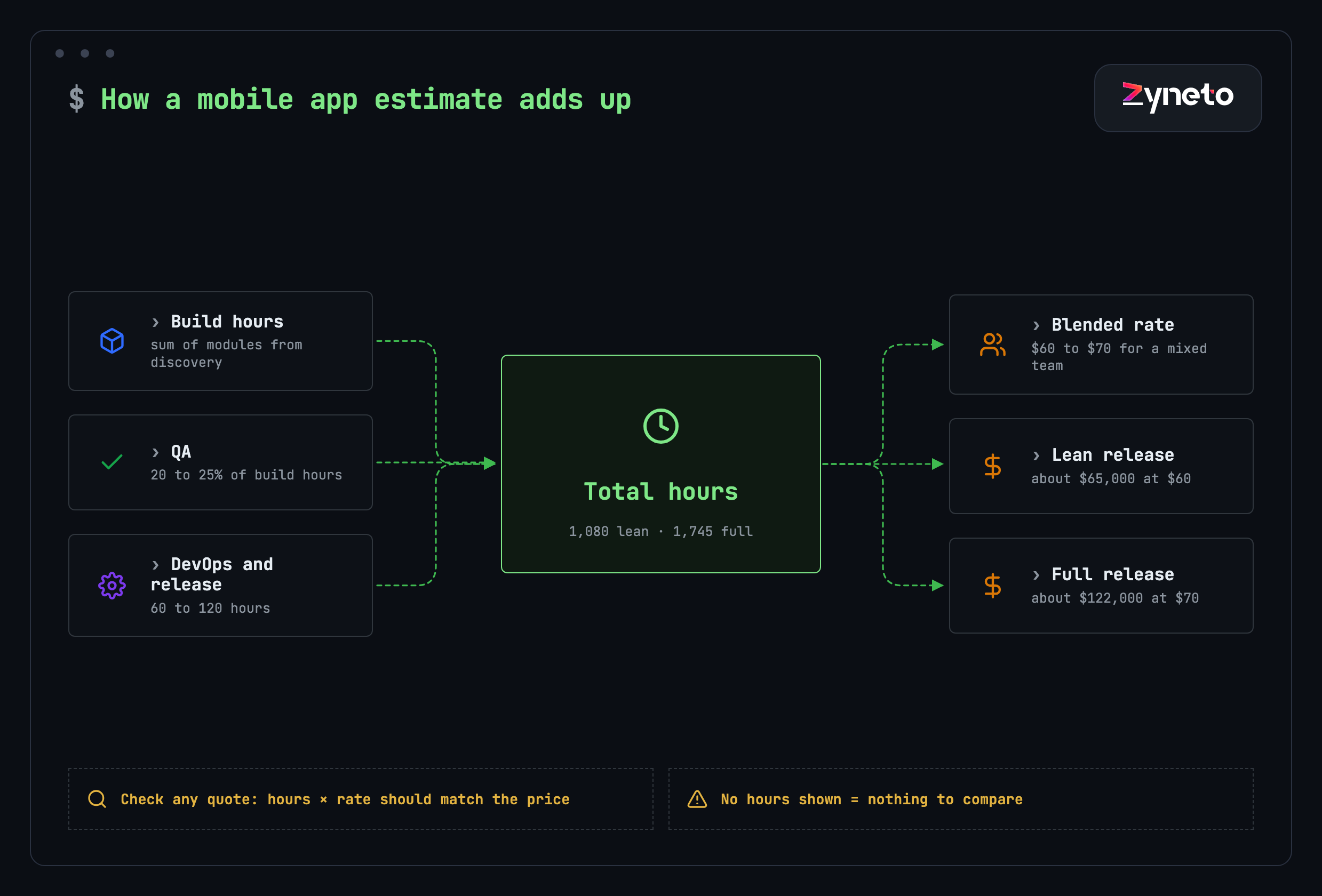
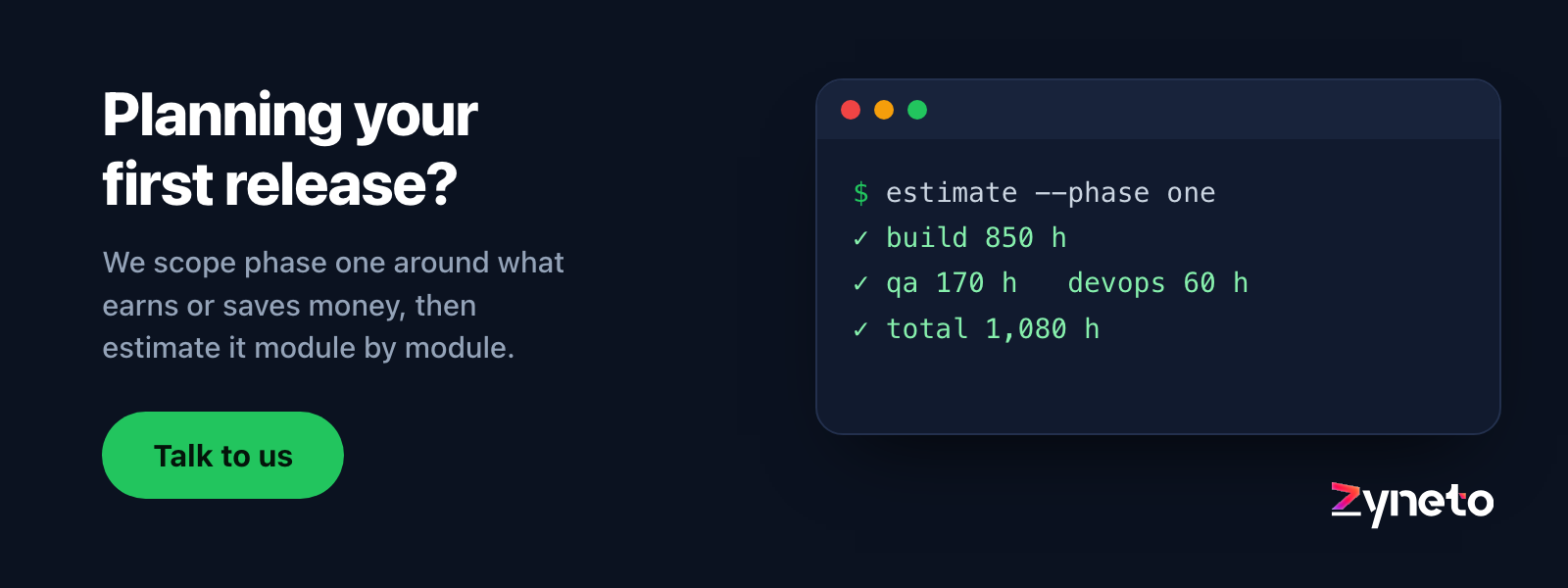
Testing and release work are added on top, not hidden inside. Zyneto's published retail estimate shows the structure: 850 build hours, plus quality assurance at 20 per cent of build (170 hours), plus 60 hours of DevOps for builds, environments and releases, equals 1,080 hours. At a $60 blend that is about $65,000. The fuller version of the same project is 1,300 build hours, QA at 25 per cent (325 hours) and 120 DevOps hours: 1,745 hours, about $122,000 at $70.
Line | Lean first release | Full first release |
Build hours | 850 | 1,300 |
QA | 170 (20%) | 325 (25%) |
DevOps and release | 60 | 120 |
Total hours | 1,080 | 1,745 |
Blended rate | $60 | $70 |
Price | about $65,000 | about $122,000 |
The rate depends on who does the hour. Zyneto's rates run from $40 to $100 an hour by role and seniority. QA and junior implementation sit near the floor; architecture and specialist engineering sit near the ceiling. A mixed squad blends to roughly $60 to $70, which is why the examples in this post use that blend.
Use this formula on any quote you receive. Total hours, multiplied by a blended rate, should land within a few per cent of the quoted price. If it does not, the quote either carries contingency nobody mentioned or prices hours it did not show you. Both are fair questions to ask before you sign.
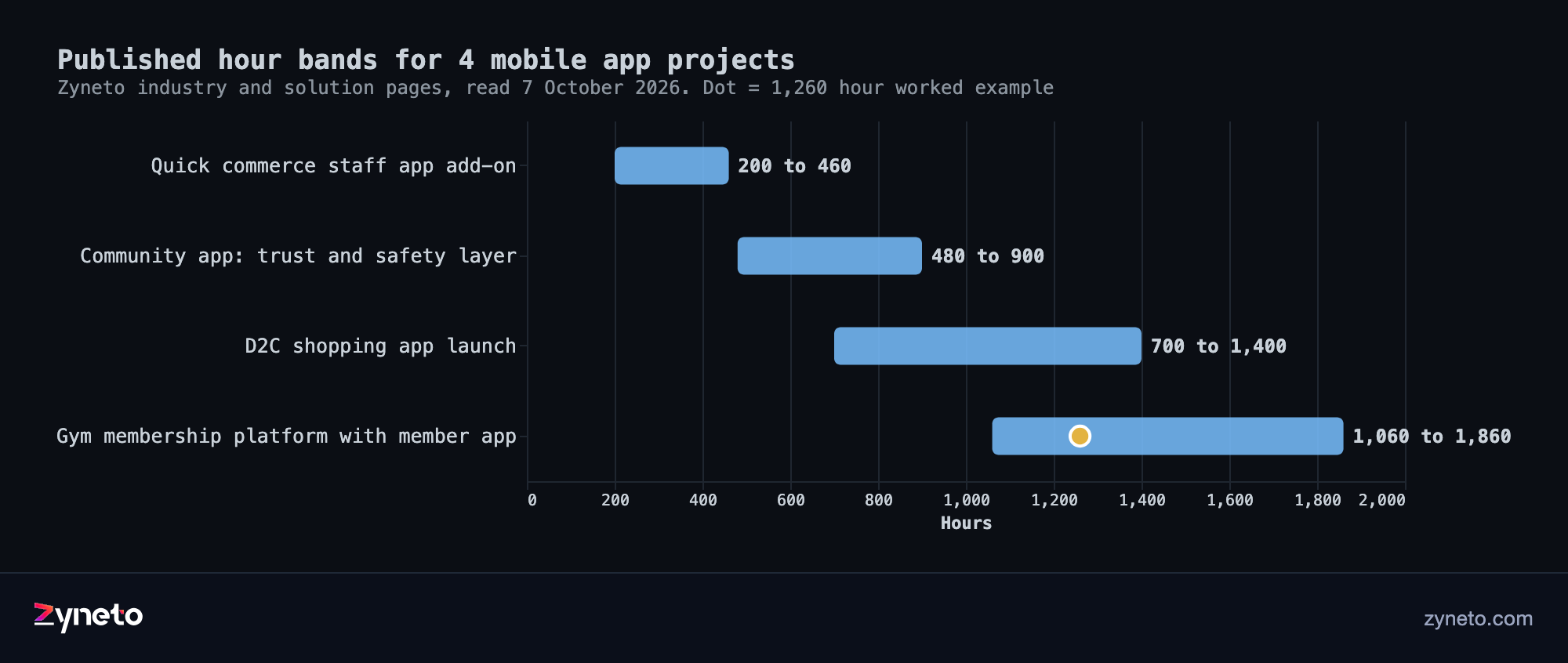
A gym and studio membership platform with a member app: 1,260 hours. Zyneto's fitness app development page prices 7 modules: membership and entitlement 200 hours, recurring billing and the retry ladder for failed payments 210, class scheduling and credits 190, door access and check-in 130, the member app 190, integrations 200, and retention analytics 140. At $40 an hour that is $50,400, at $100 it is $126,000, and at a $65 blend about $81,900, landing in 14 to 22 weeks.
Notice where the member app sits in that list. It is 190 of the 1,260 hours, about 15 per cent. The screens members tap are the smallest line. The money rules, the schedule and the access hardware behind them are the rest.
A direct-to-consumer shopping app: 700 to 1,400 hours. Zyneto's ecommerce app development estimate puts a single-channel launch at 700 to 1,400 hours, about $42,000 to $98,000 at a $60 to $70 blend. A mid-market build covering web, in-store tills, 1 ERP, click and collect and returns is 1,800 to 3,500 hours, about $108,000 to $245,000.
A quick commerce add-on to a store you already run: 200 to 460 hours. The picking and dark-store staff app is priced at 200 to 460 hours, plus delivery slots and dispatch, when it is added to an existing storefront rather than replacing it.
The trust and safety layer of a community or social app: 480 to 900 hours. Zyneto's community app development page prices moderation separately: policy and taxonomy, classifier integration, the review queue, enforcement and notices, appeals, and audit reporting add up to 480 to 900 hours. A founder who budgets a social app from its feed and profile screens alone has left this out.
How many apps you are really building. Most businesses that sell through an app need at least 3 surfaces: the customer app, an app or panel for staff, and an admin console for whoever runs the business. Al Amri Express, a grocery delivery business in Oman that we built for, runs on 2 apps over a shared backend: the storefront customers order from, and an operations app with separate roles for admin, packers and delivery staff. The operations app was the harder half.
How many outside systems it talks to. Every integration with a payment provider, accounting package, ERP, logistics partner or hardware reader is its own small project, with its own failure modes and its own test cases. Zyneto's fitness estimate prices each additional payment provider and region at 80 to 200 hours. The retail estimate's largest single line is ERP, till and inventory integration, at 330 to 870 hours.
Whether money moves through it. Taking a card payment is the easy part. Refunds, partial refunds, payments that arrive twice, failed renewals and the retry schedule after them, and payouts to third parties are where the hours sit. In the fitness example, billing and its retry ladder is 210 of 1,260 hours, more than the member app itself.
What must work offline or in real time. Live order tracking, chat, a door that must open when the network is down, or a rider app in an area with weak signal each need design work before code. At Al Amri Express, order status is pushed to customers as it changes rather than polled, which means the app needs a reconnect path and an honest last-known state on a flaky network.
Languages and markets. Arabic is a layout problem before it is a translation problem: screens mirror right to left, and an English order number inside an Arabic sentence displays scrambled unless the code isolates it. Each market also brings its own tax and invoicing rules. Oman, Saudi Arabia and the UAE all have mandatory e-invoicing programmes rolling out, and India requires GST e-invoicing for businesses above its turnover threshold.
The number of screens. Screens are the cheapest hours in a project because they repeat patterns. A 40-screen app with no integrations can cost less than a 15-screen app that settles payments with 3 providers.
iOS and Android together. With a cross-platform framework such as React Native or Flutter, 1 codebase ships both apps, and the backend, which is often the larger half, is shared in any case. Native apps for each platform mean 2 implementations of every screen. Our React Native and Flutter guides cover when each is the right choice.
Design polish. A design system built once and reused is a fixed cost. What makes design expensive is changing direction after screens are built, not the quality of the first direction.
"An app like X" as a reference. Naming a well-known app is useful for describing a feel. It is useless for pricing, because the parts of that app you can see are not the parts that took its engineers years.
Store accounts are cheap and fixed. Apple's Developer Program costs $99 a year. Google Play charges a one-time $25 registration fee. Neither is a reason to choose a platform.
Store commission can be much larger than the build over time. Where in-app purchase applies, Apple's standard commission is 30 per cent, or 15 per cent under its Small Business Program for developers who earned under $1 million the previous year. Google Play charges 15 per cent on the first $1 million a year in most markets, including India, the UAE and Saudi Arabia. Since 30 June 2026 in the US, UK and EEA, Google's base fee on that tier is 10 per cent, plus 5 points when Google's own billing is used. In the US, apps may also link out to a web payment page; what Apple may charge on those purchases is still before the courts. Physical goods and real-world services, such as groceries, rides and bookings, use an ordinary payment gateway instead, which typically charges a few per cent.
Running services bill monthly from the first user. Maps, SMS one-time passwords, push notifications, chat, video calls and error monitoring each have a price list. Most are small at launch and step up with active users. Ask for the list in discovery so it is in the business plan, not discovered on the first invoice.
Maintenance is a budget line, not an afterthought. Apple and Google release new operating system versions every year and raise the version an app must be built against. Since 28 April 2026, App Store submissions must be built with Xcode 26 and the iOS 26 SDK. Since 31 August 2026, new Android apps and updates on Google Play must target Android 16. An app that nobody touches eventually cannot ship an update, even a one-line fix. Plan a retained block of hours each month from the day the app goes live.
Cost outside the build | Typical amount | Paid to |
Apple Developer Program | $99 a year | Apple |
Google Play registration | $25 once | |
In-app purchase commission | 10% to 30% of digital sales, by store, market and tier | Apple or Google |
Payment gateway for physical goods and services | a few per cent per transaction | Your payment provider |
Third-party services (maps, SMS, chat, monitoring) | monthly, scaling with users | Each vendor |
Maintenance and OS updates | a retained block of hours | Your development team |
The rate band does not change by client location. Zyneto publishes the same $40 to $100 band on every service page. What changes by market is scope: the integrations, the tax rules and the languages that market requires.
Compare against an in-house hire honestly. The US Bureau of Labor Statistics put the median annual pay of software developers at $135,980 in May 2025, and of software QA testers at $104,300. That is salary alone, before benefits, recruiting, equipment and the months it takes to hire a team that covers mobile, backend, QA and DevOps. An agency team is the comparison for a first release; an in-house team is the comparison for the years after it.
Gulf apps carry Arabic and cash. Right-to-left layout, bilingual search that normalises Arabic letter variants, and cash on delivery, where a shopper may reject 1 substituted item at the door and the amount collected changes on the spot. At Al Amri Express, the Omani rial's 3 decimal places meant every amount had to be stored in thousandths, because software that defaults to 2 decimals truncates silently.
Indian apps carry UPI, GST and the DPDP Act. Payment flows built around UPI, GST on every invoice, and consent and breach-reporting duties under the Digital Personal Data Protection Rules 2025, most of which apply from 13 May 2027.
UK and EU apps carry GDPR. Records of processing, breach notice within 72 hours, and answering data requests within a month. None of these is large on its own, but each is a line in the estimate.
Ask each vendor for hours by module. If the modules differ, the quotes price different apps. Line them up and the cheapest quote usually turns out to be missing a module rather than building it more efficiently.
Ask what QA is, in hours. If quality assurance is not a line, it is either inside the build hours or not happening. Zyneto prices it at 20 to 25 per cent of build hours, as a separate line.
Ask who owns the accounts. You should hold the hosting account, the Apple and Google developer accounts and the store listings. At Al Amri Express the client holds the hosting account and both store listings, so changing supplier is a commercial decision rather than a technical one. A vendor who publishes your app under their own developer account owns your distribution.
Ask what discovery produces. A useful discovery ends with an integration inventory, a module list with hours, and a fixed price for the first release. It should not end with a mood board. Zyneto does not give a fixed price before discovery, because the integration list moves the number more than the feature list does.
Ask how the vendor handles a payment that arrives twice. It is a small question with a revealing answer. A team that has shipped payments will talk about idempotency keys and reconciliation. A team that has not will say it will not happen.
Launch the smallest version that earns or saves money. The lean retail slice above, 1,080 hours, is a launchable store, not a prototype. The full slice adds 665 hours for a wider integration set and deeper QA. Most businesses learn more from 3 months of real orders than from those extra hours.
Keep the staff side in phase one if operations depend on it. At Al Amri Express the customer app shipped first and the operations app followed, so each went into production against something stable. That order worked because orders could be handled while the staff app was finished. If your operation cannot run without the staff app, it is not phase two.
Design the parts customers did not choose first. Substitutions in grocery, refunds in ecommerce, missed classes in fitness. Looking back on Al Amri Express, we would design the substitution flow before checkout rather than after, because it moves ratings more than delivery speed does, and deciding late forces the answer around code that already exists.
Calendar time follows hours, not the other way round. The fitness example's 1,260 hours land in 14 to 22 weeks with a squad. A retail first release lands in 10 to 16 weeks. A deadline that is shorter than the hours allow is met by cutting modules, not by working faster.
Cut the second app's polish, not the second app. A staff app with plain screens that works is worth more than a beautiful customer app whose orders nobody can pick. Polish is cheap to add later; a missing workflow is not.
Cut integrations to a file export first. A nightly export to your accounting package is a few hours. A live 2-way integration is a module. Start with the export and automate when volume justifies it.
Do not cut QA. Testing hours saved in phase one come back as support hours, store review rejections and refunds. The 20 to 25 per cent is what keeps the other 75 to 80 per cent of the budget working.
Do not cut the money logic. Failed payments, retries, refunds and reconciliation are what separate an app that takes money from a business that keeps it. In every published example above, the billing lines are larger than the screens users see.
The cost of a mobile app is the sum of its hours, and the hours sit mostly behind the screens: in the staff tools, the integrations and the money. A quote that shows those lines can be checked, compared and cut to fit. One that hides them is not a lower price, only a later one.
It costs the app's hours multiplied by a rate. At Zyneto's published rates of $40 to $100 an hour, blending to $60 to $70 for a mixed team, published first releases run from 700 hours to 1,745 hours, roughly $42,000 to $122,000. A direct-to-consumer shopping app launch is 700 to 1,400 hours and a gym membership platform with a member app is 1,260 hours.
4 things, more than the number of screens: how many apps the business needs (customer, staff and admin), how many outside systems the app integrates with, whether money moves through it, and what must work offline or in real time. In Zyneto's published fitness estimate, billing and its retry logic take more hours than the member app itself.
It follows from the hours. Zyneto's 1,260 hour fitness platform example lands in 14 to 22 weeks with a squad, and a retail first release lands in 10 to 16 weeks. A shorter deadline is met by cutting modules, not by working faster, so agree on the module list before agreeing on a date.
Neither platform is meaningfully cheaper to build for. Store accounts cost $99 a year with Apple and $25 once with Google. With a cross-platform framework such as React Native or Flutter, 1 codebase ships both apps and the backend is shared, so launching on both usually costs far less than twice a single platform.
Store accounts, any in-app purchase commission (10 to 30 per cent of digital sales, depending on store, market and earnings tier), payment gateway fees for physical goods and services, monthly third-party services such as maps, SMS and chat, and maintenance. Apple and Google release new operating systems every year and raise the minimum version apps must be built against, so plan a retained block of hours from launch.
Ask every vendor for hours by module, QA as a separate line, the blended rate, and who will own the hosting and store accounts. Multiply the hours by the rate and check it matches the price. When quotes differ widely, the cheapest one is usually missing a module rather than building it more efficiently.
For a first release, an agency team is usually faster to start because it already covers mobile, backend, QA and DevOps. The US Bureau of Labor Statistics put the median software developer salary at $135,980 in May 2025, before benefits and recruiting. An in-house team makes more sense once the app is live and the work is continuous.

Vikas has around fifteen years of experience building software and now builds generative AI systems at Zyneto. His work covers retrieval augmented generation, agentic AI, knowledge graphs, AI memory, and the evaluation and guardrails that decide whether any of it is safe to put in front of customers. He has shipped enterprise copilots, document AI, chatbots and predictive analytics for e-commerce, fintech and marketing teams, and works day to day in Python, JavaScript and SQL. He follows multimodal models, business process automation and enterprise AI security closely, and mentors engineers moving into AI. He writes about architecture, inference cost and the failure modes that only show up at production scale.
Share your details and we will talk soon.
Be the first to access expert strategies, actionable tips, and the trends actually shaping the digital world. No fluff - just practical insights delivered straight to your inbox.
Dive into our blog and stay ahead of the curve with expert perspectives, future-ready trends, and tech tips written for decision-makers and doers alike.