Quick Commerce App: What It Costs to Build and to Run


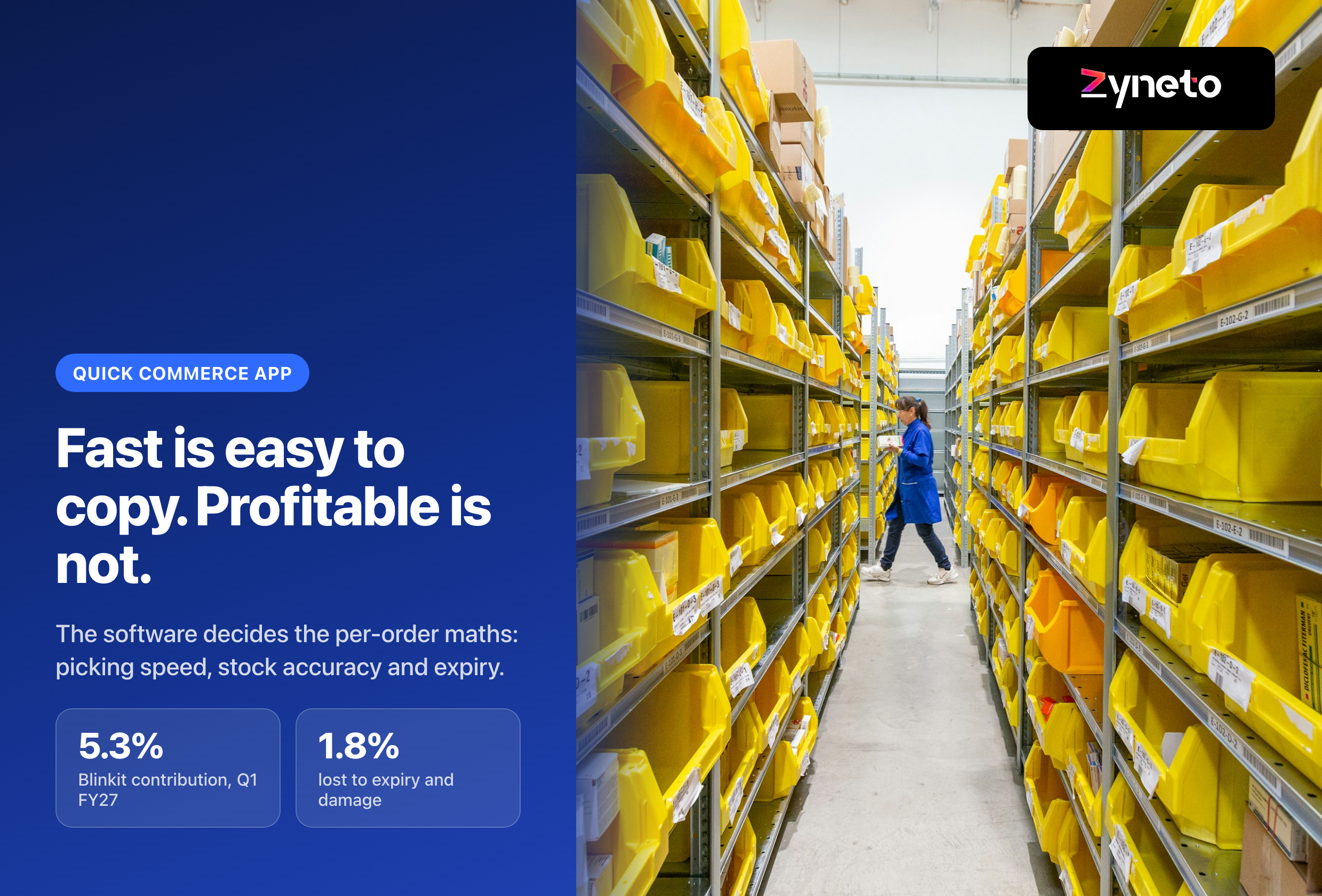
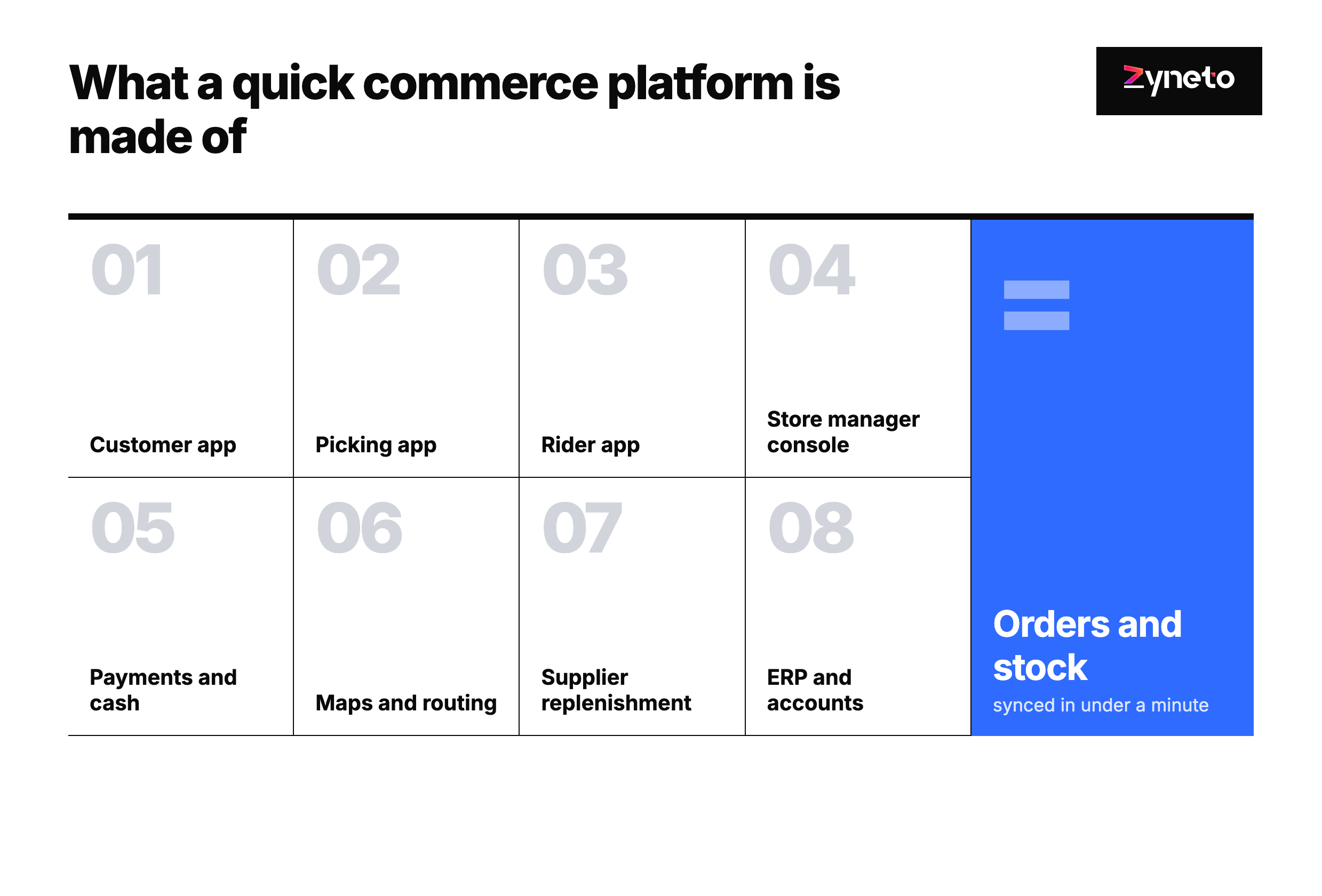
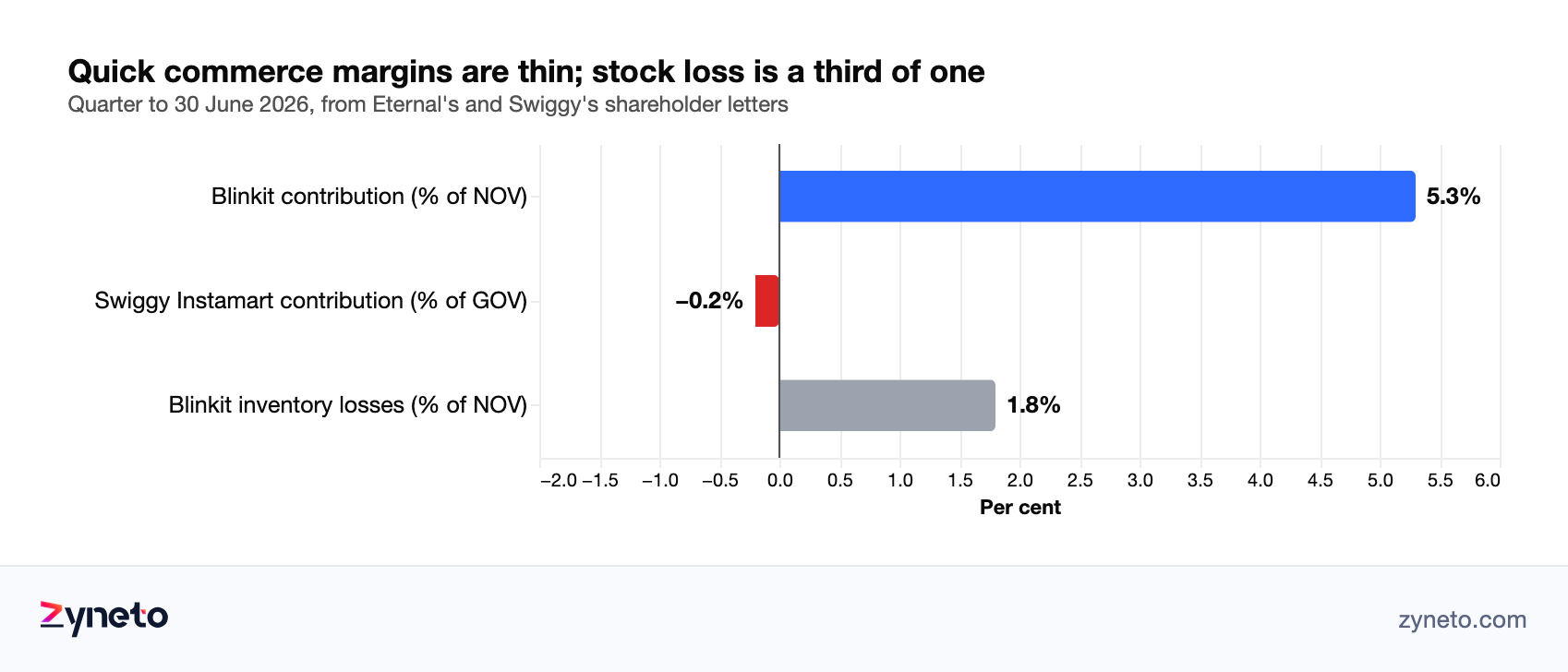
A quick commerce app costs less to build than to run. The software is a customer app, a picking app for the dark store, a rider app and the order and stock system behind them. Zyneto publishes the dark-store picking app as an add-on to an existing storefront at 200 to 460 hours, plus slot capacity and dispatch. A full platform from scratch adds the storefront, catalogue and order management. The running cost is the real question: India's largest operators publish theirs, and in the quarter to 30 June 2026 Blinkit made a contribution of 5.3 per cent of net order value, Swiggy Instamart made minus 0.2 per cent of gross order value, and Zepto's adjusted EBITDA for the year to March 2026 was minus 20.3 per cent of revenue.
Most founders start with the 10-minute promise and work backwards. The promise is the easy part to copy. The ordinary failure is a dark store that delivers fast, loses close to 2 per cent of its sales to expired and damaged stock, and loses money on every order below a basket size nobody calculated before launch.
Zyneto prices the dark-store side separately. On our retail and grocery page, the picking and dark-store app is 200 to 460 hours, plus slot capacity and dispatch, when it is added to a storefront you already run rather than replacing it. We describe it there as the cheapest useful project in the sector and the one most often skipped.
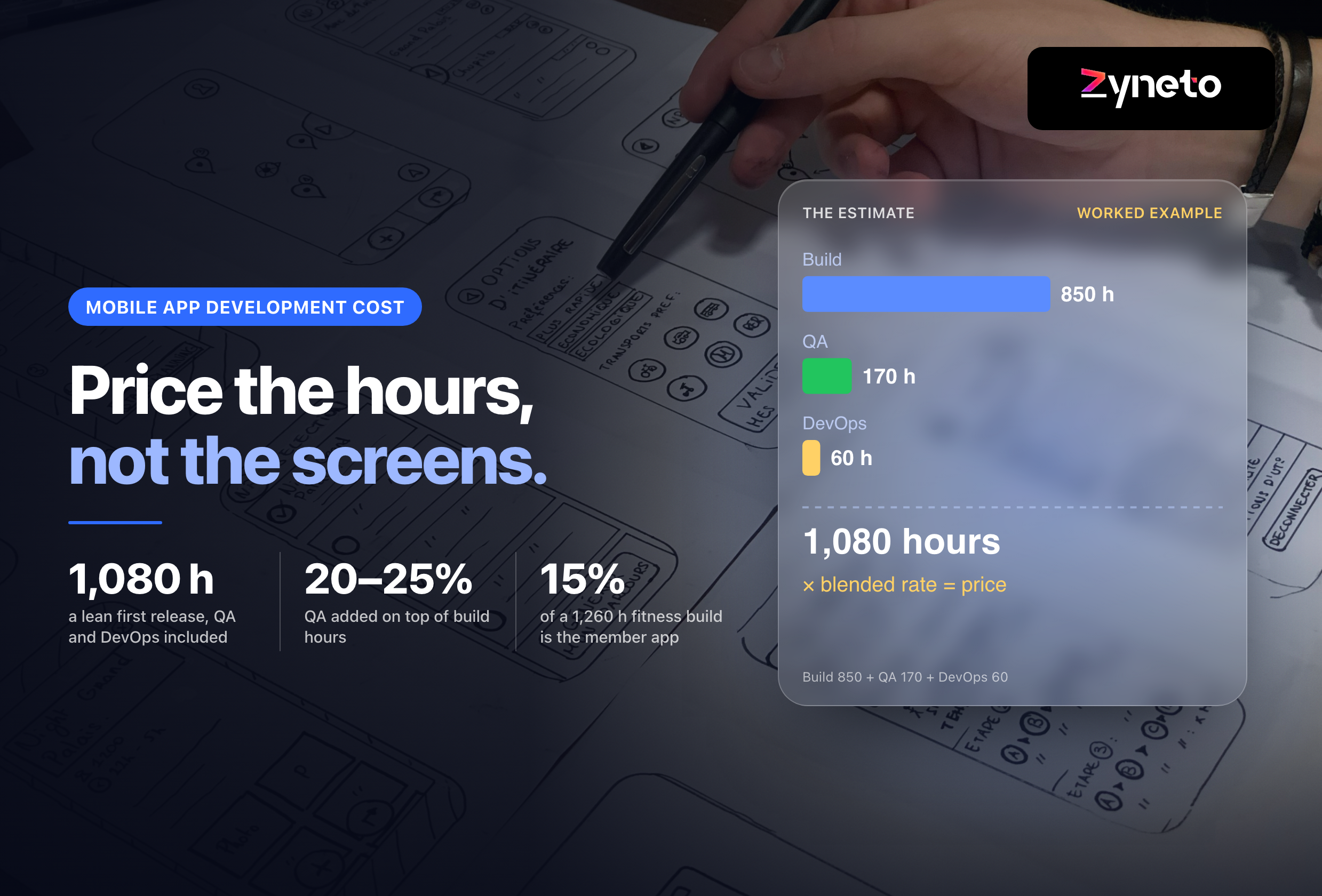
A platform from scratch draws on more modules. Zyneto's published retail module hours, at $40 to $100 an hour by role and a $60 to $70 blend for a mixed team, are the starting point.
Module (Zyneto retail page) | Published hours |
Discovery and integration contracts | 80 to 180 |
Catalogue, product information, search and merchandising | 220 to 520 |
Storefront, checkout, payments and tax | 160 to 360 |
Order management: available stock, routing and allocation | 250 to 600 |
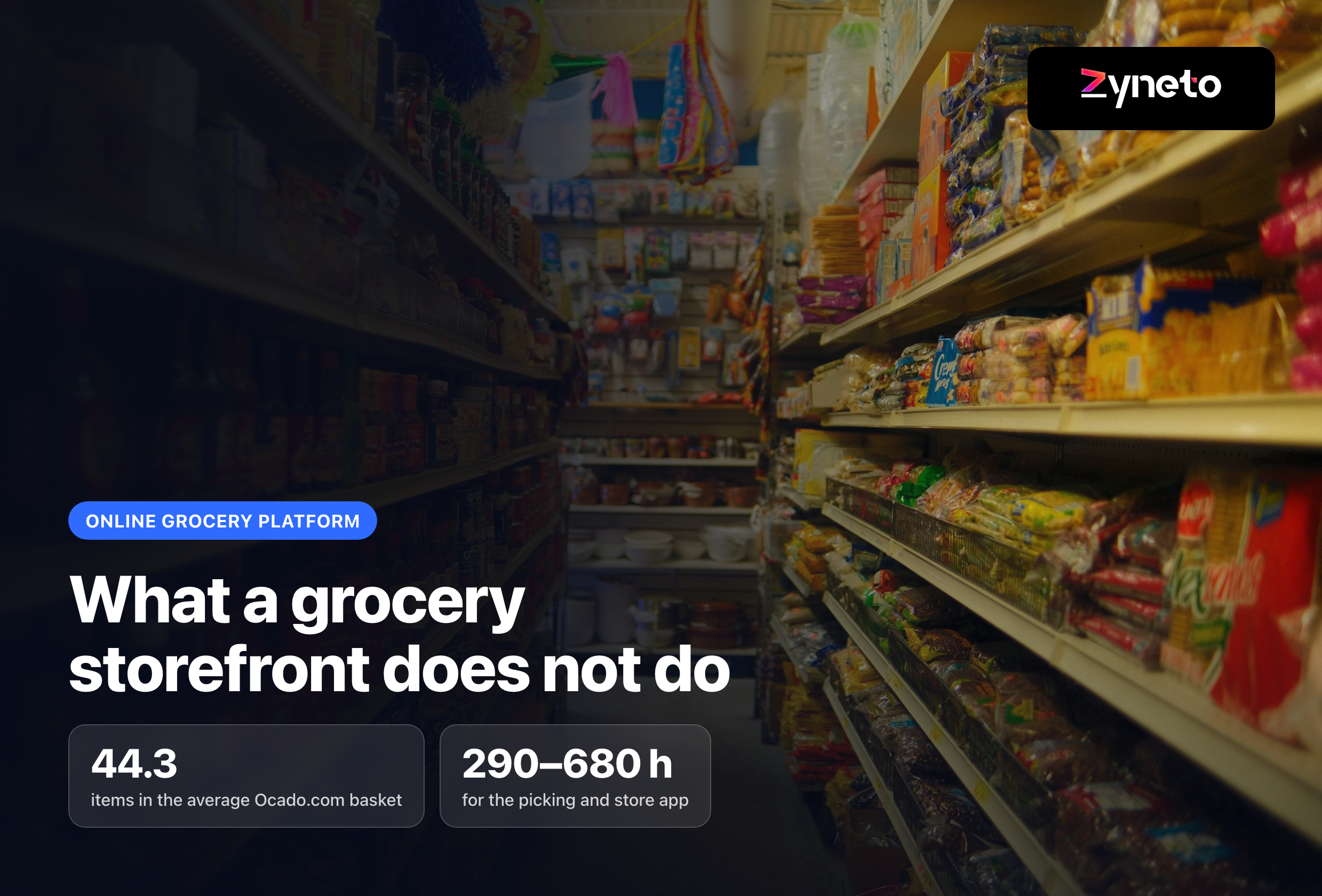
Picking, dark store app and returns | 290 to 680 |
ERP, till and inventory integration | 330 to 870 |
Add those 6 lines and the range is 1,330 to 3,210 hours. That is our arithmetic on the published module ranges, not a published quote. It does not include a rider app or dispatch, which are scoped in discovery because they depend on whether you run your own riders or use a delivery partner. A smaller catalogue and a modern stock system put you near the bottom; a decade-old back office puts you near the top.
The order of build matters more than the total. The customer app is the part everyone sees, and the dark-store app is the part that decides whether the promise is kept. At Al Amri Express, a grocery delivery business in Oman that we built for, the warehouse operations app was the harder half of the project.
The customer app. Search, a basket, payment, live tracking and one-tap reorder. At Al Amri Express, order status is pushed to the customer as it changes over websockets, so the app shows picking, dispatch and arrival as they happen and keeps an honest last-known state when the network drops.
The picking app. A picker in a dark store works from a queue, not a catalogue: the next order, the route through the shelves, a barcode scan for each item, and a substitution step when something is missing. It runs on a shared device, often with gloves on and in a chiller. Al Amri Express runs it as a separate application with roles for admin, packers and delivery staff.
The rider app. Assigned orders, navigation to a pin rather than an address, proof of delivery, and cash collection if you accept it. Zyneto's published last-mile build includes rider auto-allocation and batching, OTP and photo proof of delivery, and pin-drop geocoding.
The store manager's console. Stock levels, open orders, rider availability and the ability to stop taking orders when the store is overloaded. This is the screen that keeps a bad hour from becoming a bad day of reviews.
India's quick commerce operators publish unit economics every quarter. They are the best public evidence anywhere on what a dark-store network costs, and they disagree with each other in useful ways.
Operator, period | Stores | Orders | Average order | Margin reported |
Blinkit, quarter to 30 Jun 2026 | 2,443 | 331 million | ₹518 net | Contribution 5.3% of net order value; adjusted EBITDA 0.6% |
Swiggy Instamart, quarter to 30 Jun 2026 | 1,171 in 131 cities | 114.5 million | ₹691 gross, ₹508 net | Contribution −0.2% of gross order value; adjusted EBITDA −₹778 crore |
Zepto, year to 31 Mar 2026 | 1,139 | 640 million | not disclosed | Adjusted EBITDA −20.3% of revenue |
Volume per store is what turns a loss into a margin. Swiggy reported 1,089 orders per dark store per day and store utilisation of about 40 per cent, with more than 45 per cent of stores contribution-positive. Zepto's filing reports 1,677 orders per store per day for the year. Blinkit reports average net order value per store of ₹8.27 lakh a day, against a steady-state assumption of ₹11 lakh.
A dark store is expensive before it sells anything. Eternal's management assumes capital spending of about ₹2.5 crore per Blinkit store including warehousing, up from ₹1 crore previously. That is a property and fit-out cost, not a software one, but it is why the software has to make each store busy.
Inventory loss is a line of its own. Eternal says Blinkit's inventory losses from expiry, shrinkage, damage, transit and pilferage were about 1.8 per cent of net order value, driven mostly by fruit and vegetables. In a business whose contribution is 5.3 per cent, that is a third of the margin.
Swiggy puts a number on it. In its letter for the quarter, Swiggy says its path to EBITDA break-even is about ₹30 of contribution per order, and that densification and warehouse and store automation are worth about ₹5 per order. Its adjusted revenue per order was ₹108. Software is not the whole answer, but it is a sixth of the gap.
Picking speed sets the promise. Delivery in minutes leaves little time in the store. A picking app that routes the picker through the shelves in order, scans rather than reads, and batches small orders together shortens the slowest step that you control entirely.
Stock accuracy decides how many orders are complete. If the app sells an item the store does not have, the order becomes a substitution, a refund or a cancellation. Zyneto's published build for last mile and quick commerce syncs inventory to the storefront in under a minute. Overnight stock updates do not work at this speed.
Expiry rules cut losses. First-expiry, first-out picking, a shelf-life check before an item is packed, and markdowns for short-dated stock attack the 1.8 per cent directly. In India the check is also a legal requirement: FSSAI requires food sold online to reach the customer with at least 30 per cent or 45 days of shelf life left.
Basket size is set in the app. Picking and delivery costs are close to fixed per order, while revenue grows with the basket. Minimum order values, delivery fees below a threshold, and suggestions that add the second and third item are product decisions that live in the customer app.
An address is often a pin and a landmark. In Oman, the national addressing standard has no location-based postcode and street names are only unique within a wilayat, so at Al Amri Express the pin drop is the primary key and the customer's landmark note is something the rider reads as written. Delivery zones are polygons on a map, not postcode lists.
Batching riders is where routing pays. Sending 1 rider with 2 nearby orders halves a trip. On 7 October 2026, Google's Routes API charged $5 per 1,000 requests after 10,000 free a month, or $10 per 1,000 for traffic-aware routing, and $30 per 1,000 for its fleet route optimisation after 1,000 free. Mapbox's Directions API charged $2 per 1,000 after 100,000 free. At these prices, routing is a fraction of a cent per order; the saving from batching is far larger.
Cash on delivery needs its own ledger. Zyneto's logistics page describes cash on delivery that takes 2 days to reconcile against what riders actually banked. At Al Amri Express, a shopper can refuse 1 substituted item at the door, so the rider app reprices the amount to collect on the spot. The Omani rial has 3 decimal places, so every amount is stored in thousandths.
Proof of delivery protects you in disputes. A one-time code read by the customer, or a photo at the door, settles "it never arrived" in seconds. Both belong in the rider app from the first release.
Payments are the largest variable software cost. Razorpay's standard rate in India is 2 per cent plus GST on the fee. Stripe's standard US rate is 2.9 per cent plus 30 cents per domestic card payment. On a ₹508 order, 2 per cent is about ₹10, roughly a third of the ₹30 contribution per order Swiggy is aiming for.
One-time passwords add up in India. Twilio's list price for an SMS to India is $0.0832 per segment, against $0.0083 in the US plus carrier fees. A login code on every order is a real cost at that price. Domestic SMS providers and WhatsApp or app-based login are cheaper; price them before choosing.
Maps and routing are small per order. At $5 per 1,000 requests, a route calculation costs half a US cent. The traffic-aware and optimisation products cost more and are worth it only when batching is in play.
Per-order running cost | List price, 7 Oct 2026 | Note |
Payment gateway, India | 2% plus GST on the fee | Razorpay standard |
Payment gateway, US | 2.9% + 30¢ | Stripe standard |
SMS one-time code, India | $0.0832 per segment | Twilio list price; domestic providers cheaper |
SMS one-time code, US | $0.0083 per segment plus carrier fees | Twilio |
Route calculation | $5 per 1,000 after 10,000 free | Google Routes Essentials |
Directions | $2 per 1,000 after 100,000 free | Mapbox |
India is the proof that it can work at scale. Blinkit's net order value grew 86 per cent year on year to ₹17,132 crore in the quarter, and its adjusted EBITDA improved for the fifth quarter running, to 0.6 per cent of net order value. Swiggy reached contribution break-even in May 2026. Zepto's filing shows revenue up 103.6 per cent to about ₹22,624 crore and a large loss.
The Gulf is investing through grocery. talabat reported $2.9 billion of gross merchandise value in the second quarter of 2026 and plans to invest $120 million in grocery in 2026, partly to add talabat mart dark stores. No official dark-store count is published for talabat mart, Noon Minutes or Careem Quik.
Europe and the US have been harder. Getir left the UK, Germany, the Netherlands and the US in April 2024 and closed Gorillas, as Tech.eu reported at the time. In the US, Instacart's 90.3 million orders in the quarter to 30 June 2026 are picked from retailers' own stores rather than from dark stores.
The pattern is density. Quick commerce works where many orders come from a small area, labour for picking and riding is affordable, and customers order often. A business plan that does not show orders per store per day rising towards the operators' figures is a plan for a loss.
India puts food rules on the listing. FSSAI requires an e-commerce food business to hold a central licence, sellers to display their licence or registration, and packaged food listings to show a clear picture of the label's principal display panel. Mandatory food information has to be visible before purchase, and a non-compliant product must be delisted immediately. Each of these is a field, an image or a switch in your catalogue tools.
India's Legal Metrology rules add pack declarations. Listings must show most of the declarations printed on the pack, including net quantity, MRP and the country of origin for imported goods. From 1 July 2027, listings of imported products must also have a searchable, sortable country-of-origin filter. A catalogue built today should store origin as structured data so that the filter is a setting, not a migration.
FSSAI also expects food and non-food to travel separately. At a meeting with e-commerce food businesses in November 2024, FSSAI's chief executive directed that food and non-food items be delivered separately. For a dark store selling cleaning products next to bread, that is a packing rule the picking app has to enforce.
The UAE limits returns on short-life food. Federal Decree-Law 14 of 2023 removes the general return right for food and consumer goods that expire within 3 weeks, though defective or not-as-described items can still be returned. It also requires that delivery fees and payment surcharges do not exceed what was announced, which matters when fees change with basket size or demand.
The UK requires unit prices online. The amended Price Marking Order, in force since 6 April 2026, applies to online sales and requires a price per kilogram or litre, with loyalty prices shown alongside normal prices and neither given more prominence. A UK quick commerce app needs net quantity and unit as structured product data from the start.
If you already run stores, start there. Our online grocery platform guide covers the scheduled-delivery operation underneath. The cheapest useful project, by our own published estimate, is a picking app and slot capacity added to a storefront you already have, at 200 to 460 hours plus dispatch. One store, fast delivery in a small radius, and the same stock you already sell.
Keep the delivery radius small at first. A tight radius keeps rider trips short and predictable, which is what makes a fast promise honest. Widen it only when the store's picking and riders can absorb the extra orders without the delivery time drifting. The zone is a polygon in the platform, so changing it is a setting, not a release.
Prove the 3 numbers before the second store. Orders per store per day, the share of orders delivered complete, and contribution per order after picking, delivery, payment fees and inventory loss. If those work in 1 store, the software scales with you. If they do not, more stores multiply the loss.
Own the operation that makes the promise. Al Amri Express delivers through its own operation rather than a marketplace of third-party riders, which is why its customer app and warehouse were built as one system. If someone else controls your riders, they control your delivery time.
Design the parts the customer did not choose. Substitutions and missing items move ratings more than delivery speed does. We would design the substitution flow before checkout on any new build. Ten minutes is a promise any competitor can make. Keeping it at a profit is decided in the dark store, by software most customers never see.
Zyneto publishes the dark-store picking app at 200 to 460 hours, plus slot capacity and dispatch, when added to an existing storefront. Building the whole platform draws on published retail modules that add up to 1,330 to 3,210 hours before a rider app and dispatch, at $40 to $100 an hour by role and a $60 to $70 blend. Discovery turns that range into a fixed price.
4: a customer app for ordering and tracking, a picking app for dark-store staff, a rider app for navigation, proof of delivery and cash collection, and a store manager console for stock, orders and riders. All 4 share one order and stock system, which must update inventory in under a minute to keep orders complete.
For some operators, at scale. In the quarter to 30 June 2026, Blinkit reported a contribution of 5.3 per cent of net order value and adjusted EBITDA of 0.6 per cent. Swiggy Instamart's contribution was minus 0.2 per cent of gross order value, after reaching break-even in May 2026. Zepto's adjusted EBITDA for the year to March 2026 was minus 20.3 per cent of revenue.
The operators' own figures give the range. Swiggy Instamart reported 1,089 orders per dark store per day in the quarter to June 2026, at about 40 per cent utilisation. Zepto reported 1,677 a day for the year to March 2026. Your own break-even depends on rent, labour, basket size and inventory loss, so model it per store before opening a second.
Eternal's management assumes capital spending of about ₹2.5 crore per Blinkit store including warehousing, as stated in its shareholder letter for the quarter to June 2026. That is a large-network figure in India. A single dark store or a back room of an existing shop costs far less, and the software can start the same way.
By updating stock from every pick, receipt and adjustment as it happens, and syncing it to the customer app in under a minute. Picking by first expiry, checking shelf life before packing and marking down short-dated items reduce losses, which Blinkit reported at about 1.8 per cent of net order value.
Quick commerce delivers a small basket in minutes from a dark store close to the customer, stocking a limited range of fast-moving items. Online grocery usually delivers a full weekly shop in a scheduled slot, picked from a store or warehouse. They share a catalogue and payments, but need different stock positioning, picking and economics.

Vikas has around fifteen years of experience building software and now builds generative AI systems at Zyneto. His work covers retrieval augmented generation, agentic AI, knowledge graphs, AI memory, and the evaluation and guardrails that decide whether any of it is safe to put in front of customers. He has shipped enterprise copilots, document AI, chatbots and predictive analytics for e-commerce, fintech and marketing teams, and works day to day in Python, JavaScript and SQL. He follows multimodal models, business process automation and enterprise AI security closely, and mentors engineers moving into AI. He writes about architecture, inference cost and the failure modes that only show up at production scale.
Share your details and we will talk soon.
Be the first to access expert strategies, actionable tips, and the trends actually shaping the digital world. No fluff - just practical insights delivered straight to your inbox.
Dive into our blog and stay ahead of the curve with expert perspectives, future-ready trends, and tech tips written for decision-makers and doers alike.