AI Memory: How AI Remembers, Short-Term and Long-Term


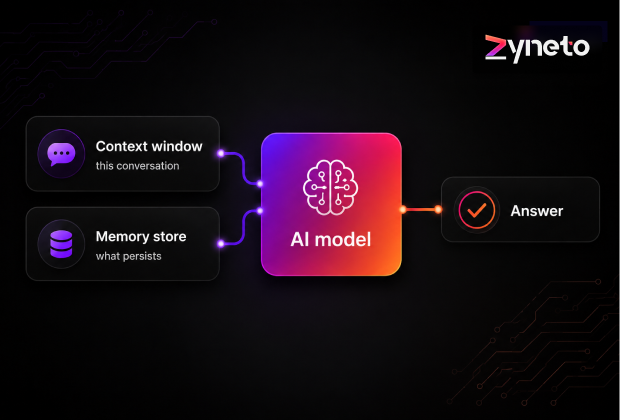
Ask a language model a question, get an answer, ask a follow-up, and it seems to remember what you just said. Start a fresh conversation tomorrow, and it has forgotten you entirely. That gap is one of the most misunderstood things about AI, and closing it is what AI memory is all about. On their own, these models remember nothing between requests. They only know what is in front of them right now. Memory is the machinery we build around them so an assistant can hold a conversation and, eventually, remember a customer, an account, or a decision from weeks ago. This guide explains how AI memory works, the difference between short-term and long-term, why it matters for business, and how to design it well.
Here is the part that surprises people. A language model is, by default, stateless. Each request stands alone. The model carries nothing over from the last question to the next. It simply reads whatever text you hand it and responds. When a chatbot seems to remember your name from three messages back, it is not because the model stored it somewhere. It is because the whole conversation so far was fed back into the model along with your latest message.
That is the foundation to hold onto. The model provides the intelligence. Memory is something we bolt on around it, and how we do that decides whether your assistant feels like a goldfish or a colleague.
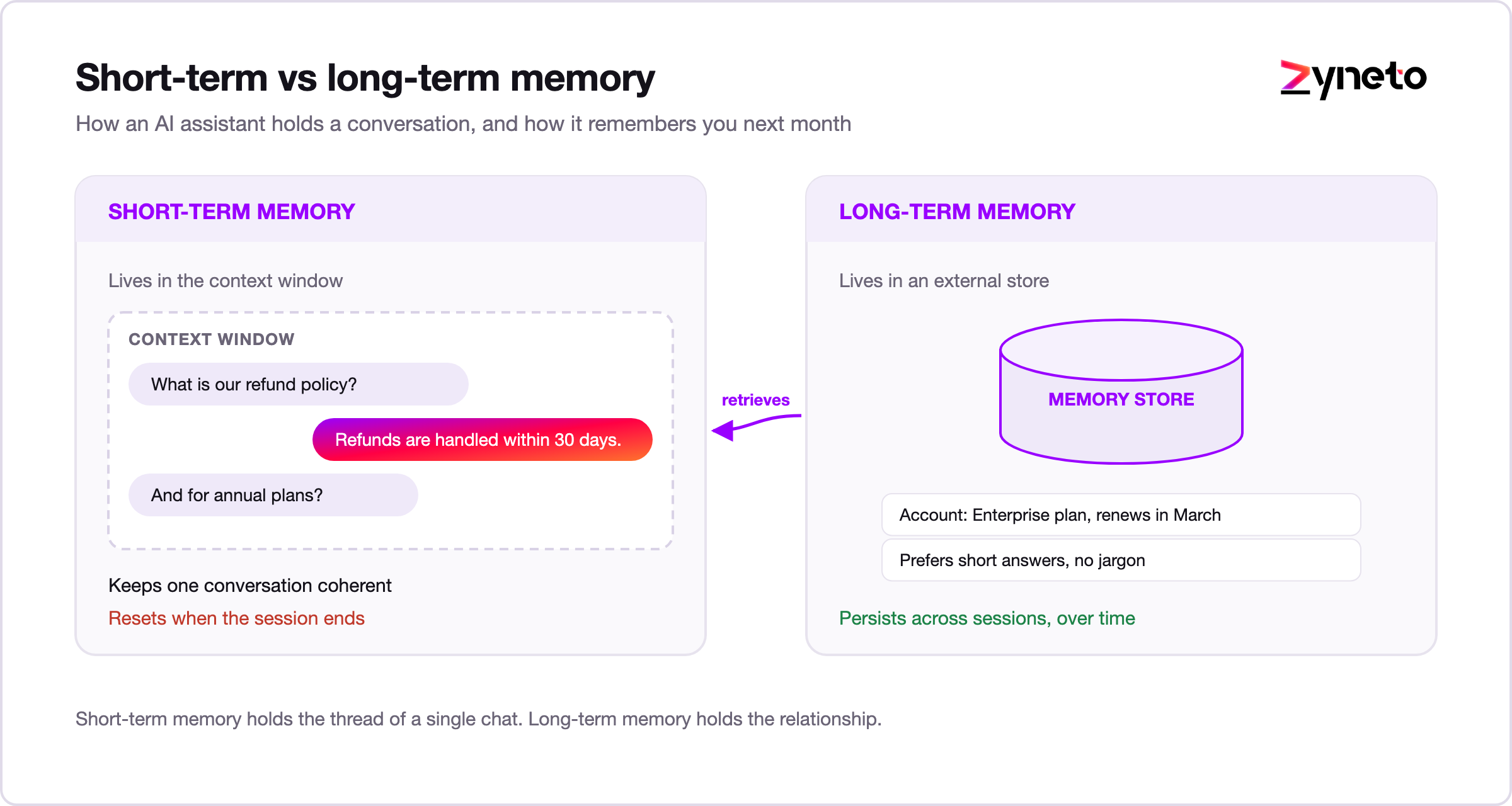
Short-term memory is the current conversation, and it lives in what is called the context window.
The context window is the amount of text a model can consider at once, its working memory, measured in tokens. As a conversation goes on, the recent back-and-forth is included in that window, which is why the assistant understands a follow-up like "and what about last year?" It has the earlier turns sitting right there in front of it.
But the window has a limit. When a conversation grows longer than the window can hold, something has to give: the oldest parts drop off, or they get summarized to save room. And when the session ends, this memory is simply gone. Short-term memory is exactly that, short-term. It makes a single conversation coherent, and nothing more.
Long-term memory is what lets an assistant remember you tomorrow, and next month.
Because the model itself forgets everything between sessions, long-term memory has to live outside it, in an external store. The assistant saves the things worth keeping, a user's preferences, key facts about an account, decisions made, and retrieves them later when they are relevant, dropping them back into the context window so the model can use them. In practice, this usually runs on the same retrieval mechanism behind AI that answers from documents: the memories are stored and pulled back by relevance, exactly the way a passage is retrieved in RAG. Long-term memory, under the hood, is often just retrieval pointed at your own history instead of your documents. We cover that mechanism in the guide to chatting with your documents.
This is the difference between an assistant that starts every conversation cold and one that knows an account's history, a user's role, and what was agreed last time.
The two work together, and it helps to see them side by side.
|
|
Short-term memory |
Long-term memory |
|
Where it lives |
The context window |
An external store |
|
Spans |
One conversation |
Across sessions, over time |
|
Limited by |
The model's token window |
Storage and retrieval quality |
|
Resets |
When the session ends |
Persists until you remove it |
|
Good for |
A coherent conversation |
Remembering users, accounts, decisions |
Short-term memory holds the thread of a single chat. Long-term memory holds the relationship. Good assistants use both, and know which is which.
A few techniques do most of the work, and knowing them helps you tell a thoughtful build from a shaky one.
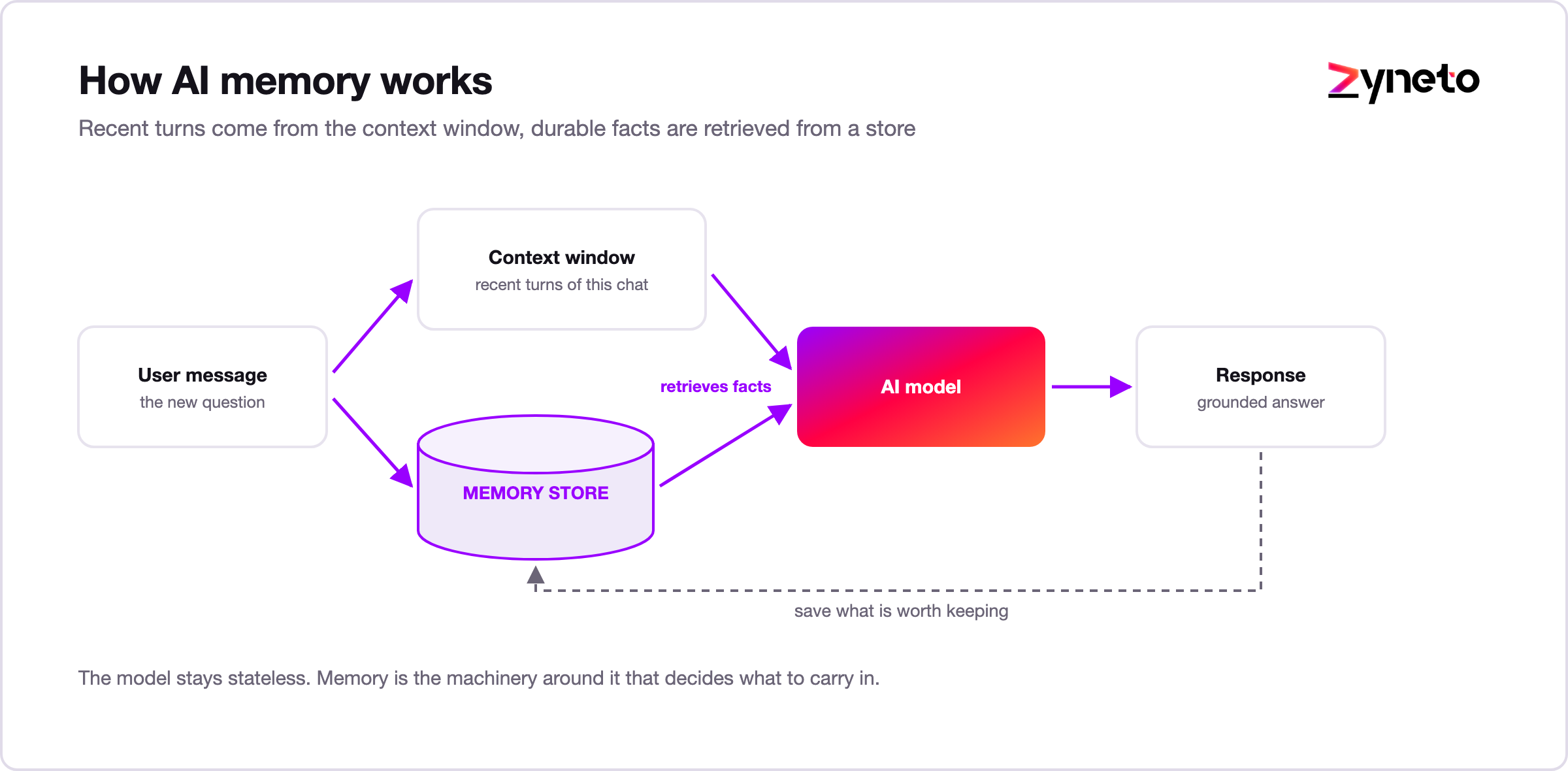
The context window carries the recent conversation, the short-term layer. Summarization compresses the older parts of a long conversation, so the gist survives even when the raw text will not fit. A memory store, usually a vector database, holds long-term facts and retrieves them by relevance when they matter. And some systems keep structured memory, specific key facts about a user or account held in a tidy form rather than as loose text. The real art is in what gets remembered, what gets summarized, and what gets forgotten, because keeping everything is expensive and, worse, drowns the useful memories in noise.
It helps to borrow three words from how people talk about human memory, because AI memory splits along the same lines.
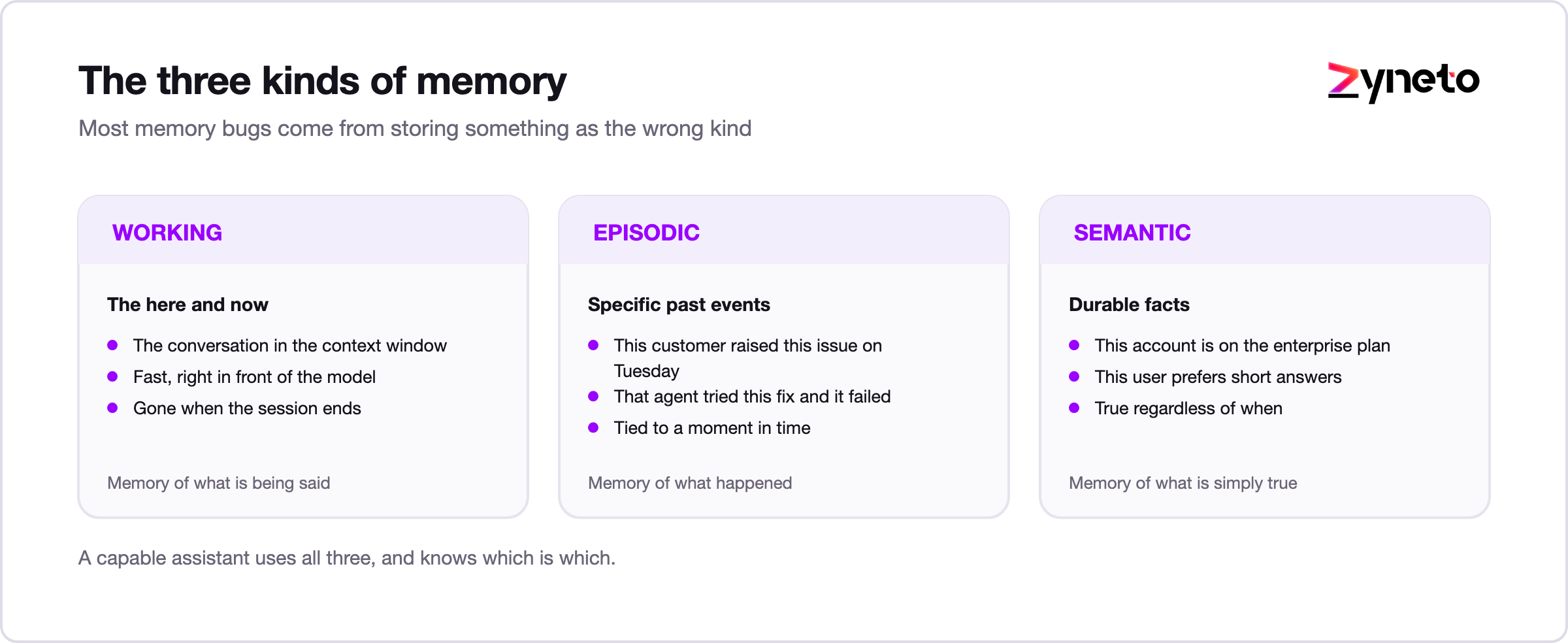
Working memory is the here and now, the conversation currently in the context window. It is fast, it is right in front of the model, and it disappears the moment the session ends. Episodic memory is the record of specific past events: this customer raised this issue on Tuesday, that agent tried this fix and it failed. It is memory of what happened. Semantic memory is durable facts that do not belong to any single moment: this account is on the enterprise plan, this user prefers short answers, this company ships on Fridays. It is memory of what is simply true.
A capable assistant uses all three. Working memory keeps the current chat coherent. Episodic memory lets it recall what was tried before. Semantic memory lets it know the account without being told again. Most memory problems, in practice, come down to storing something as the wrong kind, treating a one-off event as a permanent fact, or letting a durable fact vanish with the session.
A fair question at this point is whether memory is even necessary now that context windows are getting huge. If a model can read a million tokens, why not just pour everything in and skip the machinery?
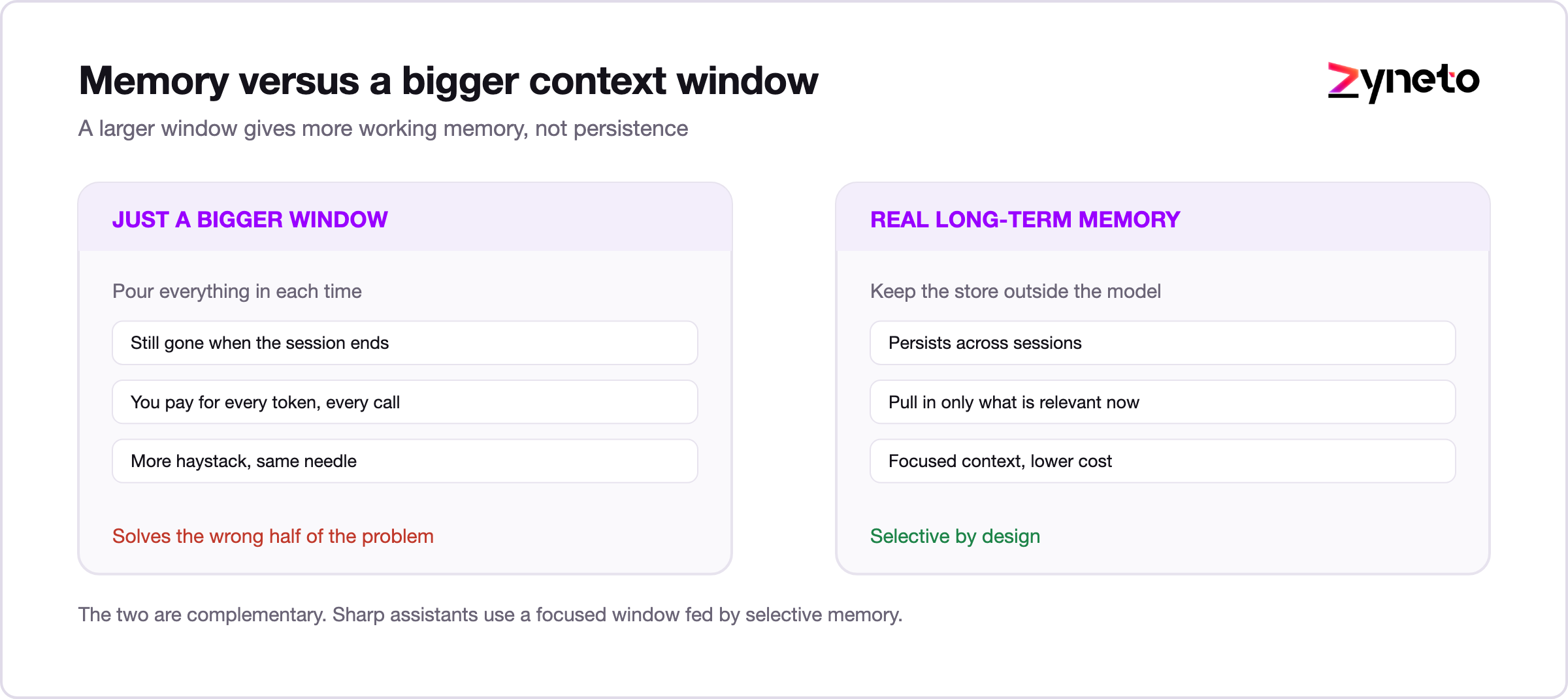
Because a bigger window solves the wrong half of the problem. It gives you more working memory, not persistence, so the moment the session ends, that million tokens is gone just like the small window was. It is also expensive: you pay for every token on every call, so carrying a giant history into each request adds up fast. And it is noisy, because a model handed a mountain of context still has to find the few lines that matter, and more haystack does not help it find the needle. Long-term memory is the opposite bet: keep the store outside the model, and pull in only the handful of facts that are relevant right now. A large window and real memory are complementary, not competing, and the assistants that feel sharp use a focused window fed by selective memory, not a vast window fed by everything.
For a business, memory is the difference between a demo and a tool people actually rely on.
An assistant with memory can pick up where a customer left off instead of asking them to repeat the whole problem. A copilot can remember a user's role and preferences and stop asking the same setup questions every time. An agent can recall a decision made last week rather than starting every task from zero. And personalization becomes real, because the assistant remembers the account it is serving rather than treating every interaction as a first date. Without memory, even a brilliant model feels forgetful and faintly rude, because nothing erodes trust like being made to explain yourself twice.
Two small scenes show the difference memory makes.
A customer opens a support chat about a billing error they reported last week. Without memory, the assistant greets them like a stranger and asks them to explain the whole thing again, and the customer sighs and types it all out for the second time. With memory, the assistant already knows the account, sees the earlier ticket, and opens with "I see the billing issue you flagged on the 12th is still open, let me pick that up." Same model, entirely different experience, and the second one is the reason people stop dreading support.
Now a longer-running agent handling a multi-day migration. Without memory, each morning it wakes up with no idea what it did yesterday, re-checks work already done, and risks redoing steps it finished. With memory, it remembers the plan, what it completed, what failed, and what it decided to skip, so day three continues cleanly from day two. The gap between those two agents is not intelligence. It is memory, and it is the difference between a tool you can hand real work and one you have to babysit.
Memory is not a standalone product. It is the thing that makes the other AI applications useful over time.
A copilot leans on short-term memory to help you inside a task and on long-term memory to stay useful across the weeks you work with it. An agent needs memory even more, because it carries out multi-step work and has to remember what it has already done, what it learned, and what it decided, or it will loop and repeat itself endlessly. As assistants and agents move from clever demos into daily use, memory is what carries them across the gap. We go deeper on both in the guides to AI copilots and AI agents.
It is worth saying plainly, because it clears up a lot of confusion. Long-term memory and retrieval-augmented generation are close cousins. RAG retrieves relevant passages from your documents. Long-term memory retrieves relevant facts from your history. Both drop the right information into the context window at the right moment so the model can use it. A serious assistant often blends the two, pulling from documents and from memory in the same breath, and sometimes from a knowledge graph for the structured relationships. Memory is retrieval turned inward, on the conversation and the account, rather than outward, on the knowledge base.
Memory sounds simple and gets hard fast, and the hard parts are worth knowing before you build.
The context window is finite, so you cannot just keep stuffing more in; you have to choose what matters. Cost scales with context, because every token you carry into the window is paid for on every single call, so remembering everything is not just messy, it is expensive. Relevance is tricky, because the value of long-term memory depends on retrieving the right memory at the right time, and a system that surfaces the wrong one is worse than one that surfaces nothing at all. Memories go stale, because a fact that was true last quarter may not be now, so memory needs updating and expiry, not just endless accumulation. And forgetting is a feature, not a bug. Deciding what not to keep is as important as deciding what to remember.
This one deserves its own line, because it is where memory meets the law. What an assistant remembers about a person is, by definition, personal data. It has to be handled with the same care as any sensitive record: stored securely, used within rules like GDPR, and deletable when someone asks. An assistant that quietly remembers everything about your customers is a privacy problem waiting to happen. Good memory systems are deliberate about what they retain, honest about it, and built so a person can see and remove what is held. Memory is powerful precisely because it is personal, which is exactly why it needs guarding rather than hoarding.
The teams that get this right treat memory as a design decision, not an accident.
Decide what is worth remembering, and be selective, because a small store of the right facts beats a vast one full of noise. Keep a human able to see and correct what the assistant remembers, so a wrong memory can be fixed rather than repeated forever. Set memories to expire or update, so the assistant is not confidently answering from last year. Respect privacy from the start, keeping only what you should and letting people remove it. And test what the assistant recalls with real conversations, because memory bugs, remembering the wrong thing, or the wrong person's thing, only show up in the messy middle of live use. Done this way, memory turns a capable model into an assistant that feels like it genuinely knows you.
You do not need to solve all of memory on day one. The teams that ship well start narrow and grow the store as they learn what actually helps.
Begin with short-term memory done properly, a clean context window and sensible summarization, because most of the "it forgot what I said" complaints live there and it is the cheapest thing to fix. Then add long-term memory for one high-value case, say remembering an account's plan and open issues, rather than trying to remember everything about everyone at once. Watch what the assistant recalls, prune what it gets wrong, and only then widen the net. Treat the first version as a small, well-chosen set of memories you can inspect, not a firehose you switch on and hope for. That path gets you an assistant that feels attentive quickly, and it keeps the cost and the privacy surface small while you learn what is worth keeping.
Two things are shifting at once. Context windows are getting larger, so short-term memory can hold more of a conversation, which helps but does not remove the need for real long-term memory, since more context also means more cost and more noise to sort through. And memory systems themselves are getting smarter, better at deciding what to keep, when to recall it, and when to let it go, which is the harder and more valuable problem. As AI moves toward agents that work over days and weeks rather than single turns, memory stops being a nice extra and becomes the backbone. An agent without memory is a very smart employee with amnesia. Fixing that is a large part of what will make the next wave of AI genuinely useful.
AI memory is the machinery that lets a forgetful model hold a conversation and, eventually, remember a customer, an account, or a decision. Short-term memory lives in the context window and keeps a single conversation coherent. Long-term memory lives in an external store, usually retrieved the same way RAG retrieves documents, and it persists across sessions so the assistant remembers over time. The value for business is real, and so is the responsibility, because what an assistant remembers about people is sensitive. Be deliberate about what you keep, let people see and remove it, expire what goes stale, and treat memory as the design decision that turns a clever model into an assistant worth trusting.
If you want assistants and agents that remember what matters and forget what should not stick around, Zyneto builds AI agents and assistants with memory designed in, grounded, private, and useful over time. Book a free consultation and we will work out what your assistant actually needs to remember.
It is the machinery built around a language model so it can remember. On their own, models forget everything between requests. Memory adds short-term recall within a conversation and long-term recall across sessions, so an assistant can hold a thread and remember users, accounts, and decisions over time.
Not by default. A language model is stateless: each request stands alone. When a chatbot seems to remember earlier messages, it is because the conversation so far is fed back into the model with each new message. Real memory is added around the model.
Short-term memory is the current conversation, held in the context window, and it resets when the session ends. Long-term memory lives in an external store and persists across sessions, so the assistant can remember you next month.
Short-term, by keeping the recent turns in the context window. Long-term, by saving useful facts to an external store and retrieving them later by relevance, usually the same way RAG retrieves documents, then adding them back into the context.
Long-term memory and RAG are close cousins. RAG retrieves relevant passages from your documents; long-term memory retrieves relevant facts from your history. Both feed the right information into the context window. Memory is retrieval pointed inward, on the conversation, rather than outward, on documents.
What an assistant remembers about a person is personal data and must be treated as such: stored securely, used within rules like GDPR, and deletable on request. Good systems retain only what they should, are transparent about it, and let a person see and remove what is held.

Vikas has around fifteen years of experience building software and now builds generative AI systems at Zyneto. His work covers retrieval augmented generation, agentic AI, knowledge graphs, AI memory, and the evaluation and guardrails that decide whether any of it is safe to put in front of customers. He has shipped enterprise copilots, document AI, chatbots and predictive analytics for e-commerce, fintech and marketing teams, and works day to day in Python, JavaScript and SQL. He follows multimodal models, business process automation and enterprise AI security closely, and mentors engineers moving into AI. He writes about architecture, inference cost and the failure modes that only show up at production scale.
Share your details and we will talk soon.
Be the first to access expert strategies, actionable tips, and the trends actually shaping the digital world. No fluff - just practical insights delivered straight to your inbox.
Dive into our blog and stay ahead of the curve with expert perspectives, future-ready trends, and tech tips written for decision-makers and doers alike.