CPQ Implementation Cost: What Drives It, And When Building Is Cheaper


A CPQ phase one runs 890 to 1,800 hours to build. Buying instead has a published price: Salesforce lists Revenue Cloud Growth at $150 and Revenue Cloud Advanced at $200 per user per month, both billed annually, read on 16 November 2026. So the decision is a seat count before it is a feature list. Below about 25 seats, buy. Above 50, a build pays back inside two years.
That is the whole answer. The rest of this post is where each number comes from, which of them you can check yourself, and the four cost lines that no page selling you CPQ has any reason to mention.
Start with the question most comparisons get wrong. The usual framing is "what does CPQ cost", which produces a range so wide it cannot be acted on. The useful question is narrower: what does the quoting flow you actually need cost to stand up, and how many seats would have to use it before a licence costs more than owning it. It is the same test we apply to professional services software, build against buy. That question has an answer. The first one does not.
How much does CPQ implementation cost?
CPQ implementation is quoted at $10,000 to $250,000 for services on WTS Paradigm's published table, on top of licensing. The only vendor publishing a fixed fee charges $15,000 to $30,000 by edition. Built instead, a phase one is 890 to 1,800 hours, which is $57,850 to $117,000 at a blended rate.
The widely quoted figure is $10,000 to $250,000 for implementation services, on top of licensing. It comes from a cost table published by WTS Paradigm on 21 July 2026, which breaks down as software licensing $5,000 to $100,000 a year, implementation services $10,000 to $250,000, product configuration setup $5,000 to $100,000, ERP and CRM integrations $5,000 to $150,000, training $1,000 to $25,000, and ongoing support at 15 to 25 per cent of annual software cost.
Read the scope on that table before you plan against it. Its own opening line says it covers costs "for window and door manufacturers", and the words window or door appear 17 times in the page. It is a good table for a window manufacturer. If you sell anything else, you are reading one industry's numbers presented as the market's, and Google's AI Overview on this search quotes them without the scope.
Three other figures circulate on the same search, and they are worth separating by what kind of claim each one is. GrexPro, writing on 29 October 2026 under the heading "How Much Does CPQ Implementation Cost?", answers that "simpler deployments may cost a few thousand to tens of thousands of dollars, while complex enterprise implementations can reach six figures or more", and adds that these "are broad planning categories, not standardized market prices". That page contains no currency figure anywhere in its 14,067 characters of text, and no occurrence of the phrase "per user" or the word "hours". It is honest about being a framework rather than a price.
What is actually published, and what you have to ask for
We read eight vendor pricing pages on 16 November 2026 to see how many would give a buyer a number without a sales call. Two did.
|
Vendor |
Page |
What it publishes |
|---|---|---|
|
Salesforce |
Revenue Cloud pricing |
Growth $150, Advanced $200 USD per user per month, billed annually |
|
Kugamon |
Pricing and implementation cost |
CPQ $65, Quote to Cash $95, Subscription Management $95, Subscription Billing $125 per user per month, plus a fixed implementation fee of $15,000 to $30,000 by edition |
|
Odoo |
Pricing |
Per user per month, but served to us in rupees from an Indian connection, so not comparable here |
|
DealHub |
Pricing |
No price |
|
Conga |
Pricing |
Nothing a plain request could read |
|
HubSpot |
Sales pricing |
Nothing a plain request could read |
|
PandaDoc |
Pricing |
Refused the request |
|
Zuora |
Pricing |
Redirects to a solutions page with no price |
Salesforce publishes more than most buyers realise. Its Revenue Cloud pricing page carries both editions in seven currencies, including 150 and 200 euro, 120 and 160 pounds, and 18,000 and 24,000 yen, and states in its own FAQ that "the growth edition is available for $150 per user per month, while the advanced edition is available for $200 per user per month". Growth covers quoting and configurator, order capture and subscriptions. Advanced adds contracts and the rest of the quote-to-cash chain.
Kugamon is the only vendor on this search publishing an implementation fee, and says so in those words: "Implementation cost. The line nobody publishes." Its fee is fixed by edition, $15,000 for CPQ through $30,000 for Subscription Billing, $5,000 less on a two or three year term, with durations of 4 to 8 weeks migrating from Salesforce CPQ and 3 to 12 weeks from other tools. It also labels its own comparison chart "Solid = published price, Hatched = estimate" and states that the rival figures in it are midpoints from its own October 2026 research. That is better sourcing discipline than most vendor content, and it is worth saying so rather than pretending nobody publishes anything.
What you cannot get is an implementation price from Salesforce. Neither the Revenue Cloud pricing page nor the product page carries one. On a platform where the licence is published in seven currencies, the services line is still a conversation.
Is Salesforce discontinuing CPQ?
No, and the distinction matters to anyone benchmarking against it. Salesforce's own article on the subject, bylined Annie Wright, VP of Product Marketing, and dated 10 July 2026, states: "Salesforce CPQ is end of sale, not end of life." Existing customers keep using it, can buy additional users, can renew licences and continue to get support. What has stopped is the sale of new Salesforce CPQ licences to new customers, with investment moved to Revenue Cloud Advanced, which that article calls the successor and describes as API first and composable.
One detail worth knowing before you repeat a date. Salesforce's own page gives no end of sale date. Across 42,832 characters of text the only date on it is the byline. The March 2025 date in circulation comes from CloudMasonry, a Salesforce consultancy, not from Salesforce. If a date matters to your contract, get it from your account team in writing rather than from any article, this one included.
The practical consequence is that the product most CPQ price comparisons are anchored on cannot be bought. A new buyer is choosing between Revenue Cloud at a published seat price, a smaller vendor at a lower published seat price, several vendors who will not publish anything, and building. That last option is the one nothing on this search prices, so here it is.
Where do the hours actually go in a CPQ build?
This is an estimating model, not a quote and not a record of a delivered project. The assumptions are printed below it so you can argue with any line.
|
Module |
Hours |
|---|---|
|
Product model and option rules |
200 to 420 |
|
Pricing, price books and discount rules |
160 to 300 |
|
The approval chain |
90 to 170 |
|
The quote document |
120 to 240 |
|
Write-back to the book of record |
150 to 320 |
|
Multi-currency |
60 to 140 |
|
Admin tooling for the rules |
110 to 210 |
|
Phase one total |
890 to 1,800 |
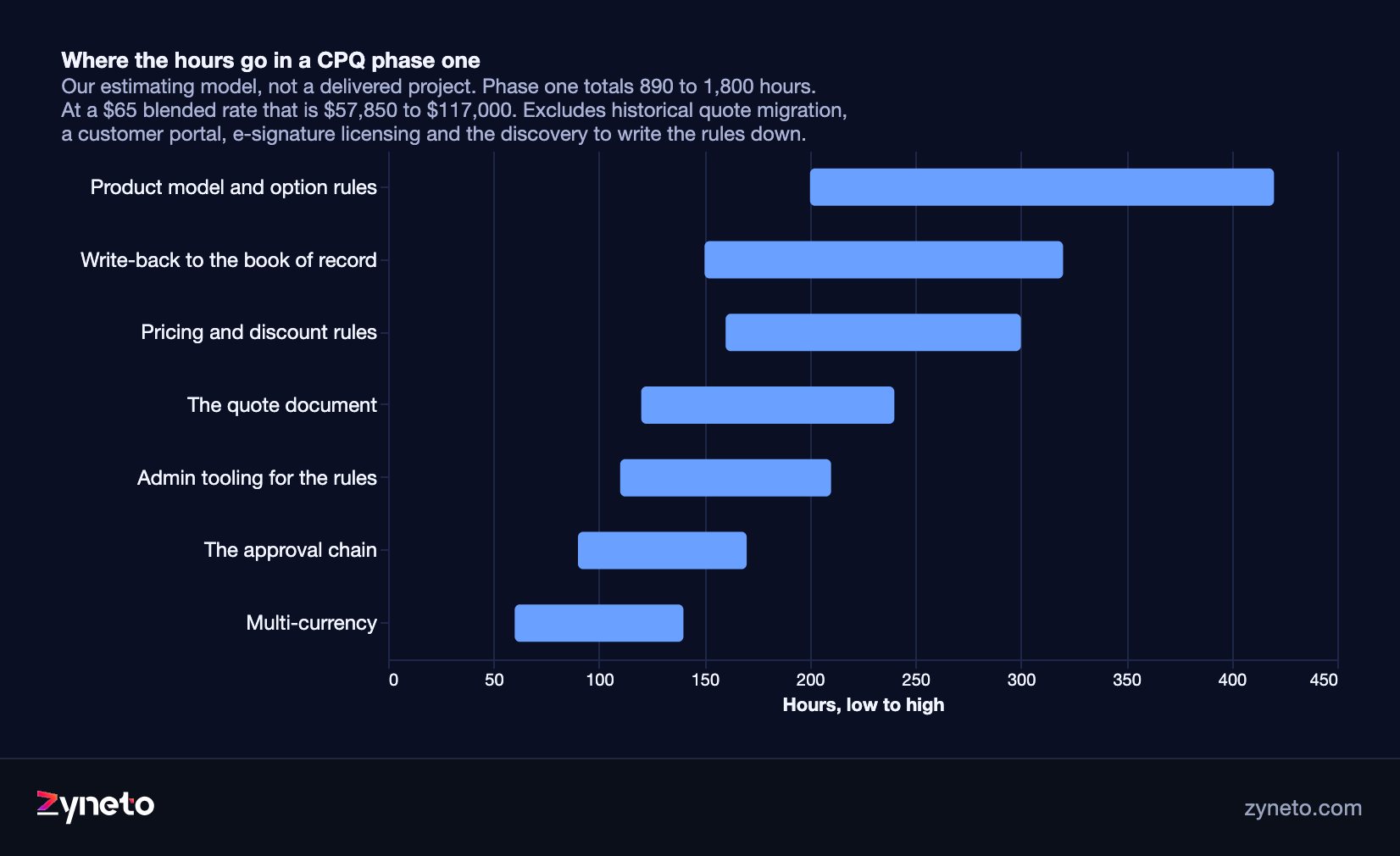
At $40 an hour that is $35,600 to $72,000. At $100 an hour, $89,000 to $180,000. At a $65 blended rate, $57,850 to $117,000.
The spread is a description of your catalogue, not vagueness. A company selling 40 products with three options each and a single discount tier sits near the bottom of every row. A company whose configuration rules encode manufacturing constraints, whose pricing differs by customer and region, and whose approvals route by margin rather than by amount, sits near the top of several rows at once. Where those rules have to reach a shop floor or a plant system, add the cost of integrating a manufacturing execution system on top. Work out which one you are before reading any total, including this one.
Pricing rules are where the hour range widens fastest. GrexPro names pricing rules and approval workflows together as a cost driver, and the pairing is right. A discount that needs sign off above 15 per cent is one rule. A discount whose threshold moves by product family, by customer tier and by region is three rules that reference each other. The question to settle before anyone estimates is not how many rules you have, it is how many of them depend on another rule's outcome. Independent rules add up. Interacting rules multiply, and that is the difference between the 160 and the 300 in the table above.
What the band excludes matters as much as what it covers. It does not include migrating historical quotes, which costs in proportion to how inconsistent your old records are rather than how many there are. It does not include a customer-facing portal, and if yours needs a live configurator on the product page the constraints are the ones in our headless commerce write-up. It does not include e-signature licensing, which is a third party subscription whatever you build. And it does not include the discovery needed to write the rules down in the first place, which on a configured product is frequently the longest part of the calendar and the shortest part of the engineering.
The same arithmetic applied to a different system is in our custom ERP development cost post, which compares a build against the one mid-market ERP that publishes a list price, and the module-by-module method is worked line by line in the garment ERP software breakdown.
What does the quote document itself cost?
None of the four pages ranking for this search mentions the quote document. It is the one artefact the entire system exists to produce.
A quote is a versioned document, not a screen. Someone sends version 3, the customer replies about version 2, and the pricing changed between them. That means every quote needs an immutable record of what was sent, when, at what price, under which approval, with the rendered file kept rather than regenerated. Regenerating from current data gives you a different document from the one the customer is holding, which is the failure that turns a quoting tool into a dispute.
Then the rendering. A quote that goes to a customer carries your layout, their terms, line-level options, taxes where they apply, and a signature block. A field engineer quoting on site needs the same document from a price book that works offline. Templating that for one product family is a week. Templating it so a non-engineer can change the layout next quarter without a deployment is the 120 to 240 hours in the table, and it is the line most often cut from a first estimate and added back in month four.
E-signature is a subscription, not a feature. Whether you build or buy, the signing provider bills separately. Put it in the model as a third party cost from the start.
Multi-currency is not a checkbox
Also absent from all four ranking pages, and the reason it belongs in the table is that currency arithmetic has a shape most quoting prototypes get wrong.
Not every currency has two decimal places. The Omani rial, Bahraini dinar and Kuwaiti dinar carry three. A quote engine that stores money as a two decimal value, or rounds to cents at any step, produces totals that do not reconcile against the invoice in those markets. A system that defaults to two decimal places truncates silently in those currencies, which is the failure described in why online payments fail.
The same arithmetic bites any system that has to post a figure into an accounting ledger, which is why we argue for keeping the book of record where it already is rather than moving it. Then the rate question, which is a policy decision before it is a technical one. Is a quote priced at the rate on the day it was issued, the day it was accepted, or the day it was invoiced? Each answer is defensible, each produces different revenue, and the quote document has to state which one it used. Salesforce publishing Revenue Cloud in seven currencies is a hint about how much of a platform this touches.
When does building beat buying?
Above roughly 25 seats, and the case gets stronger fast after 50. Below 25, a licence costs less than maintaining the thing you would own. These figures put Salesforce's published seat prices against a build maintained at 12 to 25 hours a month, which is $9,360 to $19,500 a year at a $65 blended rate.
We budget maintenance from the calendar rather than as a percentage of build cost, and the reasoning is in app maintenance cost.
|
Seats |
Revenue Cloud Growth, a year |
Build payback |
Revenue Cloud Advanced, a year |
Build payback |
|---|---|---|---|---|
|
10 |
$18,000 |
6.7 years at best, never at the top of the band |
$24,000 |
4.0 to 26.0 years |
|
25 |
$45,000 |
1.6 to 4.6 years |
$60,000 |
1.1 to 2.9 years |
|
50 |
$90,000 |
9 months to 1.7 years |
$120,000 |
6 months to 1.2 years |
|
100 |
$180,000 |
4 to 9 months |
$240,000 |
3 to 6 months |
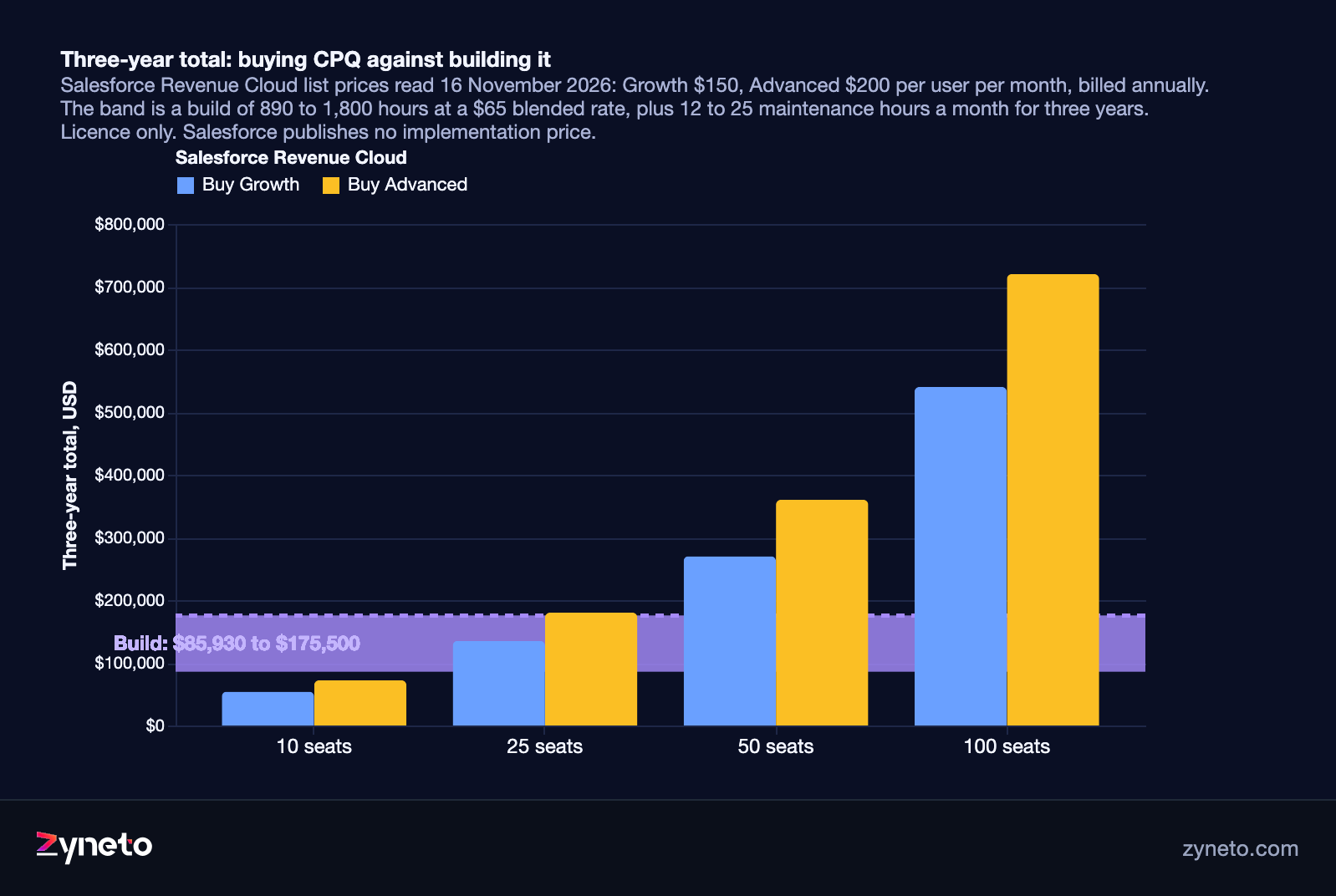
At ten seats, do not build. The licence is cheaper than the maintenance on the thing you would own, and at the top of the build and maintenance bands it never pays back at all. This is the row that should stop most readers, and no page that sells development hours has much incentive to print it.
Between 25 and 50 seats the answer is genuinely open and turns on how unusual your configuration rules are. On a three year view, the crossover against Growth sits at 16 to 33 seats on licence alone, and at 13 to 30 seats once a published implementation fee of $15,000 is added. Against Advanced it is 12 to 24 seats. If your rules are ordinary, buy and spend the difference on the catalogue data, which is where these projects actually fail. If your product cannot be expressed in a vendor's rule model without workarounds, the workarounds are the hidden cost of buying and they recur at every upgrade.
Above 50 seats the arithmetic stops being close. At 100 seats on Advanced, a year of licences at Salesforce's published $200 is $240,000 and the whole build band is $89,000 to $180,000 at the highest of our three rates. The question there is not cost, it is whether you want to own a quoting system, because owning one means staffing it. Several of the figures above come from one vendor's published list, so re-read them before you commit: licence prices move, and on this product they moved twice in two years.
How long does a CPQ implementation take?
Published durations cluster tighter than published prices. Kugamon states 4 to 8 weeks migrating from Salesforce CPQ and 3 to 12 weeks from other tools for its own product, and says a full Revenue Cloud Advanced rebuild runs 12 to 18 months in practice. GrexPro carries a heading asking the same question with no figure under it.
For a build, the engineering is not the long pole. The 890 to 1,800 hours are 5 to 11 weeks of elapsed time for a small team. What extends the calendar is writing down rules that currently live in a sales engineer's head, and getting a decision on the ones nobody has ever had to make explicit. Two prices for the same configuration, both in use, both defended, is a normal discovery finding and it is a commercial decision rather than a technical one.
Where CPQ projects fail
The four pages on this search disagree about prices and agree almost completely about failure. All of them name the product catalogue. GrexPro puts catalogue and configuration complexity first among its cost drivers. Kugamon's heaviest subject after implementation fees is data migration, mentioned 20 times on its implementation page and 41 times on its Revenue Cloud analysis. WTS Paradigm's table puts product configuration setup at $5,000 to $100,000, the same order as the implementation services line.
Migration is the second thing they agree on, and it is where a fixed fee stops being fixed. Data migration is the heaviest subject on Kugamon's implementation page after the fee itself, appearing 20 times there and 41 times in its Revenue Cloud analysis. The reason is that a quote is not a row. It is a row, plus the configuration it was built from, plus the version of the price book that priced it, plus the approval that cleared it. Move the quotes without those and you have a list of totals nobody can reproduce. Most teams work out halfway through that they only need the last eighteen months, which is the cheapest scope decision on the table and almost nobody makes it at the start. Training is the other line that gets cut early, at $1,000 to $25,000 on the Paradigm table, and it comes back as support tickets.
The pattern is that the software is rarely the problem. The catalogue is. A rule engine is only as good as the product data underneath it, and most companies discover during implementation that their catalogue contains options that have not been sold in three years, two names for the same component, and prices that were agreed verbally. None of that is fixed by choosing a different platform, and all of it has to be fixed before either path works. Catalogues with seasonal templates and per customer specifications have the same problem in a different industry, which we cover in apparel PLM software.
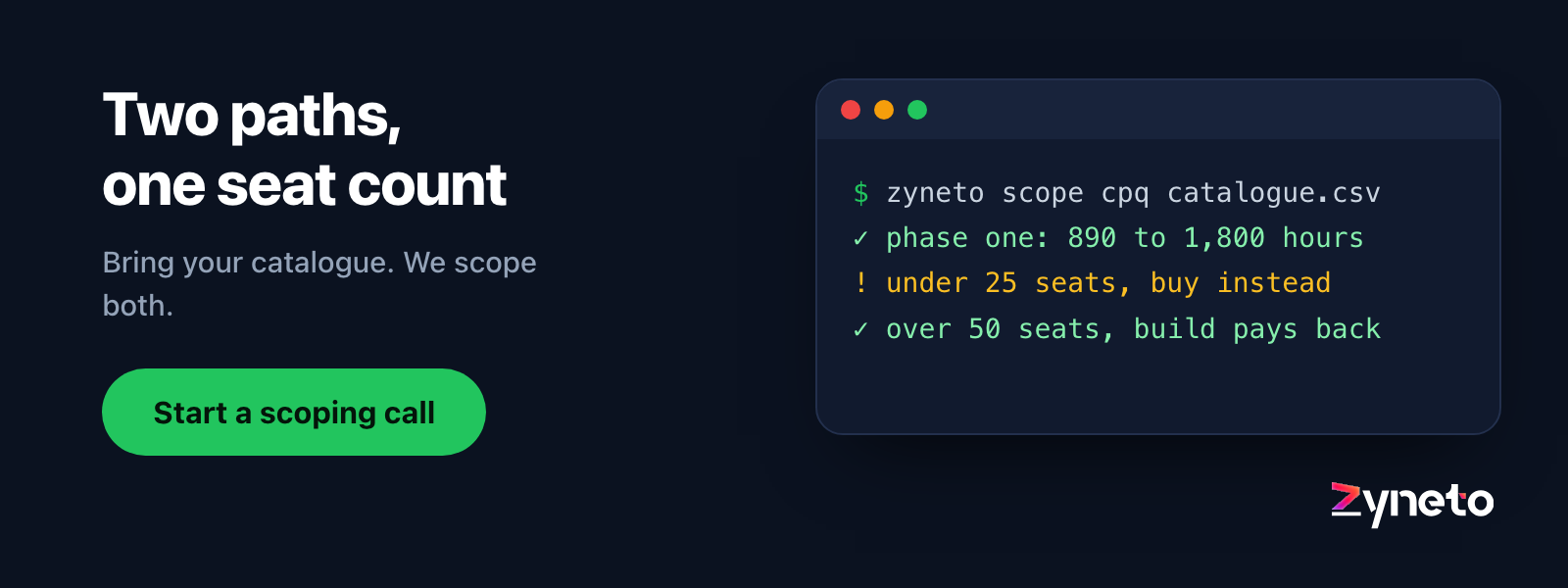
So the honest summary is narrower than the search suggests. One vendor publishes an implementation fee, one publishes two seat prices in seven currencies, four will not publish anything, and the most quoted range on the internet belongs to the window and door industry. Against that, a build is 890 to 1,800 hours, it is the wrong answer under about 25 seats, and above 50 it pays back before most procurement cycles finish. The number you need next is not a market average. It is the hour count for your own catalogue, and that is a day of reading your product data, not a quarter of evaluating platforms.
Frequently asked questions
Published figures put implementation services at $10,000 to $250,000, from a WTS Paradigm cost table dated 21 July 2026, though that table scopes itself to window and door manufacturers. The only vendor on this search publishing a fixed implementation fee is Kugamon, at $15,000 for its CPQ edition through $30,000 for Subscription Billing, $5,000 less on a two or three year term. Salesforce publishes no implementation price for Revenue Cloud at all. Built instead, a CPQ phase one is 890 to 1,800 hours, which is $57,850 to $117,000 at a $65 blended rate.
Salesforce publishes Revenue Cloud Growth at $150 and Revenue Cloud Advanced at $200 per user per month, billed annually, read 16 November 2026, and lists both in seven currencies including 120 and 160 pounds. Kugamon publishes CPQ at $65, Quote to Cash at $95, Subscription Management at $95 and Subscription Billing at $125, with a 10 user minimum. Of eight vendor pricing pages read on the same day, four published no seat price a buyer could read without contacting sales.
No. Salesforce's own article on the subject, dated 10 July 2026, states that "Salesforce CPQ is end of sale, not end of life". Existing customers continue to use it, can add users, renew licences and receive support. What has ended is the sale of new Salesforce CPQ licences to new customers, with investment moved to Revenue Cloud Advanced as the successor. Salesforce publishes no end of sale date on that page, so if a date affects your contract, get it from your account team rather than from any article.
It turns on seat count. Against Revenue Cloud Growth at $150 per user per month, a build of 890 to 1,800 hours pays back in 1.6 to 4.6 years at 25 seats, 9 months to 1.7 years at 50 seats, and 4 to 9 months at 100 seats. At 10 seats it takes 6.7 years at best and at the top of the build and maintenance bands it never pays back. On a three year view the crossover sits at roughly 16 to 33 seats against Growth and 12 to 24 against Advanced.
Kugamon publishes 4 to 8 weeks to migrate from Salesforce CPQ to its own product and 3 to 12 weeks from other tools, and reports that a full Revenue Cloud Advanced rebuild runs 12 to 18 months in practice. For a build, 890 to 1,800 hours is 5 to 11 weeks of engineering for a small team. The calendar is usually set by something else: writing down configuration rules that currently live in a sales engineer's head, and getting decisions on the pricing questions nobody has had to make explicit before.
The product catalogue, and every page on this subject agrees on it even where they disagree about prices. The number of products matters less than how many ways each one can be configured, how many of those combinations are invalid, and whether the invalid ones are written down anywhere. A rule engine is only as useful as the product data beneath it, and the common discovery finding is a catalogue with duplicate component names, options nobody has sold recently, and prices that were agreed verbally.
Four things, and none of them appears on the pages currently ranking for this search. The quote document, which is a versioned artefact that has to be stored exactly as it was sent rather than regenerated. Multi-currency, which is not a checkbox once a quote reaches Oman, Bahrain or Kuwait, where the currency carries three decimal places rather than two. The write-back to whatever holds your orders. And the discovery time to write down rules that are currently tribal knowledge.

Vikas Choudhary
Vikas has around fifteen years of experience building software and now builds generative AI systems at Zyneto. His work covers retrieval augmented generation, agentic AI, knowledge graphs, AI memory, and the evaluation and guardrails that decide whether any of it is safe to put in front of customers. He has shipped enterprise copilots, document AI, chatbots and predictive analytics for e-commerce, fintech and marketing teams, and works day to day in Python, JavaScript and SQL. He follows multimodal models, business process automation and enterprise AI security closely, and mentors engineers moving into AI. He writes about architecture, inference cost and the failure modes that only show up at production scale.
Zyneto builds custom software, AI and automation
Tell us what you are building and we will reply with a clear next step.