TMS Software Cost: What The Licence Hides


A transport management system phase one runs 1,060 to 2,320 hours to build. Buying instead has published prices: Load Manager lists three tiers at $49.95, $89.95 and $139.95 a month, and TenTrucks prices by fleet size at $145 a month for up to five trucks, both read on their own pages on 16 November 2026. So the first decision is not a feature list. It is whether your freight flows through somebody else's data model or through one you control.
That is the short answer. The rest of this post is where the hours come from, which published numbers you can check for yourself, and the two lines that decide the total and that no page selling you a TMS has any reason to price.
What does a TMS cost to put in?
Two numbers, not one. The licence runs from $49.95 to a few hundred dollars a month for a small carrier, published and checkable. The work to put it in, or to build instead, runs 1,060 to 2,320 hours on our estimating model, and almost none of that is the software itself.
The hours, module by module:
|
Module |
Hours |
|---|---|
|
Carrier and lane master, with rate tables |
140 to 300 |
|
Load tender and response |
180 to 420 |
|
Shipment status events |
120 to 260 |
|
Freight invoice and settlement |
160 to 340 |
|
Dispatch board and assignment |
150 to 320 |
|
Hours of service and ELD constraint checks |
120 to 260 |
|
Documents: bill of lading, proof of delivery, accessorials |
90 to 200 |
|
Reporting and admin for the rules |
100 to 220 |
|
Phase one total |
1,060 to 2,320 |
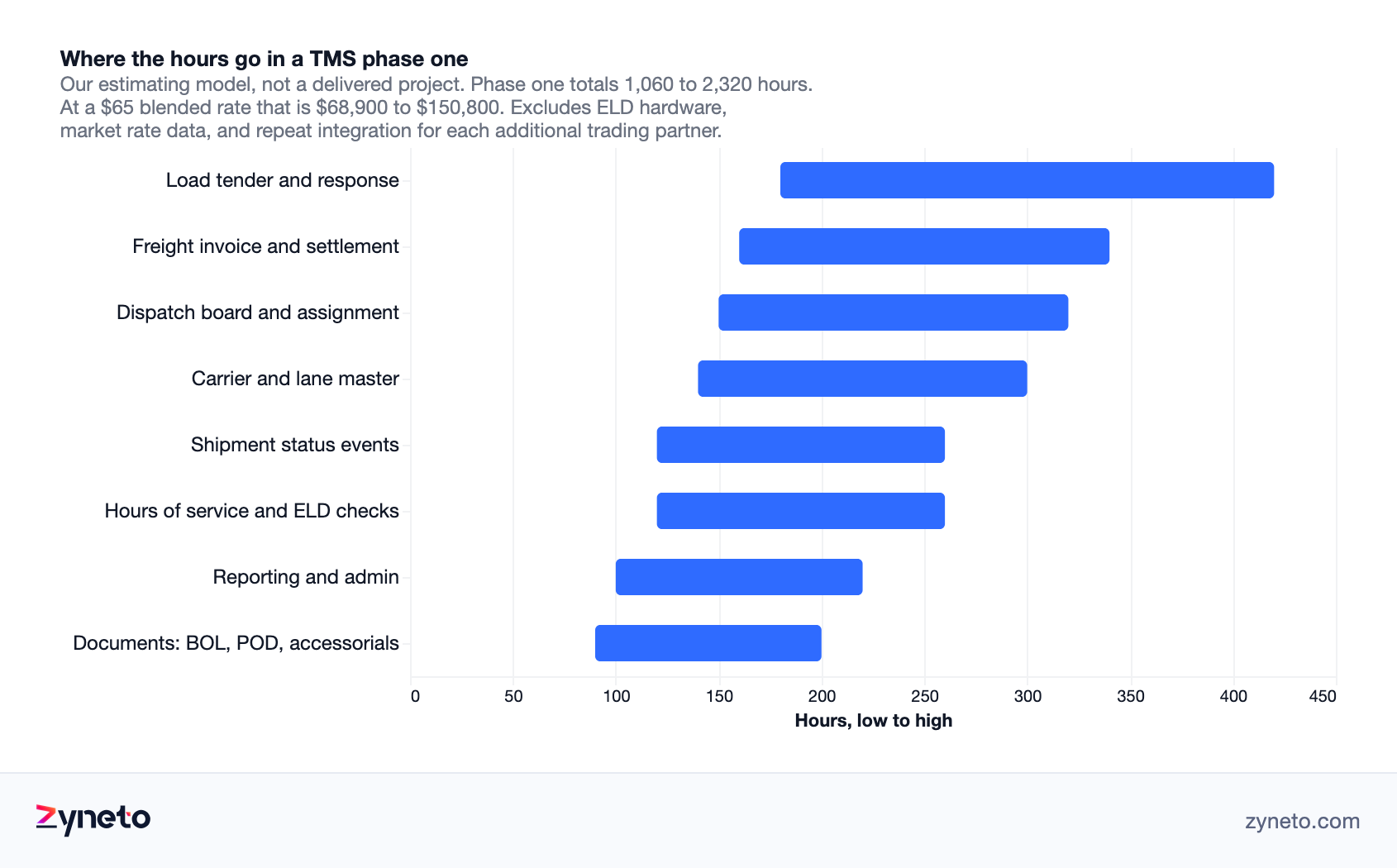
Read that as our estimating model with its assumptions printed, not as a quote and not as a record of delivered work. The assumptions: one carrier network rather than a marketplace, truckload and less than truckload but not parcel or ocean, one country's compliance rules, two trading partner integrations inside phase one, and a team that has built dispatch before. Blended at $65 an hour across roles, those hours come to $68,900 to $150,800, which is arithmetic from the table rather than a price we are quoting you.
Every range in that table has a reason, and the reasons are the useful part, because they are what let you move our numbers towards your own. They are set out further down.
What the published prices actually are, and one that is not
The buy side is easy to check, which is exactly why it is worth checking rather than repeating.
Load Manager publishes Starter TMS at $49.95 a month capped at 30 loads, Professional TMS at $89.95 with unlimited loads, and Premium TMS at $139.95 adding integrated accounting with QuickBooks and Microsoft Dynamics. Read 16 November 2026.
TenTrucks prices by fleet size, per company per month: $145 for up to five trucks, $280 for up to ten, $540 for up to twenty, custom above that, with every feature on every plan and no per driver or per load fee. Read the same day. Its own page contrasts that with the per driver model it argues against, at $55 to $75 per driver per month.
Now the part worth your attention. Google's AI Overview for this search, read the same day, summarises Load Manager as "$79.95 to $129.95". The vendor's own page says $49.95, $89.95 and $139.95. The summary is thirty dollars out at the bottom and ten out at the top, and it is wrong in the direction that matters, because it hides the entry tier a small carrier would actually buy and invents a ceiling below the real one.
That is not an argument against summaries. It is an argument for opening the vendor's page before a number reaches a budget, which takes under a minute and is the only way to catch it. The same discipline applies to every figure in this post, which is why each one carries the page it came from and the day we read it.

Why is the integration the real build?
Here is the line that decides a TMS project, and it appears on no pricing page.
A TMS earns its place by speaking to the companies on either side of your freight, and in North America that conversation is a set of named EDI transaction sets. ASC X12, the standards body that maintains them, publishes each by number and name. Read 16 November 2026:
- 204 Motor Carrier Load Tender, the offer of a load
- 990 Response to a Load Tender, the accept or decline
- 214 Transportation Carrier Shipment Status Message, every event after that
- 210 Motor Carrier Freight Details and Invoice, the bill
- 997 Functional Acknowledgment, the receipt saying the message arrived
- 856 Ship Notice/Manifest, where a shipper's warehouse is in the loop
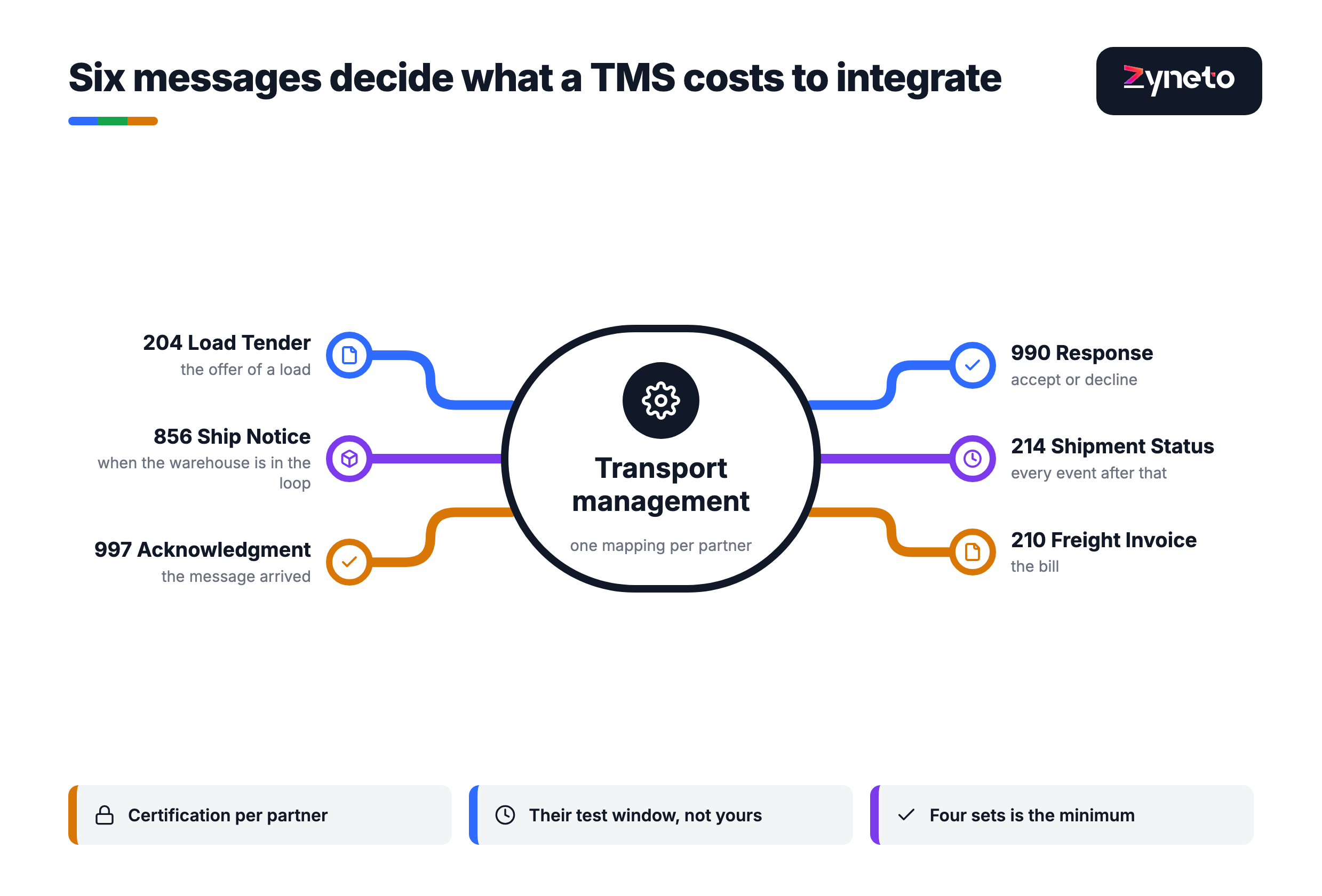
Four of those are the minimum for one trading partner who tenders freight electronically. That is the 180 to 420 hours on the tender line and the 160 to 340 on settlement, and at the margin it is per partner, because every shipper implements the standard with its own required segments, its own qualifier codes and its own test cycle before go live. The standard tells you the shape of the message. The partner tells you which fields they will reject you for omitting, and they tell you during certification rather than before it.
One vendor on this search prices that work, and the figure is instructive. TenTrucks charges $499 one time per trading partner for EDI connection setup, naming Walmart as the example, and says it covers setup, certification testing and go live with no monthly EDI fee. A buyer reading that single line learns more about the real shape of a TMS project than from any of the monthly prices, because it is the only number on the search attached to a unit of work rather than to a subscription period.
If you integrate three shippers, you do that three times. If you build rather than buy, you do it three times and you own the certification cycle each time. Neither is a licence cost and both are the project. This is the same pattern we described for distribution software in Oman, where the integration surface rather than the feature list set the build.
Is hours of service a report or a constraint?
A constraint, and almost everybody builds it as a report. That is the single most expensive ordering mistake in this category, because it surfaces late, after the dispatch flow is already built and the screens are already signed off.
The rules are published. 49 CFR part 395, read 16 November 2026, gives a property carrying driver a driving limit that "does not exceed 11 hours" under section 395.3(a)(3), inside a 14 hour duty period limit under section 395.5(a), with a "consecutive 30 minute interruption of driving status" required, and a weekly ceiling of 60 hours in any 7 consecutive days for a carrier that does not operate every day of the week. Subpart B of the same part covers electronic logging devices, with section 395.20 setting applicability and scope and section 395.22 setting what the carrier is responsible for.
Read that as an engineering statement and the consequence is immediate. Available driving time is a computed value, not a stored one. It depends on the driver's preceding several days, it changes while the truck is moving, and a dispatch board that assigns a load without consulting it will produce assignments that are already illegal by the time the driver arrives. That is why the constraint check is 120 to 260 hours rather than a database field: it is a running calculation the assignment screen consults synchronously, and it has to agree with whatever the electronic logging device is recording independently.
One page on this search quotes the 11 hour limit. It quotes it as a rule drivers follow, which it is, rather than as a rule your software has to enforce before it offers a load to a dispatcher, which is where the hours go. The gap between those two readings is most of the difference between a demo and a system.
What moves each line between low and high
The ranges are not padding. Each has a driver, and knowing yours turns our table into an estimate for your situation.
Carrier and lane master, 140 to 300. The bottom is a flat list of carriers with a contract rate per lane. The top is rate tables with accessorials, fuel surcharge schedules that update on their own cadence, effective dating so a rate change does not restate last month's invoices, and tariff logic for less than truckload. Effective dating is the line people cut and then rebuild, and we have written about why it belongs in the data model rather than in a report.
Load tender and response, 180 to 420. The bottom is one trading partner and one format. The top is three or more, each with its own segment requirements and certification cycle, plus a tender queue that survives a partner being unreachable for an afternoon.
Shipment status events, 120 to 260. The bottom is manual status updates typed by a dispatcher. The top is automated events from telematics with the status code mapping the shipper actually requires, which is where a generic specification stops being generic. Where the same movement also has to decide which location fulfils an order, that decision belongs upstream, in omnichannel inventory sync, not in the status feed.
Freight invoice and settlement, 160 to 340. The bottom is an invoice per load. The top is settlement proper: driver pay by mile or percentage, deductions, advances, accessorial approval, and reconciliation against what the shipper paid rather than what you billed. Any system that posts a figure into an accounting ledger inherits the problem we describe in ERP integration cost, where the ledger's own rules decide the build.
Dispatch board and assignment, 150 to 320. The bottom is a list with drag and drop. The top consults the constraint engine above, holds multi stop and multi leg movements, and does not lose the board when two dispatchers edit the same load within a second of each other.
Hours of service and ELD checks, 120 to 260. The bottom is a warning banner. The top is a hard constraint that blocks the assignment and explains which rule it hit, which is the only version dispatchers do not learn to click past.
Documents, 90 to 200. The bottom is a generated bill of lading. The top is capture, proof of delivery images, accessorial evidence, and the retention policy that goes with keeping them.
Reporting and admin, 100 to 220. Reliably underestimated, because every rule above needs a screen where somebody can change it without a deployment. The same argument applies to operational dashboards: the value is in the rule being editable, not in the chart.
Should we build or buy a TMS?
Fleet size decides this more than the feature list does.
Below roughly ten trucks, buy. TenTrucks at $145 a month for five trucks is less than a day of engineering across a year, and no build recovers that. The published plans at this end are genuinely inexpensive relative to the work they replace, and the correct move is to accept somebody else's data model and get on with hauling freight.
Between ten and about fifty, buy and extend. The licence stays small, and what you build is the integration layer plus whatever your freight does that the product does not model. The hours above then apply to a slice rather than to the whole, which is also how we handle process automation around a bought system.
Above that, or wherever your freight is genuinely unusual, the arithmetic changes, because what you are paying for stops being software and starts being fit. A build at 1,060 to 2,320 hours pays back against licences plus per partner integration fees plus the cost of the workarounds, and the third of those is the one nobody counts because it never arrives as an invoice. It arrives as three people doing a spreadsheet step every morning.
The honest version of this answer is that we cannot tell you which band you are in from a blog post, and anybody who can has not asked enough questions yet. What we can tell you is which question settles it: how many trading partners tender you freight electronically, and how many of them will not change their process for you. If the freight starts with a customer order rather than a shipper tender, the promise is set upstream of the TMS, in the order management tier we cost in ecommerce app development cost.
How long does a TMS implementation take?
Four to eight months with a small team, and the variance is almost entirely integration rather than build.
The reason is scheduling rather than effort. Each trading partner adds a specification review, a build, and a certification cycle the partner schedules at their convenience, not yours. Two partners can run in parallel until the test windows collide. A single large shipper can hold a go live for six weeks while its own team works through a queue, and no amount of engineering capacity on your side shortens that. The compliance work is the opposite: it is pure effort with no external dependency, so it compresses with people.
So the planning rule is to start the partner conversations before the build, in the same way that product data work should start before a replatform rather than being discovered inside it. The build has a schedule you control. The certification does not.
What sits outside the number
Four lines fall outside phase one and all four are real money.
Per trading partner integration, repeated. Priced at $499 by one vendor on the bought path, read 16 November 2026. On a build it is yours, including the certification cycle each shipper runs on its own timetable.
ELD hardware and subscription. Separate from the TMS in every pricing model we read. TenTrucks publishes $29 per truck per month, with the device free on a one year plan or $129 with no contract, read 16 November 2026.
Market rate data. Rate benchmarks are a subscription from the firms that publish them, priced per user, and they are not a TMS feature in any plan we read.
The year after. Carriers change their EDI requirements, surcharge schedules move, and compliance rules get amended. A TMS carries a maintenance line permanently. On a bought system that shows up as a renewal, and on a build it shows up in your team, which is the same cost wearing different clothes. Warehouse systems have the identical shape, which we cover in warehouse management system cost.
Where TMS projects fail
Three failures, in the order they usually arrive.
The data model belongs to somebody else's business. A product built for brokers models a load as a brokered transaction with a margin on it. A product built for asset carriers models it as a truck's day. Buying across that line produces a year of workarounds that get reported as user error, and the people who could explain it have already stopped filing tickets.
The integration was scoped as one line item. "EDI integration" on a statement of work, with no partner count and no certification allowance, is the commonest single reason a TMS implementation doubles. The fix is arithmetic rather than insight: count the partners, multiply, and put the certification windows on the schedule as dependencies you do not control.
Compliance was built as a report. It arrives at user acceptance testing, when it turns out the constraint belongs in the assignment screen rather than in a monthly export, and the dispatch flow gets rebuilt in the last fortnight of the project.
None of those three is a licence problem, and none of them is visible in a price range. That is the argument for reading the hours before reading the quote, and for asking any vendor which of the six transaction sets above they support out of the box, because the answer to that question costs you nothing and tells you most of what the first six months will feel like. The parallel in last mile delivery, where dispatch and proof of delivery carry the same weight, is set out in logistics software development cost.
Frequently asked questions
Published plans start low: Load Manager lists $49.95, $89.95 and $139.95 a month and TenTrucks prices by fleet size from $145 a month for up to five trucks, both read on 16 November 2026. Building instead is 1,060 to 2,320 hours for a phase one on our estimating model, which is $68,900 to $150,800 blended at $65 an hour. The licence is rarely the decision.
Our phase one model of 1,060 to 2,320 hours lands between four and eight months with a small team, and the variance is almost entirely integration. Each trading partner adds a specification review, a build and a certification cycle that the partner schedules rather than you.
ASC X12 names it the Motor Carrier Load Tender: the message in which a shipper offers a load. Supporting it is expensive because every partner implements the standard with its own required segments and qualifier codes, and each one runs a certification test cycle before go live. One vendor prices that setup at $499 per trading partner.
If it assigns work to drivers, yes, as a constraint rather than a report. 49 CFR part 395 sets an 11 hour driving limit inside a 14 hour duty period, a required 30 minute interruption and a 60 hour weekly ceiling for carriers not operating every day. Available time is computed from recent history, so an assignment made without consulting it can be illegal on arrival.
Below about ten trucks, buy, because no build recovers a $145 monthly licence. In the middle, buy and extend, with the hours going into the integration layer. Above that, or wherever your freight does not match a product's data model, the fit costs more than the software and a build becomes arguable.
Because it is not a licence. Of six ranking pages we read on 16 November 2026, all six publish a price and none publishes an implementation effort figure. The one partial exception prices connection setup per trading partner, which is the only number on that search attached to a unit of work.
Four things: per trading partner integration repeated for each shipper, ELD hardware and its subscription priced separately in every model we read, market rate data as a per user subscription, and the maintenance year that follows, since carriers change EDI requirements and compliance rules get amended.

Vikas Choudhary
Vikas has around fifteen years of experience building software and now builds generative AI systems at Zyneto. His work covers retrieval augmented generation, agentic AI, knowledge graphs, AI memory, and the evaluation and guardrails that decide whether any of it is safe to put in front of customers. He has shipped enterprise copilots, document AI, chatbots and predictive analytics for e-commerce, fintech and marketing teams, and works day to day in Python, JavaScript and SQL. He follows multimodal models, business process automation and enterprise AI security closely, and mentors engineers moving into AI. He writes about architecture, inference cost and the failure modes that only show up at production scale.
Zyneto builds custom software, AI and automation
Tell us what you are building and we will reply with a clear next step.