Auction App Development Cost: The Closing Second Decides It



Published quotes for an auction app run from about $30,000 to $500,000. One agency breakdown read on 2026-11-11 puts a basic build at $30,000 to $50,000, mid-level at $50,000 to $100,000 and advanced at $100,000 to $150,000 and up, pricing the real-time bidding backend separately at $15,000 to $25,000. Another, read the same day, gives a basic version at $50,000 and up and an enterprise platform at $150,000 to $500,000. Those ranges are priced against feature lists, which is why they disagree tenfold.
Our rate band is published: $40 to $100 an hour by role, blending to $60 to $70 for a mixed team. On this product the blend is misleading unless you know where the senior hours go, because almost all of them go to one place.
Here is the thing nobody selling you an auction app will say: only the bid engine is hard, and only in the last second. Listings, a catalogue, image upload, search, filters, messaging, reviews and seller onboarding are ordinary marketplace work, well understood and cheaply built, sitting at the floor of any rate band. The expensive part is narrow: taking bids that arrive within milliseconds of each other on a lot that is about to close, and producing one answer that is right and that you can prove later.
Three questions set the price. Does bidding extend when a late bid lands? Is there proxy or automatic bidding? And how many bidders are realistically live on your hottest lot in its final ten seconds? Everything else is a marketplace, and a marketplace has a known price.
The closing second is the only genuinely hard part
In an auction app, only the bid engine is hard. Taking two bids that arrive in the same millisecond on a closing lot and producing one correct winner is a correctness problem, not a speed problem. The catalogue, listings, search and messaging are ordinary marketplace work, priced accordingly.
The two are fixed in opposite ways. A speed problem is solved with more machines, a cache or a faster query, and you can buy your way out of it after launch. A correctness problem is a property of your data model, and a wrong model does not give you a slow auction. It gives you one that quietly awards a lot to the wrong person and cannot tell you why.
A performance failure is visible and recoverable. A correctness failure in an auction is invisible and permanent. If your platform drops a bid, the bidder who lost by $50 does not see an error page. They see a lot sold to somebody else at a price they beat. They tell you, you check your database, and the database agrees with the wrong answer because it overwrote the right one.
How do online auctions handle two bids placed at the same moment?
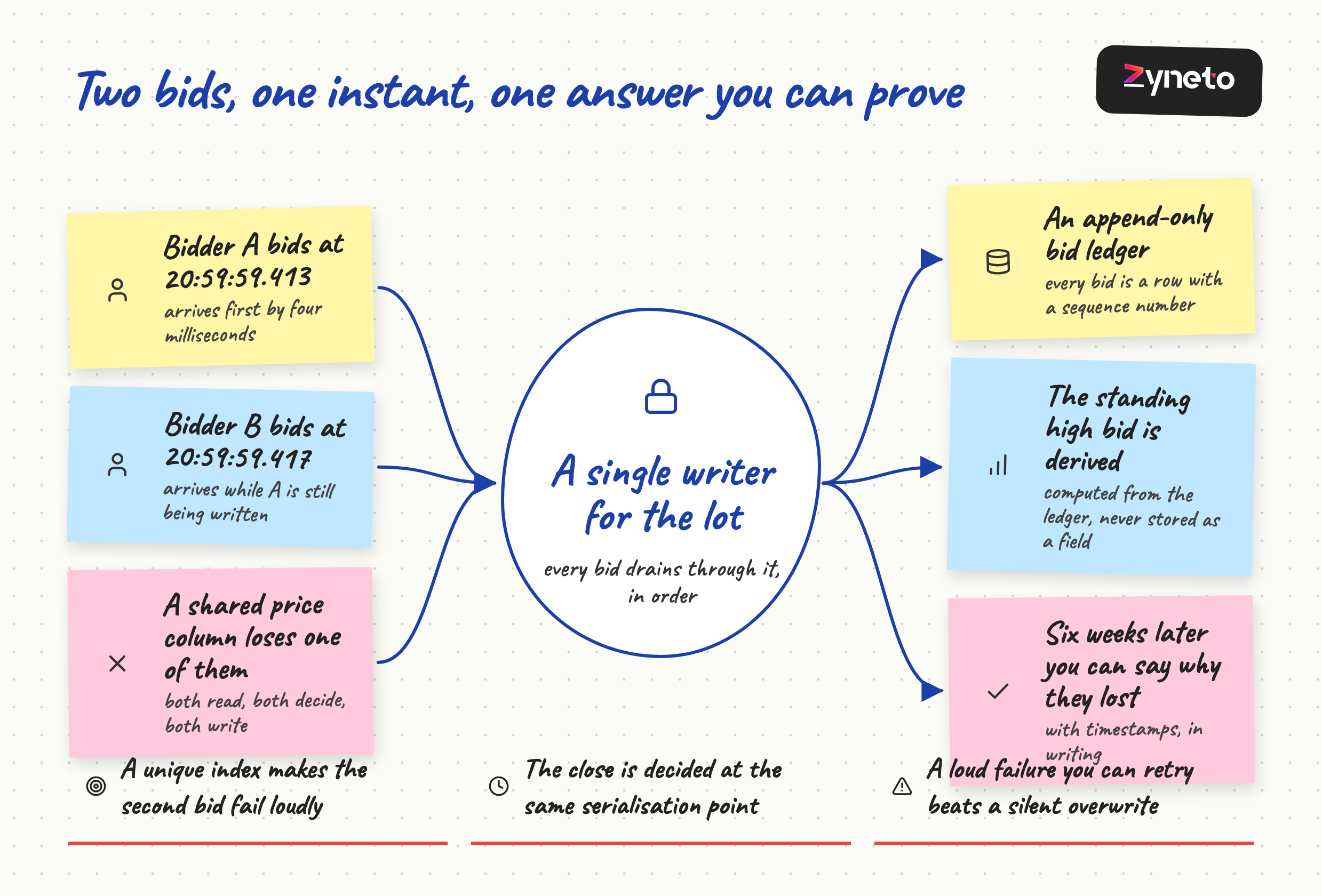
The platform serialises them. Bids for a single lot are processed one at a time, in a defined order, with a server timestamp that the platform assigns rather than one the phone sent. The second bid is then validated against the price the first one created, so it is either accepted at a higher amount or rejected outright.
Three designs do this.
A lock on the lot row is the usual first answer and it works. The Auctions for WooCommerce plugin documentation, read on 2026-11-11, describes exactly this: "The auction row is locked for the moment of the write so two simultaneous bidders can never both win the same price," with a colliding request waiting, typically under ten milliseconds, then re-reading the updated price and being rejected if it no longer beats it. Cheap, correct, and it makes the hottest row in your database the bottleneck at precisely the moment the most people want it.
A single writer per lot is the design that survives a hot close. All bids for one lot go onto a queue and one worker drains them in order. The same documentation offers this as an optional mode for heavy load, noting that "Incoming bids are queued and drained serially by a single worker" and that bidders briefly see a queue position. You trade instant feedback for predictable throughput, and you gain something a lock does not: an ordering you can replay.
Optimistic concurrency keeps a version number on the lot, writes only if the version has not moved, and retries on failure. It suits contention that is usually low and occasionally extreme, and it is the most likely of the three to be implemented subtly wrong, because the retry loop has to re-validate the bid against the new price rather than just resubmitting it.
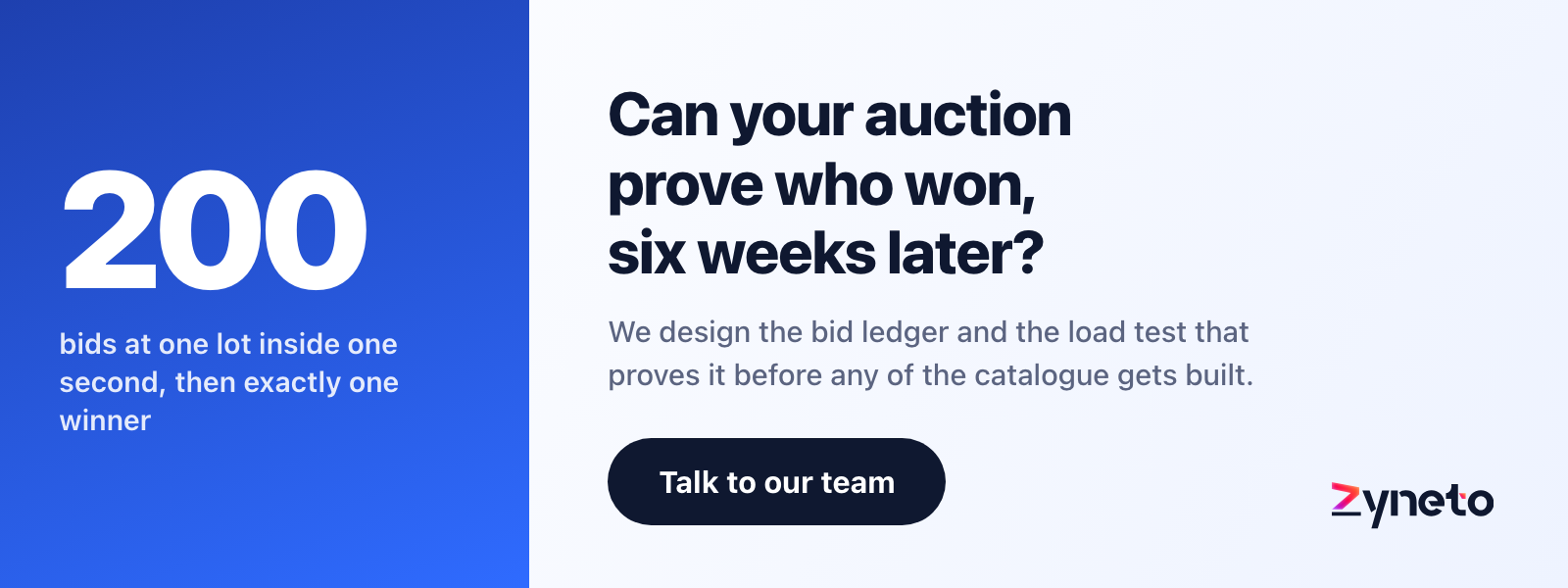
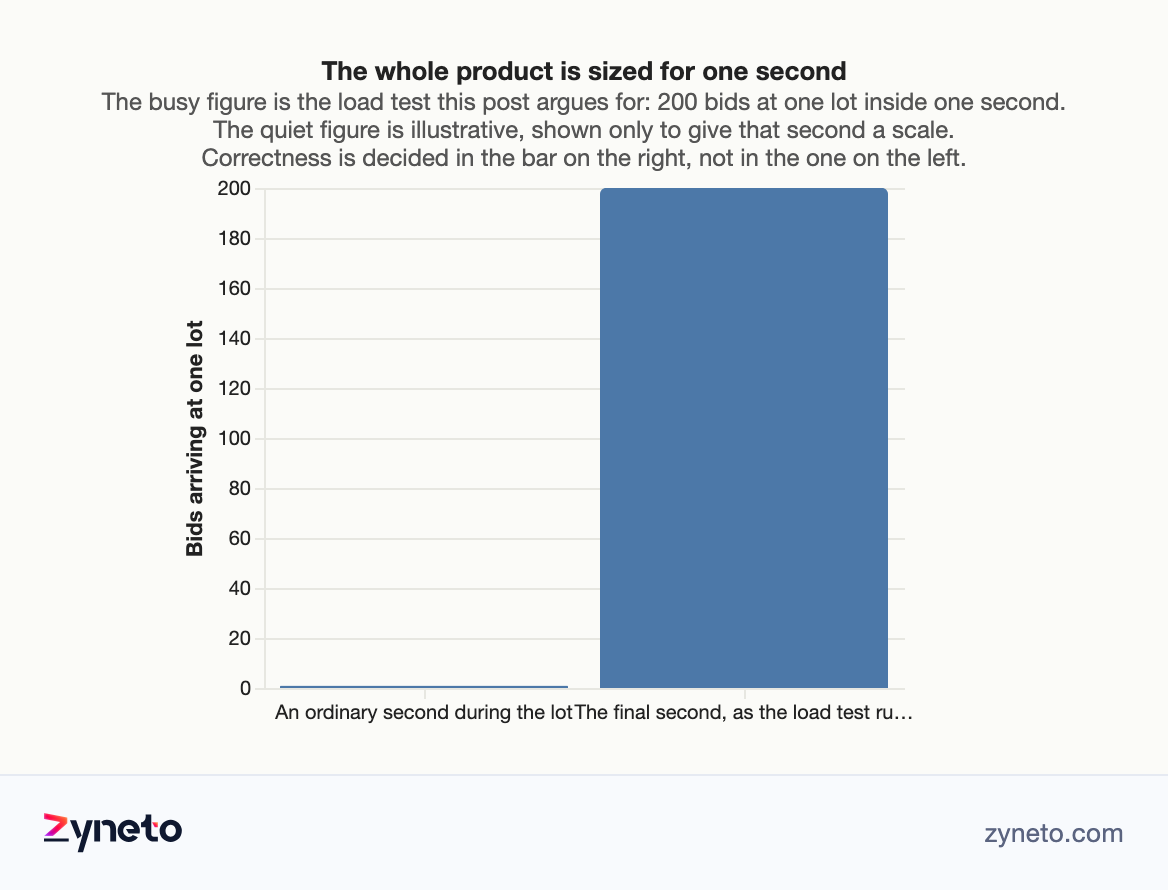
Pick one deliberately, early, and build the load test that proves it. The test is not "can the system take a thousand bids a second". It is: fire two hundred bids at one lot inside one second, then assert exactly one winner, a winning amount equal to the highest valid bid submitted, and every rejected bidder told the truth. A quote without that test is a hope. We make the same argument about onsale load in our event ticketing app development cost post, where the contention is over numbered seats rather than one lot.
Why a current_price column is the wrong model
Almost every first build stores the state of a lot as a number on the lot: current_price, plus maybe high_bidder_id and bid_count. It is the obvious design and it is the source of most auction bugs.
The failure is the classic lost update. Two bids arrive, both read the current price as $100, both decide they are valid at $110, both write $110. One bid has disappeared, no error was raised, and the row looks healthy. Put a lock around it and you have fixed the lost update and created a hot row. Neither version answers the question a disputing bidder will ask, which is what the price was when their bid was evaluated.
The right model is an append-only bid ledger. Every bid attempt becomes an inserted row: lot, bidder, amount, server timestamp, a per-lot sequence number, and the outcome. Nothing is ever overwritten. The current price is derived from the ledger, and cached wherever you like, because the cache is no longer the truth.
This changes what you are serialising. Instead of fighting over an update to a shared number, you are inserting rows and enforcing a constraint: a unique index on the lot and its sequence number, or on the lot and the amount, so the second simultaneous bid fails loudly at the database rather than silently overwriting. A loud failure you can retry is a different category of problem from a silent one you cannot detect.
Three things fall out of the ledger for free, and all three are otherwise expensive. You get an answer to "why did I lose", six weeks later, in writing, with timestamps, which on a platform where people spend real money is the difference between a support reply and a refund. You get the ranked losers, which is what you need when the winner does not pay and what you cannot reconstruct from a single current_price value. And you get retraction without destruction: when a bid must be removed, say a seller cancelled it or an account was banned for shill bidding, a ledger records a reversal row and recomputes, where a column model must delete history and hope nothing depended on it.
To be plain about the status of this claim: the ledger-over-column argument is engineering judgement, not a measurement from a system we have shipped. It is standard practice in event-sourced financial systems and it is the design we would propose. It is not a benchmark, and we do not present it as one.
Proxy bidding moves the hard work into the write path
Automatic bidding, which eBay calls proxy bidding, is the feature a product owner describes in one sentence and which doubles the complexity of the write path.
eBay's own help page, read on 2026-11-11 and re-read on 2026-11-13, describes entering the highest price you are willing to pay and letting the site "bid in increments on your behalf to keep you in the lead but only up to your limit." The published increments run from $0.05 on items priced $0.01 to $0.99, up to $100.00 on items priced $5,000 and above.
Read that as a specification and the cost appears. One human action now generates a cascade of writes.
A bidder sets a maximum of $500 against someone else's stored $450, at a current price of $200. Accepting that bid does not write one row. It has to resolve the contest between both maximums until neither can beat the price, writing the loser's raised bid at $450 and the winner's one increment above it, then telling two people different things.
That whole cascade has to happen inside the same serialisation boundary as an ordinary bid. If it runs outside, two cascades interleave and produce a price that no bidder ever authorised, which is the single worst bug this product can have. On a ledger that is tractable: the cascade is a batch of inserts in one transaction with consecutive sequence numbers. On a current_price column with a lock held across several round trips, it is a lock held for a long time on the hottest row in the system.
The stored maximum is a secret, and it leaks through more surfaces than people expect. Not just through an API that returns it, which nobody does on purpose, but through increment patterns, through response timing, and through any endpoint that returns enough of the ledger to let someone binary-search a rival's limit. Deciding what your bid history endpoint returns is a product decision with a security consequence.
And you have to decide what happens on a tie. eBay's automatic bidding page, checked on 2026-11-11, does not state what happens when two bidders hold the same maximum. So the rule is yours to choose and to publish in your terms. First valid bid stamped by the server wins is the usual answer, and the important part is that your ledger can prove which one that was.
Anti-snipe extension rewrites your closing logic
Sniping is bidding in the final seconds so nobody has time to respond. Platforms answer it by extending the lot when a late bid lands. This is the feature most likely to appear in a brief as a tick box and most likely to break a build that was costed without it.
There is real research on this, and it is not ambiguous. Alvin Roth and Axel Ockenfels, in the American Economic Review, September 2002, compared eBay, which ended auctions at a fixed time, with Amazon, which extended by ten minutes from the latest bid whenever one was cast in the final ten minutes. The share of bids submitted in the closing seconds was substantially larger on eBay than on Amazon, and more experienced eBay bidders bid later while more experienced Amazon bidders bid earlier. The ending rule changes bidder behaviour, measurably.
So extension is a defensible choice. Here is what it costs you.
The lot's end time stops being a constant. It becomes a value written by the same transaction that accepts a bid. Every piece of your system that treated the end time as fixed now depends on something that can move while it is running: the scheduled close job, the "closing soon" cache, the notification batch, the search index, the email that says the auction ends at eight.
The close can no longer be a cron job that scans for expired lots. A bid accepted one millisecond before the scan will move the end time after the scan has already decided the lot was over. Close has to be a decision made at the same serialisation point that accepts bids: the writer holding the lot observes that the clock has passed the end time and no extension applies, and writes a terminal row to the ledger. A separate scanner can trigger that decision, but it must not make it.
Only the server clock counts. The countdown on the phone is decoration. Stamp bids with the server's time, not the client's, and accept that a bidder on a slow connection will sometimes be told they were late when their thumb moved in time. Say so in your terms.
Cap the extension or your operations never end. A contested lot with an unbounded extension rule can run for hours past its advertised close. You need a maximum number of extensions or an absolute end time, chosen before the first auction rather than during one.
The auction closed and the payment is still authorising
This is the scenario that ruins the first month of a live auction platform, and it comes from one assumption: that the close of a lot and the receipt of money are the same event.
They are not, and they cannot be made to be. The lot closes at a fixed instant. The payment provider returns "processing", and the confirming event arrives some seconds later, or much later, or never. In that gap your platform has a winner who may not have paid, and your interface, your email and your seller's dashboard all want to say something definite.
The fix is a terminal state that is not "paid". The lot moves to awarded with payment pending and a deadline. The award is the thing you treat as final, not the money. Payment success or failure then moves the award forward or fails it, and a failed award falls to the next bidder in the ledger or relists. That option only exists because the ledger kept the ranked losers.
Authorising cards at bid time is the alternative, and a bigger product than it looks. You are then holding authorisations on everyone who bid, releasing them as they are outbid, and dealing with authorisations that expire while the lot is still running. Right for high-value lots with a serious non-payment risk, wrong for a general marketplace.
Either way, the payment state is a system of its own, not a column on the lot. Authorisation, capture, partial capture, refund, partial refund and chargeback each need to exist in your own records, which is the argument we make at length in our payment gateway integration cost post. If your auction takes money, that post is the other half of this one.
Non-payment is a business process, not an error state. Deposits, bidder verification above a value threshold, a strike policy, re-offering to the second bidder and relisting are policy decisions the build has to implement. Deciding them during your first failed sale is how platforms acquire their worst code. The escrow and payout side, where you hold a buyer's money before releasing it to a seller, belongs to the territory on our fintech and banking software development page rather than to this post.
What does it cost to build an auction app, and which parts are cheap?
Most of an auction app is cheap. The catalogue, listings, media upload, search, messaging and seller onboarding are ordinary marketplace work at the floor of any rate band. The money sits in a narrow set of parts: the bid ledger, the serialisation point, the proxy cascade, the close decision and the award state machine.
None of that half is specific to auctions. It is the same work as any listings marketplace and the patterns are settled. Our ecommerce app development solution page and our multi-vendor marketplace development post cover it directly, and our classified app development page covers the listings-only version.
One trap hides in the cheap half. Search and category pages will show a stale price during a contested close, because invalidating a search index on every bid is not something you want to do. Decide explicitly that the list view may be seconds behind and the lot view may not, and design the interface so a bidder is never asked to act on the stale number. Skip that decision and you get either a wrong price on a listing page or a search index rewritten two hundred times a minute.
Refuse a round number for the expensive half. That is where the senior hours go, and it is the part we will not price before a discovery that establishes whether closing extends, whether proxy bidding exists, and how many bidders are live on your hottest lot at the end.
Comparable builds give you a shape. Our ecommerce app development cost and saas development cost posts price the ordinary half on the same rates, and the gap between those numbers and an auction quote is, roughly, the bid engine. No gap means either the bid engine is not in the quote or the marketplace is overpriced.
The parts that get left out of every auction quote
Each of these is small. Together they are the reason auction projects run long.
Increment tables. eBay publishes an increment schedule, $0.05 at the bottom to $100.00 above $5,000. You need one per category and per currency, somebody has to own it, and changing it mid-auction has to be impossible or your proxy cascades become unreproducible.
Reserve prices. A lot can close above the highest bid and still not sell. "Reserve not met" is a third terminal state alongside sold and unsold, with its own emails and relisting rules. Teams modelling lot state as a boolean discover this late.
Retraction and cancellation. Sellers cancel bids. Platforms remove bids from banned accounts. On a ledger that means a reversal row and a recompute of every proxy cascade that depended on the removed bid. The most expensive item here to retrofit, and almost never in a first quote.
Shill bidding detection. Accounts that bid up a seller's lots and never win are the fraud pattern native to this product. You do not need a model to start: a report of bidder and seller pairs with a high bid count and no completed purchases finds most of it, cheaply, once the ledger exists. Monitoring competitor pricing or ingesting catalogue data is a separate discipline, on our web scraping and data extraction services page.
Buyer's premium shown at bid time. If you charge a premium, the bidder has to see the real total they are committing to at the moment they commit, not at checkout, which puts a fee calculation on the hottest page in the product.
Fulfilment of physical lots. Collection windows, storage deadlines, condition reports and delivery. At volume this becomes its own operational system, and our warehouse management system cost post covers the shape of that work.
Auction law varies and this post does not cover it. Rules on binding bids, cooling-off rights, auctioneer licensing and online auction disclosure differ by market and by what you sell. Get a direct answer from a specialist in your launch market before you write terms, not after.
What we would build first, and in what order
The ledger and the serialisation point come first, with no interface at all. Bids in, one winner out, provable. This is the part that cannot be corrected later without reprocessing history.
The close decision comes second, made at the same serialisation point, with the extension rule and its cap configured rather than coded.
The proxy cascade comes third, inside the same boundary, with a test that fires interleaved cascades and asserts the resulting price is one a bidder actually authorised.

The award state machine comes fourth, including the fall to the second bidder, because this is what makes non-payment survivable rather than a crisis.
The marketplace comes fifth and goes quickly. Catalogue, listings, search, messaging, back office. Built first, as it almost always is, the bid engine ends up fitted around a data model designed for browsing. Our MVP development post makes the general version of this argument about sequencing.
On rates: $40 to $100 an hour by role, blending to $60 to $70 for a mixed team, assuming roles drawn from our published band and no fixed-price wrapper. The bid engine sits at the ceiling and the catalogue at the floor, so the blend you are quoted tells you less than the mix behind it. Ask any vendor, including us, which hours are senior and why.
What we will tell you for nothing is this. If your lots can close hard, at a fixed time, with no extension, you have removed the most expensive requirement on the list. If they cannot, say so on the first call, because every estimate that does not mention mutable end times was written for a different product than the one you are buying.
Frequently asked questions
Published agency estimates read on 2026-11-11 range from about $30,000 to $150,000 and higher, with one breakdown pricing a real-time bidding backend separately at $15,000 to $25,000 and another putting an enterprise platform at $150,000 to $500,000. Our own published rate band is $40 to $100 an hour by role, blending to $60 to $70 for a mixed team. The variable that moves the total is not feature count. It is whether bidding extends when a late bid lands, whether proxy bidding exists, and how many bidders are live on your busiest lot in its final seconds.
They serialise them. Bids for a single lot are processed one at a time in a defined order, with a timestamp the server assigns rather than one the client sent, and the second bid is validated against the price the first created. Three designs do this: a lock on the lot row, a single worker draining a per-lot queue, or optimistic concurrency with a version number and a retry that re-validates rather than resubmits. The Auctions for WooCommerce plugin documentation, read 2026-11-11, describes both the row lock and the single-worker queue as the available modes, the second being for heavy load.
A current price column invites the lost update: two bids read $100, both write $110, and one bid disappears with no error raised. Locking the row fixes that and creates a hot row at the worst moment. An append-only ledger inserts every bid attempt with a server timestamp and a per-lot sequence, derives the current price, and never overwrites anything, so a duplicate fails loudly at a uniqueness constraint instead of silently winning. It also gives you the ranked losers for when a winner does not pay, an evidence trail for disputes, and retraction by reversal rather than deletion.
It extends a lot's end time when a bid arrives close to the close, so late bidders cannot win by leaving no time to respond. It makes the build meaningfully harder because the end time stops being a constant and becomes a value written by the same transaction that accepts a bid. Every scheduled close, cache, notification batch and search index that assumed a fixed time now depends on a moving one, and the close can no longer be a job that scans for expired lots. Roth and Ockenfels, in the American Economic Review in September 2002, found the share of bids in the closing seconds was substantially larger on eBay, which closed at a fixed time, than on Amazon, which extended by ten minutes from the latest bid.
You store a bidder's maximum and the platform bids on their behalf in set increments only up to that maximum. eBay's help page, read 2026-11-11, describes it as entering the highest price you are willing to pay and the platform bidding in increments to keep you in the lead but only up to your limit, with published increments from $0.05 to $100.00 depending on price. The build cost is that one human action becomes a cascade of writes resolving competing stored maximums, and the whole cascade has to run inside the same serialisation boundary as an ordinary bid or two cascades interleave and produce a price nobody authorised.
Nothing good, unless you planned for it. Payments are asynchronous and the close is an instant, so there is always a gap in which you have a winner who may not have paid. The workable design gives the lot a terminal state that is not "paid": awarded with payment pending and a deadline, where the award is final and the money moves the award forward or fails it. A failed award then falls to the next bidder, which is only possible if your bid records kept the ranked losers. Treat non-payment as a business process with deposits, strikes and relisting rules, not as an error state.
Most of it. The catalogue, categories and attributes, lot creation with media upload, search and filtering, watchlists, buyer and seller messaging, reviews, seller onboarding and the back office are ordinary listings-marketplace work that sits at the floor of any rate band. The expensive parts are narrow: the bid ledger, the serialisation point, the proxy cascade, the close decision and the award state machine. One trap hides in the cheap half, which is that list and search views will show a stale price during a contested close, so decide explicitly which views may lag and design the interface so nobody acts on the stale number.

Vikas Choudhary
Vikas has around fifteen years of experience building software and now builds generative AI systems at Zyneto. His work covers retrieval augmented generation, agentic AI, knowledge graphs, AI memory, and the evaluation and guardrails that decide whether any of it is safe to put in front of customers. He has shipped enterprise copilots, document AI, chatbots and predictive analytics for e-commerce, fintech and marketing teams, and works day to day in Python, JavaScript and SQL. He follows multimodal models, business process automation and enterprise AI security closely, and mentors engineers moving into AI. He writes about architecture, inference cost and the failure modes that only show up at production scale.
Zyneto builds custom software, AI and automation
Tell us what you are building and we will reply with a clear next step.