AI Document Processing Cost: What a Page Actually Costs to Read


Four numbers decide this entire category, and they are published.
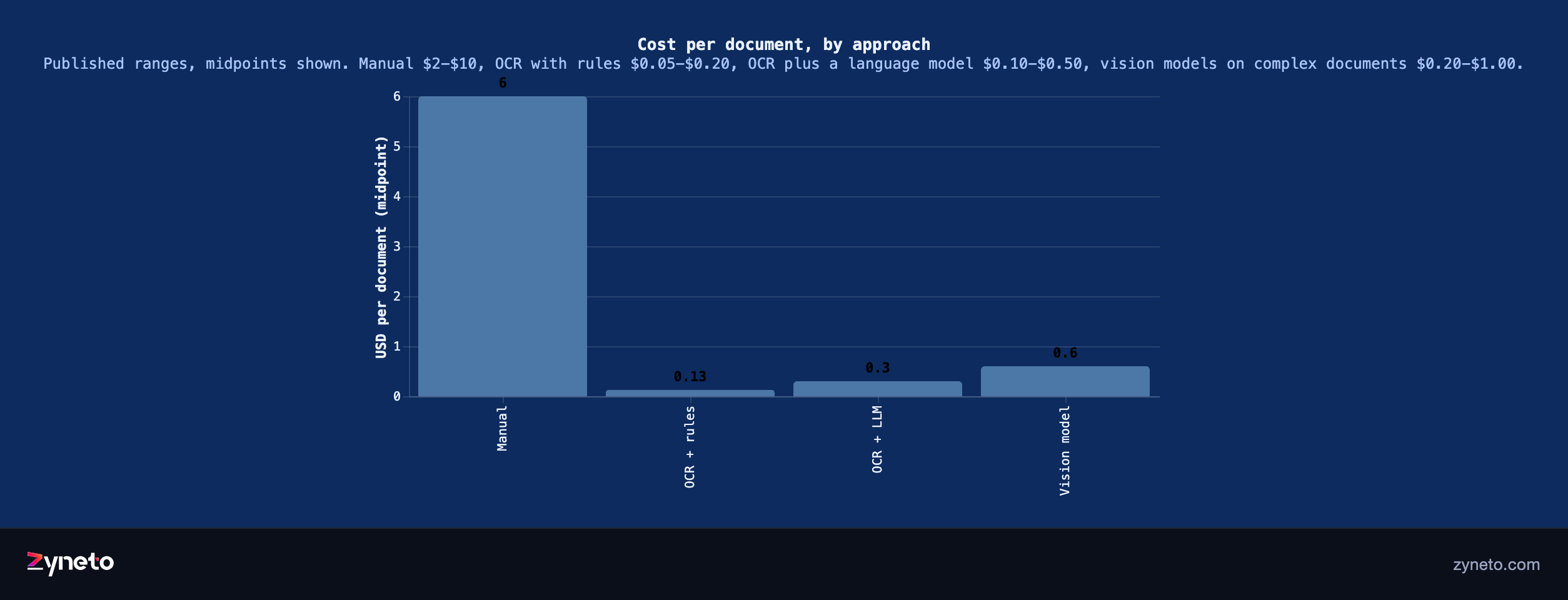
Manual processing costs $2 to $10 per document. Traditional OCR with rules costs $0.05 to $0.20. An AI pipeline combining OCR with a language model costs $0.10 to $0.50. Vision models reading complex documents cost $0.20 to $1.00. A managed API handling 50,000 pages a month runs about $6,000 a year, while one published build-versus-buy analysis puts in-house development at $150,000 to $230,000 initially plus $75,000 to $100,000 a year to maintain, for a first-year total of $237,000 to $366,000.
So the question is not whether AI is cheaper than people. It obviously is. The question is whether building is ever cheaper than buying, and at ordinary volumes the answer is no, by a factor of thirty or more in year one.
The case for building starts at a volume most companies never reach. One firm processing documents at genuine scale reports that managed OCR APIs cost 100 to 200 times more per page than running their own models, which is why they run their own. Both things are true: the API is thirty times cheaper than building at 50,000 pages a month, and a hundred times more expensive at whatever volume that firm operates at. The crossover is the only number that matters and almost nobody calculates it.
Three questions set what you should do. How many documents a month, and will that number grow by an order of magnitude? How many distinct document types? And what happens when the extraction is wrong? That third question is the one that decides the real cost, and it is not about software at all.
AI document processing costs $0.10 to $0.50 a document through an API, against $2 to $10 for manual handling. Building in-house runs $237,000 to $366,000 in the first year. At 5,000 documents a month the API is cheaper by more than an order of magnitude, and the two converge near 100,000 a month.
Take the published figures and the arithmetic is straightforward enough to do before any vendor conversation.
At 5,000 documents a month, an AI API at $0.30 a document costs $1,500 a month, or $18,000 a year. Building costs $237,000 to $366,000 in year one. The API is cheaper by more than an order of magnitude and will remain so for years.
At 100,000 documents a month, the same API costs $30,000 a month, or $360,000 a year, which lands in the same range as building. Now the comparison is real, and it turns on whether your documents are uniform enough for a self-hosted model to handle without the vendor's accuracy work.
The growth rate matters more than today's volume. A business at 5,000 documents a month growing 20% monthly crosses into build territory inside two years, and a migration from an API to self-hosted models mid-flight is considerably more expensive than having built for it.
Hybrid is the answer more often than either extreme. Route the easy, high-volume, uniform documents to a cheap self-hosted path and send the awkward minority to the expensive vision model. Most document sets are dominated by a few predictable formats, and that split captures most of the saving without the full build.
Headcount cost belongs on both sides of the comparison. A build needs someone to own it afterwards, and that person is not free. The $75,000 to $100,000 annual maintenance figure in the published analysis is engineering time, and it does not go away when the project is declared finished.
Write the crossover into the plan as a trigger. "At 40,000 documents a month we re-evaluate" is a better artefact than a decision made now on a volume you are guessing at.
Vendors quote 93% to 98% field-level accuracy depending on document quality, complexity and approach. Those numbers are real and they are also the most misleading thing in the category.
Field-level accuracy does not mean document-level accuracy. A document with 20 fields at 97% per field has roughly a 54% chance of being entirely correct. If your process requires every field to be right, the useful accuracy is far below the headline.
So the real design question is what happens to the other documents. Human review of low-confidence extractions is not a failure mode, it is the architecture. The pipeline's job is to be correctly uncertain: to know which documents it got right and flag the rest.
Confidence calibration is worth more than raw accuracy. A model that is 95% accurate and knows exactly which 5% it is unsure about is far more useful than one that is 97% accurate and confidently wrong on the remainder. Ask any vendor how they calibrate confidence, and treat a vague answer as a red flag.
The review interface is a real part of the build and is always underscoped. Somebody sits in it all day. It needs the document and the extracted fields side by side, keyboard-first navigation, the disputed field highlighted in the image, and single-keystroke accept. A good one processes a document in seconds; a bad one is slower than typing from scratch.
Set the confidence threshold as a business decision. Lower it and fewer documents reach a human, but more errors reach your accounting system. Raise it and accuracy improves while cost per document rises. That dial belongs to whoever owns the consequences of a wrong figure, not to the engineer who built the pipeline, and it should be adjustable without a deployment.
Measure the review rate, not the accuracy. The percentage of documents needing human eyes is the number that determines your actual cost per document, and it is the only one that reflects both model quality and confidence calibration.
Everyone focuses on extraction. The failures are mostly elsewhere.
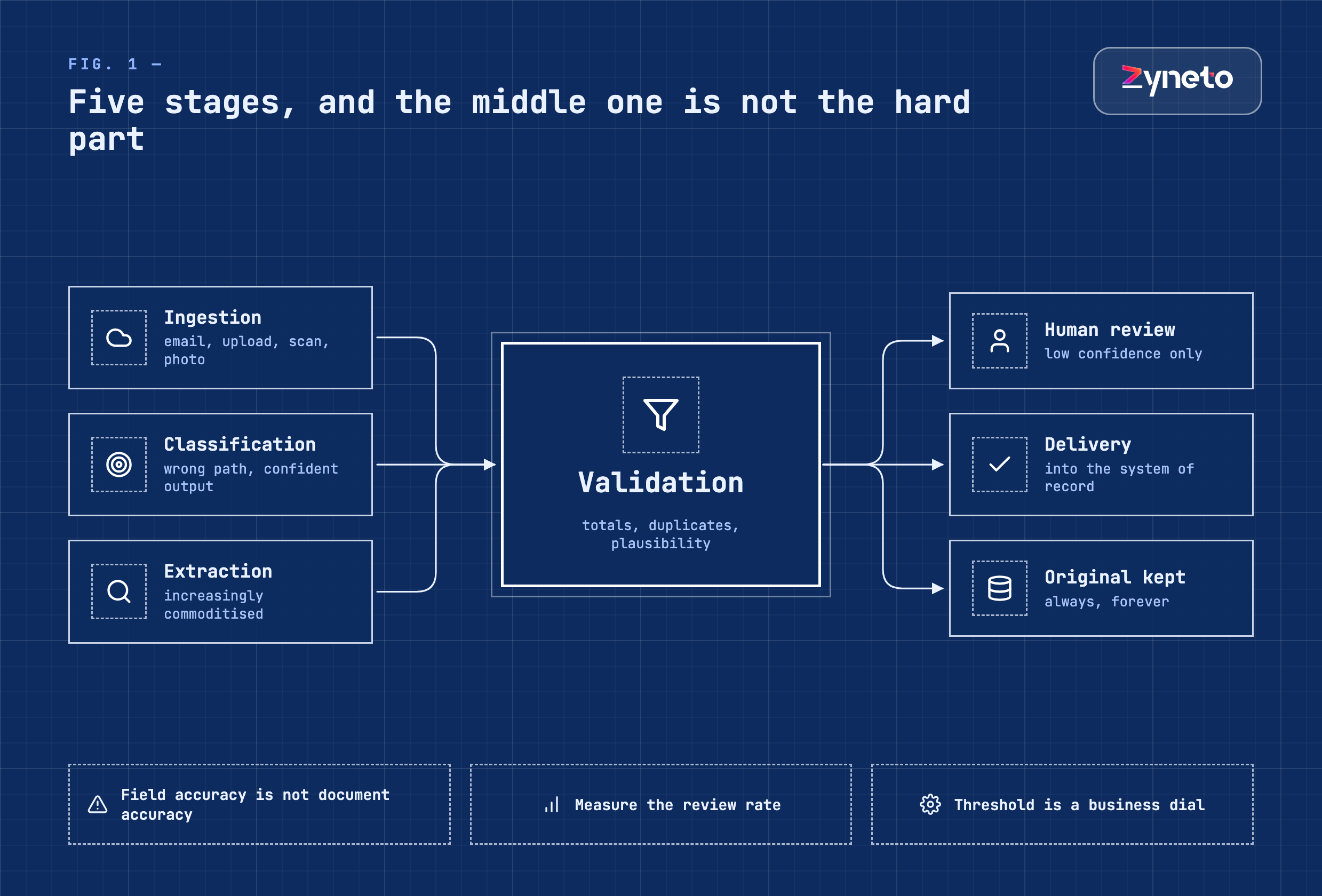
Ingestion is messier than any demo. Documents arrive by email attachment, upload, scanner, API and occasionally fax. They are PDFs, photographs taken at an angle, multi-page scans with pages in the wrong order, and files that claim to be PDFs and are not. Normalising all of that is unglamorous work that consumes a large share of the project.
Classification decides which extractor runs. An invoice, a purchase order, a delivery note and a credit note look similar and need different fields. Misclassification sends a document down the wrong path and produces confidently wrong output, which is worse than a failure.
Extraction is the part with the vendors and the benchmarks, and it is increasingly commoditised.
Validation is where the value is and is routinely skipped. Does the line-item total match the invoice total? Is the supplier one you recognise? Is the date plausible? Is this a duplicate of something processed last week? These checks catch more real errors than any accuracy improvement, and they are ordinary code rather than machine learning.
Delivery into the system of record is the last mile and the most likely place to lose data. An extraction that succeeds and then fails to post leaves the document in limbo, and limbo needs its own queue and owner.
The single best predictor of what this project costs is how many distinct document types it has to handle, and that number is almost always larger than the first answer.
Each type needs its own field set, its own validation and its own test cases. An invoice and a purchase order share almost nothing beyond a supplier name. Adding a type is not a configuration change; it is a small project.
Variants hide inside types. "Invoices" is not one type when forty suppliers each use their own layout, some of them scanned, some emailed as structured data, one of them a photograph of a handwritten docket. Modern extraction models handle layout variation far better than the template-matching tools they replaced, which is the real advance in this category, but variation still shows up as accuracy spread.
Count the types and the variants before quoting. A pipeline for three types is a different size of project from one for thirty, and the difference is roughly linear, which makes it the easiest part of the estimate to get right and the most common thing left vague.
Start with the highest-volume type and finish it. One document type processed end to end, with validation, review and delivery into the system of record, is a working product that pays for itself. Three types half-finished is a pilot that stalls.
New types will arrive forever. A supplier changes format, a regulation adds a form, the business enters a market with different paperwork. Budget the ongoing capacity to add a type, because a pipeline nobody can extend becomes a pipeline people work around.
Not all documents cost the same to read, and the published per-page ranges hide a wide spread inside them.
A clean, typed, single-column document is nearly solved. Modern OCR handles it at the low end of the cost range with high accuracy, and has for years.
Tables are considerably harder than prose. A table has structure that matters — which number belongs to which row and column — and that structure survives badly through OCR. Merged cells, tables spanning pages, nested headers and borderless layouts each break naive extraction. If your documents are mostly tables, budget for the vision-model end of the range at $0.20 to $1.00 per document rather than the cheap end.
Handwriting is a different problem. Accuracy drops sharply, varies by writer, and the confidence signals are less reliable. Documents with handwritten annotations on printed forms are common and routinely surprise projects scoped on the printed part alone.
Photographs are worse than scans and are increasingly what you receive, because the person capturing the document has a phone rather than a scanner. Skew, shadow, glare, cropping and focus all degrade accuracy, and pre-processing to correct them is a real stage.
Audit a representative sample before scoping. A hundred real documents, chosen randomly rather than selected, will tell you which end of the cost range you are in. Projects scoped on the clean examples somebody picked out run over, every time.
The business case is usually written as headcount and that framing causes problems later.
The honest saving is time on the predictable majority. If a person processes 40 documents a day and the pipeline handles 70% without review, you have freed most of that time rather than eliminated the role. The remaining 30% is the hard 30%, and the person handling it is now doing only difficult work, which is more tiring and needs more skill.
Speed is often worth more than the labour saving. Invoices processed same-day capture early-payment discounts and avoid late fees. Applications processed in minutes rather than days convert better. These are revenue effects and they are frequently larger than the cost line that justified the project.
The accuracy comparison should be against the humans, not against perfection. Manual data entry has an error rate too, and it is rarely measured. A pipeline at 95% with flagged uncertainty may be better than the status quo, and the only way to know is to measure the current error rate before you start, which almost nobody does.
Do not promise straight-through processing. The honest claim is a review rate that falls over time as the validation rules accumulate, and that framing survives contact with reality.
Sending documents to a third-party API is a data-processing decision before it is a technical one, and it surfaces late in most projects.
Your documents contain other people's information. Invoices carry commercial terms, applications carry personal data, medical and financial paperwork carries categories that attract additional obligations almost everywhere. Routing them through an external model is a transfer, and whoever signs your contracts will eventually ask about it.
The questions to settle before choosing a vendor are where the processing happens geographically, whether inputs are retained, whether they are used for training, and how long anything persists. Most serious providers answer all four clearly and offer a no-retention mode; the answers differ enough between vendors to decide the choice.
Self-hosting is the escape hatch and it has a price. Running extraction on your own infrastructure removes the transfer question entirely and replaces it with model-operations work: hosting, updating, monitoring quality drift. That cost belongs in the build-versus-buy arithmetic rather than being treated as free because no invoice arrives.
A hybrid split works here too. Route documents containing sensitive categories to a self-hosted path and everything else to the cheaper managed service, which keeps most of the cost advantage while removing the hardest compliance conversation.
Decide this before the pilot, not after. Pilots run on whatever was quickest, and a pilot that proved the concept on a vendor you cannot use in production has proved less than it appears.
Extraction answers what the document said. It does not answer where the document goes, and conflating the two expands scope.
Storage, retention and retrieval are a different product with its own requirements around access control, search, versioning and disposal. Some of this may already exist in systems you run.
Retention periods are usually set by someone other than you and differ by document type. Build the retention rule as data with a period per type, not as a single global setting, because the moment two document classes need different periods a global setting becomes a migration.

Keep the original, always. Models improve and extraction rules change, and re-processing the archive against a better pipeline is a genuine source of value that is only available if the source document survived. Storing originals is the cheapest line in the budget.
The extraction and the document need to stay linked for audit. When a figure in your accounting system is questioned, the answer is the page it came from and the confidence it was extracted with.
The sample audit comes first and is not a formality. A hundred real documents, classified by type, with the share of tables, handwriting and photographs counted. That single exercise determines the cost per document, the review rate and whether building is even the right question.
Validation rules second, before extraction quality work. They are cheap, they catch the errors that matter, and they tell you where the pipeline actually fails rather than where you assume it does.
The review interface third, treated as a product used by a real person all day rather than as an admin screen.
Extraction last, because by then you know which documents are hard and can buy a managed service for the easy majority and spend effort only on the rest.
Our rate band is published: $40 to $100 an hour by role, blending to $60 to $70 for a mixed team. We do not quote a fixed total before the sample audit, because the audit is what makes a quote mean anything. What we will tell you before it is that at ordinary volumes you should buy the extraction and spend your money on validation and review, which is where the errors that cost you money actually live.
Published figures put manual processing at $2 to $10 per document, traditional OCR with rules at $0.05 to $0.20, an AI pipeline combining OCR with a language model at $0.10 to $0.50, and vision models reading complex documents at $0.20 to $1.00. Where you land inside those ranges depends mostly on document type: clean typed text sits at the cheap end, while tables, handwriting and phone photographs push you toward the expensive end.
Buy, at ordinary volumes. One published build-versus-buy analysis puts in-house development at $150,000 to $230,000 initially plus $75,000 to $100,000 a year in maintenance, against roughly $6,000 a year for a managed API handling 50,000 pages a month. Building becomes arguable only at genuinely high volume, where one firm reports managed APIs costing 100 to 200 times more per page than running their own models. Calculate your crossover rather than choosing on principle.
Vendors quote 93% to 98% field-level accuracy depending on document quality and approach, but field-level accuracy is misleading. A document with 20 fields at 97% each has roughly a 54% chance of being entirely correct. The number to design around is the review rate: what percentage of documents need human eyes. A model that is correctly uncertain about its errors is worth more than a marginally more accurate one that is confidently wrong.
Tables, handwriting and photographs, in roughly that order of frequency. Tables carry structure that matters and survives OCR badly, particularly when cells are merged, borders are absent or the table spans pages. Handwriting drops accuracy sharply and varies by writer. Photographs taken on phones bring skew, shadow, glare and focus problems that scans do not. Audit a random sample of your real documents before scoping, not the clean examples someone selected.
Yes, and planning otherwise is how these projects disappoint. Human review of low-confidence extractions is the architecture, not a failure mode. If the pipeline handles 70% without review, you have freed most of a person's time rather than removed the role, and the remaining 30% is harder work needing more skill. The honest promise is a review rate that falls as validation rules accumulate, not straight-through processing.
Three parts, none of them extraction. Ingestion, because documents arrive by every channel in every format including photographs and files that lie about their type. Validation, because checking that line items sum to the total and that the supplier is known catches more real errors than any accuracy improvement and is ordinary code. And the review interface, which someone uses all day and which is the difference between seconds per document and slower than retyping.
No. Extraction answers what the document said; storage, retention, search and disposal are a separate product with their own access control and compliance requirements, and some of it may already exist in systems you run. Keep the two linked for audit, so a questioned figure can be traced to the page and confidence it came from, and always keep the original document, since re-processing the archive against an improved pipeline is only possible if the source survived.

Vikas has around fifteen years of experience building software and now builds generative AI systems at Zyneto. His work covers retrieval augmented generation, agentic AI, knowledge graphs, AI memory, and the evaluation and guardrails that decide whether any of it is safe to put in front of customers. He has shipped enterprise copilots, document AI, chatbots and predictive analytics for e-commerce, fintech and marketing teams, and works day to day in Python, JavaScript and SQL. He follows multimodal models, business process automation and enterprise AI security closely, and mentors engineers moving into AI. He writes about architecture, inference cost and the failure modes that only show up at production scale.
Share your details and we will talk soon.
Be the first to access expert strategies, actionable tips, and the trends actually shaping the digital world. No fluff - just practical insights delivered straight to your inbox.
Dive into our blog and stay ahead of the curve with expert perspectives, future-ready trends, and tech tips written for decision-makers and doers alike.