AI Feature Pricing: What to Charge When Every Use Costs You Money


Every software business that adds an AI feature discovers the same thing at the same moment: the product has a fixed price and the feature has a variable cost, and nobody decided what happens when those two diverge.
The honest starting position is that the companies with the most data about this have not agreed either. Read two published rate cards side by side. Intercom's Fin charges $0.99 per outcome, with no seat cost at all when it runs on somebody else's helpdesk, and explicitly does not charge when a conversation goes to your team without an outcome. Salesforce's Agentforce charges $2 per conversation, $2 per Help Agent resolution, $500 per 100,000 Flex Credits at 20 credits per standard action, $125 per user per month for the add-ons, and from $550 per user per month for Max Edition. Those are the same job, priced four incompatible ways in one product and one way in the other.
So the question is not which model is correct. The question is which risk you are willing to hold. A seat price means you absorb every extra call your heaviest customer makes. A usage price means your customer absorbs it and watches a meter while they work. An outcome price means you absorb the cost of every attempt and get paid only for the ones that land, which is a bet on your own accuracy.
Three numbers decide it, and you can calculate all three before writing any code. Your cost per successful use. The distribution of uses per customer, not the average. And the point at which your worst-case customer stops being profitable. Everything after that is packaging.
How should I price an AI feature?
Start from cost per successful outcome, not cost per call, because failed attempts still cost you. Then check the distribution of usage across your customers rather than the mean, since the top few per cent set your downside. If your heaviest plausible user stays profitable at a flat price, charge flat. Otherwise meter or cap.
That is the whole method, and it takes an afternoon with a spreadsheet and a sample of real usage. The reason so few teams run it is that the cost side arrives after launch, by which time the price is on a published page and in signed contracts.
The rest of this post is the arithmetic behind each of those three numbers, taken from rate cards you can read yourself.
A seat price is a bet you gradually stop winning
Per-seat pricing works because a seat's cost to serve is roughly constant and roughly zero. Adding a user costs you storage and a little compute. The economics are so forgiving that most SaaS pricing has not had to think about marginal cost in twenty years.
An AI feature breaks that quietly. Two customers on the same plan paying the same amount can now cost you ten times apart, and nothing in your pricing page notices. The heavy customer is often your best reference account, because heavy use means they find it valuable, which means the cheapest customers to serve are the ones least likely to renew.
Put numbers on it. Say the feature costs you $0.06 per successful use and your plan is $49 a month. A customer using it twice a week costs you about $0.50 and nobody notices. A customer who builds it into a daily workflow across six people costs you roughly $7. A customer who wires it into an automation costs you more than the plan. All three are on the same page of your pricing table, and only the third one is visible in your accounts, usually a quarter late.
Worse, the cost moves without you. A model change, a longer context, an extra retrieval step, a customer who discovers they can paste a whole document: each shifts your cost per use with no corresponding change in revenue. What AI costs to run at real volume is the companion piece to this one, and the two have to be read together, because the price you publish is only defensible against a cost you have actually modelled.
None of this argues against a flat price. It argues against a flat price chosen by default.
The arithmetic Salesforce publishes against itself
Here is the useful thing about a detailed rate card: you can do arithmetic on it that the vendor did not put in the marketing.
Agentforce's published consumption prices, read on 13 November 2026:
Unit | Published price |
|---|---|
Flex Credits | $500 per 100,000 credits |
Standard Agentforce action | 20 credits |
Agentforce Voice action | 30 credits |
Conversations | $2 per conversation |
Help Agent Resolutions | $2 |
Agentforce add-ons (Sales, Service, Field Service and Operations) | $125 per user per month |
Agentforce User License | $5 per user per month, requires Flex Credits |
Max Edition | From $550 per user per month, including 2.75M Flex Credits per org per year |
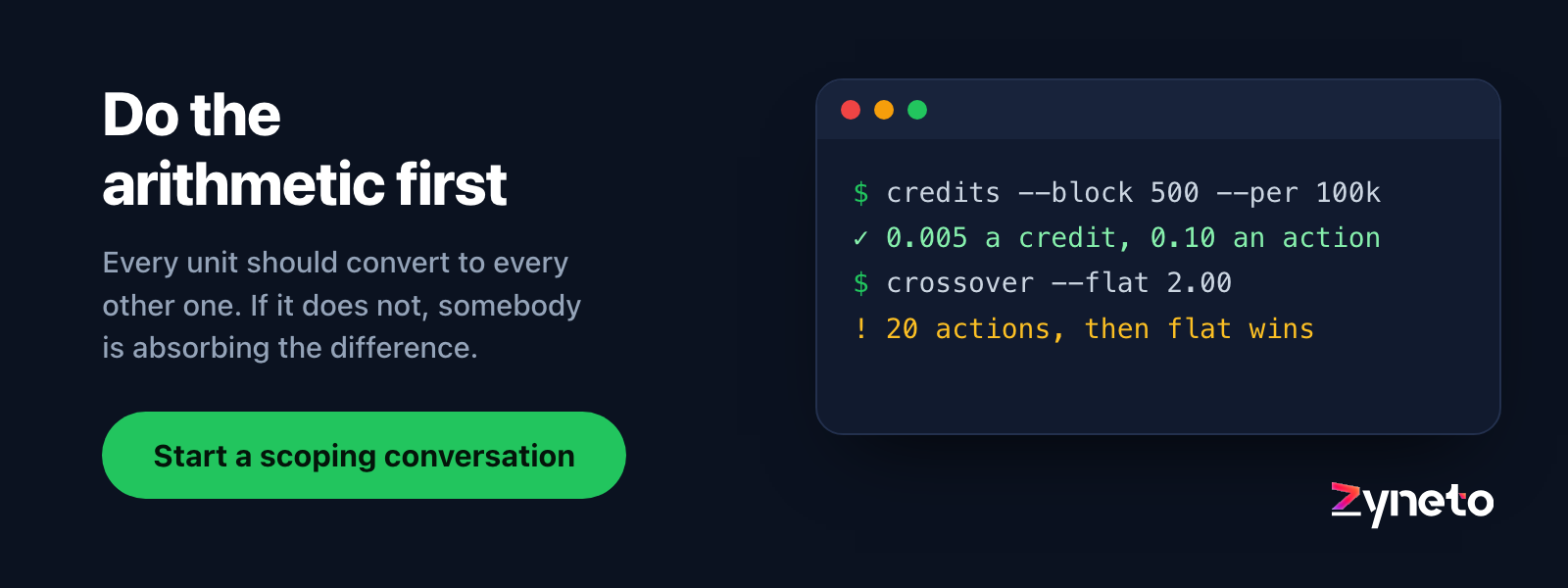
At $500 per 100,000 credits, one standard action costs $0.10 and one voice action costs $0.15. So a conversation that takes ten standard actions costs a dollar in credits, against a flat $2 for the Conversations unit. The two SKUs cross at twenty actions. Below that, credits are cheaper. Above it, the flat conversation price is, and the vendor is absorbing the difference.
Run the Max Edition number too. 2.75 million Flex Credits per organisation per year is 137,500 standard actions a year, which is about 376 a day for the entire organisation. For a large sales team that is not a generous allowance; it is a carefully sized one.
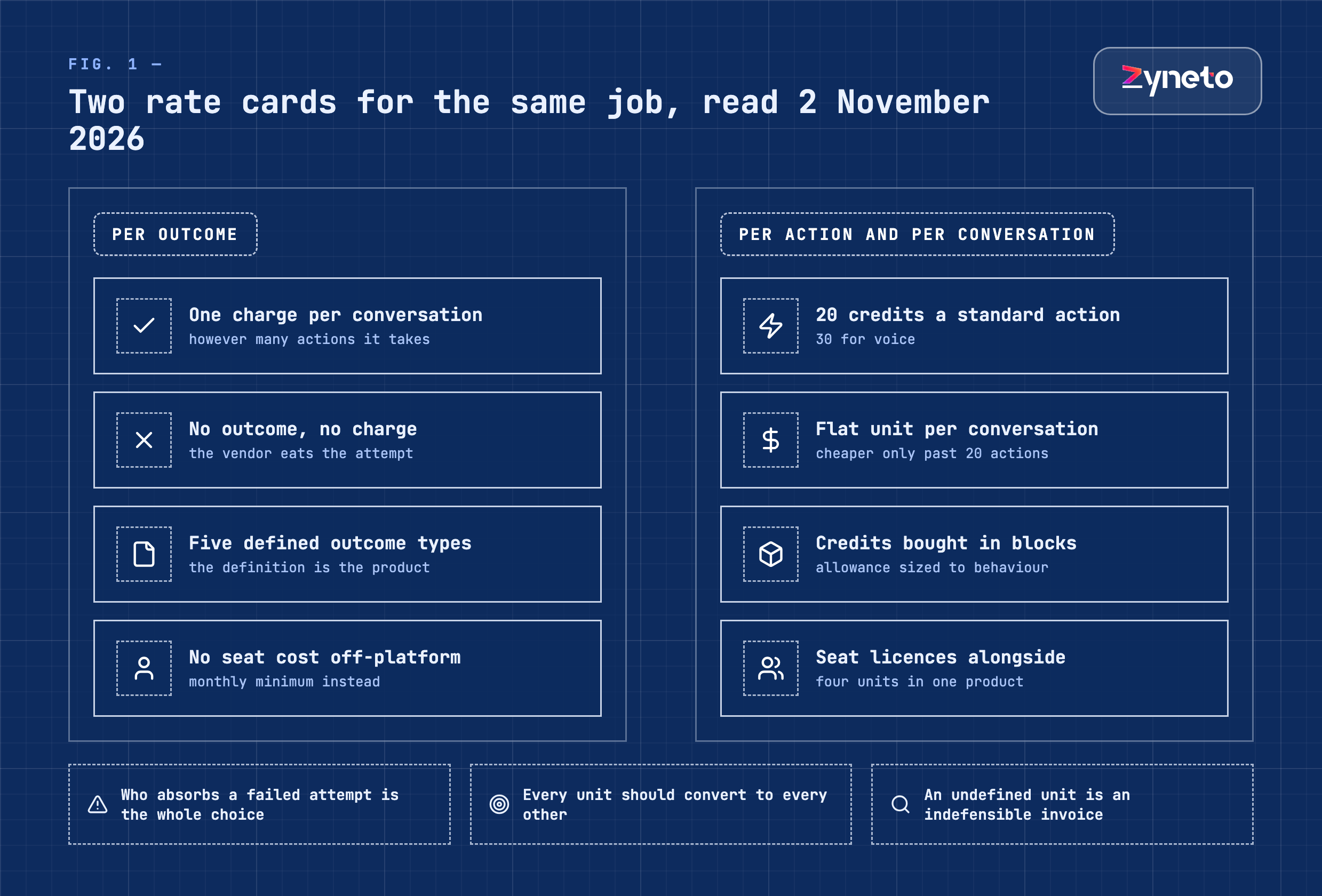
This is what a priced AI feature looks like when somebody has done the work. Every unit has a conversion to every other unit, the crossover is knowable, and the included allowance is sized against expected behaviour rather than rounded to something that sounds big. You can disagree with the model and still copy the discipline.
Outcome pricing moves the risk, it does not delete it
Fin's rate card takes the opposite position, and it is worth reading closely because the definitions are the product.
$0.99 per outcome. One outcome per conversation, even when Fin takes several actions to get there. Billable outcomes are resolutions, procedure handoffs, disqualifications, self-serve routings and qualifications, and a qualification is priced separately at $9.99. When a conversation goes to your team without an outcome, there is no charge. Running on another helpdesk, there are no seat costs at all and a minimum of 50 outcomes a month; running inside Intercom, the card reads from $0.99 per outcome plus $19 per helpdesk seat per month.
Notice what the vendor has taken on. Every failed attempt, every retry, every conversation that ends in nothing is their cost and not yours. That is only a sane position if you are confident about your own success rate and can improve it faster than your customers' questions get harder.
And notice what the definitions do. Five different things count as an outcome, including handing off and disqualifying. A conversation that reaches a human through a procedure is billable; one that reaches a human without one is not. The pricing unit is not "we solved your problem", it is "we did something identifiable", and the gap between those two is where the model stays viable.
If you copy outcome pricing, copy that part. An outcome you cannot define precisely is an invoice you cannot defend, and the first billing dispute will be about a definition rather than a number.
Should I charge per seat or per usage?
Per seat if usage per customer is predictable and your heaviest user is still profitable at the flat rate. Per usage if the distribution has a long tail you cannot cap, or if the feature's value genuinely scales with volume. Hybrid if neither holds cleanly: a seat price for access, a metered allowance included, and overage above it.
The hybrid is where most products land, and it has one design requirement teams skip. The customer has to be able to see the meter before they hit it. A surprise overage invoice costs more in trust than the overage recovers in revenue, and the support ticket it generates is handled by a human you are paying for.
There is a second-order effect worth naming. A metered AI feature changes user behaviour: people use it less, including in the cases where it would have helped most. If adoption is the goal for the first year, a generous included allowance with visible metering usually beats precise pricing, because you are buying usage data you cannot get any other way.
What to write in the terms so you can change your mind
The pricing decision is reversible for about as long as your contracts allow, which is usually shorter than anyone assumes.
Publish a limit even when you do not intend to enforce one. A fair-use number on the pricing page, with a stated right to review it, costs nothing while usage is low and is the only thing standing between you and a renewal argument later. The word to avoid is the obvious one: anything described as unlimited in a signed agreement sets your economics for the term, and the customers who take you at your word are the ones you least want to annoy.
Separate the AI feature from the plan in the contract, even if it is included at no extra charge. A feature named and scoped as its own line can be repriced, limited or withdrawn on its own terms. A feature absorbed into "the platform" cannot be touched without reopening the whole agreement.
Write down what a unit is before you need to invoice one. Fin's card is instructive here: five named outcome types, one charge per conversation, and an explicit statement that no outcome means no charge. That precision exists because somebody had to defend an invoice. Yours will be defended too, just later.
And keep the right to change models. If your terms name a vendor or a model version, a deprecation becomes a contractual event rather than an engineering one, which is an expensive way to discover that the agent you built sits on somebody else's release schedule.
The margin test to run before you build
This is the spreadsheet, and it is short.
Cost per successful outcome, not per call. Take the full path a real request takes: retrieval, the model call, any retries, any second model used to check the first, and the human review if your workflow has one. Divide by the proportion that succeed. Take an illustration, not a benchmark: a feature with a 70% success rate and a $0.04 cost per call costs you roughly $0.06 per success, and the gap widens as the task gets harder.
The distribution, from real behaviour. Not the average uses per customer, the percentiles. Take a sample of existing usage of the nearest non-AI feature as a proxy, and look at the 95th and 99th. Those users are usually a large multiple of the median rather than a little above it, and they are the ones who will adopt the AI feature first. Measure that multiple in your own product; we have no published figure for it and nor does anybody else.
The break-even user. At your proposed price, how many uses per month before a customer costs more than they pay? Compare that number against the 99th percentile from the step above. If break-even sits below your 99th percentile, a flat price is a slow loss concentrated in your most engaged accounts.
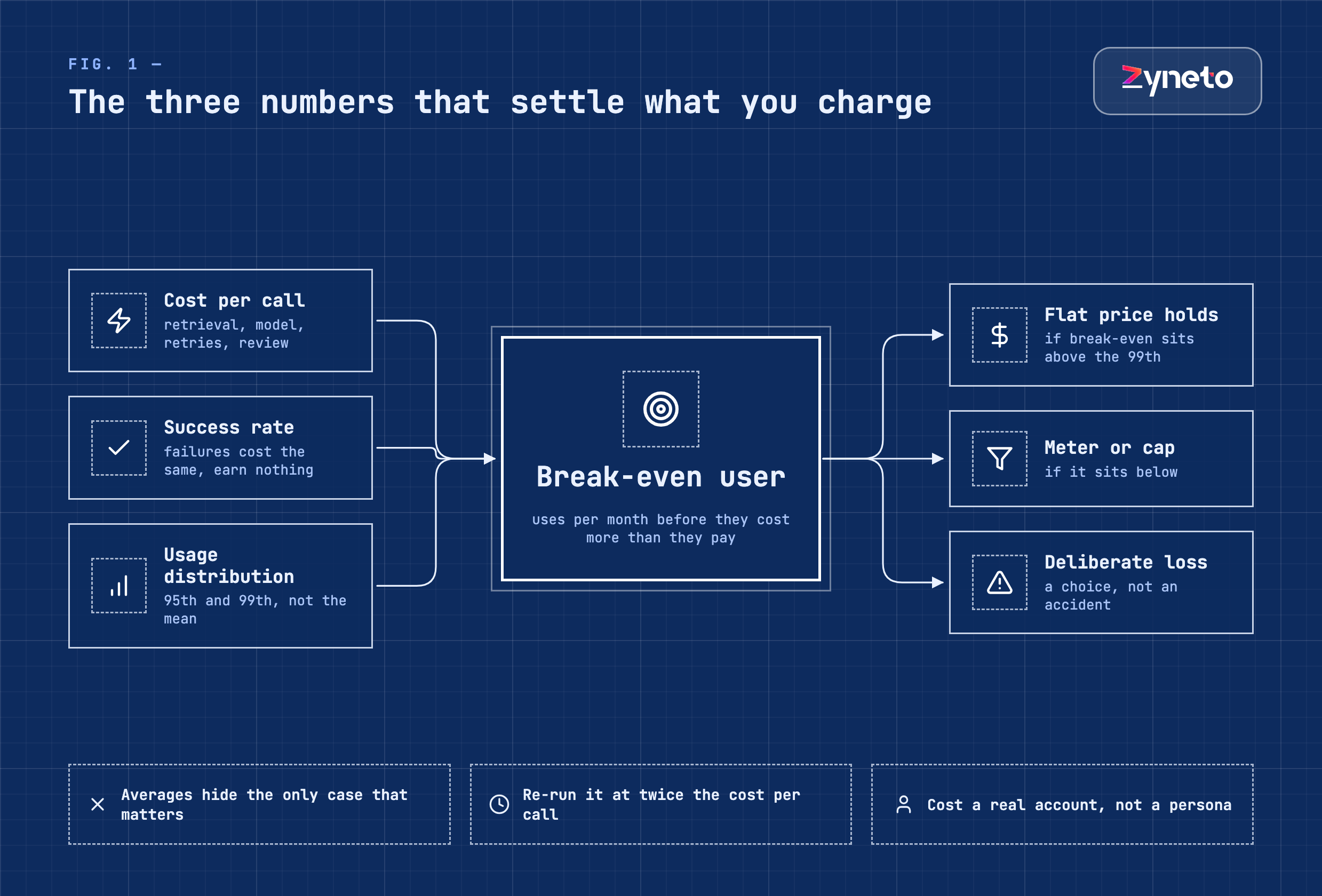
Then the sensitivity. Redo it at twice the cost per call. Model prices fall over time but context lengths and agent step counts rise, and the second number has been moving faster than the first.
What happens to your heaviest user
Averages hide the only case that matters.
This is the same discipline that decides whether a feature is worth building at all, and it travels: retrofitting AI into an existing product runs into the identical distribution problem one layer down. Pick the single customer most likely to use the feature hardest, and cost them specifically. Not a persona, a real account with a name. Model them at the usage level they reach in month six, after they have told their team about it, and look at what they pay you.
If that account is unprofitable, you have four choices and they are all legitimate: raise the price, meter the feature, cap it, or accept the loss deliberately as the cost of a reference customer. The failure is making that choice by accident, which is what happens when the feature ships flat and the finance review happens two quarters later.
One more thing belongs in the model. A feature that is wrong rather than broken generates a support category your team has not handled, needing someone who can inspect what was retrieved and why; tracing and observability is the tooling that makes those tickets answerable, and it has its own running cost. Count it.
Can I just include AI in the existing plan?
Often yes, for a first release, provided you do it deliberately and with an exit. Include it, instrument every call, publish no commitment about limits, and set a review date before you have enough contracts to make a change painful.
What makes this safe is the instrumentation, not the generosity. You need cost per customer per month from day one, broken out by feature, or the review date arrives and nobody can answer the question it exists to settle. Getting the data ready applies to your own telemetry as much as to the model's inputs.
What makes it unsafe is a contract. The moment "unlimited" appears in a renewal, the decision is made for several years, and the customers who exploit it are not acting in bad faith. They are using the thing you told them to use.
What we would meter, and what we would include
Include the feature that makes the product obviously better and costs pennies: summarising something the user is already looking at, drafting a reply they will edit, classifying a record on save. These are the cases where AI workflow automation genuinely replaces work rather than adding a step. Predictable, bounded, one call, and the value is in adoption rather than in the invoice.
Meter the feature whose cost scales with somebody else's decision. Anything that reads a whole corpus, anything an agent drives through several steps on its own, anything that processes a file whose size you do not control. The retrieval design matters to the bill as much as to the answer, which is one more reason permissions and retrieval decide the architecture before cost does. What an AI agent costs to build is a separate question from what one costs to run, and multi-step agents are where the two diverge fastest.
And price nothing at all until the feature works. A price attached to an unreliable feature funds the refunds. The sequence that holds is the one we would use on any build: get it out of the pilot and into production with a measured success rate, cost it against that rate, then decide what to charge. The teams who do it the other way round find out their margin from an invoice, which is the most expensive place to learn it.
FAQs
Cost the whole path, not the model call. Add retrieval, the model call itself, any retry, any second model that checks the first, and any human review step. Then divide by your success rate, because failed attempts cost the same and earn nothing: a feature costing $0.04 a call that succeeds 70% of the time costs about $0.06 per success. Re-run the figure at double the per-call cost, since agent step counts and context lengths have been rising faster than model prices fall.
Per seat if usage is predictable and your heaviest plausible user is still profitable at that flat rate. Per use if the usage distribution has a tail you cannot cap. Per outcome if you are confident in your own success rate, because outcome pricing means you absorb the cost of every failed attempt. Most products end up hybrid: seat price for access, an included allowance, metered overage above it, with the meter visible to the customer before they reach it.
As published on 13 November 2026, $0.99 per outcome, charged once per conversation however many actions Fin takes. Billable outcomes are resolutions, procedure handoffs, disqualifications, self-serve routings and qualifications, with qualifications priced separately at $9.99. Conversations handed to your team without an outcome are not charged. On another helpdesk there are no seat costs and a 50-outcome monthly minimum; inside Intercom the card reads from $0.99 per outcome plus $19 per helpdesk seat per month.
Re-read on 13 November 2026, Flex Credits are published at $500 per 100,000 credits, with a standard action consuming 20 credits and a voice action 30. That works out at $0.10 per standard action and $0.15 per voice action. Conversations are listed at $2 each and Help Agent Resolutions at $2, so the credit route is cheaper below roughly 20 actions per conversation and dearer above it. Max Edition includes 2.75 million Flex Credits per organisation per year, which is 137,500 standard actions.
Yes, and that is the real cost of metering. People ration a metered feature, including in the situations where it would have helped most, which suppresses exactly the usage data you need to price it properly later. For a first release, a generous included allowance with visible metering usually beats a precise price, because the usage data is worth more in year one than the revenue. Set a review date before the contracts make changes painful.
Technically yes, commercially it is the hardest change in SaaS, and renewal contracts make it harder still. Anything described as unlimited in a signed agreement fixes your economics for the term. The workable path is to ship the first release with no commitment about limits, instrument cost per customer per feature from day one, and set an explicit review date. The customers who use a flat feature heavily are not acting in bad faith; they are doing what you invited.
Because nobody has settled the question, including the vendors. Two published rate cards for the same job use incompatible units: Fin bills a single defined outcome per conversation and charges nothing when there is no outcome, while Agentforce simultaneously offers credits per action, a flat price per conversation, a price per resolution and several per-user licences. That is not indecision so much as an unsolved problem, and it is a reason to design your own unit deliberately rather than copy one.

Vikas Choudhary
Vikas has around fifteen years of experience building software and now builds generative AI systems at Zyneto. His work covers retrieval augmented generation, agentic AI, knowledge graphs, AI memory, and the evaluation and guardrails that decide whether any of it is safe to put in front of customers. He has shipped enterprise copilots, document AI, chatbots and predictive analytics for e-commerce, fintech and marketing teams, and works day to day in Python, JavaScript and SQL. He follows multimodal models, business process automation and enterprise AI security closely, and mentors engineers moving into AI. He writes about architecture, inference cost and the failure modes that only show up at production scale.
Let's make the next big thing together!
Share your details and we will talk soon.