Pharmacy Management Software Cost: Your Inventory Has an Expiry Date



Agency blogs price pharmacy management software at $30,000 to $150,000 and describe it as billing plus inventory plus prescriptions. The description is the problem, because it implies the inventory part is the same inventory any retail system has.
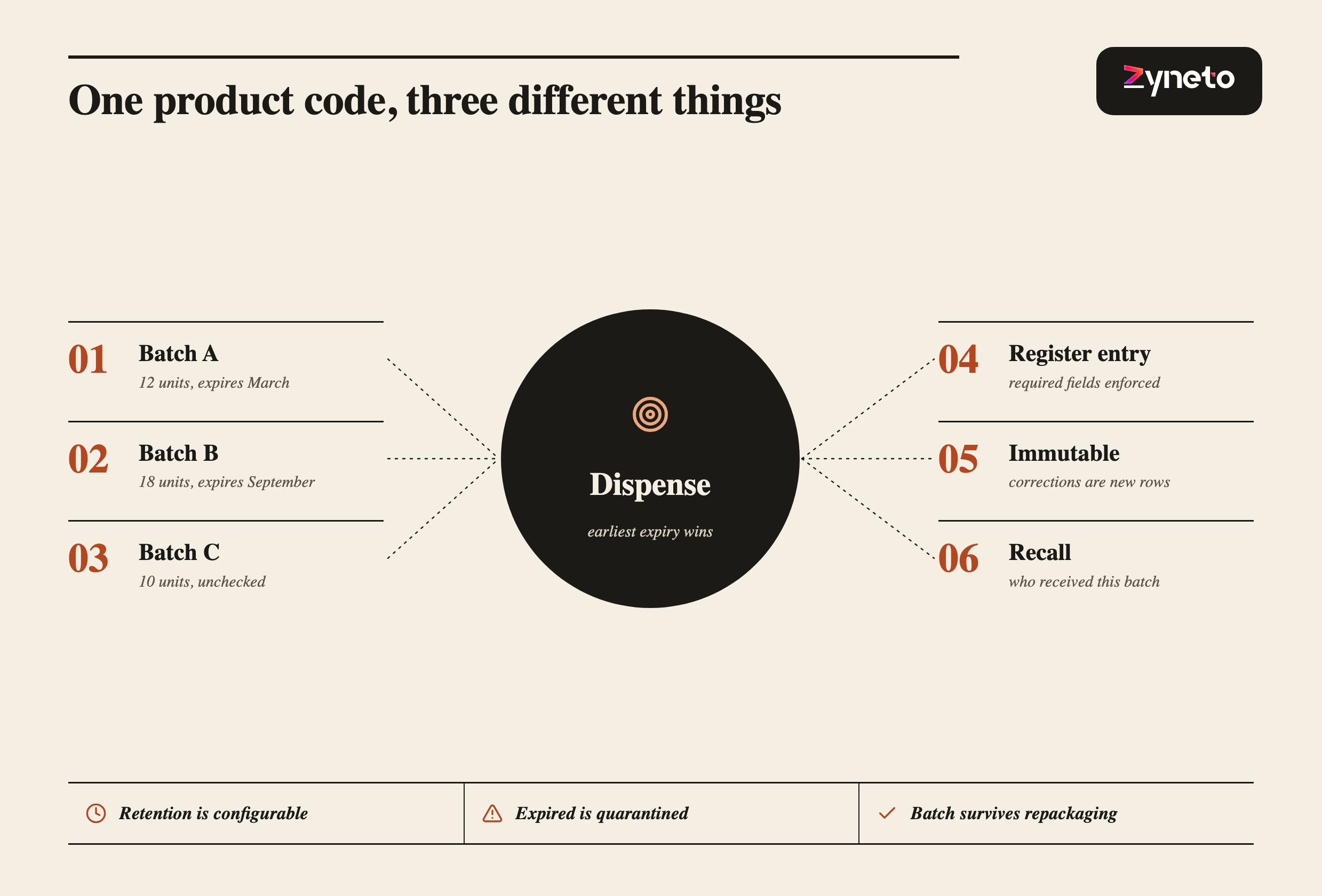
It is not. A pharmacy does not hold 40 units of a drug. It holds 12 of batch A expiring in March, 18 of batch B expiring in September, and 10 of batch C it has not checked. Those are three different things that happen to share a product code, and almost every decision the software makes has to pick between them.
Dispense the wrong one and the consequences are not commercial. Selling expired stock is an offence. Missing a batch in a recall means you cannot tell the regulator or the patient who received it. Getting first-expired-first-out wrong is not an inefficiency, it is the mechanism by which expired medicine reaches someone.
Then there is the register. Under India's Drugs and Cosmetics Rules, supply of Schedule H and Schedule H1 drugs must be made against a prescription or signed written order which the licensee retains, and Schedule H1 medicines require a separate register. Rule 65(3)(h) says those records shall be maintained for three years and be open for inspection. Rule 65(7) is the general rule for everything else: not less than two years from the date of the last entry. Two rules, two periods, so retention is configuration per record type rather than one constant.
The schedule list itself changes. Pregabalin was brought under Schedule H1 by Gazette Notification G.S.R. 377(E) dated 13 May 2026, published in the Gazette of India Extraordinary on 20 May 2026. A product with the schedule hard-coded against each drug needs a code change every time the Ministry moves one.
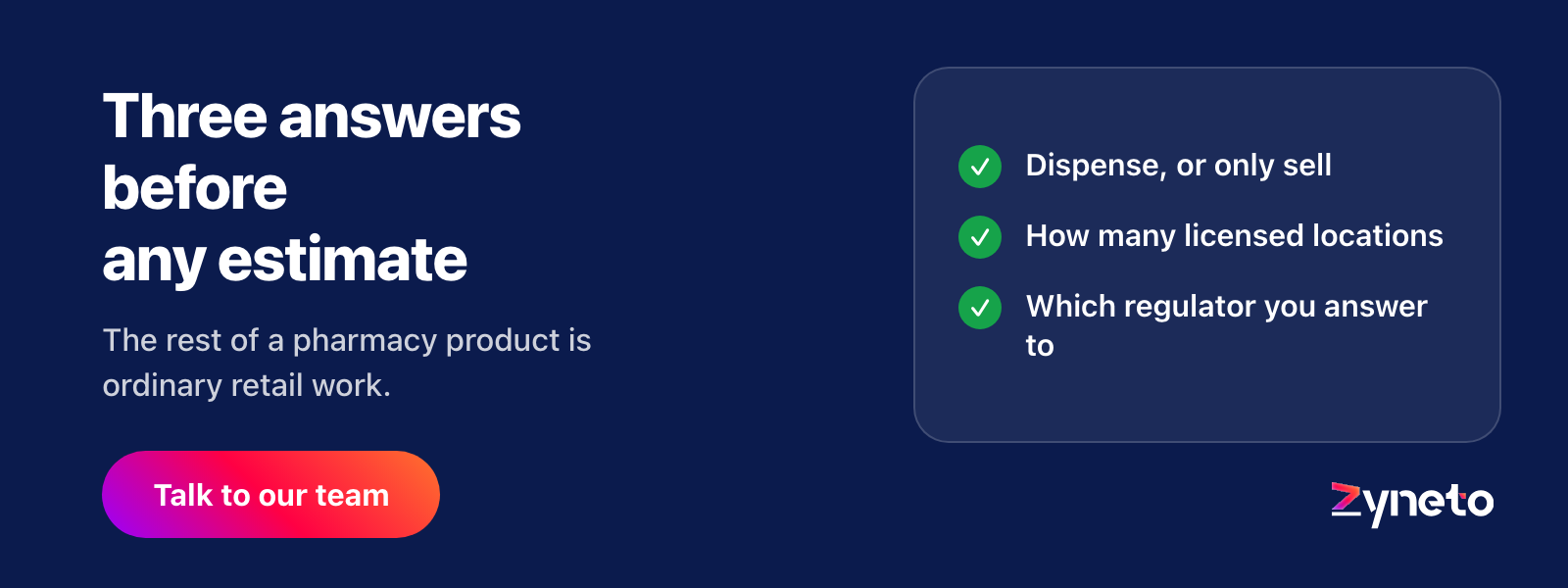
Three questions set the price. Does the software dispense, or only sell? How many locations, and do they transfer stock? And which regulator are you answering to? Everything else (billing, loyalty, reports) is ordinary retail work.
Why is pharmacy inventory different from retail inventory?
The single most consequential decision in this product is whether batch is an attribute of a stock line or the identity of it. Make it the identity. Every quantity you hold, move, sell or write off belongs to a batch with its own expiry date, and a column cannot answer what expires next week.
It has to be the identity. Every quantity, every movement, every sale and every count is against a batch, and the product-level number is a sum rather than a stored value. Systems that keep a product quantity and a separate batch table drift apart within weeks, and the drift is invisible until a recall needs an exact answer.
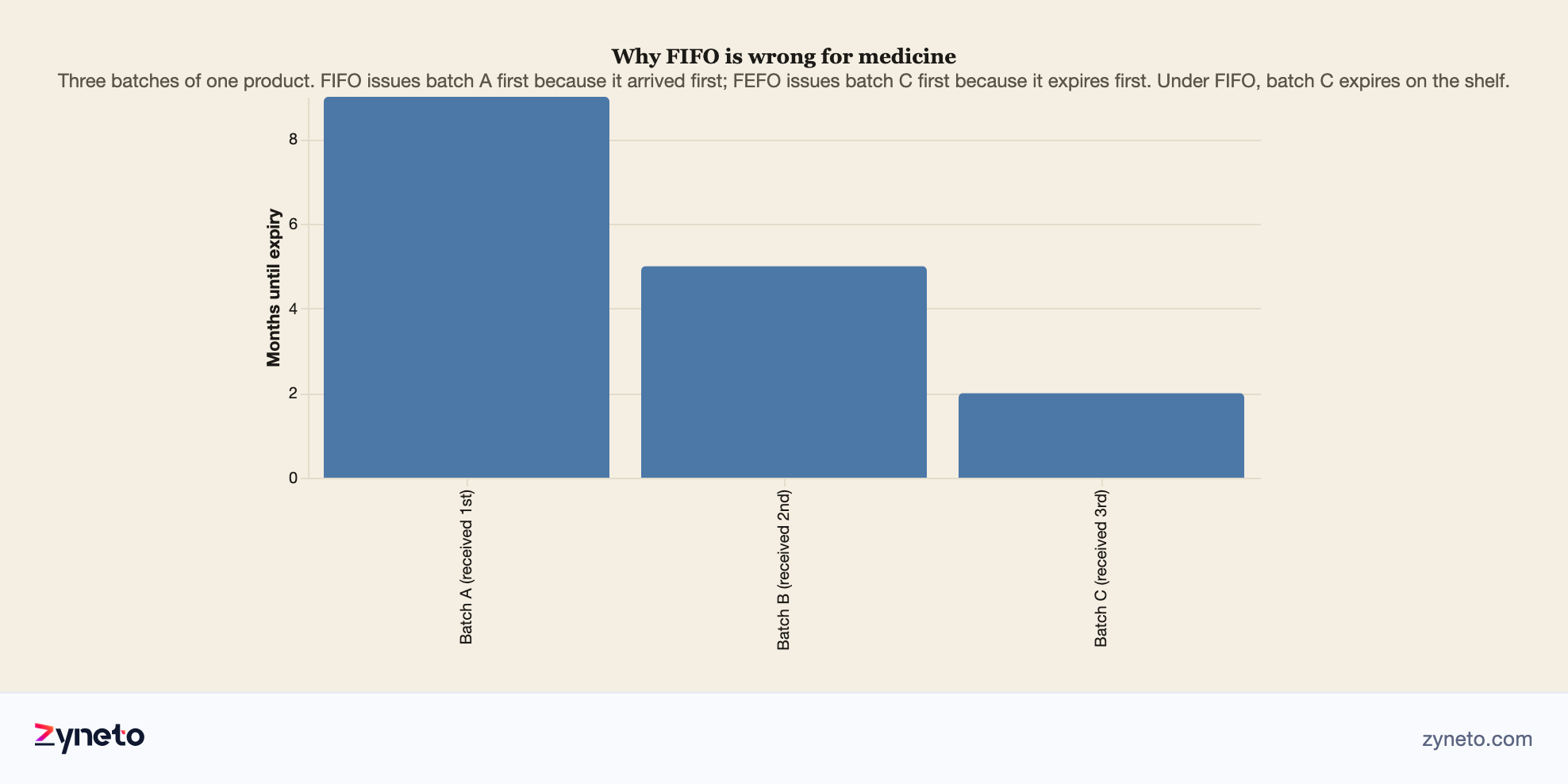
Expiry drives allocation, which means FEFO rather than FIFO. First expired, first out requires the system to know expiry at the point of dispensing and to pick the earliest-expiring saleable batch by default. First in, first out is wrong here: a batch received later may expire sooner, and in this category that is not a rounding error.
Near-expiry has a workflow before it has a report. Stock approaching expiry needs to be visible early enough to return to the supplier under whatever credit terms exist, which is typically a window of months rather than days. A product that only reports expired stock reports losses that were preventable.
Expired stock must be quarantined, not deleted. It moves to a non-saleable location, waits for documented destruction or supplier return, and leaves an audit trail. Writing it off with a stock adjustment loses the record that proves it was not sold.
Batch has to survive repackaging. A strip cut from a box, a bottle dispensed into a smaller container, a loose-sale quantity broken out of a pack: each keeps the batch of its parent, and a system that loses the link at the moment of breaking a pack has broken the recall chain at exactly the point most sales happen in a neighbourhood pharmacy.
Recall is the test the data model is really for. Given a batch number, the system must produce every unit received, every unit still in stock across every location, and every patient or customer it was dispensed to, quickly. If that query is hard to write, the model is wrong.
What is a Schedule H1 register and what does software need to do about it?
Scheduled drugs bring record-keeping obligations that are separate from your sales records and are not satisfied by being able to export a spreadsheet.
Schedule H and H1 supply requires a prescription or signed written order, retained by the licensee. Schedule H1 also requires a register with prescribed contents, and rule 65(3)(h) requires those records to be maintained for three years. Rule 65(7) preserves every other register and record for not less than two years from the date of the last entry rather than from the date of each entry, which is a clock most developers implement incorrectly on the first attempt.
The two periods come from two different rules, and the commentaries that report a conflict have applied the general rule to the specific one. Rule 65(3)(h) gives the Schedule H1 register three years. Rule 65(7) gives every other register and record not less than two years from the date of the last entry. Build retention as a configurable value per record type and per jurisdiction, and state the configured value on screen so the pharmacist knows what the system is enforcing.
Schedule X is stricter again, with tighter storage, separate records and different retention. Narcotic and psychotropic substances sit under their own statute entirely, with their own forms.
The register entry has required fields and they are not yours to choose. Patient name, prescriber details, drug, quantity, date, and the pharmacist dispensing. The system should refuse to complete a Schedule H1 dispense without them, because an incomplete register is the finding an inspector writes down.
The pharmacist, not the till operator, is the actor on a scheduled dispense. That distinction has to exist in the user model before it can be recorded, and it is the kind of thing retrofitted badly by adding a dropdown that anyone can set to anyone.
Make the register immutable and corrections additive. An entry edited after the fact is worthless as a legal record. Corrections are new entries referencing the original, with both visible to an inspector.
How should software handle partial fills and repeat prescriptions?
The dispensing flow is where this product earns its name, and it is considerably more stateful than a retail sale.
A prescription is not one transaction. It may be dispensed in part because stock is short, with the balance owed and collected later. It may be repeatable a fixed number of times. It may be for a quantity that does not divide into available pack sizes, which forces a decision about whether to over-supply, under-supply or split a pack.
Substitution needs rules and a record. Dispensing a generic against a branded prescription is permitted in some circumstances and not others, and when it happens the record must show what was prescribed and what was supplied.
Interaction and allergy checking is a buy, not a build. The drug databases that power it are licensed products maintained continuously, and building one is not a software project. The integration is modest; the licence is a recurring cost that belongs in your plan from the start.
Dosage and label generation is where errors become harm. The label that goes on the box is generated from structured data, and it has prescribed content in most jurisdictions. Treat it as a regulated output with its own tests rather than as a print template.
Keep the patient record thin unless you intend to be a clinical system. The moment you store diagnoses and clinical notes you are holding health data under a different regime, with different obligations, and the scope change is larger than it looks from the outside.
Insurance, reimbursement and who is actually paying
In many markets the person collecting the medicine is not the person paying for it, and that single fact doubles the billing model.
A claim is a parallel transaction to a sale. The patient pays a co-payment, the insurer or scheme pays the rest, and the two settle on different timescales through different channels. The system has to record one dispensing event with two financial counterparties and reconcile both.
Eligibility has to be checked before dispensing, not after. Finding out a claim was rejected after the patient has left with the medicine means the pharmacy has absorbed the cost. Where a real-time eligibility interface exists, using it is the whole value; where it does not, the rules have to be encoded locally and kept current.
Formularies and prior authorisation change what may be dispensed. A drug that is covered for one scheme is not covered for another, and some require approval before supply. These are rules that change on the payer's schedule and belong in data.
Rejections need a workflow with an owner. A rejected claim is money the pharmacy has already spent, and the resubmission window is finite. A list of rejections nobody is responsible for is a slow write-off.
In cash markets this entire section disappears, which is a legitimate scope reduction worth asking about explicitly before anyone quotes. A pharmacy product for a purely cash market is materially cheaper than one carrying claims, and conflating the two is how quotes end up four times apart.
Purchasing is where the margin is made or lost
Retail pharmacy runs on thin margins and the buying side is where they are decided.
Purchase schemes are the complication. Suppliers offer free goods rather than discounts: buy ten, get one free. That free unit has a cost of zero and a batch and an expiry, and the effective cost per unit of the whole receipt changes. A system that records the invoice value and divides by the invoice quantity has the wrong cost on eleven units.
Expiry return terms differ by supplier and are a real asset. Knowing which suppliers accept returns, within what window, and at what credit, turns near-expiry stock from a loss into a recoverable. That is supplier master data most systems never capture.
Reorder has to understand both velocity and expiry. Ordering a quantity that will not sell before it expires is a loss even when the velocity calculation says it is correct, so the suggested order quantity is capped by shelf life rather than by demand alone.
Multi-location transfers are a regulated movement, not a stock adjustment. Stock moving between licensed premises carries documentation requirements, and the batch has to travel with it intact.
Price changes apply to stock you already hold. When a maximum retail price changes, existing stock may be labelled at the old price, and the rules about which price may be charged are jurisdictional. The system has to hold price against the batch, not only against the product.
What an inspector looks for, and what the software should produce
The regulator's visit is the moment the software either helps or becomes evidence against the business.
They ask for the registers first, in the prescribed form, for a date range. The system should produce them as a document matching the official format, not as a generic export that a pharmacist then reformats by hand.

They check that stock on the shelf matches the records, by sampling. That is a batch-level comparison, and a system whose batch quantities are derived correctly from movements will pass it. One holding a separate product total will not.
They look for expired stock in saleable locations. This is the easiest finding to avoid and one of the most common, which is why near-expiry needs a workflow that physically moves stock rather than a report that notes it.
They check the licence conditions, including who is permitted to dispense. The system's user model should encode the pharmacist's registration, because a dispense recorded against an unregistered user is a finding regardless of who actually performed it.
Produce an inspection pack as a feature. Registers for the period, batch movements, expired stock disposals with documentation, and a list of dispenses by pharmacist. It takes a day to build, it is the single most appreciated feature in this category, and it is almost never in the specification.
What is ordinary, and should be priced that way
Having described the hard parts, most of the surface area of this product is routine and should sit near the floor of our published band of $40 to $100 an hour by role, blending to $60 to $70 for a mixed team.
Point of sale, billing, tax, customer records, loyalty, day-end reconciliation, user management and a reporting layer are all well-trodden retail work. So is a basic online ordering front end, if the regulatory position in your market allows one.
The parts that need senior time are the batch and register model, the dispensing state machine, and the integrations.
Speed at the counter is a product requirement, not a nice-to-have. A pharmacist serving a queue will not tolerate a three-second search, and the system's usability under time pressure determines whether the regulated parts get used properly or worked around. A slow Schedule H1 register is a register that gets completed at the end of the day from memory.
Offline matters more than people expect. A pharmacy cannot stop dispensing because the internet is down, so the till and the dispensing flow need to work locally and reconcile afterwards, which pulls in the same conflict-handling problems as any offline-first product.
Online ordering, and the rules that decide whether you can
Every pharmacy owner asks about an app. The answer depends on law before it depends on budget.
The regulatory position on online pharmacy differs sharply by market and has moved repeatedly in several of them, including India, where the framework has been litigated and revised rather than settled. Before scoping delivery, get a current written position for your jurisdiction, because the feature may be permitted, restricted to non-prescription items, or not permitted at all.
Where it is permitted, prescription handling is the hard part, not the storefront. Validating a prescription image, preventing the same prescription being used twice across orders, and recording the dispensing pharmacist against a remote transaction are all real work.
Delivery of scheduled drugs usually carries extra conditions, including who may hand over the package and what must be recorded at the point of handover. Treating medicine delivery as ordinary parcel delivery is how a product becomes non-compliant quietly.
Non-prescription ordering is a much smaller build and is where most of the commercial return actually sits for a neighbourhood pharmacy: wellness, baby care, devices and repeat consumables.
Start there. A storefront for non-prescription items with click-and-collect gets the business online in weeks, and the prescription flow can follow once the legal position is confirmed in writing.
How we would sequence it
The batch-as-identity data model comes first, with expiry, location and cost carried at batch level and product quantities derived. Nothing else is worth building until this is right, and it cannot be corrected afterwards without reprocessing every movement.
The register second, immutable, with configurable retention per schedule and the required fields enforced at dispense time rather than validated later.
The dispensing state machine third: partial fills, owings, repeats, substitutions, each with its own record.
Purchasing fourth, including free-goods cost allocation, because the margin reporting is wrong until it exists.
Point of sale and reporting last, which will feel backwards and is not, because the counter flow depends on every decision above it.
We do not quote a fixed total before a discovery that establishes which jurisdiction's rules apply, whether the product dispenses or only sells, and how many licensed locations are in scope. What we will tell you now is that any quote that describes pharmacy inventory as inventory has not read the rules the business operates under.
FAQs
Published vendor estimates put a basic system with prescriptions, inventory and billing at $30,000 to $75,000 and advanced multi-location systems with integrations at $115,000 to $150,000 or more. Our published rate band is $40 to $100 an hour by role, blending to $60 to $70 for a mixed team. Most of the product is ordinary retail work near the floor of that band; the cost concentrates in the batch model, the statutory register and the dispensing state machine.
Because the unit of stock is a batch, not a product. A pharmacy holds specific batches with specific expiry dates, and dispensing requires choosing between them on first-expired-first-out rather than first-in-first-out. Batch must be the identity of a stock line rather than an attribute of one, with product-level quantities derived as sums. That single decision determines whether a recall can be answered, since a recall asks which batch went to whom.
Under India's Drugs and Cosmetics Rules, Schedule H and H1 drugs must be supplied against a prescription or signed written order retained by the licensee, and Schedule H1 requires a separate register with prescribed contents. Rule 65(3)(h) requires those records to be maintained for three years. Software should enforce the required fields at the point of dispensing, make entries immutable with corrections recorded as new referencing entries, and hold the retention period as configuration.
Two different rules set two different periods. Rule 65(3)(h) of India's Drugs and Cosmetics Rules requires the Schedule H1 register to be maintained for three years. Rule 65(7) is the general rule for everything else: not less than two years from the date of the last entry. Build retention as a configurable value per record type and per jurisdiction, display the configured value, and confirm the period applying in your state, because enforcement sits with state drug controllers.
FEFO means first expired, first out: the system allocates the earliest-expiring saleable batch rather than the earliest received. It matters because a batch received later can expire sooner, so FIFO will leave older-expiring stock on the shelf until it is unsaleable or, worse, dispensed after expiry. For medicines this is not an efficiency question; dispensing expired stock is an offence and FEFO is the mechanism that prevents it.
Licensed. The clinical databases behind interaction, allergy and contraindication checking are maintained products updated continuously as evidence changes, and recreating one is not a software project. Budget the licence as a recurring cost from the start rather than discovering it late, and treat the integration itself as modest work. The same applies to drug master data, which changes as products are launched, reformulated and rescheduled.
Yes. A pharmacy cannot stop dispensing because connectivity has dropped, so the till and the dispensing flow must work locally and reconcile afterwards. That brings the usual offline problems (locally generated identifiers, record versioning and a conflict queue) into a product where the records also have statutory weight, which makes the reconciliation rules a compliance question rather than only a technical one.

Vikas Choudhary
Vikas has around fifteen years of experience building software and now builds generative AI systems at Zyneto. His work covers retrieval augmented generation, agentic AI, knowledge graphs, AI memory, and the evaluation and guardrails that decide whether any of it is safe to put in front of customers. He has shipped enterprise copilots, document AI, chatbots and predictive analytics for e-commerce, fintech and marketing teams, and works day to day in Python, JavaScript and SQL. He follows multimodal models, business process automation and enterprise AI security closely, and mentors engineers moving into AI. He writes about architecture, inference cost and the failure modes that only show up at production scale.
Let's make the next big thing together!
Share your details and we will talk soon.