Restaurant Management Software Cost: Six Modules, and Why Your POS Decides the Number


A restaurant operations platform costs $28,000 to $70,000 for phase one. That is 700 hours at a $40 to $100 rate band, or about $45,500 at a $65 blend. The honest span across the six modules is 510 hours at every minimum to 980 at every maximum.
The six: the menu and availability model at 100 hours, POS and payment integration at 150, kitchen display and routing at 120, aggregator channel integration at 140, franchise reporting and reconciliation at 110, and fiscal output at 80.
This is one of the cheapest platform builds we price, and the reason is that you already own the expensive part. Your point of sale takes the money and keeps the books. What you are buying is the layer that makes your POS, your kitchen, your delivery aggregators and your head office agree about a menu — and that layer is small in hours and large in consequences.
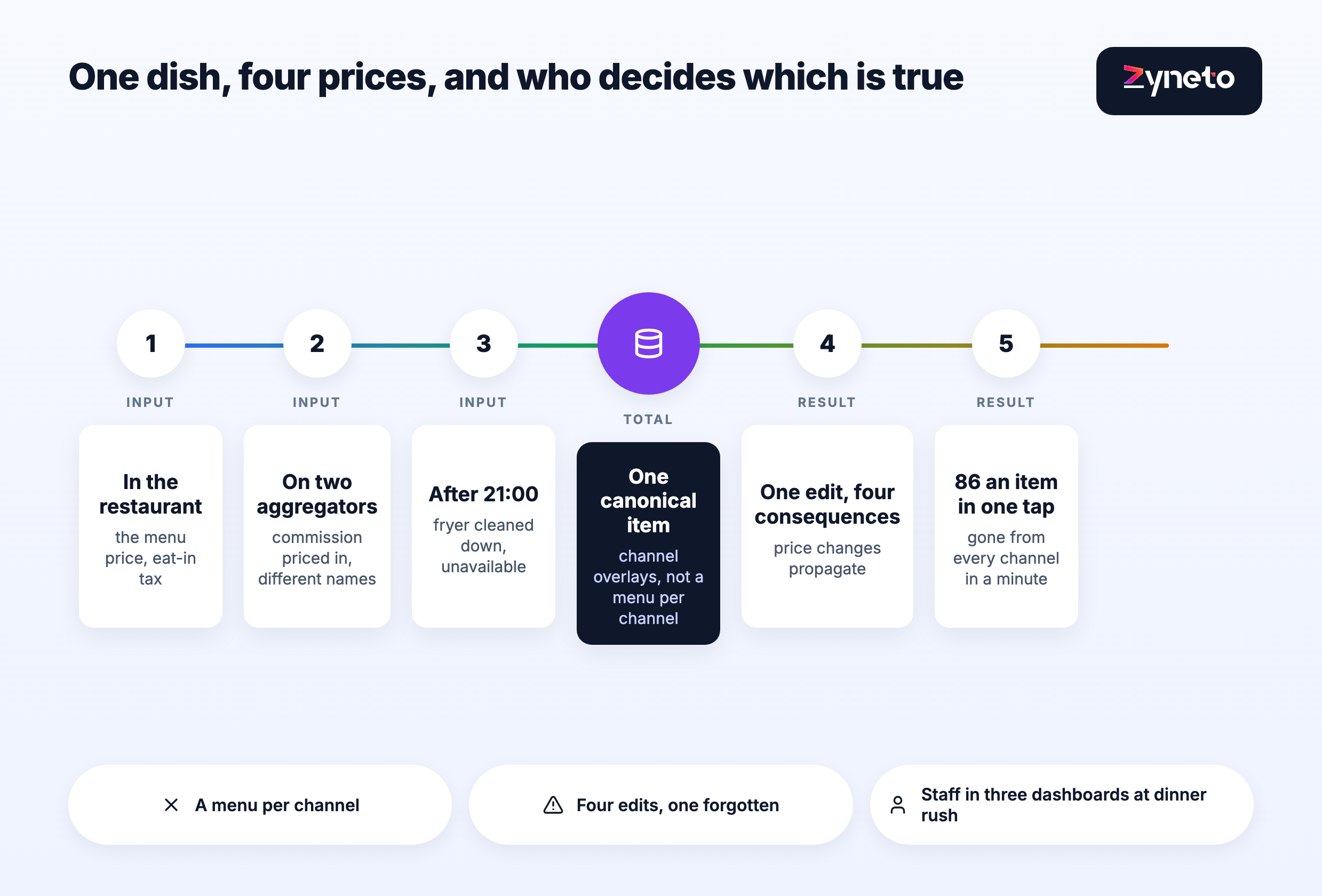
The slow part is agreeing one menu definition across four channels, not the integration work. That sentence is the whole project. Here is what it looks like in practice. A dish is £12.50 in the restaurant, £14.50 on one aggregator because their commission is baked into the price, and unavailable on a third channel after 21:00 because the fryer is cleaned down. Those are three different facts about one dish, and somebody has to decide where the truth lives before anyone writes code.
The menu and availability model is only 70 to 140 hours and it is the module everything else reads.
A dish is not a row. It is a base item, a set of modifiers with their own prices and their own availability, a channel-specific price, a channel-specific name sometimes, a tax treatment that may differ between eat-in and takeaway, and a schedule that says when it can be ordered at all.
Get this wrong and the failures are the ones customers notice. A modifier that is out of stock in the kitchen but still orderable on an aggregator produces a refund and a one-star review. A price updated in the POS but not pushed to a channel produces a margin leak nobody finds until month end.
The same plumbing carrying allergen data instead of prices stops being a margin problem and becomes a safety one. What that payload has to hold, and where it drifts between the kitchen and the channel, is covered in restaurant allergen management systems.
The shape that works is one canonical item with channel overlays, rather than a menu per channel. Channel overlays mean a price change is one edit with four consequences. A menu per channel means a price change is four edits, and the fourth one is the one that gets forgotten.
Availability is the harder half, because it changes during service rather than between services. A kitchen runs out of a prep item at 19:40 and three dishes that use it should disappear from every channel within a minute, not at the next sync. That means availability is a push from the kitchen rather than a pull from a schedule, and it means somebody at the pass needs a way to mark an ingredient down without navigating a menu tree.
The groups that handle this well treat 86ing an item as a first-class action with one tap and four downstream effects. The ones that do not end up with a staff member logging into three aggregator dashboards during a dinner rush, which is exactly when nobody has the time.
POS and payment integration runs 110 to 200 hours, and the range is set by what your POS will tell you rather than by what you want.
Some point-of-sale systems expose a documented API with webhooks for order events. Others expose a nightly export. A few expose nothing at all without a partner agreement and a commercial conversation that takes longer than the build.
This is why we sell a two-week POS capability read before anything else on larger engagements: establishing exactly what your point of sale can emit and what it cannot, ending in a written integration plan. It is the cheapest way to de-risk everything downstream.
What the read actually establishes is four things: whether order events arrive as they happen or in a batch, whether the menu can be written to or only read from, whether modifiers come through with enough structure to map onto a channel, and whether refunds and voids are reported in a way you can reconcile. Any one of those answered badly narrows the project.
You pay for a document, and the answer is sometimes that your POS cannot support what you want. That is worth knowing in week two rather than month four, and it is not what anybody hopes to hear.
The honest version of this advice: if your POS cannot emit an order event in near real time, a lot of what people want from an operations platform is not available at any price, and the right project is a smaller one.
Payment is the other half of the same module and it is usually simpler than people fear, because the POS already owns the card transaction. What the platform has to handle is the orders that arrive already paid — aggregator orders settle to you later, net of commission, on the platform's schedule — and reconciling those settlements against the orders they relate to. That is finance work, and it is the part of the build a restaurant group feels the benefit of first.
Channel integration at 100 to 190 hours covers the delivery platforms, and each one is a separate piece of work with its own rules.
They differ on the things that matter operationally. How an order arrives, whether you can reject it and what happens if you do, how long you have to accept, whether you can mark a single item unavailable or must pause the whole store, how cancellations and refunds are reported, and when settlement data becomes available.
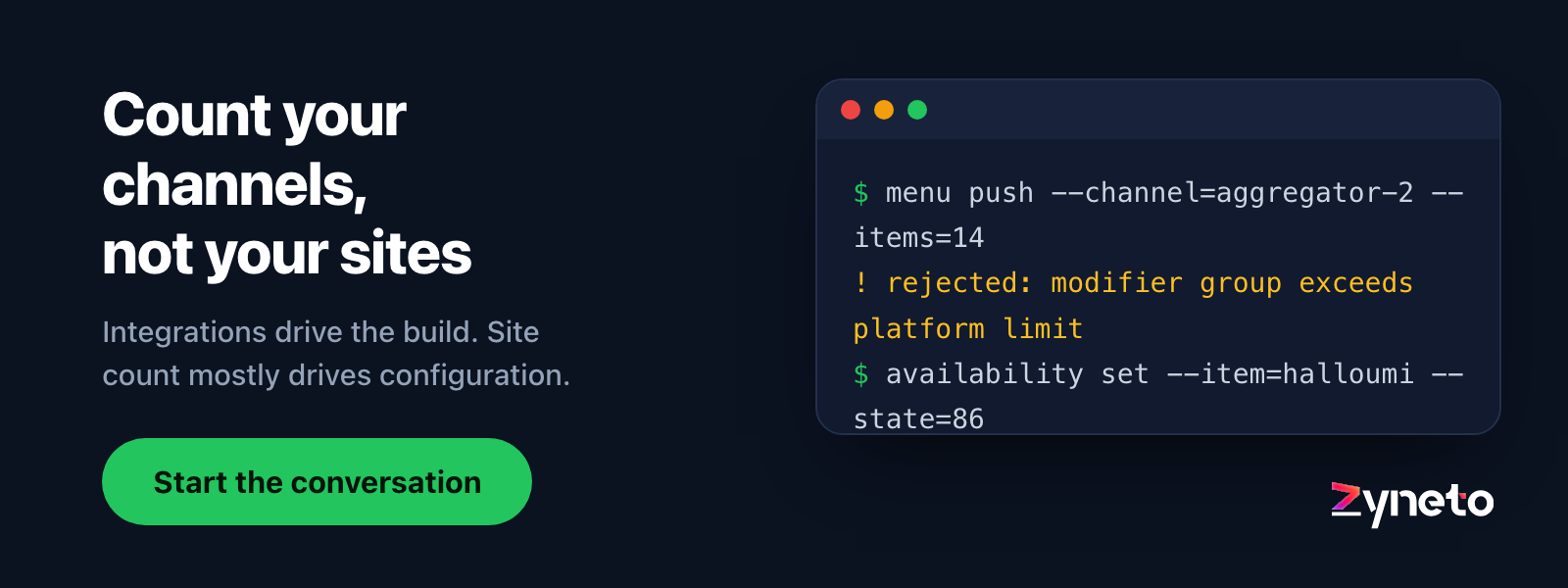
Menu push is the part that looks simple and is not. Each platform has its own structure for modifier groups, its own limits on image sizes and description lengths, and its own validation that will reject a push for a reason it describes unhelpfully. Teams that build a push-and-pray sync discover that a failed push leaves two channels disagreeing, silently, until a customer orders something you stopped selling.
The fix is cheap if designed in and expensive if retrofitted: treat a menu push as a job with a status, a diff of what changed, and an alert when a channel has been out of sync for longer than a threshold. That is a day of work at the start. After launch it is a rewrite, because by then four things read the sync state and none of them expected it to have one.
Budget per platform, not once. The second aggregator is nearly as much work as the first, and the only thing that carries over is your own internal model.
Store status is the operational lever worth building properly. Every platform lets you pause a store, and every platform punishes you for it in search ranking. A kitchen that is forty minutes behind needs to extend prep times rather than go dark, and doing that across channels from one screen — instead of three tablets by the pass — is the feature managers actually ask for once they have used the system for a week.
The kitchen display module at 90 to 170 hours is about where an order goes and in what order it gets made.
A single kitchen with one screen is straightforward. The work appears when a site has stations — grill, fryer, cold prep — and one order has items that belong to different stations and must still arrive at the pass together. Add a delivery rider waiting and an eat-in table on the same screen, and sequencing becomes a real policy rather than a queue.
Timing is the part that generalises badly from one site to another. A burger takes eight minutes and a salad takes two, so starting them together sends the salad out cold. Fire times have to be computed backwards from when the whole order should reach the pass, which means every item needs a prep duration and the routing logic needs to understand that an order is a set of items with different clocks.
Delivery adds a second clock on top. A rider arriving in six minutes changes the priority of an order that was behind two others, and a rider who is late turns a finished order into one that needs holding or remaking. Groups that ignore the rider clock get food sitting under a lamp, which is the most common quality complaint in delivery and almost never a kitchen skill problem.
We priced the screen side of this separately, including hardware and layout decisions, in kitchen display system cost. What sits in this build is the routing logic that decides what appears on which screen and when.
Franchise reporting and reconciliation at 80 to 160 hours is the module that justifies the project for a group, and it is almost always underspecified in the brief.
A franchisor needs sales by site on a consistent definition, and "consistent" is doing a lot of work in that sentence. Does a refunded order count? Does an aggregator order count gross or net of commission? Is a discount a reduction in revenue or a marketing cost? Franchisees and head office will answer those differently, and the system has to implement one answer and show its working.
Timezones and trading days sound like trivia and are not. A site that closes at 02:00 has sales after midnight that belong to the previous trading day, and a group across two countries has two definitions of when a day ends. Report on calendar days and your franchisees will tell you the numbers are wrong, because by their reckoning they are.
Royalty calculation sits on top of it. If franchise fees are a percentage of net sales, the definition of net sales is a contractual term, and the number your platform produces is the number that gets invoiced. Getting it wrong is not a reporting bug; it is a billing dispute with your own franchisees.
The same reporting layer earns its keep in a second way that nobody briefs for: comparing like sites. A group with thirty restaurants wants to know which three are losing margin on delivery and why, and that question needs channel-level revenue net of commission against site-level labour and waste. None of that is hard once the definitions are settled. All of it is impossible before they are.
Sixty to 120 hours, and the range is entirely about which markets you trade in.
A restaurant bill is a regulated document in a growing number of places. India requires e-invoicing through the Invoice Registration Portal above a turnover threshold. Several Gulf markets run their own e-invoicing regimes with clearance before issue. European markets are moving the same way.
The constraint this creates is architectural rather than cosmetic. A document that an authority must clear before it is valid cannot be produced by a nightly batch, which means fiscal output belongs at the point of sale rather than in the reporting layer.
The practical consequence for scoping is that this module cannot be deferred to phase two in a market that requires clearance. It is not a report; it is part of the transaction.
Phase one of a restaurant operations platform is 700 hours, which is $28,000 to $70,000 at a $40 to $100 rate band and about $45,500 at a $65 blend. Six modules: the menu and availability model, POS and payment integration, kitchen display and routing, aggregator channels, franchise reporting, and fiscal output.
Every competitor publishes a total with no hours behind it. Here are the hours.
Module | Hours |
|---|---|
Menu and availability model | 70 to 140 |
POS and payment integration | 110 to 200 |
Kitchen display and routing | 90 to 170 |
Aggregator channel integration | 100 to 190 |
Franchise reporting and reconciliation | 80 to 160 |
Fiscal and compliance output | 60 to 120 |
The worked example takes a mid-point from each: 100 plus 150 plus 120 plus 140 plus 110 plus 80, which is 700 hours. At $40 per hour that is $28,000. At $100 it is $70,000. At a $65 blend, about $45,500. The full span is 510 hours at every minimum to 980 at every maximum.
Deliberately not in that number: a POS replacement, hardware, and any PCI DSS assessment fee. The first two are yours to buy and the third belongs to a qualified assessor rather than to us.
If what you actually want is a consumer-facing ordering app rather than the operations layer behind it, that is a different build and we costed it in restaurant app development cost.
Channels move it more than sites do. Twenty restaurants on one POS and one aggregator is a smaller build than four restaurants on two POS systems and three aggregators, because the integration count drives the work and the site count mostly drives configuration.
Second is whether you run more than one point-of-sale system. Groups that grew by acquisition frequently do, and it is the single most expensive discovery in this category: every downstream module now has two sources with different event shapes, and the reconciliation between them is permanent rather than one-off.
Third is franchise reporting, through the definition problem rather than the code. Agreeing what counts as net sales across a franchise network is a commercial negotiation that the build waits on.
What barely moves it: the number of sites, the design of the dashboards, and whether staff use tablets or fixed terminals. Those are the first questions we are usually asked and they sit comfortably inside normal variance, which is worth saying plainly because they are also the easiest things to spend a discovery workshop arguing about.
Three failures, none of them technical.
The first is specifying the platform before reading the POS. Everything downstream depends on what the point of sale can emit, and that is answerable in two weeks by asking rather than in four months by discovering.
The second is building a menu per channel. It is the faster start and it guarantees that channels drift, because the edit that keeps them aligned is manual and the person doing it is busy.
The third is leaving net sales undefined. A franchise group that has not agreed what counts will not agree after the reports exist; it will argue about them instead, and the platform gets blamed for a contract that was never settled.
There is a fourth that is less common and more costly: assuming the aggregators will stay still. Platforms change their APIs, their commission structures and their menu validation on their own schedule, and a group running three channels should expect to spend some engineering time every quarter keeping up. That is an operating line rather than a build line, and it belongs in the plan rather than in a surprise.
The cost question has a short answer and it is the arithmetic above. The longer answer is that a restaurant platform is cheap because your POS already did the expensive part, and the moment a second POS appears in the estate, that stops being true.
A restaurant operations platform phase one costs $28,000 to $70,000, which is 700 hours at a $40 to $100 hourly band, or about $45,500 at a $65 blended rate. The span across the six modules runs 510 hours at every minimum to 980 at every maximum. It is cheaper than most verticals we price because the point-of-sale system already handles payment and bookkeeping; the build is the layer that makes POS, kitchen, delivery channels and head office agree.
Six. The menu and availability model at 70 to 140 hours. POS and payment integration at 110 to 200. Kitchen display and routing at 90 to 170. Aggregator channel integration at 100 to 190. Franchise reporting and reconciliation at 80 to 160. Fiscal and compliance output at 60 to 120. A mid-point from each totals 700 hours.
Because the integration range is set by what it will tell you rather than by what you want. A modern system with a documented API and order-event webhooks sits at the bottom of the range. One that exposes only a nightly export sits at the top, because the platform then reconciles rather than reads. Some require a partner agreement before exposing anything, which is a commercial conversation that can take longer than the build. If your POS cannot emit an order event in near real time, much of what people want from an operations platform is unavailable at any price.
Two weeks establishing exactly what your point of sale can emit and what it cannot, ending in a written integration plan. It is the cheapest way to de-risk everything downstream, and it is deliberately sold as a document rather than a build. The uncomfortable part is that the answer is sometimes that your POS cannot support what you want — which is far better to learn in week two than in month four.
Channel integration is 100 to 190 hours in total, and the work is per platform rather than once. Each has its own rules for how orders arrive, whether you can reject them, how long you have to accept, whether you can mark a single item unavailable or must pause the whole store, and when settlement data appears. Menu push differs too, with each platform using its own modifier structure and validation. The second aggregator costs nearly as much as the first.
Three things sit outside the build number: a POS replacement, hardware such as kitchen screens and terminals, and any PCI DSS assessment fee. The first two are bought from vendors and the third is paid to a qualified assessor rather than to a development team. Aggregator commissions and payment processing charges are operating costs rather than build costs.
Buy if you run one point-of-sale system, one or two channels, and no franchise reporting obligation — the vendor platforms fit that shape and cost less than any build. Build the layer when your menu has to stay consistent across several channels you do not control, or when head office needs sales on a definition your POS does not produce. Replace the POS only when it cannot emit order events at all, which is a far larger project than the one priced here.

Vikas has around fifteen years of experience building software and now builds generative AI systems at Zyneto. His work covers retrieval augmented generation, agentic AI, knowledge graphs, AI memory, and the evaluation and guardrails that decide whether any of it is safe to put in front of customers. He has shipped enterprise copilots, document AI, chatbots and predictive analytics for e-commerce, fintech and marketing teams, and works day to day in Python, JavaScript and SQL. He follows multimodal models, business process automation and enterprise AI security closely, and mentors engineers moving into AI. He writes about architecture, inference cost and the failure modes that only show up at production scale.
Share your details and we will talk soon.
Be the first to access expert strategies, actionable tips, and the trends actually shaping the digital world. No fluff - just practical insights delivered straight to your inbox.
Dive into our blog and stay ahead of the curve with expert perspectives, future-ready trends, and tech tips written for decision-makers and doers alike.