Podcast App Development Cost: The Licensing Layer You Don't Pay For


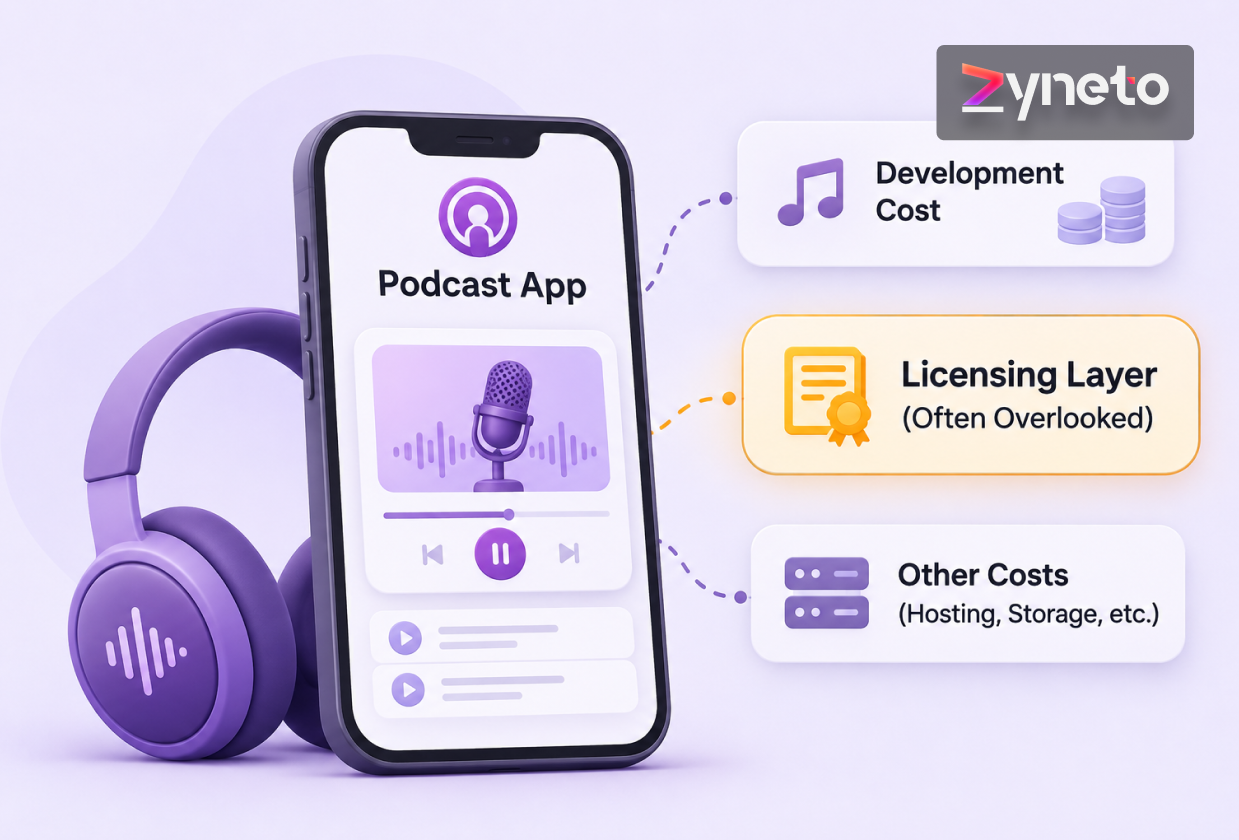
Every agency blog prices a podcast app as a cheaper music app. That framing is wrong in a way that costs you money, because it treats the difference as a discount rather than a different shape. A podcast app is a rights platform with the rights removed. The licensing layer does not shrink. It disappears, and the money moves somewhere most quotes never mention.
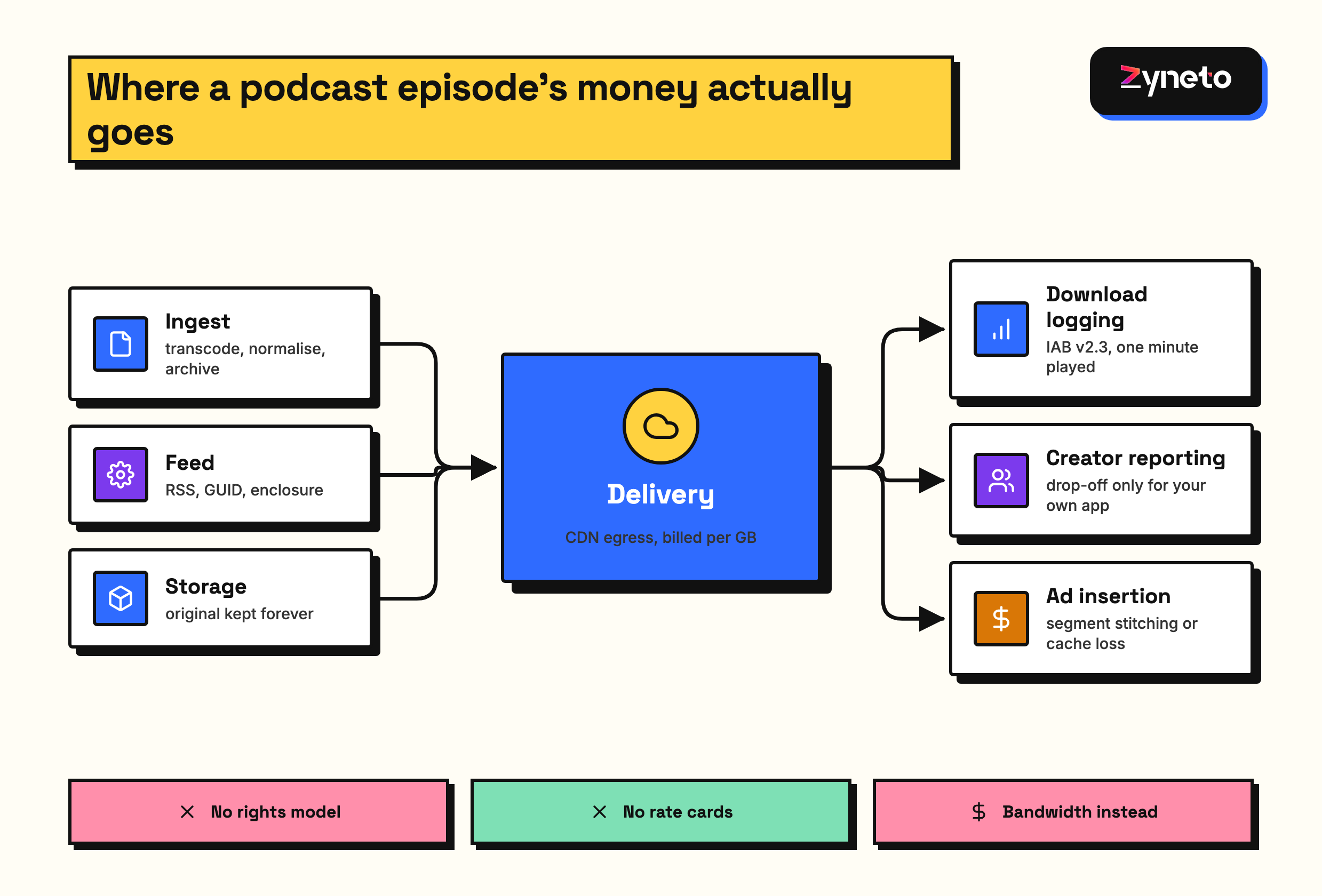
Here is the arithmetic, from our own published numbers. Our media software development page puts a rights and royalty platform at 1,480 hours of phase one work, broken into seven modules, at $59,200 to $148,000 across our rate band of $40 to $100 per hour depending on role. A podcast app does not build four of those seven modules. Rights and party model, deal and rate cards, royalty calculation, statements and payouts come to 900 hours of that 1,480. At a $65 blend that is $58,500 you do not spend.
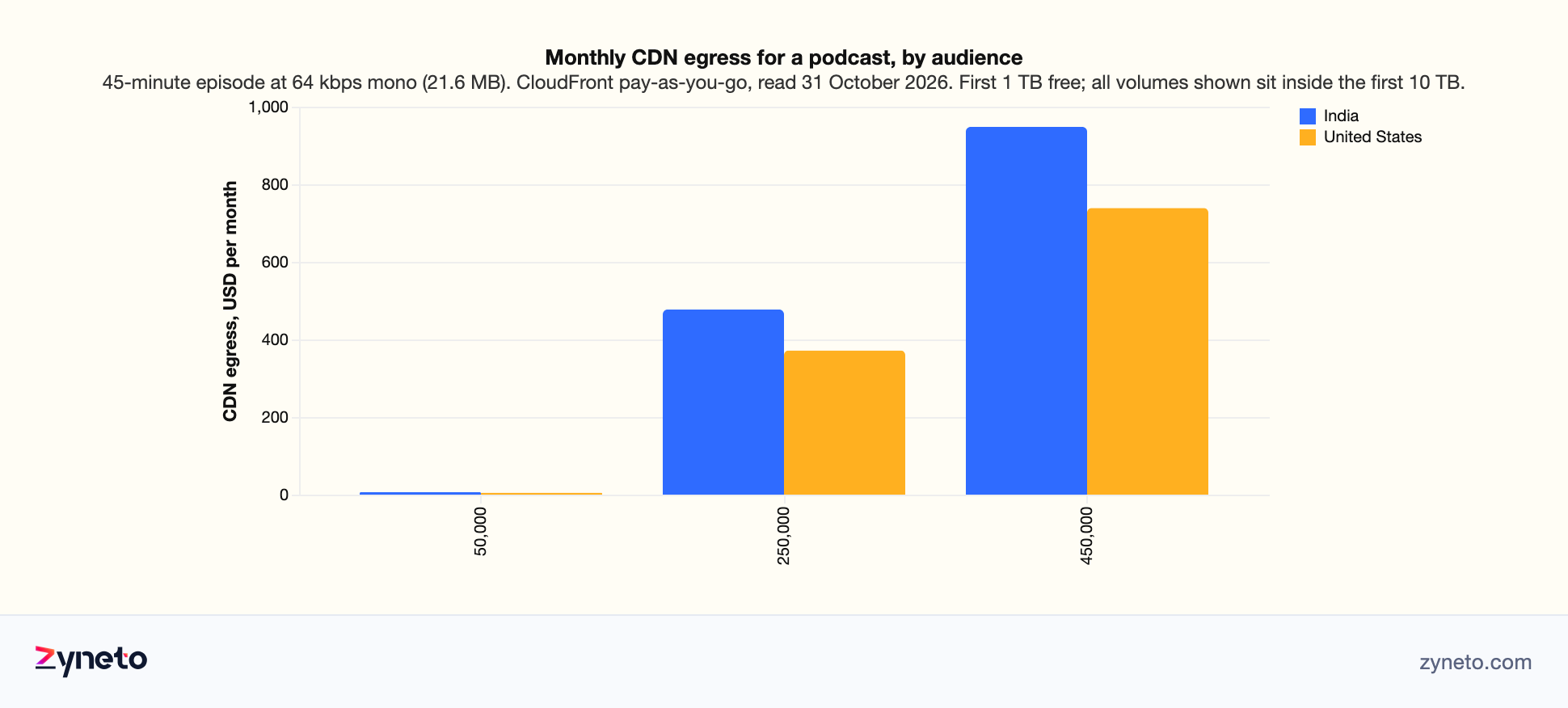
What you spend it on instead is bandwidth, and nobody quotes you that. A show doing 450,000 downloads a month at a normal spoken-word bitrate moves about 9.7 TB and costs roughly $739 a month in CloudFront egress in the United States, $948 in India. That is a recurring number with no ceiling, and it grows with exactly the metric your investors want to see grow.
Three questions decide what you actually pay. What bitrate ships? Does the product do dynamic ad insertion, and if so does it stitch whole files or segments? And is the catalogue open RSS or private paid feeds? Everything else, meaning playback, offline sync and a creator dashboard, is well-trodden work any competent team can scope from memory.
A podcast app is a rights platform with the rights removed. The party model, rate cards, royalty calculation and statement generation are 900 of the 1,480 hours we publish for a royalty platform, and a podcast needs none of them. RSS is an open specification and there is no collecting society.
Music streaming is expensive because of paperwork that executes in code. You need a party model that knows a work is not a recording and that both have multiple owners with shares that must sum correctly. You need rate cards per territory per deal. You need a calculation engine that turns plays into money, and a statement generator whose output a rights holder will accept. Those four modules are 900 of the 1,480 hours we publish, and they are the hardest 900, which is why our rate band puts rights modelling and royalty calculation near the $100 ceiling rather than the $40 floor.
Podcast distribution has none of this. RSS is an open specification. There is no mechanical licence for distributing a podcast you produced, no collecting society to report to, no rate card, no per-territory split. The publisher owns the audio and points a feed at it. That is the whole rights model.
The exception is music inside the episode, and it is a real one. Play a commercial track under your intro and you are back in sync and mechanical licensing, with the same per-track clearance a karaoke product deals with. This is why production libraries exist and why most shows use them. If your product lets creators upload arbitrary audio and you monetise it, get a lawyer before you get a developer. But that is a content-policy problem, not a platform-architecture problem, and it does not put the 900 hours back.
|
Module, from our media platform page |
Hours |
Podcast app |
|---|---|---|
|
Rights and party model |
200 |
Not built |
|
Deal and rate cards |
240 |
Not built |
|
Royalty calculation |
260 |
Not built |
|
Statements and payouts |
200 |
Not built |
|
Catalogue and identifiers |
180 |
Built, much smaller — episodes and GUIDs, not ISRC and ISWC |
|
Usage ingest |
220 |
Built, differently — download logging, not DSP usage files |
|
Reporting and admin |
180 |
Built |
The IAB Podcast Measurement Technical Guidelines v2.3, released September 2026, define a valid download as the file header plus enough content to play for one minute. There is deliberately no byte threshold in the specification, because the byte count depends on the header size and the bitrate of each individual file. Partial requests, the HTTP 206 responses every podcast player issues, count only if the download reaches that one-minute threshold. Repeat requests are deduplicated across a calendar-day window in a timezone the publisher chooses.
Work out what that means for a 45-minute episode at 64 kbps mono, which is the normal spoken-word shipping format. One minute of audio at 64 kbps is 480 KB. The whole episode is 21.6 MB. So a download counts after you have served roughly 0.5 MB, and if the listener actually listens you serve 45 times that.
Your download number and your egress bill are measuring different things, and the ratio between them is your completion rate. A show with 100,000 downloads and a 30% completion rate moves a fraction of the bytes of a show with 100,000 downloads and a 90% completion rate, and both report 100,000 downloads. Any budget built by multiplying downloads by file size is wrong, usually high. Any budget that forgets bytes are still served to people who abandon at minute two is wrong the other way.
This matters commercially because your advertisers buy the download number and your CDN invoices the bytes. Build the reporting so you can see both from day one, because the first time finance asks why hosting went up 40% in a month when downloads went up 12%, the answer is a completion-rate shift and you will not be able to prove it retroactively.
CloudFront's pay-as-you-go rates, read from the AWS pricing page on 31 October 2026: the first 1 TB a month is free in every region, then the next 9 TB bills at $0.085 per GB in the United States, Mexico and Canada, $0.085 across Europe, Israel and Türkiye, $0.109 in India, and $0.110 across the Middle East and much of Africa. Japan and Australia sit at $0.114. Southeast Asia is the expensive one at $0.120.
Hold the episode at 45 minutes and 64 kbps mono, so 21.6 MB, and assume listeners complete.
|
Downloads per month |
Egress |
Billable after free tier |
US |
India |
|---|---|---|---|---|
|
50,000 |
1,080 GB |
56 GB |
$5 |
$6 |
|
250,000 |
5,400 GB |
4,376 GB |
$372 |
$477 |
|
450,000 |
9,720 GB |
8,696 GB |
$739 |
$948 |
The free tier covers a show doing under about 47,000 downloads a month entirely. That is the number most founders need and almost nobody tells them: at launch scale, your delivery cost is zero and the whole budget is the build.
The first tier runs out at about 475,000 downloads a month at this episode size, after which rates step down and, at genuine scale, you stop paying list and negotiate a committed-use contract. Do not plan past that boundary with a spreadsheet. Plan to renegotiate.
Ship 128 kbps stereo instead of 64 kbps mono and the 45-minute episode goes from 21.6 MB to 43.2 MB. The simplest way to read that is that you halve the audience you can serve for the same money: the $739 month arrives at 225,000 downloads instead of 450,000.
For spoken word, nobody can hear the difference on the devices podcasts are actually consumed on. For a show with music, scoring or field recording, some people can. That is the entire decision, and it is worth more over three years than most of the feature arguments you will have.
The reason it belongs to you and not to your developer is that it is a product and brand call with a direct, compounding cost attached, and developers default to whatever the encoder's example config says. Decide it explicitly, write it into the spec, and revisit it once you have real completion data.
Host-read ads baked into the file are free to serve. The episode is one object, the CDN caches it once per edge location, and almost every subsequent request is a cache hit you do not pay origin egress for.
Dynamic ad insertion breaks that, and how badly depends on an architectural choice most quotes do not surface. If your stitcher assembles a unique, complete audio file per listener, the CDN has nothing to share between requests. Cache hit ratio collapses, and you pay to serve every byte from origin rather than from the edge. If it stitches at segment level, the content segments stay identical for everyone and only the ad segments vary. AWS's own guidance for its MediaTailor server-side ad insertion product targets above 95% cache hit ratio on content segments and above 90% on ad segments, and explicitly warns that personalised manifests must not be cached while segments are.
Those two designs produce the same product experience and very different invoices. Ask any vendor or team quoting you dynamic ad insertion which one they are building, and ask what cache hit ratio they expect. If the answer is vague, the budget is wrong.
Creators do not upload shipping-ready audio. They upload a 1.2 GB WAV from a recording app, an MP3 at whatever bitrate their editor defaulted to, or occasionally a file with a corrupt header that plays fine in QuickTime and nowhere else. The ingest pipeline is the part of the product most likely to be underestimated, because the happy path takes an afternoon and the real path takes three weeks.
Transcoding is cheap and loudness normalisation is not optional. Podcast listening happens in cars and on walks, where a show that is 6 dB quieter than the previous one in the queue gets skipped rather than turned up. The industry target is −16 LUFS for stereo and −19 LUFS for mono, and hitting it means measuring the uploaded file and applying gain, not just re-encoding at a fixed bitrate. Build it into ingest and every episode is consistent. Leave it to creators and you will be fielding support tickets about volume for the life of the product.
Store the original upload and never overwrite it. Transcode settings change: you will want a different bitrate, a new format, or a re-encode after you discover a bug in your pipeline. If the only copy of an episode is the lossy file you generated in year one, you cannot re-derive anything, and re-encoding an MP3 to a different MP3 compounds artefacts. Archive storage is the cheapest line in this whole budget and the only one that is unrecoverable if you skip it.
Chapters, transcripts and episode artwork each add a processing step. Transcripts in particular are now a default expectation rather than an accessibility extra, and they are also the thing that makes a back catalogue searchable, which is the single highest-value feature most podcast products never build. Speech-to-text is a per-minute API cost that scales with catalogue size rather than with audience, which makes it one of the few costs here that does not grow when you succeed.
Every podcast platform ships a dashboard, and most ship the wrong one first: a line chart of downloads over time, which tells a creator nothing they cannot get from their host.
The numbers creators act on are different from the numbers they ask for. They ask for total downloads. They act on where listeners drop off inside an episode, which episodes keep bringing in new listeners months after publication, and which apps their audience actually uses, because that decides what they optimise for. None of those come free with download logging; each needs deliberate instrumentation.
Drop-off reporting is the hard one, and it is hard for a structural reason. Downloads happen at 3am over wifi when a device syncs. Listening happens at 8am on a commute. If your only signal is the HTTP request for the file, you know nothing about what happened afterwards. Getting drop-off data means the playback client reports progress back, which means you only have it for listeners using your own app and never for the ones in Apple Podcasts or Spotify. State that limitation in the dashboard itself, because a creator who thinks a 40% drop-off figure covers their whole audience will make bad editorial decisions with it.
Advertiser-facing reporting has a different bar than creator-facing reporting. A creator will accept your numbers. An advertiser buying on those numbers will eventually ask whether your measurement is IAB-certified, and certification is an annual independent audit, not a self-assessment. If the business model involves selling inventory, the measurement implementation has to be built to the specification from the start rather than approximated and corrected later, because an audit failure invalidates historical numbers you have already invoiced against.
Apple's podcast requirements are not suggestions, and three of them break products that were built without reading them.
Your server must support HTTP HEAD and byte-range requests. Apple states this directly, and it is also what makes the IAB partial-download rule work at all. Put your audio behind something that answers every request with a full 200 and you have broken both artwork display and the measurement standard you will be audited against.
Every episode needs a GUID that never changes, and a unique enclosure URL. Apple ignores duplicate enclosure URLs outright. Teams that generate enclosure URLs from a mutable field, such as a title slug, a CDN path that changes when storage is reorganised, ship a migration that silently re-publishes a back catalogue as new episodes into every listener's queue. This is the single most common self-inflicted podcast platform incident, and it is unrecoverable from the publisher side because the damage happens in clients you do not control.
Filenames and URLs are restricted to letters and digits, dates must be RFC 2822 with the weekday and a timezone offset, and tag values are case-sensitive down to the exact capitalisation of category names. These are trivial to satisfy and expensive to retrofit, because by the time you notice, a directory has already rejected the feed and you are waiting on a re-crawl.
Build a feed validator into continuous integration on day one. It costs a day. The alternative is discovering a malformed feed when a creator tells you their show vanished from Apple Podcasts.
Paid podcast subscriptions work by issuing each subscriber a private RSS URL containing a token. The subscriber pastes it into whatever player they already use. That is the entire mechanism, and it is worth understanding what it does and does not give you.
There is no DRM in podcasting. A private feed is an unguessable URL, not an encrypted file. A paying subscriber can hand their feed URL to anyone, and that person gets the full catalogue. Platforms manage this with per-token download-rate limits, rotation, and watermarking, not with prevention.
Price the subscription assuming some leakage and design the limits to catch the egregious cases, which in practice means one token pulling at a volume no human listener produces. Trying to build real content protection into a format whose entire value is that any player can read it is how teams spend six figures and arrive back where they started.
The commissioning implication is that the paywall is a billing and token-management problem, not a media-security problem. Scope it as such. It is substantially cheaper than the DRM conversation that music and audiobook products genuinely have to have.
The ingest and delivery path comes first, because everything else depends on the shape of it and because it is the only part whose mistakes are expensive to undo. That means feed generation and validation, storage and CDN with the bitrate decision made and written down, download logging that can be audited against the IAB definition, and a GUID and enclosure-URL scheme you have deliberately made immutable.
The creator dashboard can wait, and almost always should. It is the part founders most want to see first because it is the part they will use, and it is the part most likely to be rebuilt once real creators have told you which numbers they actually care about. Ship reporting as a flat export before you ship charts.
Dynamic ad insertion should be deferred until there is inventory to insert. It is a meaningful build, it changes your cost model, and it is the clearest case on the whole project of something that is cheaper to add later than to carry unused.
Offline sync deserves more respect than it usually gets. It is where podcast apps earn their retention, it is fiddly across both platforms, and it interacts with your measurement in ways that surprise people. A device that downloads six episodes overnight on wifi generates six downloads at 3am and zero listens until the commute.
Our rate band is published: $40 to $100 an hour by role, blending to $60 to $70 for a mixed team. We do not quote a fixed total on a build like this before a discovery that establishes the bitrate, the ad model and whether the feeds are public or private, because those three answers move the delivery cost by a factor of four and the build cost by rather less. What we can tell you now, before any discovery, is which 900 hours you are not paying for.
The build is smaller than a music streaming app because the licensing layer does not exist. Our published rate band is $40 to $100 an hour by role, blending to $60 to $70 for a mixed team. For comparison, we publish a full rights and royalty platform at 1,480 hours of phase one work, or $59,200 to $148,000; a podcast app does not build four of those seven modules, which removes 900 hours. The variable nobody quotes is delivery: CDN egress is $0 at launch scale and roughly $739 a month in the United States at 450,000 downloads.
Because podcast distribution has no mechanical licensing. There is no collecting society to report to, no per-territory rate card, no royalty calculation engine, and no statement generator that a rights holder has to accept. Those four modules are 900 of the 1,480 hours in a rights platform, and they are the most expensive hours in it. A podcast publisher owns the audio and points an RSS feed at it, which is the entire rights model.
Under the IAB Podcast Measurement Technical Guidelines v2.3, released September 2026, a valid download is the file header plus enough content to play for one minute. There is no fixed byte threshold, because that depends on each file's header size and bitrate. HTTP 206 partial requests count only if they reach the one-minute threshold, and repeat requests from the same listener are deduplicated across a calendar day. A download does not confirm that anyone listened.
Take a 45-minute episode at 64 kbps mono, which is 21.6 MB. On CloudFront's published rates as of 31 October 2026, the first 1 TB a month is free in every region, then $0.085 per GB in the US and Europe, $0.109 in India and $0.110 across the Middle East. That puts 50,000 downloads a month at about $5, 250,000 at about $372, and 450,000 at about $739 in the US. Shows under roughly 47,000 downloads a month fall entirely inside the free tier.
Yes, and the size of the increase depends on how the stitching is built. If each listener receives a uniquely assembled complete file, the CDN cannot share anything between requests, cache hit ratio collapses and you pay to serve every byte from origin. If stitching happens at segment level, content segments stay identical and cacheable. AWS targets above 95% cache hit ratio on content segments for its own server-side ad insertion product. Ask which design you are being quoted.
Not for distributing podcasts your publishers own and produce. You do need them for commercial music inside an episode, where sync and mechanical licensing apply per track, which is why most shows use production libraries. If your platform lets creators upload arbitrary audio and you monetise it, that is a content-policy and liability question to resolve before launch. It does not change the platform architecture.
Each subscriber gets a private RSS URL containing a token, which they paste into any podcast player. There is no DRM in podcasting, so a private feed is an unguessable URL rather than an encrypted file, and a subscriber can share it. Platforms manage this with per-token download-rate limits, token rotation and watermarking rather than prevention. Scope a paywall as a billing and token-management problem, not a media-security one.

Vikas has around fifteen years of experience building software and now builds generative AI systems at Zyneto. His work covers retrieval augmented generation, agentic AI, knowledge graphs, AI memory, and the evaluation and guardrails that decide whether any of it is safe to put in front of customers. He has shipped enterprise copilots, document AI, chatbots and predictive analytics for e-commerce, fintech and marketing teams, and works day to day in Python, JavaScript and SQL. He follows multimodal models, business process automation and enterprise AI security closely, and mentors engineers moving into AI. He writes about architecture, inference cost and the failure modes that only show up at production scale.
Share your details and we will talk soon.
Be the first to access expert strategies, actionable tips, and the trends actually shaping the digital world. No fluff - just practical insights delivered straight to your inbox.
Dive into our blog and stay ahead of the curve with expert perspectives, future-ready trends, and tech tips written for decision-makers and doers alike.