Context Window Limits: Why There Is No Single Number


A vendor tells you the model takes a million tokens. That is a ceiling on what you can send, not a promise about what the model will use, and the distance between those two things is where long-context products disappoint.
Here is the answer, with the headline number withheld on purpose. Quality falls as context grows, the fall is measured and real, and how far it falls depends on the model to a degree that makes any single figure useless. The most quoted number on this subject comes from a 2025 preprint on web agents: success rates drop from "40-50% in baseline conditions to less than 10% in long context scenarios". That sentence now circulates flat, including on a vendor engineering blog. The paper's own table does not support it for every model. At 150,000 tokens, o4-mini scores 21.2% and GPT-4.1 scores 2.7%. Same benchmark, same context length, a spread of roughly eight times.
So the usable finding is the spread, not the average. You cannot size a product on "under 10%", you cannot plan a budget around it, and quoting it to a board invites a correction you will have to issue yourself. What you can do is measure your own pipeline, on your own task, at the lengths it will actually see.
The rest of this is what the research does support, what it does not, and which four questions to put to whoever is building for you.
What is a context window limit?
A context window is the maximum amount of text, counted in tokens, that a model can take in one request. It covers your instructions, the documents you retrieved, the conversation so far and the model's own reply. The limit is a hard cap on input. It is not a guarantee that material placed anywhere inside it gets used equally.
A token is roughly three quarters of a word in English and fewer than that in most other languages, so a 100,000 token window is not 100,000 words of your content once the prompt, the tools and the reply are accounted for. Code, tables and non-Latin scripts all consume more tokens per visible character than plain English prose.
The number in the marketing material is a capacity figure. It tells you what the request will accept without an error. For anything that reads long source material, such as a chat with documents product, that capacity is the least interesting property of the window. Everything this post is about happens inside the limit, well below the ceiling, and none of it produces an error message. That is the part that makes it a commissioning problem rather than an engineering curiosity: there is no exception thrown, no alert, no red line in a dashboard. There is a slightly worse answer, and then another one.
Does a bigger context window mean better answers?
No. A larger window lets you send more. It does not make the model attend to all of it. Measured results on long-context tasks are model dependent to an extreme degree: on one web agent benchmark at 150,000 tokens, one model scored 21.2% and another scored 2.7%. Test your own model, on your own task, at your own length.
The study behind those two figures is worth understanding, because it is also the study being misquoted. Chung, Zhang, Lin, Rawal, Gao and Chai published "Evaluating Long-Context Reasoning in LLM-Based WebAgents" as arXiv:2512.04307, submitted 3 December 2025. It is a preprint, accepted to the LAW 2025 workshop at NeurIPS 2025.
The method matters more than the headline. They take two subtasks where the second depends on the first, then inject irrelevant task trajectories between them, producing "contexts ranging from 25,000 to 150,000 tokens". A task counts as successful only if every key step completes. The benchmark is built on WebCanvas tasks and run on the live open internet, against Claude-3.7, GPT-4.1, Llama 4 (17B Maverick) and o4-mini.
That design is close to what an agent in your product will actually face: a long session, mostly noise, with one earlier step the later step depends on. Anything built as a multi-step loop, of the kind described in agentic retrieval, accumulates exactly that shape of context by design, because every tool call and every intermediate result stays in the request. The abstract reports "success rates dropping from 40-50% in baseline conditions to less than 10% in long context scenarios", and that is the sentence that travelled.
Table 1 of the same paper breaks the sentence. At 150,000 tokens o4-mini sits at 21.2% and GPT-4.1 at 2.7%. Both are long-context results on the same benchmark. One of them is twice the quoted ceiling and the other is a third of it. An average across models that far apart describes none of them, and the choice of model is a decision you are making anyway.
The practical reading for a buyer: model choice is a long-context decision, not only a price and speed decision, and the ranking you get from short prompts will not predict the ranking you get from long ones. That is also why a per-task evaluation set matters more than a leaderboard, an argument we make at length in evaluating AI agents.
Position beats volume, and that part is peer reviewed
The agent results are a preprint. The underlying effect is not.
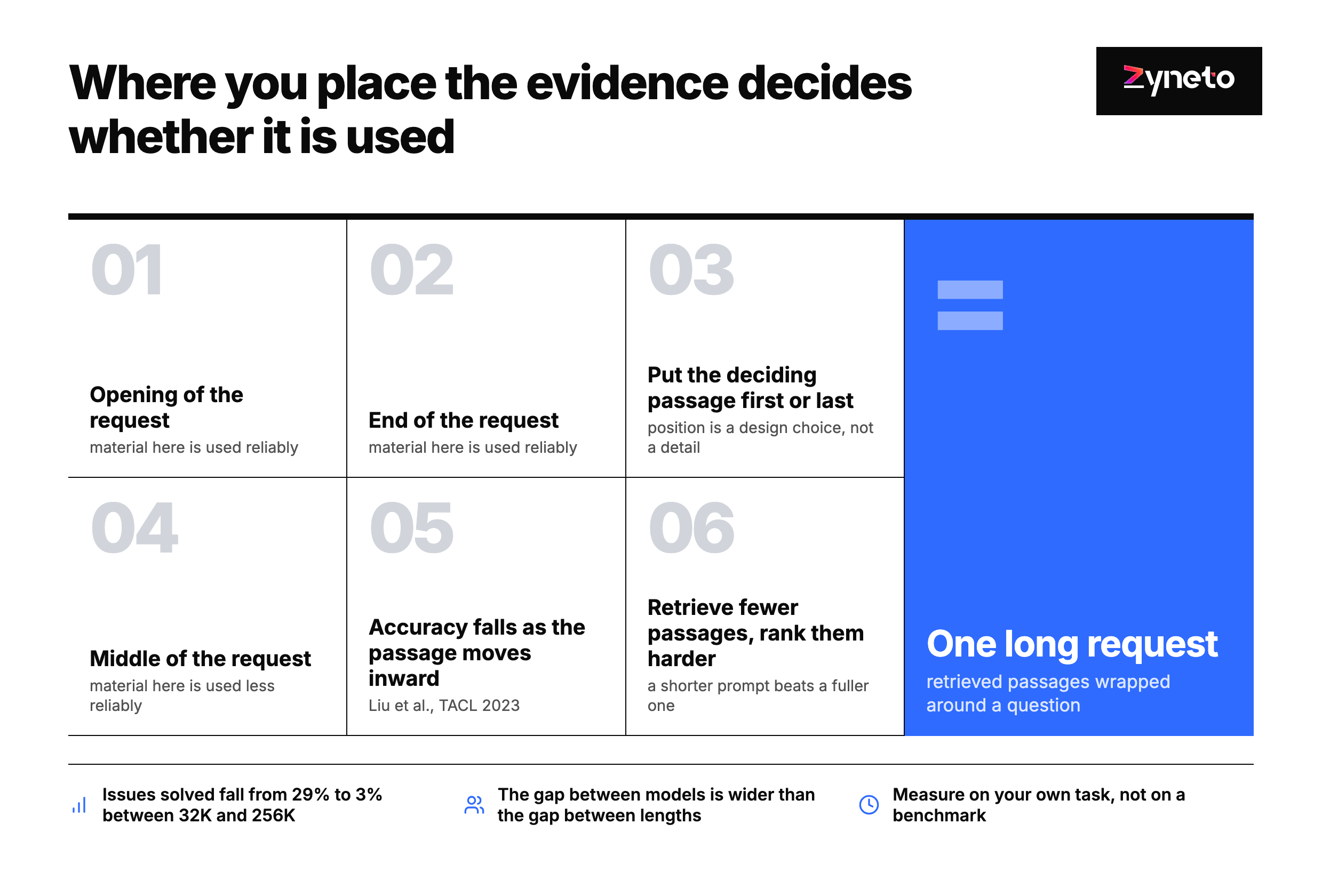
Liu, Lin, Hewitt, Paranjape, Bevilacqua, Petroni and Liang published "Lost in the Middle: How Language Models Use Long Contexts" in the Transactions of the Association for Computational Linguistics in 2023, arXiv:2307.03172. From the abstract: "performance can degrade significantly when changing the position of relevant information". Performance "is often highest when relevant information occurs at the beginning or end of the input context", and "significantly degrades when models must access relevant information in the middle of long contexts". The paper states this holds even for models built explicitly for long contexts.
Read that again with your own product in mind. The same information, in the same request, produces a different answer depending on where in the request it sits. Nothing about the content changed. Only its position.
Two notes on how we are quoting this. We describe the shape of the effect rather than naming it, because the popular term for it does not appear in the material read, and a borrowed label is the easiest thing to be corrected on. And we do not explain why the middle is weaker, because the paper read does not settle that, and the explanations in circulation are reasoning rather than findings.
What follows is a design instruction you can hand to a team today. Decisive material goes at the start or the end of the request. If you are stuffing eighty pages into a prompt because the window allows it, the ordering of those pages is now a product decision that somebody has to own, and in an AI document management system that ordering is usually whatever the database returned. The cheaper route is usually to send less: retrieve broadly, then re-rank tightly and send the few passages that matter, which is the discipline we set out in evaluating retrieval systems.
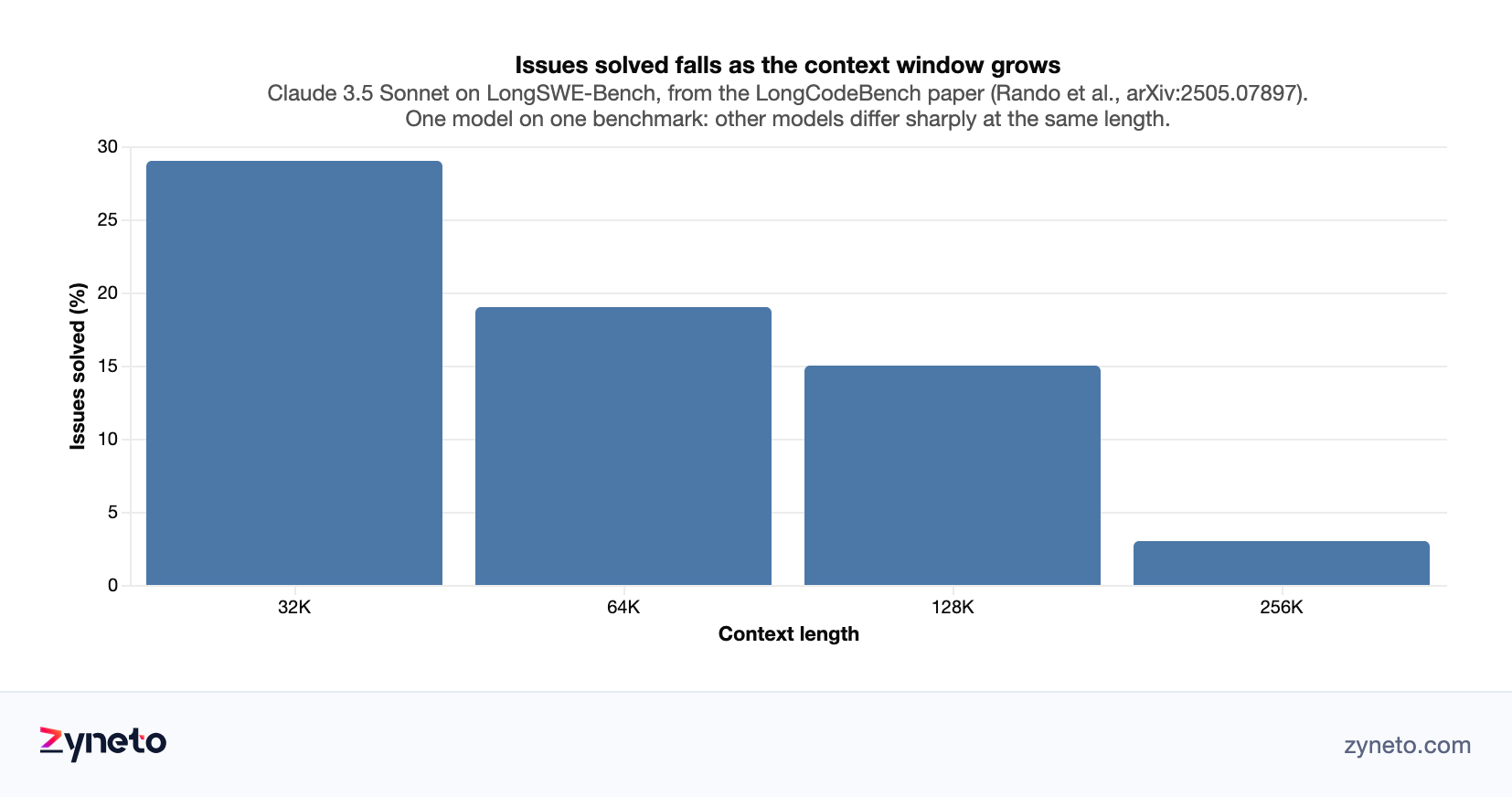
One model, one task, 29% down to 3%
The sharpest published drop comes with the tightest scope, and both halves of that sentence are load bearing.
Rando, Kyuragi, Romani, Galasso, Sampieri, Franco, Yang and Hashimoto published "LongCodeBench: Evaluating Coding LLMs at 1M Context Windows" as arXiv:2505.07897 on 12 May 2025. It is a preprint with no venue stated. From the introduction: "The accuracy of Claude 3.5 Sonnet on LongSWE-Bench drops from 29% to 3% when increasing context length from 32K to 256K."
Their Table 3, for that model on that benchmark, reported as the percentage of issues solved:
Context length | 32K | 64K | 128K | 256K |
Issues solved | 29% | 19% | 15% | 3% |
What this is: one model, on one bug-fixing benchmark, scored as the share of issues solved. It is not a general accuracy figure and it does not transfer to your summarisation feature or your support assistant. Anyone who quotes "29% to 3%" without the model, the benchmark and the unit is handing you a number that cannot be checked.
What it is still good for: it shows the decline is not a cliff you can design around by staying under one threshold. Eight points between 32K and 64K, four more by 128K, twelve more by 256K. A product that works acceptably at 32K and ships a feature that quietly pushes requests to 128K has no single moment where anything breaks.
That last point is the one to carry into a specification. Ask what the context length distribution looks like in production, not the maximum. The maximum is a capacity question. The distribution is a quality question.
What happens when a model's context window fills up?
Behaviour depends on the system around the model rather than on the model alone. A request over the limit is rejected or truncated, and most products quietly drop the oldest turns, or summarise them, and continue. Nothing warns the user. The reply that comes back is as confident as any other and may be missing the material that was removed.
That is engineering practice rather than a research finding, and it is worth stating plainly because it decides how your product fails in front of a customer. Three questions settle it.
What is the policy when the budget is exceeded? Truncate the oldest turns, summarise them, drop retrieved documents first, or refuse the request. Each produces a different failure, and the choice is usually made by whoever wrote that function rather than by anyone who thought about the product.
Is it recorded? A counter of how often requests hit the cap, and what was dropped, is a few hours of work and the only way you will ever know this is happening. Without it, the symptom reaching you is a support ticket saying the assistant "forgot" something, with no way to confirm it.
Can the user tell? A session that has silently lost its first ten turns is a session where the next answer may contradict an earlier one. Showing that state, even as a small notice, converts a mystery into a known limitation.
Long sessions are where this bites hardest, and it is why session-level measurement matters more than per-turn scoring. A product where every individual reply looks fine and the session as a whole fails is the normal shape of this defect, which is why whole-session scoring is the approach we argue for in agentic retrieval rather than step-by-step checks.
One team's account, and the caveat attached to it
One published engineering account is worth reading alongside the research, with its status stated clearly: this is a vendor engineering blog, not a study.
Microsoft published "Context Engineering for Reliable AI Agents: Lessons from Building Azure SRE Agent" on 26 December 2025, last updated 11 January 2026. The team describes starting with "100+ tools and 50+ specialized agents" and ending with "5 core tools and a handful of generalists".
Three of their observations are useful to a buyer. Their gains "were visible in offline evals, but they didn't translate into the reliability and outcomes we wanted in production". Long-context degradation "shows up well before we hit the advertised limits". And: "More tokens don't just cost latency; they quietly erode accuracy."
The first of those is the one to sit with, because it is an argument against the thing most teams buy instead of production measurement. An offline score that improves while production does not is the central problem in evaluating retrieval systems too, and the answer in both cases is to measure on traffic rather than on a fixed set alone.
The caveat, and we are applying our own rule here. That post is internally inconsistent about its own after-state, saying "5 core tools" in one place and "Three tools instead of hundreds" in another. We quote the first and flag the disagreement rather than averaging them or picking the more impressive one. Where a source contradicts itself, the honest move is to use no figure from the contested claim, and to say so where the figure would have gone.
The reason this account is worth your attention anyway is the direction of the change. A team with every incentive to show a sophisticated architecture reported cutting tools and agents down hard, and reported that the offline numbers had been misleading them. Tool definitions sit in the context on every single request, which is why tool count is a context decision as much as a capability decision, and why how tools are described and exposed, including through the Model Context Protocol, affects answer quality rather than only developer convenience.
What we will not put a number on
This post could carry four more figures. Each was checked and left out, and the reasons are the part worth keeping.
"Under 10%" as a flat result. It is the published abstract's own phrasing for a range of conditions, and Table 1 of the same paper shows 21.2% and 2.7% at the same context length. Repeating it as a single result misrepresents the paper it came from.
Any "fails about 40% of the time" style claim. These circulate on this topic and the adjacent one, sourced to blog posts with no study, no corpus, no task definition and no model named. There is nothing in them to agree or disagree with.
How common this is. No frequency, no "most teams", no share of production systems. Nobody has measured it across the installed base, and a sentence like that would be the easiest thing in this post to quote back at us.
Token prices, and therefore any cost of context. Prices move, and a post that dates itself on them starts misleading readers quietly within months. The honest version of the cost argument is directional: more tokens per request costs more money and more latency on every request, forever, and that is a shape you can plan with.
One more, from the sibling research on document splitting. A peer reviewed paper we rely on elsewhere gives two different sizes for the same corpus, 15,000 documents in one section and 4,017 in another, so we print no corpus size for it anywhere. The rule is the same in both posts: where a source contradicts itself, use no figure. Not the larger one, not the average, not a hedged version.
None of this is modesty about the research. The spread between 21.2% and 2.7% is a stronger finding than "under 10%" ever was, because it tells you something you can act on: the model you pick changes the answer more than the context length does.
What to ask for instead of a bigger window
Four asks, none of which requires you to understand attention mechanisms. This list is engineering judgement built on the sources above, not a measured result.
A context budget with a number in it. A stated cap per request, set below the model's advertised limit, with a policy for what happens when a request would exceed it. The team should be able to tell you the cap and the policy in one sentence each.
Token counts logged per request, with a distribution. Not the maximum. The median, the 95th percentile and the share of requests above your budget. This is the cheapest thing on the list and the one that turns every later argument into a measurement.
Session-level success, not per-turn quality. The question is whether the user got what they came for across the whole interaction. Per-turn scores look healthy while sessions fail, which is exactly the failure the web agent study constructs on purpose, and it is why an agent evaluation set is scored on completed goals rather than on individual replies.
Selection rather than stuffing. Retrieve broadly, re-rank tightly, send the few passages that carry the answer, and keep the decisive ones at the start or the end of the request. For document products this is the same discipline as splitting the source material well in the first place, and a chat with documents build that sends three right passages will beat one that sends forty plausible ones at any window size.
Two things to resist. The first is a bigger model as the answer to a context problem, since the evidence above says the ranking changes with length and the only way to know is to test. The second is training the model on your documents to avoid sending them, which is a different tool for a different problem, as we set out in retrieval against fine-tuning.
What the measurement costs, and what sets the number
Our published rate band is $40 to $100 per hour by role, blending to $60 to $70 for a mixed team. We publish no module hours for this work, and we are not putting an hour range here, because a range with no measurement behind it would set an expectation nothing supports. Scope decides the number, and scope comes out of a conversation.
Three pieces of work carry most of it. Token accounting and context-length logging across your existing requests. A test set of around forty real sessions, scored end to end rather than turn by turn, with the long ones deliberately over-represented. One comparison run of the same test set against two models at the lengths your product actually sees. The state of your logging moves the total more than anything else, because a team with no token accounting is building the instrument before taking the reading.
The cost of not measuring has no figure either, and we are not going to invent one. It is a model upgrade bought to fix a problem that was never diagnosed, and the same problem still present afterwards at a higher price per request.
What we would measure first
Start with the distribution of context lengths in whatever you are already running. One afternoon of logging usually settles the argument, because most teams discover either that almost nothing is long, in which case this post is not their problem, or that a quarter of requests are far longer than anyone assumed.
Then build the session test set, weighted towards the long sessions, and score whether the user's goal was met rather than whether each reply looked reasonable. Forty real sessions beat four hundred synthetic ones, and the set keeps earning its cost as a regression check every time the model, the prompt or the tool list changes. The same approach applies when documents are the bulk of the context, where an AI document management system that can report what it sent, and in what order, is worth more than one that cannot.
Then try the cheap interventions in order. Cut the tool list to what is used. Move the decisive material to the start or the end of the request. Send fewer, better-ranked passages. Each of these is hours of work, each is reversible, and each is testable against the set you just built. Only after that does a model change tell you anything, and by then you will be comparing two measured results instead of two marketing figures.
The thing we would not do is treat the advertised window as a target. It is the edge of what the request will accept. The engineering account above puts it plainly: the degradation shows up well before the advertised limit, and nothing in the product tells you when you crossed into it. That is why the measurement comes first, and why the number in the vendor's headline is the least useful number in this whole conversation.
Frequently asked questions
A context window is the maximum amount of text, measured in tokens, that a model can accept in a single request, counting the instructions, any retrieved documents, the conversation so far and the model's own reply. A token is roughly three quarters of an English word, and fewer for code, tables and most non-Latin scripts. The limit is a hard cap on input and nothing more: it does not guarantee that information placed anywhere inside the window is used equally well.
Not on its own. A larger window raises how much you can send, not how much the model attends to. Measured long-context results are strongly model dependent: in a 2025 preprint on web agents (Chung et al., arXiv:2512.04307), at 150,000 tokens o4-mini scored 21.2% while GPT-4.1 scored 2.7% on the same benchmark. Because the spread between models is that wide, no single degradation figure is usable, and the only reliable answer is to test your own model on your own task at the lengths it will actually see.
Because position changes performance. "Lost in the Middle" by Liu et al., published in the Transactions of the Association for Computational Linguistics in 2023, reports that "performance can degrade significantly when changing the position of relevant information", that it is "often highest when relevant information occurs at the beginning or end of the input context", and that it "significantly degrades" for information in the middle of long contexts. The paper states this holds even for models built for long contexts. Why it happens is not settled by that paper, so treat explanations in circulation as reasoning rather than findings.
No, not as a single number. It comes from the abstract of Chung et al. (arXiv:2512.04307), which reports "success rates dropping from 40-50% in baseline conditions to less than 10% in long context scenarios", and that phrasing now circulates as a flat result. The same paper's Table 1 shows o4-mini at 21.2% and GPT-4.1 at 2.7% at 150,000 tokens, so the figure describes neither model. Use the spread, name the models, or use no number.
The surrounding system decides, not the model. A request over the limit is rejected or truncated, and most products silently drop the oldest turns or replace them with a summary and carry on. No warning reaches the user, and the next reply is as confident as any other while missing what was removed. Ask whoever is building for you what the policy is, whether it is logged, and whether the user can tell it happened.
Log the distribution of context lengths across real requests, including the median and the 95th percentile rather than only the maximum. Then build a test set of around forty real sessions, weighted towards the long ones, and score whether the user's goal was met across the whole session rather than scoring each reply. Run it against two candidate models at the lengths you actually see. Per-turn scores often look healthy while sessions fail, which is why session-level scoring is the measurement that matters here.
No. Sending everything puts your decisive material somewhere in the middle of a long request, which is where measured performance is weakest, and it adds cost and latency to every request. Retrieval exists to send less and send it in a better order: retrieve broadly, re-rank tightly, and place the passages that carry the answer at the start or the end of the prompt. A long window makes that approach cheaper to get wrong, not unnecessary.

Vikas Choudhary
Vikas has around fifteen years of experience building software and now builds generative AI systems at Zyneto. His work covers retrieval augmented generation, agentic AI, knowledge graphs, AI memory, and the evaluation and guardrails that decide whether any of it is safe to put in front of customers. He has shipped enterprise copilots, document AI, chatbots and predictive analytics for e-commerce, fintech and marketing teams, and works day to day in Python, JavaScript and SQL. He follows multimodal models, business process automation and enterprise AI security closely, and mentors engineers moving into AI. He writes about architecture, inference cost and the failure modes that only show up at production scale.
Zyneto builds custom software, AI and automation
Tell us what you are building and we will reply with a clear next step.