Veterinary Practice Management Software Cost: Three Parties and a Date



Published estimates for custom veterinary practice software run from $40,000 to $300,000, with one firm advertising builds from $4,997 and another quoting euros for a build in Dublin. The ranges are so wide they carry no information, because every one of them is pricing a feature list: records, appointments, billing, reminders.
Three facts about the patient set the real cost, and none of them appears on a feature list.
The patient is an animal. It cannot consent, cannot describe symptoms, cannot pay, and has no identity document. Everything in a human clinical system that hangs off the patient has to hang off something else here.
The client is not the patient. The owner is the legal person, and the relationship is many-to-many and unstable: one owner with four animals, one animal with two owners after a separation, a horse on loan, a cat whose owner changes twice in its life while its clinical history must follow it rather than them. A system that models an animal as a field on a customer record cannot express any of that, and it is the commonest reason a practice outgrows its software.
The payer is frequently a third party. An insurer paying a claim directly, a charity funding a treatment, a breeder with an account, a corporate group with a contract, a farm business paying for a herd. The visit has a clinical record, a client, and an invoice that may be split between several of these, which is the same shape as a rights and royalty ledger and about as cheap to retrofit.
And then the fourth fact, which is the one that makes veterinary software genuinely unlike every human clinical system: some patients enter the food chain, and the software is responsible for the date on which that becomes legal again.
How much does veterinary practice management software cost to build?
Published ranges of $40,000 to $300,000 reflect feature lists rather than scope. The cost is set by four things: a patient who is not the client, a payer who may be neither, batch-level medicine stock with a controlled drugs register, and withdrawal periods where food-producing animals are treated. A companion-animal-only practice can skip the fourth and part of the third.
Our rates are published: $40 to $100 an hour by role, blending to $60 to $70 for a mixed team. We do not quote a fixed total before a discovery that establishes whether food-producing animals are in scope, how many parties can pay for one visit, and which jurisdiction's medicine records apply.
The withdrawal period is a date on an animal, not a note on a visit
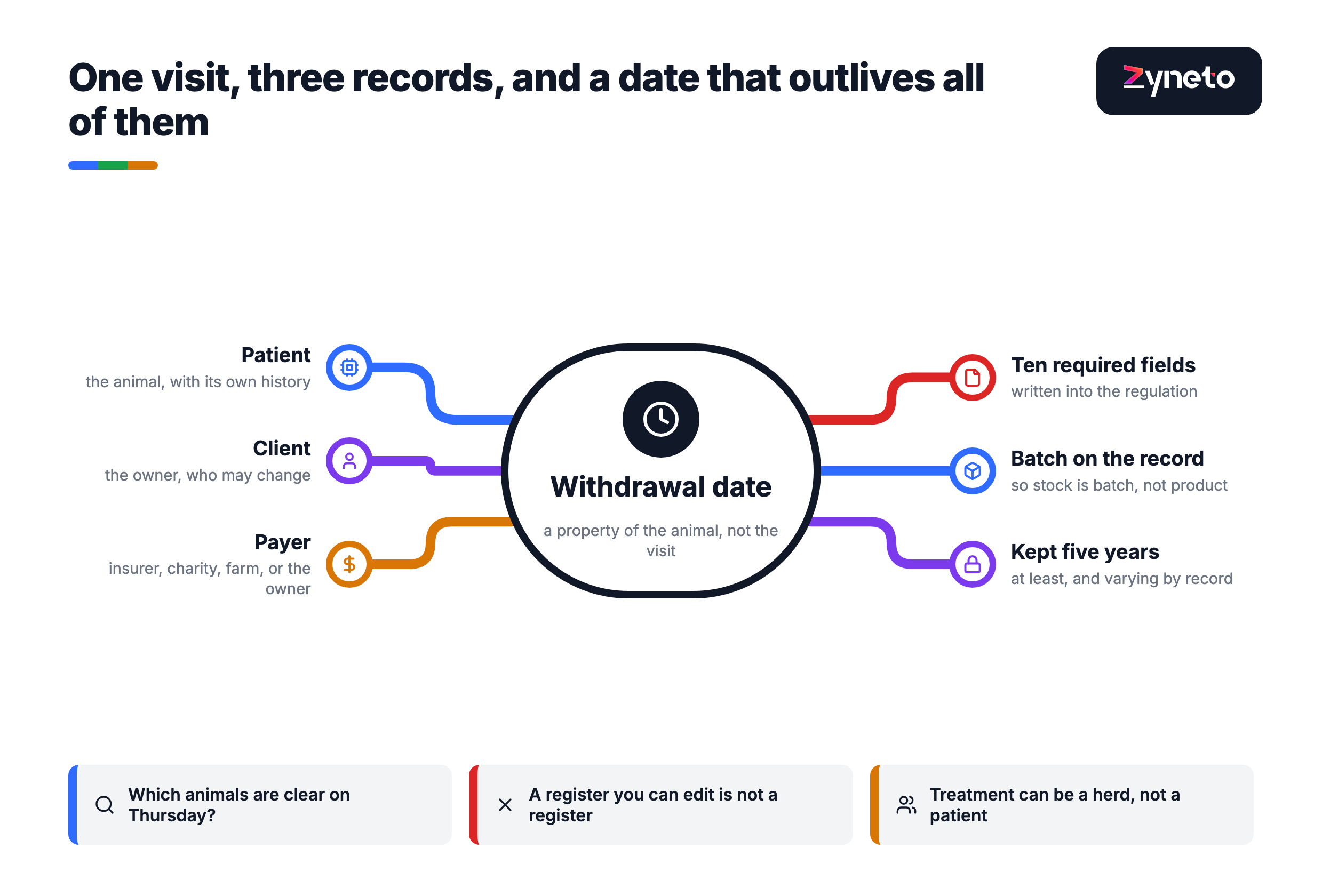
When a food-producing animal is treated, there is a period before its milk, meat or eggs may legally enter the food chain. That is not a clinical note. It is a computed date that attaches to the animal, sometimes to a group of animals, and it has to be visible to people who are not in your software at all.
Three consequences for the build, in order of how expensive they are to discover late.
The date is derived from the product, the dose and the route, which means the product catalogue has to carry withdrawal data and the calculation has to survive the product being reformulated or replaced. A hard-coded number ages badly.
The date belongs to the animal, not the treatment record, so it has to be queryable as a property: which of these 400 cows is clear on Thursday. A system that stores it only inside a visit cannot answer that, and answering it is the entire point.
It has to leave the system. The farmer needs it, the milk buyer needs it, the inspector may ask, and the practice is the source. Export, print and integration are part of the feature rather than a reporting afterthought.
This is the single clearest line between a companion-animal product and a mixed or farm one, and it is why pricing them as the same build is wrong.
Regulation 24 hands you a schema
Most industries make you infer the data model from the rules. Veterinary medicine writes it out.
The ten fields regulation 24 requires
Under regulation 24 of the Veterinary Medicines Regulations 2013 (as amended) in the United Kingdom, a veterinary surgeon administering a product to food-producing animals under the cascade, or permitting another person to administer it under that surgeon's responsibility, must record, as soon as is reasonably practicable:
- the date of examination.
- the name and address of the owner.
- the identification and number of animals treated.
- the result of the clinical assessment.
- the trade name of the product if there is one.
- the manufacturer's batch number shown on the product if there is one.
- the name and quantity of the active substances.
- the doses administered or supplied.
- the duration of treatment.
- the withdrawal period.
The record must be kept for at least five years.
Read that as a specification, because it is one. Ten mandatory fields, several of which are not where a naive design would put them.
The batch number is on the record, which means stock is tracked at batch level and the dispensing event captures which batch was used. The same argument we make about batch as the unit of pharmacy stock applies here with a statutory list attached.
The number of animals treated is a field, so a treatment is not necessarily one patient. Group and herd treatment is a first-class case, not a loop over individuals.
The clinical assessment result is required, which makes a structured outcome field rather than free text the safer design, because free text cannot be reported on and an inspection is a report.
Five years of retention sits on top of whatever your ordinary data policy says, and retention periods differ by record type and jurisdiction. As with statutory parameters in payroll, these belong in a dated configuration table rather than in code.
A 2024 amendment added a further record, this time in Schedule 3, paragraph 5 rather than in regulation 24. Where a product is supplied under a prescription that is not written, for instance a verbal one, the prescriber must make a record of the reason for prescribing it, and must keep that record for five years from the date the product was prescribed. It was inserted on 17 May 2024 by the Veterinary Medicines (Amendment etc.) Regulations 2024, which extend to England, Wales and Scotland only, so the Northern Ireland text does not carry it. Build it as a configurable obligation rather than a universal one.
Stock is batch, and the register is not a table you can edit
A practice is a small pharmacy with a clinic attached, and the medicine side carries most of the compliance weight.
Batch and expiry are properties of stock rather than attributes of a product, which changes every quantity in the system. Controlled drugs sit on top of that with their own register: an append-only record with its own required fields and its own retention period, which differs from the five years above and differs again by jurisdiction. A register you can edit is not a register, and discovering that after launch means reprocessing every movement.
Dispensing is its own state machine: supplied, administered, partially used, wasted, returned, disposed of. Waste matters more here than in most settings because a controlled drug that was drawn up and not fully used has to be accounted for, and the person doing the accounting is standing in a consulting room rather than at a desk.
And the purchasing side decides whether the practice makes money. Medicines are a large share of revenue, margins are set by buying terms and free-goods allocation, and a system that cannot allocate the cost of a free case across the units it covers reports a margin that is simply wrong.
Do we need separate systems for farm and companion animals?
Usually one system with two configurations rather than two products, but the decision has to be made before the data model is fixed. The shared core is the patient, client and payer model, stock at batch level, the dispensing state machine and the medicine register. The farm-specific layer is group and herd treatment, withdrawal periods as animal properties, movement and holding records, and visits that bill against a business rather than a person.
The mistake is building for companion animals and adding farm later. Group treatment and withdrawal dates are not features bolted on to an individual-patient model; they change what a treatment record *is*. Building the general case first and configuring the simpler one down costs a little more at the start and far less than the alternative.
Migration is how a practice judges you
Practices change systems rarely and remember it for years. The data that has to move is worse than in most verticals and the quote usually ignores it.
Clinical history must follow the animal, across owners, across practices, and across the previous system's idea of what a patient was. Where the incumbent stored the animal as a field on a client, splitting it back out is handwork, because the information that two records are the same animal frequently exists only in a free-text note.
Medicine records cannot be summarised. Five years of dispensing records with batch numbers, and a controlled drugs register that an inspector may read, have to arrive intact rather than as opening balances. A register that starts on go-live day with no history is a gap somebody will have to explain.
And the practice cannot stop. There is no weekend when nothing is treated, so the cutover is a parallel-running exercise with an agreed authoritative system per day, the same shape as a construction or contract system changeover. Budget it as a phase.
Insurance, charities and who is actually paying
The payment side is where a quote and a reality diverge most often.
Direct insurer claims change the invoice lifecycle. A claim is submitted, assessed, partly paid, queried, resubmitted, and the balance falls back to the owner. That is a receivable with states, a correspondence trail and a reconciliation, not a payment method. The work resembles the claims side of a payments build more than it resembles a card terminal.
Split invoices are normal, not exceptional. One visit, part funded by a charity, part by the owner, part written off. If the invoice model assumes a single payer, every one of these becomes a manual workaround that destroys the reporting.
Payment plans and account clients both exist, often in the same practice. A farm account settled monthly and a pet owner paying over four instalments are different mechanisms with different failure modes, and both need the ledger discipline that any system holding other people's money needs. A legal practice system reaches the same conclusion from a different regulation: money owed and money held are not the same record.
Out-of-hours changes who is paid and who is liable. Many practices share an out-of-hours provider or rotate cover, which means a consultation recorded in one system is invoiced by another and the clinical record has to reconcile afterwards. If remote consultation is in scope at all, the constraints are the ones we set out for telemedicine builds, with the added complication that the patient cannot describe anything.
Estimates and consent are the clinical-financial join. An owner approves a cost before a procedure, the procedure changes, and someone has to re-consent at a new number. Practices that handle this well lose less money and have fewer arguments, and it is almost never in a specification.

What is ordinary, and should be priced that way
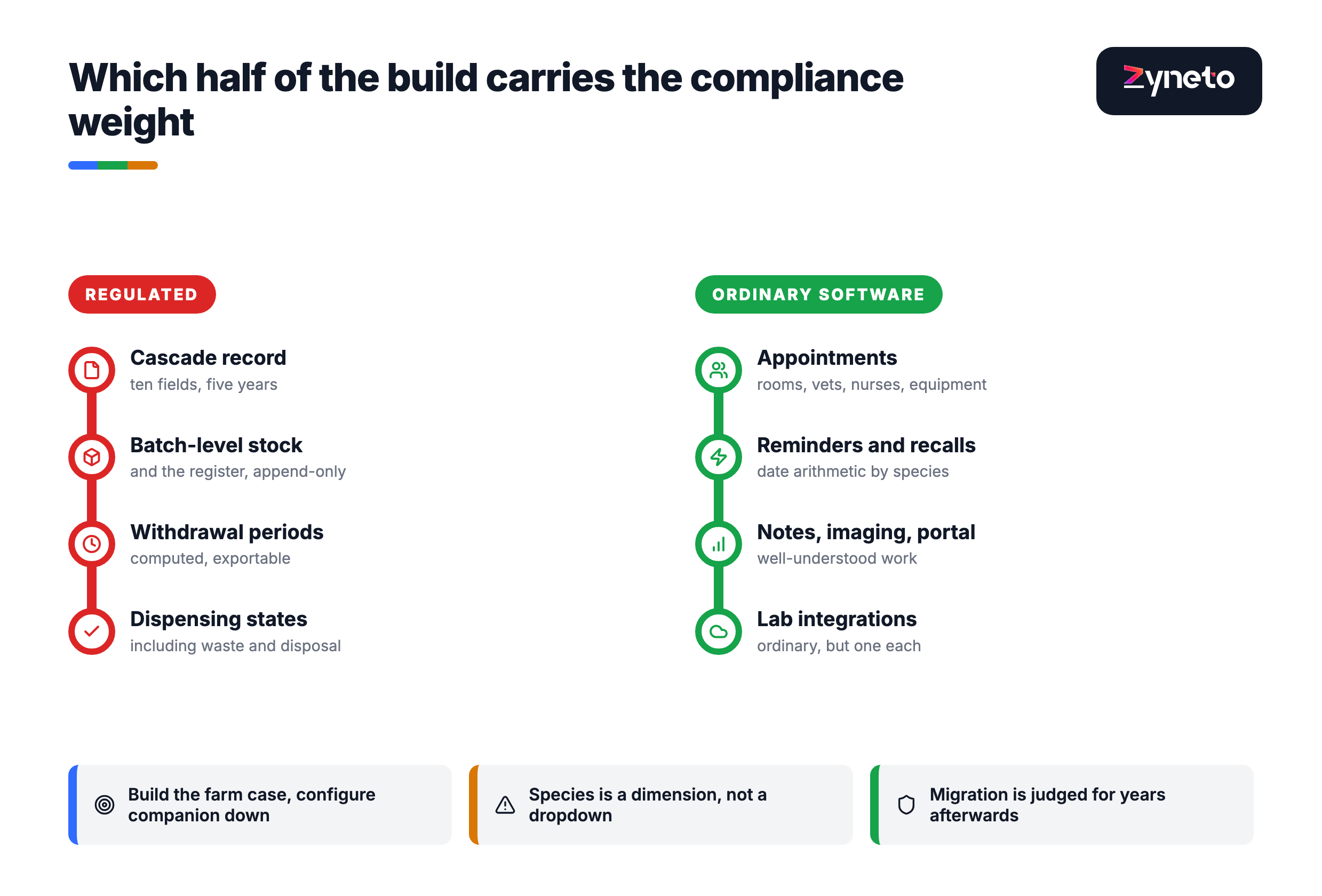
A good quote separates the regulated half from the ordinary half, and the ordinary half is substantial.
Appointments are a resource-booking problem of the kind we have described for salon and multi-resource scheduling: a consulting room, a vet, a nurse and sometimes a piece of equipment, with durations that vary by procedure and practitioner. Well understood, and not cheap, but not specialised either.
Reminders, recalls and vaccination schedules are date arithmetic against a species and product calendar. Clinical notes, imaging attachments, lab result ingestion, a client portal and reporting are ordinary software with one exception: lab integrations are per-provider and each one is its own small project, which is where schedules slip.
Species is a dimension, not a dropdown. Dose calculations, vaccination intervals, normal ranges on lab results and withdrawal data all vary by species, and several vary by weight within species. A product built around dogs and cats and then asked to handle rabbits, horses and poultry does not need new screens; it needs a reference layer it never had, maintained against sources that change. Deciding how many species are in scope is a scoping question with a real number attached, and it is almost never asked.
The multi-site question is ordinary until it is not. Shared clients across branches, stock held per site, controlled drugs registered per site, and clinicians who work across them. Deciding this at the start is free. Deciding it in year two is a migration.
Should a practice build or buy?
Buy, for a single practice, almost always. Established products carry years of regulatory updates and lab integrations that no new build has, and a practice's competitive advantage is not its software.
Building earns its place in two situations. A group large enough that the per-seat cost of a product exceeds the cost of owning one, where the saving is real and continuing. And a software business selling to practices, where the product is the asset. The third case is a corporate group buying a product and building the layer above it: consolidated reporting, group purchasing, clinical governance across sites. That is a smaller build with most of the benefit, and it is the one we see succeed.
A fourth case is worth naming because it is growing. Corporate consolidation has put many practices inside groups that inherited three or four different systems, and the realistic project is not a new product but a reporting and governance layer that reads all of them. That is an integration build with a migration hiding inside it, and it is priced very differently from a greenfield system.
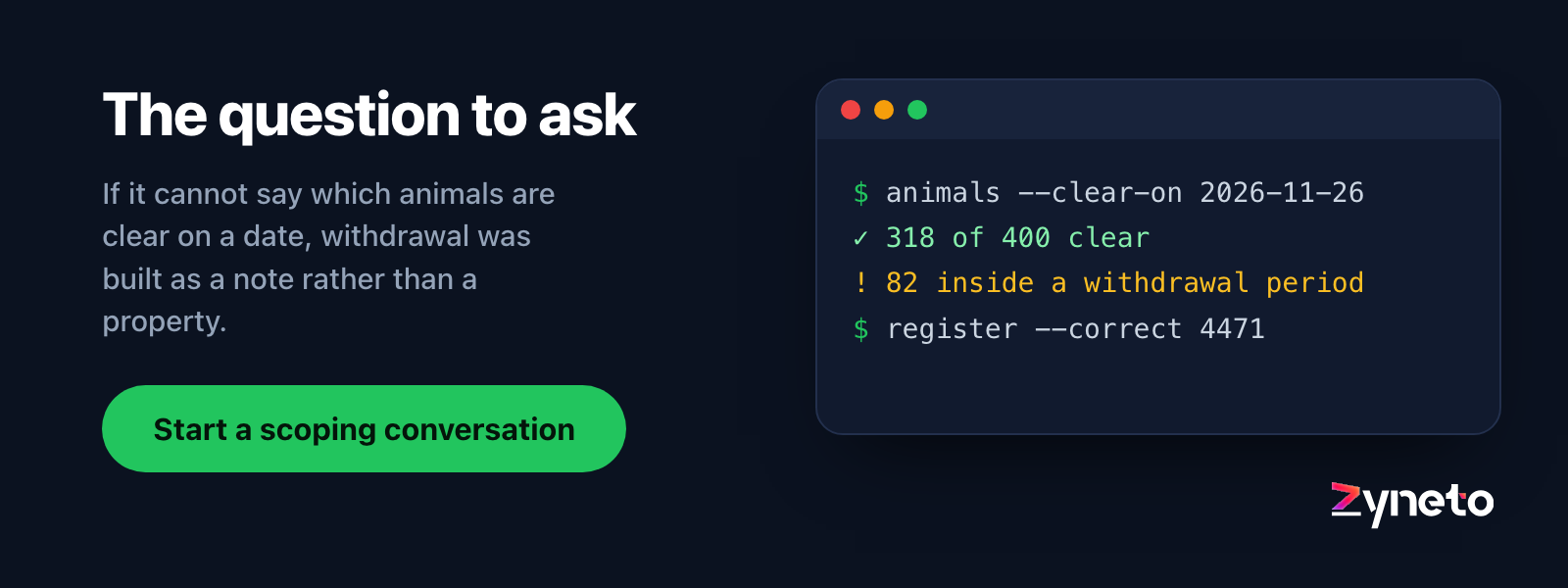
Whatever the answer, the test to apply is the same. Ask how the system answers "which of these animals is clear on Thursday", and ask to see a controlled drugs register entry being corrected. The first tells you whether withdrawal is a property or a note. The second tells you whether the register is really append-only.
How we would sequence it
The patient, client and payer model first, with the many-to-many relationships real and the clinical history following the animal rather than the owner. No screens. This is the part that cannot be corrected later, for the same reason a field service system models the asset rather than the customer before anything else.
Medicine stock at batch level second, with the dispensing state machine and the register as an append-only record with configurable retention. The acceptance test is a correction, not a dispense.
The regulation 24 record third, as a structured record with every required field present and reportable, and withdrawal as a property of the animal with an export.
Invoicing and the payer model fourth, with split invoices and insurer claims as states rather than as workarounds.
Appointments, reminders, portal and reporting last, which will feel backwards and is not, because each of them reads from everything above.
What we will say without a discovery: any quote that prices veterinary inventory as inventory, or treats a withdrawal period as a note on a visit, has scoped a different product from the one the practice needs.
Frequently asked questions
Published estimates run from about $40,000 to $300,000, and the spread reflects feature lists rather than scope. Four things set the real number: a patient that is not the client, a payer that may be neither, medicine stock tracked at batch level with a controlled drugs register, and withdrawal periods where food-producing animals are treated. A companion-animal-only practice avoids the fourth entirely. Our published rates are $40 to $100 an hour by role, blending to $60 to $70.
Because the relationship is many-to-many and it changes. One owner may have four animals, one animal may have two owners after a separation, and an animal's clinical history has to follow the animal when ownership transfers rather than staying with the previous owner. A system that stores the patient as an attribute of a customer cannot express any of those, and rebuilding it later means reprocessing every clinical record and invoice attached to it.
It is the time that must pass after treating a food-producing animal before its milk, meat or eggs may legally enter the food chain. It is a computed date derived from the product, dose and route, and it belongs to the animal rather than to the treatment record, because the question people ask is which animals are clear on a given day. It also has to leave the system, since farmers, buyers and inspectors all need it.
Regulation 24 of the Veterinary Medicines Regulations 2013 lists ten fields for products administered to food-producing animals under the cascade: the date of examination, the owner's name and address, the identification and number of animals treated, the result of the clinical assessment, the product's trade name, the manufacturer's batch number, the name and quantity of active substances, the doses administered or supplied, the duration of treatment, and the withdrawal period. The record must be kept for at least five years.
One system with two configurations is usually right, but the decision has to come before the data model is fixed. Group and herd treatment and withdrawal periods are not features added to an individual-patient model; they change what a treatment record is. Building the general case and configuring the simpler one down costs slightly more initially and far less than retrofitting herd treatment into a product designed around one animal per visit.
As a receivable with states, not as a payment method. A claim is submitted, assessed, partly paid, sometimes queried and resubmitted, and any balance returns to the owner. That requires claim status, a correspondence trail and reconciliation against what was invoiced. Split invoices between an insurer, a charity and the owner for a single visit are normal rather than exceptional, so an invoice model assuming one payer will generate manual workarounds that ruin reporting.
Buy, for a single practice. Established products carry years of regulatory updates and lab integrations that a new build does not, and software is not a practice's competitive advantage. Building makes sense for a group where per-seat costs exceed the cost of ownership, or for a software business selling to practices. The common successful middle path is a corporate group buying a product and building the layer above it for consolidated reporting, group purchasing and clinical governance.

Vikas Choudhary
Vikas has around fifteen years of experience building software and now builds generative AI systems at Zyneto. His work covers retrieval augmented generation, agentic AI, knowledge graphs, AI memory, and the evaluation and guardrails that decide whether any of it is safe to put in front of customers. He has shipped enterprise copilots, document AI, chatbots and predictive analytics for e-commerce, fintech and marketing teams, and works day to day in Python, JavaScript and SQL. He follows multimodal models, business process automation and enterprise AI security closely, and mentors engineers moving into AI. He writes about architecture, inference cost and the failure modes that only show up at production scale.
Zyneto builds custom software, AI and automation
Tell us what you are building and we will reply with a clear next step.