Courier Delivery App Development Cost: Two Line Items Decide It


Published estimates for a courier delivery app run from $8,000 to $380,000. JPLoft opens at $8,000 to $90,000+, Dev Technosys at $30,000 to $150,000+, and RaftLabs puts an MVP with dispatch and proof of delivery at $90,000 to $180,000 over 12 to 18 weeks, with its full platform at $200,000 to $380,000. Google's own summary of this question answers $20,000 to $150,000+ and then sorts the price by feature tier and developer location.
None of that tells you anything, because every one of those numbers is pricing the same feature list: a sender app, a driver app, an admin panel, tracking, payments.
Two line items actually move the number, and they are nothing alike. The first is proof of delivery. The second is the route engine. Most quotes list them as two features of similar size, a few hundred dollars each in the per-feature tables, and that is the error that produces the overrun.
Proof of delivery is an evidence problem. A signature, a photograph, a geotag and a timestamp, captured on a phone at a doorstep with no signal, attached to the right parcel, and retained in a form that settles a dispute eighteen months later. Nothing about that is hard individually. All of it has to be right at once, and it cannot be bolted on afterwards, because the records created before you got it right are the records you will be asked about.
The route engine is an optimisation problem, its cost scales with the number of stops and the number of constraints, and almost nobody commissioning a build at this budget should write one. Buy it.
Three questions set your price. Does a parcel ever get handed over somewhere with no signal? How many stops does one driver do in a shift, and do they come with time windows? And what happens on your system when the customer is not in? The third is the question nobody asks, and it is the one that reaches into every table in the database.
The two line items, and why they are nothing alike
Two line items set the price of a courier delivery app: proof of delivery and the route engine. Proof of delivery is an evidence problem, built once and built carefully. The route engine is an optimisation problem, and almost every operator should buy it rather than write it.
They get confused because both live on the driver's screen. The driver taps "arrived", sees the next stop, takes a photo, gets a signature, taps "delivered". From the outside that is one feature.
Underneath, they point in opposite directions. Proof of delivery is write-heavy, append-only and legally sensitive. It captures something once, immutably, in the worst connectivity conditions in the product, and keeps it. Routing is read-heavy, computational and disposable. Today's route is worthless tomorrow, nobody will subpoena it, and the quality of the answer is a mathematics question rather than a product one.
One you build because it encodes your commercial promise. What counts as delivered, what a driver may accept as authority to leave, how long you keep the photograph, what the customer can see. Those are your rules, they are what your B2B customers argue with you about, and a bought product imposes somebody else's version.
The other you buy because the maths is a research field. Routing with time windows is a known hard problem, and the open source and hosted options beat anything a project on a $10,000 to $50,000 budget will write. Google publishes OR-Tools, whose routing library solves the vehicle routing problem with capacity and time window extensions: in its own words, "find optimal routes for multiple vehicles visiting a set of locations". That is a solved thing you can call.
Our logistics software development work takes the same split. The parts that encode how a business actually operates get built. The general parts get bought.
How much does it cost to develop a delivery app?
Our published rate band is $40 to $100 an hour by role, blending to $60 to $70 for a mixed team of a backend engineer, a mobile engineer, a designer and a lead. That band is the only number we publish before a discovery call, because the honest total depends on the two line items above and on nothing in the feature list.
What that means for a budget between $10,000 and $50,000 is worth saying plainly. At the bottom of that range you are buying one app, not three. A driver app with a proper offline store, a real proof of delivery capture, a dispatch screen that assigns rather than optimises, and a tracking page for the customer. That is a working courier operation. It is not a platform.
Where published quotes differ by ten times, read the scope words rather than the number. "Dispatch" can mean a dispatcher dragging a job onto a driver, or an engine that decides. "Tracking" can mean a map pin that refreshes, or a predicted arrival window the customer is told about and that you are then measured against. The second of each pair costs several times the first and the feature name is identical.
The structural cost nobody prices is the number of audiences. A sender app, a driver app, a merchant portal and an admin console are four products with four release cycles, four sets of permissions and four support surfaces. Cutting one out of phase one changes the total more than any individual feature does, which is why we scope a first release deliberately small and let the second be paid for by revenue.
Proof of delivery is an evidence problem
Treat the delivery record as a document that will be read by someone who was not there and who is unhappy.
The capture is four facts, and each one fails differently. The signature is a drawing on a screen, so it needs attaching to a named person and a stated relationship to the recipient, or it proves only that a finger touched glass. The photograph needs a caption the driver picks from a short list rather than types. The geotag is wrong most often, because a phone indoors can report a position a hundred metres out, so the record carries the accuracy figure the device gave and not just the coordinates. The timestamp needs a trusted clock, because a device clock can be changed by the person holding it.
Store what the device said, separately from what you concluded. The raw capture, with its reported accuracy, its device identifier and its queue time, is evidence. "Delivered at 14:12" is an interpretation. Products that keep only the interpretation cannot answer a challenge, and the challenge is the entire reason the feature exists.
Authority to leave is a commercial policy encoded in software. Leave with a neighbour, leave in a safe place, leave only against a signature, leave only against an ID check. Each option changes what the driver app must capture and what the retailer who hired you has agreed to accept. Get the list from your contracts before anybody designs a screen.
Retention runs longer than founders expect and costs real money. Photographs are the heavy part. A thousand deliveries a day with one 2 MB photo each is about 60 GB a month of write-once storage that has to stay readable for as long as a dispute window lasts, which in B2B contract work is years rather than months. Deciding to keep everything for seven years is deciding to pay for it for seven years.
The retention rule is also a deletion rule. Photographs of doorways are personal data in most markets you will operate in, so something has to actually delete them when the period expires. In the European Union and the United Kingdom that is a storage limitation duty under the GDPR, which is a worked example rather than the rule itself. Building deletion later means building it across backups, which is a far worse project.
Buy the route engine, and here is the arithmetic
The engine is bought, but the bill is yours, and this is where a quote that ignores running costs falls apart.
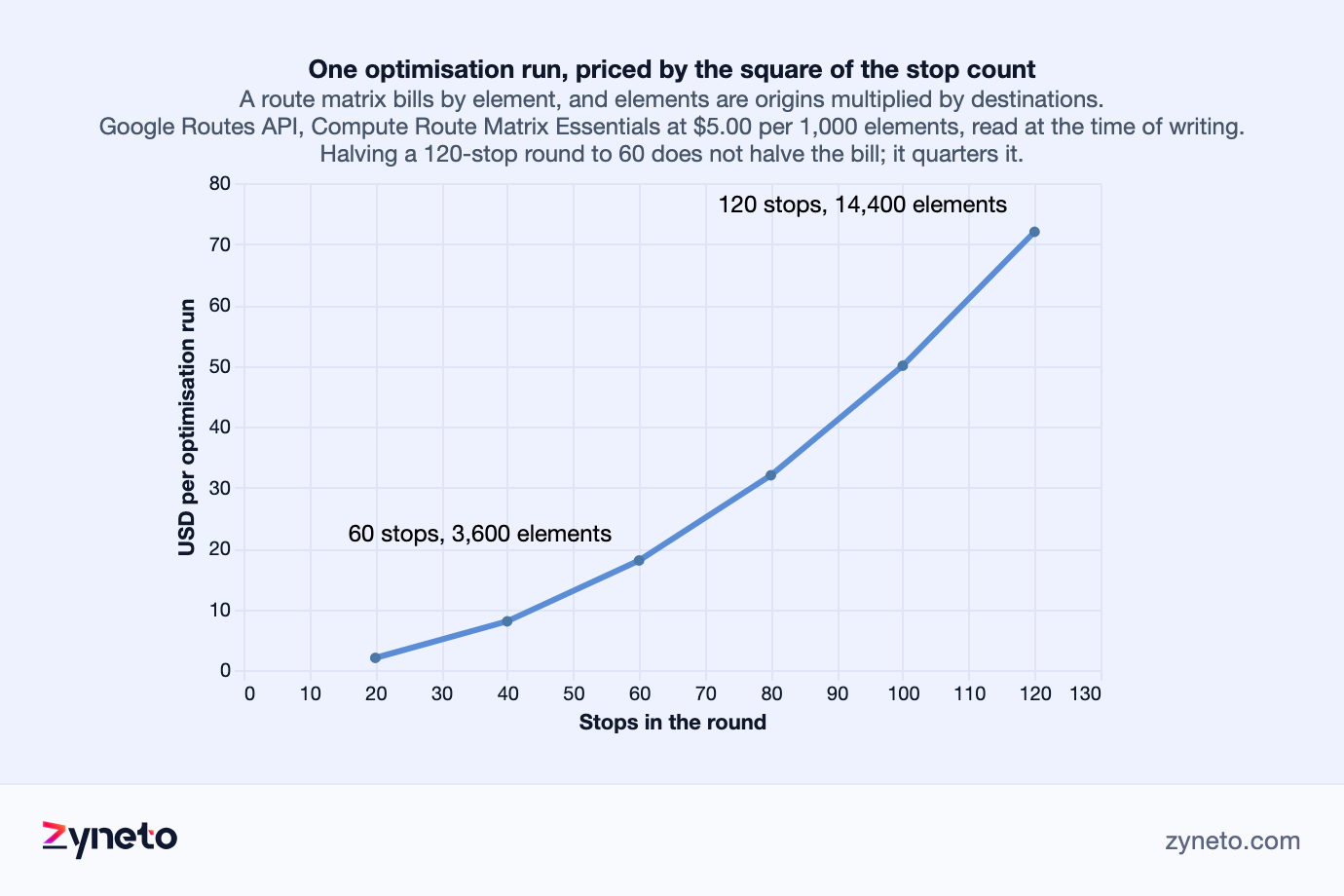
Routing is priced per request, and the cheapest request grows with the square of your stop count. Google's Routes API bills a route matrix by element, where elements are origins multiplied by destinations. At the time of writing, Compute Route Matrix Essentials is listed at $5.00 per 1,000 billable events in the first 100,000 a month, with 10,000 of them free.
Run the arithmetic on a 120-stop round. One matrix of 120 origins against 120 destinations is 14,400 elements. At $5.00 per 1,000 that is $72 for a single optimisation run, and the free monthly allowance is gone before lunch on day one. Halve the round to 60 stops and the matrix is 3,600 elements, about $18. Doubling the stops roughly quadrupled the bill. That is the shape of the cost, and it does not appear in any feature table.
So the engineering is in calling the engine less. Cache the distance matrix between points you serve every day, because the drive time between two warehouses does not change hourly. Cluster stops geographically before you optimise, so you solve several small problems instead of one enormous one. Re-optimise on an event, such as a new order or a failed attempt, rather than on a timer. All of that has to be designed in, which is why "we will just plug in the maps API" is the sentence that precedes a surprise invoice.
Google also publishes a hosted fleet routing service, listed at $30.00 per 1,000 billable events in the first 100,000 a month with 1,000 free, which is the shape of a managed option. The alternative is OR-Tools on your own compute, where the licence is free and you pay in engineering time and servers instead.
Route optimisation at genuine fleet scale, multi-depot freight and dispatch strategy are a different post. We cover them in logistics software development cost, and this one deliberately stops at last-mile parcels. If your problem is a hundred vehicles and a line-haul network, start there. Technician scheduling, where the stop is a two-hour job rather than a two-minute handover, belongs to field service management software cost instead.
A failed delivery attempt rewrites your data model
This is the thing no cost guide for this keyword mentions, and it is the one that quietly doubles the schema.
Failed attempts are not rare. A peer-reviewed study of home delivery routing by Lim, Wang and Webster, published in Production and Operations Management in 2023, opens with the finding that up to 20% of all business-to-consumer deliveries fail on the first attempt. Treat that as the shape of the problem rather than as your number, because definitions vary and so do operations, but a product designed around the happy path is designed for four deliveries in five at best.
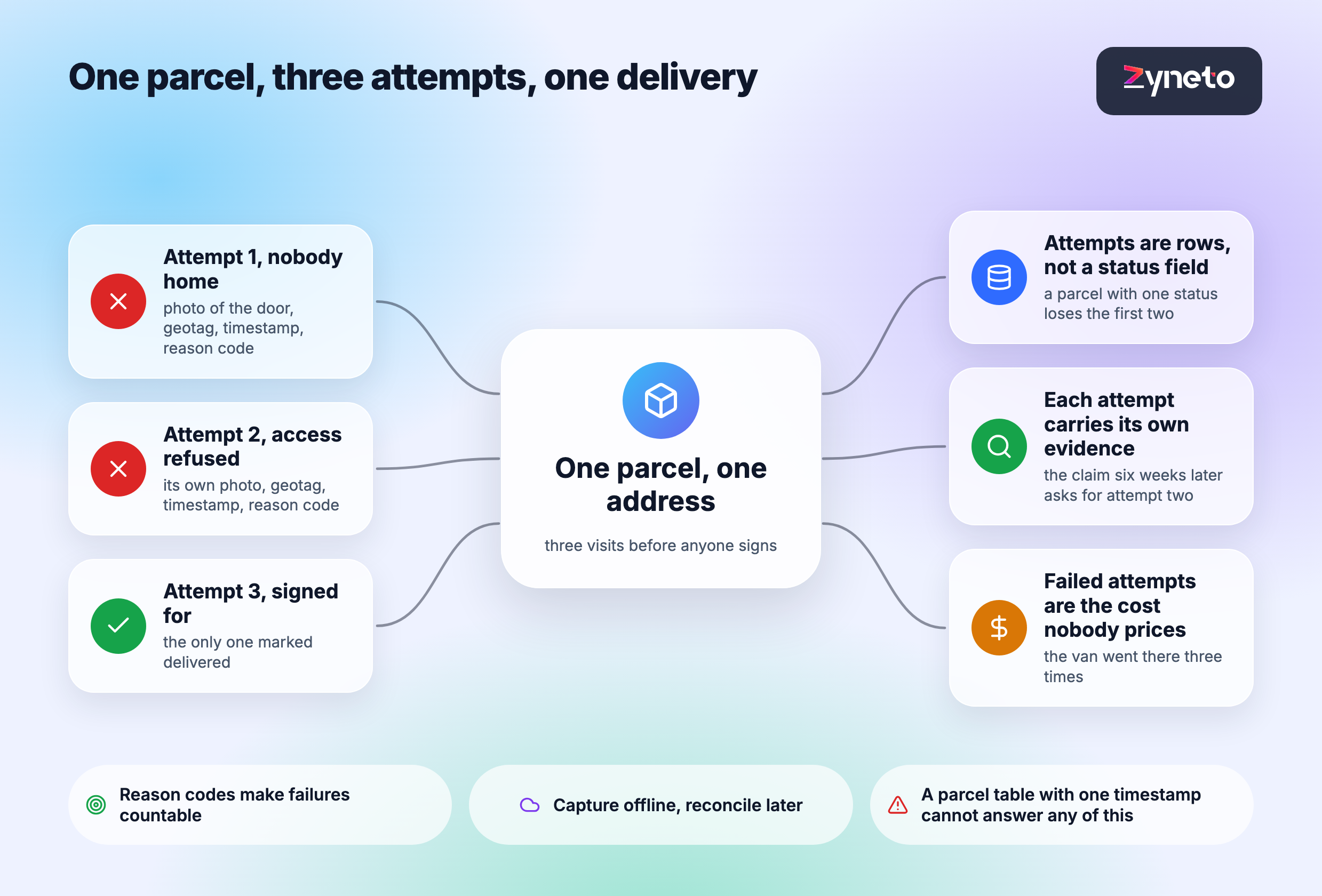
The naive model is one parcel, one delivery, one proof. The real model is one parcel, many attempts, each with its own proof, its own driver, its own geotag, its own reason for ending, and its own cost. The moment that is true, "delivered at" is no longer a column on the parcel. It is a property of the last attempt, and every report you have written needs to say which attempt it means.
Reason codes are the whole value and they are where products get lazy. Customer not in, access refused, wrong address, unsafe to leave, business closed, recipient refused, damaged in transit, unable to locate. Each one leads somewhere different: retry tomorrow, retry with an appointment, send back to depot, divert to a pickup point, raise a claim, contact the sender. A single "failed" status with a free-text note is a product that cannot route its own exceptions, and the operations team becomes the routing engine.
A failed attempt is a proof of delivery in reverse, and it needs the same evidence. A photograph of a closed door with a timestamp and a position is what you show the retailer who is charging you for a missed service level. Products that only capture evidence on success cannot defend themselves on failure, which is exactly backwards: the failure is the case you will have to argue.
Then the knock-on effects. The parcel is now in an inventory somewhere, so you need a depot location concept and a returns flow, which is where a courier product starts to resemble a small warehouse management system. The customer needs telling, and needs a way to change the outcome, which is a rebooking surface. Tomorrow's round has to include it, which is a feed into whatever is doing routing. Billing has to decide who pays for the second attempt, the single most argued clause in a B2B courier contract, and it has to be computable from the data you captured.
Design the attempt record before the delivery record. It costs almost nothing in week one and it cannot be retrofitted without reprocessing history, because the history does not contain the facts you now need.
Offline at the doorstep, and the price of adding it later
Every operator says the driver app must work offline. Most quotes price an app that caches and hopes.
The doorstep is the worst connectivity in the product, and it is where the legally important capture happens. Basements, loading bays, stairwells, rural lanes, lifts, underground car parks. If the signature can only be taken with a signal, drivers will take it in the street with a signal, and your evidence is now a drawing captured somewhere other than the place it claims.
Offline-first means every write succeeds locally. A real database on the device, identifiers generated on the device so nothing waits for a server, a queue that survives the app being killed and the phone being rebooted, and a sync process that handles the server having changed in the meantime. Attachments go separately and resumably, because a sync that blocks on a 12 MB photo on one bar of signal will never finish.
Idempotency is the unglamorous requirement that saves you. A driver taps "delivered", the request times out, the app retries, and the server must not create two deliveries. Every write from the field needs a client-generated key the server can recognise as a repeat. This is a day of work designed in and a month of reconciliation designed out.
The cost of adding this after launch is published, and it is instructive. RaftLabs lists an offline-mode retrofit after launch at $20,000 to $35,000, separate from the build. On a $10,000 to $50,000 budget that is not a change request, it is a second project. Our mobile app development scoping puts the local store and the sync contract in the first two weeks for exactly this reason, whether the app is built natively or in React Native.
Test it in the dead zones, not in a simulator. Two weeks of a real device in a real basement with the network switched off, doing a real round, tells you more about this build than any specification document. It is the cheapest insurance in the project.
Which delivery app is most profitable?
This comes up constantly next to the cost question, and the honest answer is that the software is not what makes it profitable.
Density and first-attempt success are what make it profitable. A round that drops 120 parcels inside four square kilometres and succeeds on 95% of them earns money at a price per parcel that would bankrupt a round of 40 parcels across a county with a 75% success rate. The same app runs both.
So the software's job is to raise those two numbers. Stop clustering and sensible sequencing raise density. Accurate arrival windows, a contactable recipient, authority to leave options and a working rebooking flow raise first-attempt success. Every one of those is in this post, and none of them is a feature anyone advertises.
The second profit lever is who you bill and how. A consumer-paid courier app competes on price with companies whose cost base you cannot match. A B2B courier billing retailers against a contract, with service levels, proof of delivery on demand and a monthly invoice, is a far better business, and it needs the evidence layer this post has spent its length on. That is why the merchant side of the product often matters more than the consumer side, and why it shares so much with ecommerce order flows and distributor delivery operations.
Be suspicious of any app whose profit story is volume. Volume in last-mile delivery buys a larger loss per parcel unless density and attempt rate come with it.
What sits outside the build number
The build is a one-off. These are not, and they belong in the same conversation.
Mapping and routing requests, priced as above, and growing with stops rather than with revenue. Messaging, because notifications are what raise first-attempt success and every SMS carries a per-message cost. Object storage for proof of delivery, which only ever grows until the deletion job you built runs.
Infrastructure. RaftLabs publishes ongoing infrastructure of $1,500 to $5,000 a month depending on fleet size and delivery volume. Treat that as the shape rather than your figure, but do not treat it as zero.
Maintenance. Several agency guides for this keyword put annual maintenance at 15% to 20% of the original build cost. That is the sector's rule of thumb rather than a measurement, and it is a reasonable line to hold in a budget.
Devices. Drivers' phones, mounts, chargers and a scanner if you need one. Go as far as vehicle hardware, temperature probes or fixed scanners and that becomes an IoT integration with its own supply chain, while vehicle data in particular belongs with automotive software rather than inside a parcel app.
Support hours. A courier operation runs when shops are shut. Someone answers the phone at 06:00 when a driver's app will not sync, and that someone is a cost whether or not a development quote mentions it.
What we would build first, and what we would buy
The attempt and proof data model first, before a single screen that matters. Parcel, attempt, evidence, reason code, and the idempotency keys that let a field device retry safely. This is the part that cannot be corrected later without reprocessing everything that came before it.
The driver app second, offline-first, deliberately short. A driver uses one screen all day, and every extra field on it is a field that gets filled with nonsense at 17:40.
The customer notification third, ahead of any portal. A narrowing arrival window and a message when the driver is close does more for first-attempt success, and therefore for the unit economics, than anything else on the list. An elaborate tracking portal gets built, launched, and then used by very few people.
Dispatch fourth, as assignment rather than optimisation, with the constraints recorded properly so an engine can be added when the fleet earns one. The operations dashboard comes after that, thinner than requested, showing attempt rate by reason code and by round.
What we would not build is the route engine, the map, the payment rails or the messaging. All four are better bought, and the integration cost is a fraction of the build cost with a better result. If cash is collected at the door, buy the payment layer too and read the payment side of this before scoping it, and if parcels are collected from shops as well as delivered, the retail end of the chain has its own requirements.
Our rate band is published: $40 to $100 an hour by role, blending to $60 to $70 for a mixed team, with the offline sync and evidence layer sitting at the top of that band because it needs senior time. Those figures assume a remote team, which is the same assumption behind every number on our engagement model page. We do not quote a fixed total before a discovery that establishes your attempt rate, your stop density and what your contracts say counts as delivered. What we will say for free is that a courier quote which does not contain the word "attempt" has priced the easy four deliveries in five.
Frequently asked questions
Published agency estimates run from $8,000 to $380,000, with RaftLabs putting an MVP that includes dispatch, routing, a driver app and proof of delivery at $90,000 to $180,000 over 12 to 18 weeks. Those ranges are wide because they price similar feature lists. Our published rate band is $40 to $100 an hour by role, blending to $60 to $70 for a mixed team. The real drivers are the proof of delivery evidence layer, whether the driver app is genuinely offline-first, and how many separate audiences the product serves.
Four facts that each fail differently: a signature attached to a named person and their stated relationship to the recipient, a photograph with a caption chosen from a short list, a geotag that carries the accuracy figure the device reported rather than just coordinates, and a timestamp from a trusted clock rather than the device's own. Store the raw capture separately from your interpretation of it, because the raw capture is the evidence and the interpretation is not. Also record which authority-to-leave option applied, since that is the clause your customer will quote back at you.
Buy it, at almost any budget under $50,000. Routing with time windows is a hard optimisation problem and the available options are better than anything a project of this size will write. Google publishes OR-Tools, whose routing library solves the vehicle routing problem with capacity and time window extensions, and also sells a hosted fleet routing service. What you should build instead is the constraint model: vehicle capacities, time windows, driver shifts, skills and the local rules that are specific to your operation. A solver is only ever as good as those.
Yes, and offline-first rather than offline-tolerant. The doorstep is the worst connectivity in the whole product and it is where the legally significant capture happens. Offline-first means a real database on the device, identifiers generated on the device, a queue that survives the app being killed, attachments uploading separately and resumably, and idempotency keys so a retried delivery does not create two. RaftLabs publishes the cost of retrofitting offline mode after launch at $20,000 to $35,000, which is why it belongs in week one.
More than most quotes allow for. The parcel needs a record of many attempts rather than one delivery, each with its own driver, evidence, geotag and reason code, which means "delivered at" becomes a property of the last attempt rather than a column on the parcel. The reason codes drive different outcomes: retry, appointment, return to depot, divert to a pickup point, raise a claim. A failed attempt also needs the same photographic evidence as a success, because the failure is the case you will have to argue with the retailer who hired you.
More than people expect, and the cost grows with the square of the stop count rather than with revenue. A route matrix is billed per element, meaning origins multiplied by destinations, so a 120-stop round is 14,400 elements in one call. At Google's listed Compute Route Matrix Essentials rate of $5.00 per 1,000 billable events that is about $72 per optimisation run, against a free allowance of 10,000 events a month. Cache matrices between points you serve daily, cluster stops before optimising, and re-optimise on events rather than on a timer.
Published timelines cluster between 10 and 18 weeks for a first release, with MindInventory giving 10 to 12 weeks for a courier app and RaftLabs giving 12 to 18 weeks for an MVP that includes dispatch, routing, a driver app and proof of delivery. Add time if the driver app must be genuinely offline-first, because the local store and sync contract need designing before the screens, and add two weeks for field testing on real devices in real dead zones rather than in a simulator.

Vikas Choudhary
Vikas has around fifteen years of experience building software and now builds generative AI systems at Zyneto. His work covers retrieval augmented generation, agentic AI, knowledge graphs, AI memory, and the evaluation and guardrails that decide whether any of it is safe to put in front of customers. He has shipped enterprise copilots, document AI, chatbots and predictive analytics for e-commerce, fintech and marketing teams, and works day to day in Python, JavaScript and SQL. He follows multimodal models, business process automation and enterprise AI security closely, and mentors engineers moving into AI. He writes about architecture, inference cost and the failure modes that only show up at production scale.
Zyneto builds custom software, AI and automation
Tell us what you are building and we will reply with a clear next step.