Hotel Management Software Cost: The Channel Manager Decides It


Published estimates for custom hotel management software run from $5,000 to $300,000. AppWrk puts a basic minimum viable product at $5,000 and up. Toxsl publishes $10,000 to $150,000, Django Stars $30,000 to $300,000 and above, and Binmile $40,000 to $300,000 or more, for the same described product. An entry-level cloud system for a small property can be had for under $100 a month.
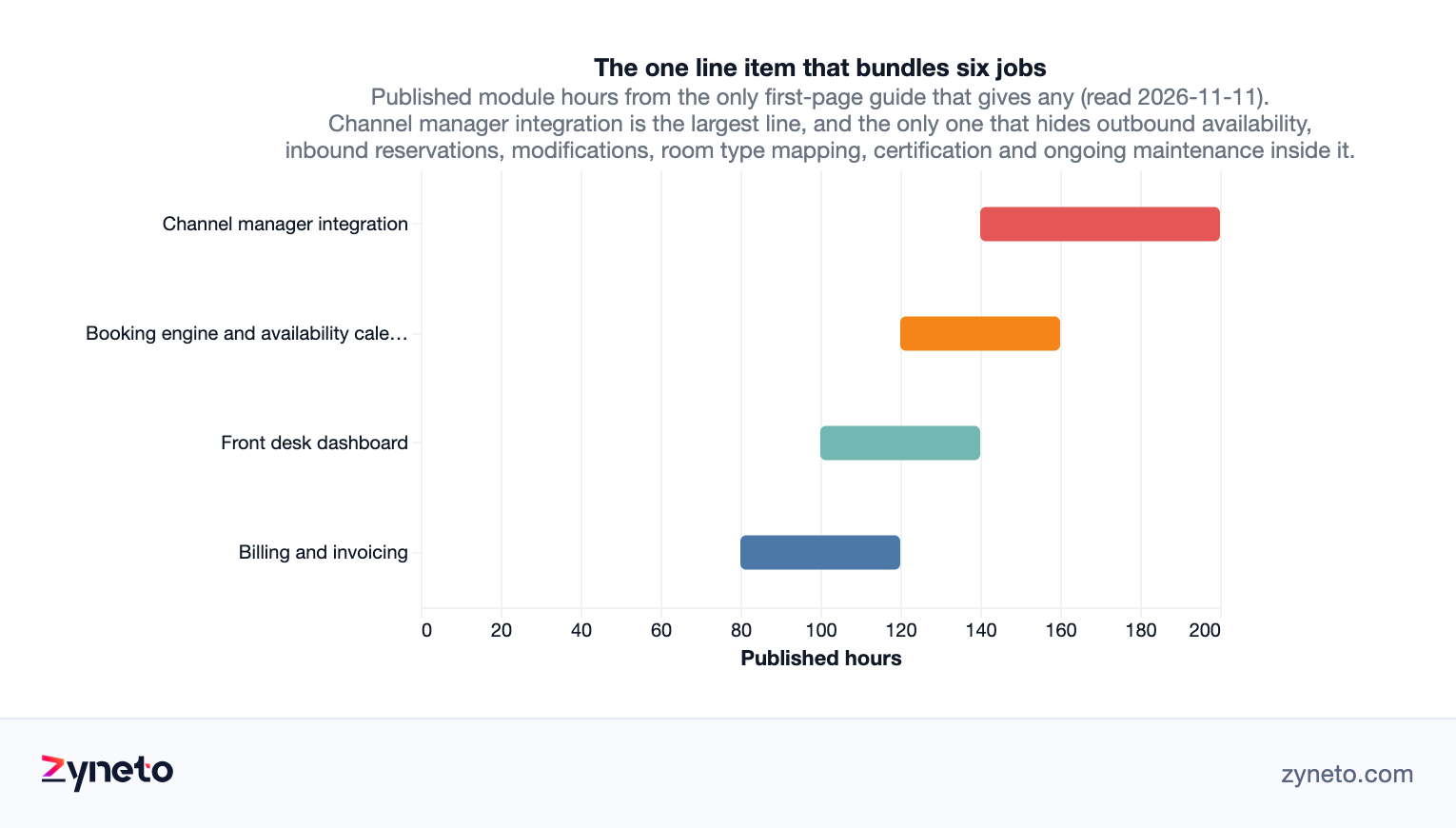
Django Stars does publish hours, which makes it the most useful page on the first results page: it prices a booking engine and availability calendar at 120 to 160 hours, a front desk dashboard at 100 to 140, billing and invoicing at 80 to 120, and channel manager integration at 140 to 200 hours, or $8,000 to $18,000.
That last line is the one worth staring at, because it is wrong in a way the others are not even close to.
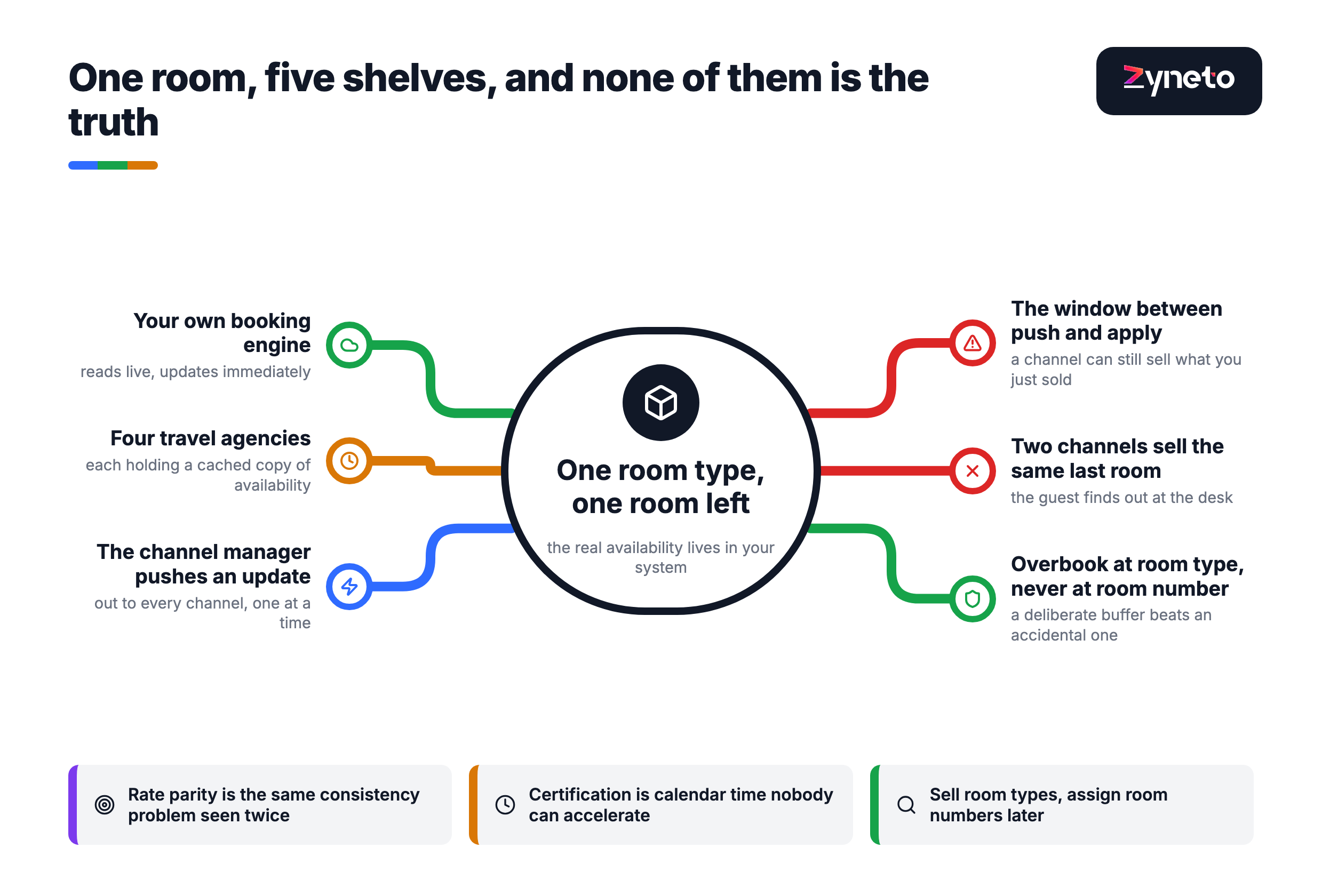
Your rooms are for sale in several places at the same time. Your own site, Booking.com, Expedia, a regional agency, a corporate portal, and the telephone. Each one holds its own copy of what is available. Sell the last room on two of them in the same minute and you have a guest with a confirmation and nowhere to sleep. Keeping every copy consistent, continuously, with no central referee, is a distributed consistency problem wearing a hospitality hat, and it is most of this build.
Three questions set the price. How many places can sell the same room? How many rate plans are there, and is any channel allowed a different price? And what is supposed to happen the moment two channels sell the last room? Everything else, including housekeeping screens, a guest app and reporting, is ordinary work priced near the floor of our published band.
What actually sets the price of hotel management software
Hotel management software costs what it costs because the same room is for sale in several places at once. The channel manager keeps your own site and every travel agency consistent without ever selling a room twice. That one requirement decides the data model, the testing burden and most of the integration budget.
The feature list is a distraction because nearly all of it is cheap. A housekeeping board is a week. A front desk screen is readable work. Reporting is ordinary once the data is right.
What is not cheap is the thing underneath. Our travel software development page publishes the distinction the whole build turns on: inventory, availability and the offer are three different things, and a system that treats them as one cannot be repaired later without a rewrite. Inventory is what physically exists, meaning a room. Availability is what may be sold right now, given holds, stop-sells, minimum stays and channel allocation. An offer is a price with conditions shown to one customer at one moment, and it can expire without anything about the room changing.
Collapse those three and you get the two failures that define this category: the same room sold twice because availability was a stale copy of inventory, and a price nobody can explain afterwards because the offer was never stored.
One room, five shelves, and none of them is the truth
Picture ten rooms and five channels. The question is what each channel is allowed to see.
Allocation gives each channel a fixed slice. Two rooms to Booking.com, two to Expedia, one to the regional agency, and so on. Nobody can oversell, because nobody can sell what they were not given. You also go to bed with empty rooms while a channel that sold out holds nothing and a channel with no demand holds two.
Pooling shows every channel all ten. Everything sells, and the last room is visible in five places simultaneously. Every hotelier wants pooling, which means every hotelier has bought the consistency problem whether anyone explained it or not.
The gap is in the cache, not the code. You do not control a travel agency's copy of your availability. You send an update and they apply it on their own schedule, which may be seconds or may be minutes under load. During that window their site is selling against a number you have already changed. No amount of care on your side closes it, which is why the correct design assumption is that channels will occasionally sell rooms you no longer have.
Our page states the counter-practice plainly: make one inventory the source of truth and treat every channel as a projection of it. Availability is derived from inventory with holds applied, never cached as a copy of it. Most overselling that gets inherited comes from a stale cache nobody chose deliberately rather than from an exotic race condition, and that is a data modelling decision made in week two.
Holds matter as much as bookings. A customer typing card details has not bought anything yet, and a system that only understands confirmed reservations either sells that room to somebody else mid-checkout or leaks it for twenty minutes after they abandon the page. The hold has to be a real object with a timeout the business chooses. The same mechanism, under a different name, is what stops a ticketing platform overselling the last seat.
What happens when the same room sells twice
The industry word for it is a walk, and it is a line in your profit and loss rather than a bug report.
You relocate the guest. That means a comparable room at another property, the fare difference, the taxi, often the first night, sometimes the phone calls for the rest of the stay. On a busy night in a full city, the comparable room costs more than the one they booked, and the review arrives whatever you spend.
The agency contract decides who absorbs the rest. A reservation you cannot honour is a commercial event with the channel as well as with the guest, and the penalty is not only money. Ranking and visibility are the currency of that relationship.
The expensive part is when you find out. Most hotels discover a double sell at the reception desk on the day of arrival, which is the one moment nothing can be done cheaply. A system worth paying for detects it the second the conflicting reservation lands, puts it in an exception queue with a name against it, and gives somebody four days to move one guest politely rather than four minutes to move one guest badly.
Controlled overbooking is not the same thing and you want it. Revenue managers deliberately sell more rooms than they have, against a forecast of cancellations and no-shows, because an empty room earns nothing. The counter-practice our page publishes is overbooking allowed only where the business chose it, with a documented answer to what happens when two customers reach the last room at the same moment. If the system cannot express "take two more deluxe rooms than exist tonight", the revenue manager will achieve the same effect by feeding the channel manager numbers that are not true, and then nobody knows the real position at all.
Sell room types, assign rooms later. Overbooking is managed at type level because that is how hotels actually sell. A system that sells a specific room number online looks tidier and creates a worse problem, because every maintenance issue and every late checkout becomes a reassignment nobody planned.
Rate parity is a data problem before it is a commercial one
For two decades, parity meant one price pushed everywhere, and systems were built on that assumption. A rate was a number, and distribution was a broadcast.
That assumption no longer holds, and the change is a matter of record rather than opinion. On 19 September 2024 the Court of Justice of the European Union ruled in Case C-264/23, Booking.com, that price parity clauses, both wide and narrow, cannot in principle be classified as ancillary restraints for the purposes of EU competition law. The European Commission designated Booking Holdings a gatekeeper under the Digital Markets Act, with all relevant obligations applying since 14 November 2024, and records the full removal of contractual parity requirements in July 2024. The Commission's own factsheet is unambiguous about what that means for a hotel: Booking.com cannot prevent accommodation providers from offering the same services through other channels at different prices or conditions, and businesses in the European Economic Area can now freely set their prices and conditions on and off the platform, including on their direct channel.
That is a worked example in one region with one platform, not the shape of the whole world. Parity may still be contractual elsewhere, and the commercial position will keep moving.
Which is exactly the point. The commercial position changes faster than anybody's database. If your rates are one number broadcast to every channel, you cannot express a direct-booking discount, a channel-specific closed rate or a regional price, and the day the commercial team wants one you are rebuilding rather than configuring.
A rate plan is a rule, not a price. Most hotel rates are derived: the agency rate is the best available rate less five percent, the corporate rate is a fixed discount off a seasonal base, the non-refundable rate is ten percent below the flexible one. Store the rule, compute the number, and keep the number you computed alongside the rule that produced it.
Then there is the part nobody budgets: proving what you published. A channel tells you that you are out of parity, or a guest disputes what they paid eight months ago. Answering either requires knowing what you sent to that channel at that moment, which means keeping what you published and not only what you intended. A rate spreadsheet maintained by hand, which our travel page lists as part of the estate we expect to meet, cannot answer that question at all.
Why "integrate with Booking.com" is not one line item
The published figure of 140 to 200 hours for channel manager integration treats as one item something with at least five distinct parts and two different kinds of clock.
Pushing out. Availability, rates and inventory have to reach the channel, in the channel's own message shapes, with retries, because the connection will fail and the retry will duplicate. Our published stack position puts a queue in front of every channel for exactly that reason.
Taking bookings in. New reservations are the easy case. A modification is a different message that refers to an earlier booking, and a cancellation is a third. Treat an incoming modification as a new reservation and you have just counted the same room twice in your own inventory, which means you caused the overbooking rather than the channel.
Mapping. Your room types and rate plans have to be matched against the channel's, by hand, per property. It is unglamorous, it is nobody's favourite afternoon, and it has to be redone the day somebody adds a room type and tells no one.
Certification. Every channel has its own test environment and its own sign-off. That is calendar rather than engineering, and our travel page is explicit that supplier certification rather than development is the pacing constraint on a first phase. Those weeks are nobody's to accelerate.
Then permanent maintenance, because each channel changes its own interface on its own schedule, forever.
So the honest way to budget it is not one line. It is one larger first item, which pays for the plumbing, plus a smaller repeating item for each additional channel covering mapping and certification. That shape is engineering judgement rather than a measured figure, and it is worth saying so rather than inventing a number.
The conclusion we publish is to not build it at all. Connecting to dozens of agencies and keeping every certification current is commodity work with a permanent maintenance cost and no differentiation in it. Our travel page says we would rather integrate with the channel manager you already pay for, and that on this vertical it concludes exactly that more often than not. What operators usually lack is not a channel manager. It is one authoritative inventory and a rate model somebody can edit. The same reasoning applies to direct airline and supplier connections, which we cover separately in our note on distribution API integration cost.
What is hotel management software?
Hotel management software is the set of systems that sell and run rooms. A property management system holds reservations, room status, guest folios and housekeeping. A channel manager keeps availability and rates consistent across travel agencies. A booking engine takes direct reservations on your own site. Revenue management sets prices. Point of sale handles the outlets.
Those are five products, and the single label is why buyers get quoted for one and expect all five. A quote for "hotel management software" that never mentions which of the five it covers is not a quote yet.
The outlets are their own question. A hotel restaurant is closer to a restaurant management build than to a reservation system, with its own food service rules, and the till that posts a dinner charge to a room is an ordinary point of sale integration with one unusual requirement: it has to find the right folio.
Should you build hotel software or buy a property management system?
Buy, for most properties. A cloud property management system under $100 a month for a small hotel encodes decades of practice you would otherwise rediscover at your own expense, and it comes with channel connections already certified.
Build the layer a bought system cannot express. That is usually the authoritative inventory, the rate rules and the booking record, with the property management system and the channel manager kept underneath. It is a smaller scope than replacing everything and it does not require migrating on day one.
Build fully when distribution is the business rather than overhead. A group with its own brand and a direct channel it intends to win with. Serviced apartments and extended stays, where the stay patterns and billing cycles look more like property management than like hotel nights. An operator selling other people's rooms, which is a marketplace build with commission, payouts and dispute handling, and a different product from anything described here. If the guest-facing side is what you care about most, that sits in our travel app development cost note instead.
The folio and the night audit, which nobody asks about
Ask a hotelier what breaks at month end and they will not mention the booking engine.
A folio is a running account for a stay, not an invoice. Charges post to it from everywhere: the room rate, the restaurant, the spa, the minibar, the car park. The folio closes at departure and becomes a bill, and until then it is an open ledger that several systems write to.
Split folios are the ordinary case, not the exotic one. A company pays the room and the tax while the guest pays extras. That is two accounts for one stay with routing rules deciding where each charge lands. A conference group is a master account plus individual folios, each with its own routing instruction, and somebody at reception changes one of those instructions on the morning of departure.
The city ledger is accounts receivable wearing a hotel name. Corporate accounts billed after departure have a credit limit, an ageing profile and a collections process, which is a different lifecycle from a card captured at checkout and frequently a link into whatever back office system finance already runs.
The night audit is the daily close. It posts room charges, rolls the business date forward and produces the day's figures. A hotel does not stop for it, so everything happening during the audit has to land on one side of the line or the other, deliberately. Systems built on the assumption that a day has a quiet boundary meet a 24-hour front desk and produce two different revenue figures for the same night.
Taxes are local and they are rules rather than rates. A city tax per person per night, a tourist levy that changes after a number of nights, exemptions by age or purpose of stay. Those are a configuration surface per jurisdiction, and they belong in editable data with effective dates, because a city council changes them with a month of notice.
Deposits need hold and release. A pre-authorisation that reserves money without taking it, released or captured later, is in our published integration set for this vertical for a reason. Payment providers differ in what they allow and for how long.
How long does it take to build hotel management software?
Our published phase one timeline for this vertical is 3 to 5 months, and the pacing constraint is supplier certification rather than engineering. Every channel has its own test environment and sign-off, and those weeks are nobody's to accelerate, which is why adding a sixth channel can cost more calendar than the previous five cost code.
What moves the date is the number of channels, the complexity of the rate model, and whether packages are in scope. What barely moves it is the number of screens, the visual design, and whether the front desk runs in a browser or an application. Those three are what founders ask about first and they sit inside normal variance.
If you want a shorter first step, scope a narrow phase one around inventory, rates and the booking record, then add channels one at a time against their certification calendars. That is the sequence we would recommend even with an unlimited budget, because a channel connected before the inventory is authoritative just distributes a wrong number faster.
Where we would start
A distribution map first, on paper. Every place a room can be sold today, including the agency nobody remembers signing, the corporate portal, the telephone and the spreadsheet. Most of the surprises in this kind of project are on that list and were never written down.
Then the inventory model: one authoritative record, availability derived from it with holds applied, and hold timeouts the business chooses rather than inherits. Then rate plans as editable data, with derived rates computed and the computed number kept. Then a booking record that survives a modification, because a modification is the message that creates overbooking when it is mishandled.
Channels after that, one at a time, against their certification calendars. The folio, the night audit and tax rules next, since they decide whether the month closes. Reporting last and shorter than requested: occupancy, average rate and revenue per available room, with a channel breakdown and the walk count. A dashboard with forty tiles is one nobody opens twice.
Our rate band is published: $40 to $100 an hour by role, blending to $60 to $70 for a mixed team, with reporting and admin near the floor and availability modelling near the ceiling. Blended and offshore delivery moves that arithmetic and we publish how. We do not quote a fixed total before a discovery that produces your distribution map and your inventory decision, and that discovery quite often concludes you should keep the channel manager you have.
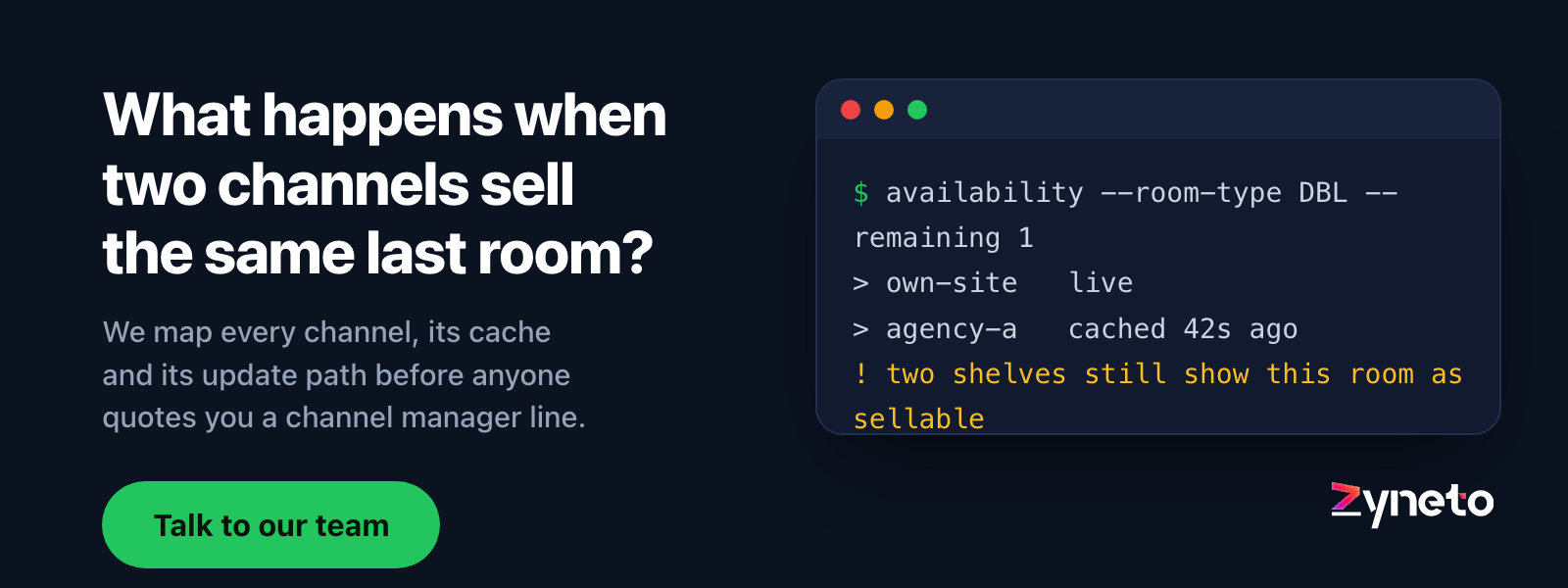
If the quote you are holding has a single line reading "channel manager integration", ask two questions before you sign it. How many channels does that cover. And what does your software do, by name, at 23:50 on a Friday when two of them sell the same last room.
Frequently asked questions
Published vendor estimates run from about $5,000 for a basic minimum viable product to $300,000, with ranges of $10,000 to $150,000, $30,000 to $300,000 and $40,000 to $300,000 all published for a similarly described product. An entry-level cloud system can cost under $100 a month instead. Our published rate band is $40 to $100 an hour by role, blending to $60 to $70. The genuine driver is how many channels sell the same room and how consistent they have to stay.
A channel manager keeps room availability and rates consistent across your own site and every travel agency that sells you. It costs because it is five things, not one: pushing availability and rates out with retries, taking reservations in, handling modifications and cancellations as separate messages, mapping your room types and rate plans to each channel by hand, and passing each channel's own certification. The last of those runs on the channel's calendar rather than yours, and all of it needs permanent maintenance.
The guest is walked, meaning relocated to another property at your expense: the rate difference, the transport, often the first night, plus a review you cannot undo. There is also a commercial consequence with the agency whose reservation you failed to honour. The avoidable part is timing. Most hotels discover a double sell at reception on the day of arrival, when nothing can be fixed cheaply, so the software's job is to detect the conflict the moment the second reservation lands and raise it as an owned exception.
It has changed, and the software needs to carry the change. The Court of Justice of the European Union ruled on 19 September 2024 in Case C-264/23 that price parity clauses cannot in principle be classified as ancillary restraints under EU competition law, and the European Commission records the full removal of Booking.com's contractual parity requirements in July 2024, with Digital Markets Act obligations applying since 14 November 2024. Hotels in the European Economic Area may now set different prices and conditions by channel, so a rate model that broadcasts one number cannot express what the commercial team will ask for.
Buy for most properties, because a cloud system costing under $100 a month for a small hotel arrives with certified channel connections and decades of encoded practice. Build the layer a bought system cannot express, usually the authoritative inventory, the rate rules and the booking record, keeping the property management system and channel manager underneath. Build fully only when distribution is the business itself: a group competing on its own direct channel, extended-stay properties with unusual billing, or an operator reselling other people's rooms.
Our published phase one timeline is 3 to 5 months, and the limit is supplier certification rather than engineering, because every channel has its own test environment and sign-off that nobody can accelerate. The variables that move the date are the number of channels, the complexity of the rate model and whether packages are in scope. The number of screens, the visual design and the choice of front desk platform sit inside normal variance and move it very little.
The night audit is the daily close: it posts room charges, rolls the business date forward and produces the day's revenue figures. It needs care rather than invention, because a hotel never stops trading, so every charge occurring during the audit has to land deliberately on one side of the business date. Systems that assume a quiet boundary between days produce two different revenue figures for the same night, which is discovered at month end by whoever has to explain the difference.

Vikas Choudhary
Vikas has around fifteen years of experience building software and now builds generative AI systems at Zyneto. His work covers retrieval augmented generation, agentic AI, knowledge graphs, AI memory, and the evaluation and guardrails that decide whether any of it is safe to put in front of customers. He has shipped enterprise copilots, document AI, chatbots and predictive analytics for e-commerce, fintech and marketing teams, and works day to day in Python, JavaScript and SQL. He follows multimodal models, business process automation and enterprise AI security closely, and mentors engineers moving into AI. He writes about architecture, inference cost and the failure modes that only show up at production scale.
Zyneto builds custom software, AI and automation
Tell us what you are building and we will reply with a clear next step.