Equipment Rental Software Cost: The Asset Is the Product


Published estimates for custom rental software run from about $10,000 to six figures, quoted in four currencies across a set of marketing pages that contradict each other. The ranges are useless for the same reason they are useless in every vertical: they price a feature list, and the feature lists are all the same.
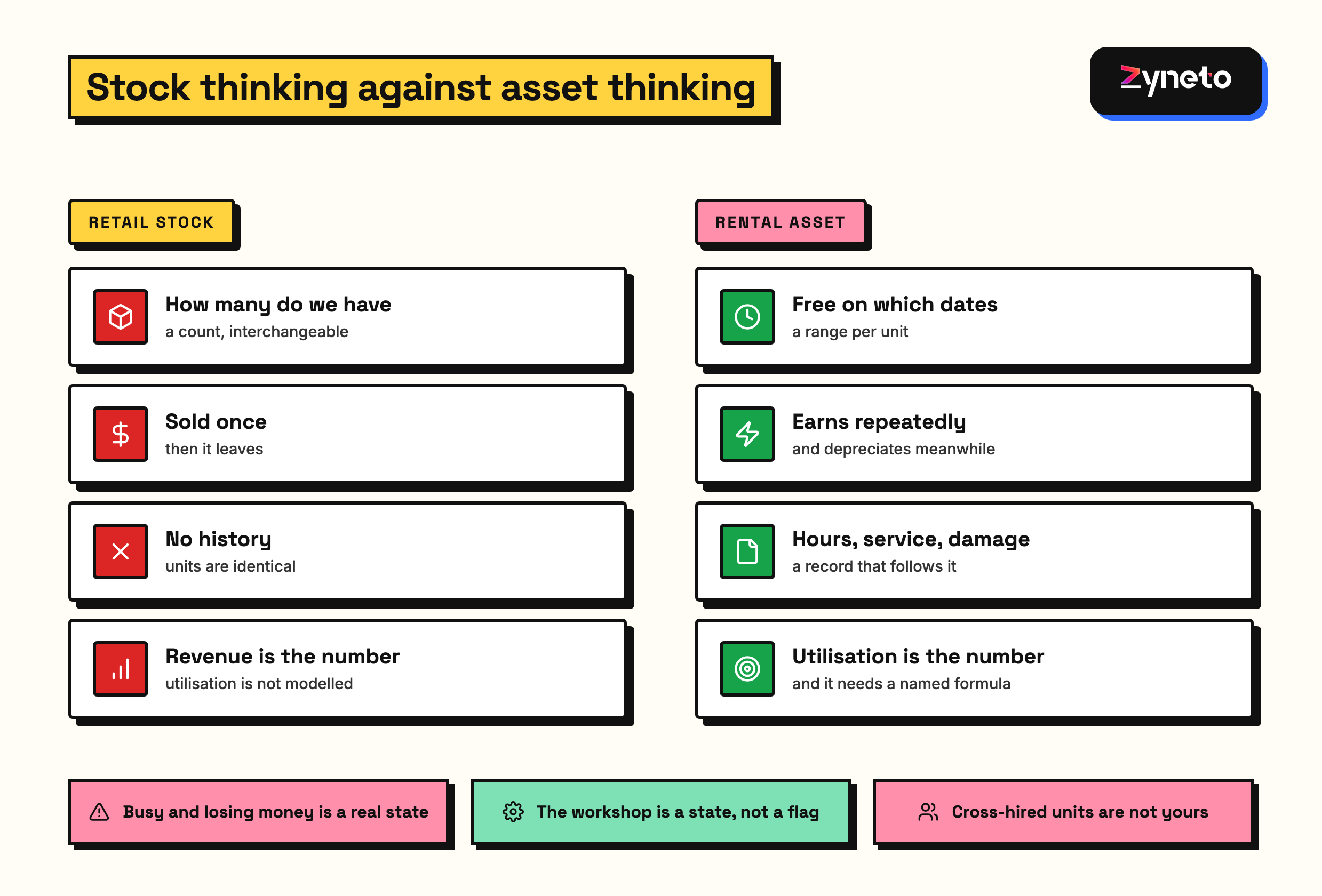
One structural fact sets the cost, and every expensive decision descends from it. An item on hire is not stock.
Retail inventory answers "how many do we have". That question is nearly meaningless here. A 3-tonne excavator is not interchangeable with another 3-tonne excavator, because one has 4,200 hours on it, a service due next month, a dent the last customer argued about, and a booking on the 14th. It is an asset with a history, a liability and a forward calendar, and every quantity in a retail system has to be replaced by something that knows which specific unit it means.
That leads straight to the second fact: availability is a date range, not a count. "We have four" does not answer "can I have one next Tuesday for a fortnight". Answering that means checking, for every unit of that class, the bookings already placed, the transport time either side, the service due dates, and whether the unit coming back on Monday will pass its inspection in time to go out on Tuesday. A single number cannot carry any of that, and a system built around one will be worked around by the counter staff within a month.
And the third: the business runs on utilisation rather than revenue, which turns reporting from a tab into the product. A rental business with rising revenue and falling utilisation is in trouble and its profit-and-loss will not say so for two quarters.
Three questions set the price. Are the items individually tracked or interchangeable? Does the fleet move between sites and customers, or sit in one yard? And does the business need to know utilisation, or only revenue? Everything else is ordinary software.
How much does equipment rental software cost to build?
The published range of roughly $10,000 to six figures reflects feature lists rather than scope. The real drivers are individual asset tracking with service and damage history, availability computed across date ranges rather than counts, contract handling for extensions, part-returns and cross-hire, and a utilisation reporting layer that is the product rather than a tab.
Our rates are published: $40 to $100 an hour by role, blending to $60 to $70 for a mixed team. We do not quote a fixed total before a discovery that establishes whether assets are serialised, how many depots are in scope, and which utilisation figure the business actually manages by.
Utilisation is two numbers, and the industry disagrees about one of them
This is the part no vendor page mentions and the part that decides whether your reporting is worth anything.
Time utilisation is the straightforward one: days on hire divided by days available, usually expressed as a percentage. Published guidance for general rental cites targets around 65%, though that varies by category and region.
Financial utilisation is where the agreement ends. Every source uses annualised rental revenue as the numerator and then picks a different denominator. One calculator divides by original equipment cost. An analytics vendor divides by total acquisition cost. Another divides by acquisition plus maintenance costs. Infor's M3 Analytics documentation defines it differently again, as rental revenue achieved over a period against the potential revenue that could have been achieved, which is not a cost basis at all.
Four published definitions of one metric. They give different answers for the same fleet, and none of them is wrong; they measure different things that share a name.
The engineering consequence is specific and cheap to get right at the start. The system must store which formula it used, display it alongside the number, and let a business configure its own. A dashboard that shows "utilisation: 61%" without naming the basis cannot be compared against a benchmark, against another depot, or against last year if anyone changed their mind in between.
And the reason to care is not pedantry. Time utilisation can look healthy while financial utilisation is poor, which happens when hire rates have not kept pace with replacement cost. The fleet is busy and losing money, and only one of the two numbers says so.
Availability is a date range, not a count
The booking question is the hardest piece of engineering in the product and it is almost never priced as such.
A reservation holds a class of equipment, or a specific unit, for a window. Checking whether that window is free means resolving several things at once: existing bookings on every unit of that class, the transport time out and back, the service interval each unit is approaching, the yard it is currently in, and the ones currently out that are expected back but might not be.
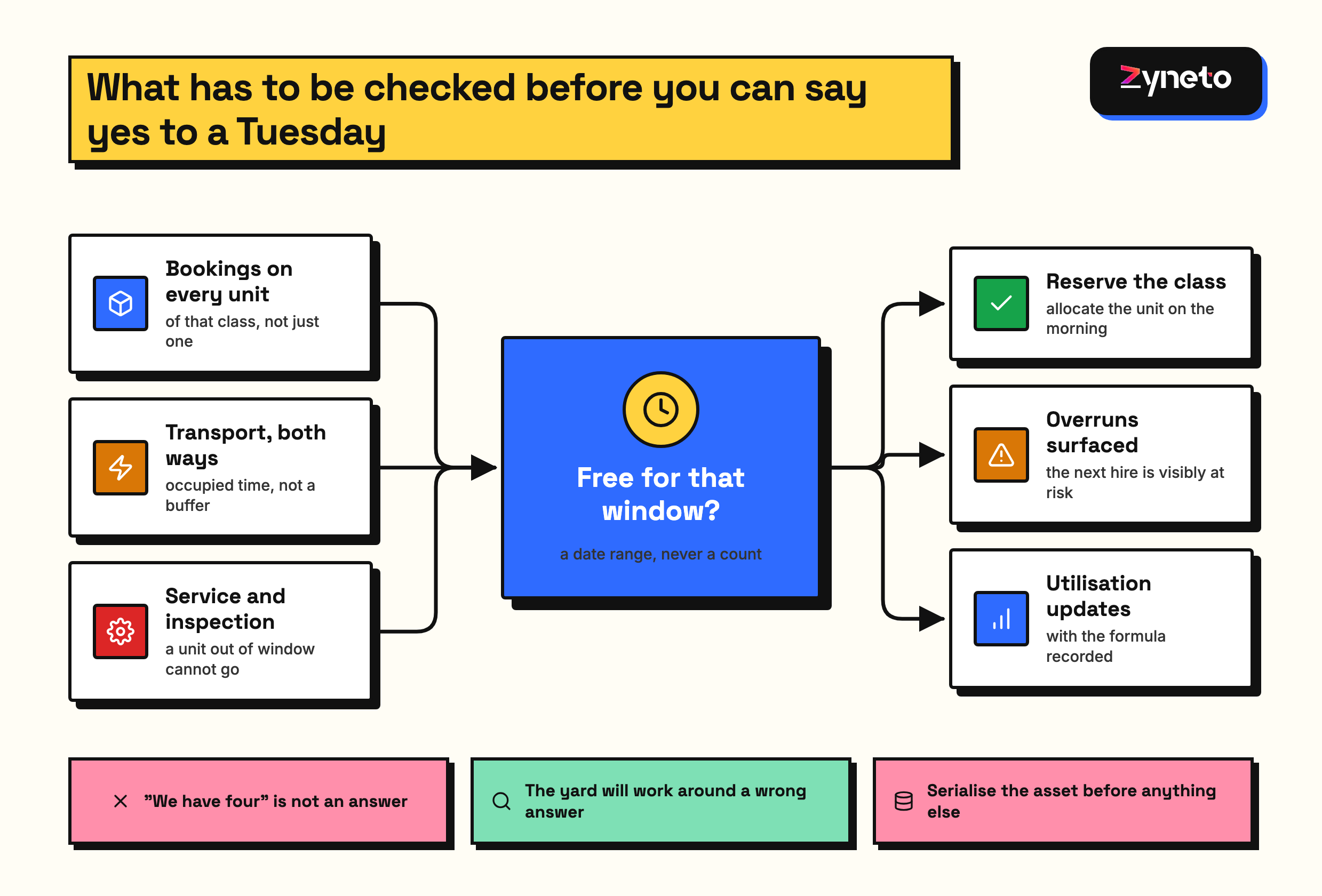
Three properties separate a working availability engine from a calendar view
- It reserves against a class and allocates a unit late. Customers hire a category; the yard picks the machine on the morning. A system that forces the specific unit at booking time generates reallocation work every single day.
- It treats transport as occupied time. A machine on a lorry is not available, and the hours either side of a hire are part of the hire's footprint. Omitting them produces a schedule that cannot physically happen, which the yard then fixes by ignoring the system.
- It handles the overrun honestly. Equipment comes back late more often than it comes back early, and the next booking has to be visibly at risk rather than silently double-allocated. This is the same shape as the resource and segment scheduling problem in appointment businesses, with the complication that the resource is in a field forty miles away.
The contract is where the money and the arguments are
A hire is a contract with a shape that retail software has no concept of.
It extends. Most hires do, and an extension is a modification to a live agreement with a new end date, a rate that may change at a duration threshold, and a knock-on effect on every booking behind it. Modelling an extension as a new hire breaks the asset's history and the customer's invoice.
It is billed in arrears against periods that do not align with months. Weekly rates, daily rates, minimum hire periods, and a billing run that has to decide what a part-week costs. Rate cards vary by customer, by duration band and by season, and a national account's rate is not the counter rate.
It comes back in pieces. Three items go out and two come back, one of them damaged. The contract is partly open, partly closed, partly disputed, and the invoice has to reflect that without a human recalculating it.
And sometimes the equipment is not yours. Cross-hire, where you rent from another company to fulfil a customer order, puts a unit in your system that you are paying for and charging on. Margin, availability and liability all behave differently, and a model that assumes every asset is owned cannot express it. The two-sided bookkeeping here has more in common with a distributor's ledger than with a shop.
The rate card is a pricing engine, not a price list
Rental pricing is the quiet second product inside the build, and the quotes that come in cheap have assumed a price field on a product.
Rates band by duration. A day rate, a weekly rate that is not seven day rates, a monthly rate, and thresholds where a hire crosses from one to another mid-contract. The engine has to decide, at invoice time, which band a given period falls into and whether a crossed threshold is applied retrospectively. Businesses differ on that answer and both answers are defensible, which makes it configuration.
Rates vary by customer and by season. A national account has a negotiated card, a walk-in has the counter rate, and some categories move with demand. That is a rate hierarchy with precedence rules, not a discount percentage.
And the extras are where margin leaks. Transport charged by distance or by zone, fuel on return, consumables, damage waiver as an optional percentage, and environmental or disposal charges in some categories. Each is a line with its own rules, and a system that cannot add one without a release will have them added in free-text instead, which destroys the reporting the whole product exists for.
The useful test is to take a real invoice from the business, with an extension and a part-return on it, and ask whether the proposed system can reproduce it without anyone editing a number. If it cannot, the pricing engine has been underscoped, which is the commonest reason a contract-heavy build overruns.
Damage, deposits and the condition record
The condition of an asset at two moments decides who pays, and the record of those moments is the product's most-used feature after booking.
Out-check and in-check are structured records with photographs, meter readings, fuel level, accessories present and a signature. They are captured on a phone, in a yard, frequently without signal, which makes offline capture a requirement rather than a nice-to-have. The constraints are the ones we set out for field service work: if the data cannot be captured without a connection, it is captured on paper and typed in later, badly.
The deposit is a financial instrument, not a payment. Held, partially released, partially applied against damage, refunded. That brings a payment provider, authorisation holds with their own expiry, and a dispute path, all of which resemble the payments side of any fintech build.
Inspection regimes deserve a line of their own. Several equipment categories carry statutory inspection intervals, and a unit outside its inspection window must not be allocated at all. That is an availability rule enforced by a compliance date, which is the same statutory-clock pattern that governs legal and contract deadlines: the date comes from outside, and the software's job is to make the breach impossible rather than merely visible.
And damage recovery is an evidence problem. The money is recovered or lost on whether the out-check photograph exists, is timestamped, and is attached to the right unit and contract. Practices that get this right recover meaningful sums; the software's contribution is making the capture fast enough that a yard operative actually does it.
Do we need GPS and telematics?
Not in phase one, usually, and the reason is that telematics answers a question you cannot act on until the rest of the system exists. Knowing where a machine is matters once you are allocating units across depots and billing against engine hours; before that it is a map nobody opens.
Where it does earn its place quickly is hour-based billing and service scheduling. An engine-hours feed turns service intervals from a calendar guess into a trigger, and turns a disputed invoice into a reading. If that is the plan, treat it as its own integration project with its own data model, as we set out in vehicle telematics platforms, rather than as a field on the asset record.
The thing to avoid is buying telematics to solve a utilisation problem. Utilisation is a booking and rate question; a tracker tells you where an idle machine is, not why it is idle.
What is ordinary, and should be priced that way
A good quote separates the specialised half from the ordinary half, and the ordinary half is real.
Customers, accounts, credit limits, quotations, invoicing and a customer portal are well-understood work. Transport scheduling is a routing problem best bought rather than built. Reporting beyond utilisation, which is to say ordinary revenue and debtor reporting, is a dashboard rather than a feature.
Multi-depot is ordinary until it is not. Stock held per depot, transfers between them, a unit's home yard against where it actually is, and pricing that may differ by region. Deciding it at the start is free; deciding it in year two is a migration, which is the same lesson a warehouse system teaches about locations.
Stock that is consumed rather than hired sits alongside the fleet. Fuel, blades, bits, slings and the small items sold outright at the counter are ordinary inventory with counts, and they share a transaction with assets that are not. A system that models only one of the two forces a second system or a spreadsheet, and the spreadsheet is where the margin reporting goes to die.
Maintenance is the half nobody scopes. Service intervals, inspections with statutory deadlines in some categories, parts consumption, and the fact that a machine in the workshop is unavailable and therefore affects every availability answer above. Treat the workshop as a first-class state of the asset rather than a flag.
Should we build or buy rental software?
Buy, for most single-depot businesses. Established rental products handle the contract shapes above and have been through enough edge cases that a new build will spend a year rediscovering them.
Building earns its place where the hire model is genuinely unusual, where the business is large enough that per-seat licensing exceeds the cost of ownership, or where the software itself is the product. And there is a fourth case that is increasingly the real one: a group that has acquired several businesses and now runs three incompatible systems, where the realistic project is a layer above them for consolidated availability and utilisation rather than a replacement. That is an integration build with a migration inside it, and it is priced very differently.
The test to apply before committing, to a vendor or to your own team: ask the system which units of a class are free for a fortnight starting three Tuesdays from now, with transport, and ask it which utilisation formula the dashboard used. The first tells you whether availability is a date range. The second tells you whether anyone thought about the reporting at all.
How we would sequence it
The asset model first: serialised units, class and category, home depot, meter readings, service schedule, condition history and ownership including cross-hired equipment. No screens. Everything else reads from it and it cannot be corrected later without reprocessing every hire.
The availability engine second, with class-level reservation, late allocation, transport time and service windows all included from the start. The acceptance criterion is the three-Tuesdays question above, not a calendar that renders.
The contract and billing model third, with extensions as modifications, part-returns as states and duration-banded rate cards as configuration.
Out-check and in-check fourth, offline-first, deliberately short, because a long form in a yard produces fiction.
Utilisation reporting fifth and no later, with the formula stored and displayed. Portals, transport and telematics after that.
What we will say without a discovery: any quote that prices rental inventory as inventory, or shows a utilisation figure without naming its denominator, has scoped a different product from the one the business runs on.
Frequently asked questions
Published estimates run from about $10,000 to six figures and reflect feature lists rather than scope. The real drivers are serialised asset tracking with service and damage history, availability computed over date ranges rather than counts, contracts that extend and come back in pieces, and a utilisation reporting layer. A single-depot business with interchangeable items is a far smaller build than a multi-depot fleet with cross-hire. Our published rates are $40 to $100 an hour by role, blending to $60 to $70.
Because the units are not interchangeable. Two machines of the same model differ by hours run, service due date, damage history and the bookings already against them, and the availability question is about a specific window rather than a quantity. A retail system answers "how many do we have", which does not answer "can I have one next Tuesday for a fortnight". Replacing counts with serialised assets after launch means reprocessing every hire.
Time utilisation is days on hire divided by days available, with published guidance citing targets around 65% for general rental. Financial utilisation uses annualised rental revenue as the numerator, but published sources divide it variously by original equipment cost, by total acquisition cost, by acquisition plus maintenance, or by the revenue that could potentially have been achieved. Those give different answers for the same fleet, so a reported figure is meaningless unless the basis is stated.
The formula, alongside the number. Because there are at least four published definitions of financial utilisation, a dashboard showing a percentage without naming its basis cannot be compared against a benchmark, against another depot, or against last year if the definition changed in between. Make the basis configurable, store which one produced each figure, and display it. It costs almost nothing at the start and cannot be reconstructed afterwards.
As modifications to a live contract, not as new ones. An extension changes the end date, may cross a duration threshold that changes the rate, and affects every booking behind it, so modelling it as a fresh hire breaks both the asset history and the invoice. A partial return leaves the contract simultaneously part-closed and part-open, and the billing run has to handle that without someone recalculating it by hand.
Usually not. Telematics answers questions you cannot act on until allocation and billing exist, and buying it to fix low utilisation misdiagnoses the problem, since utilisation is a booking and rate question rather than a location one. It earns its place quickly where billing is by engine hours or where service intervals should be triggered by use rather than by calendar, and in that case it is its own integration project with its own data model.
Buy, for most single-depot operations, because established products have already met the contract shapes that take a new build a year to discover. Building makes sense for an unusual hire model, for a business large enough that licensing exceeds ownership cost, or for a software vendor. The increasingly common fourth case is a group running several inherited systems, where the realistic project is a consolidated availability and utilisation layer above them rather than a replacement.

Vikas Choudhary
Vikas has around fifteen years of experience building software and now builds generative AI systems at Zyneto. His work covers retrieval augmented generation, agentic AI, knowledge graphs, AI memory, and the evaluation and guardrails that decide whether any of it is safe to put in front of customers. He has shipped enterprise copilots, document AI, chatbots and predictive analytics for e-commerce, fintech and marketing teams, and works day to day in Python, JavaScript and SQL. He follows multimodal models, business process automation and enterprise AI security closely, and mentors engineers moving into AI. He writes about architecture, inference cost and the failure modes that only show up at production scale.
Zyneto builds custom software, AI and automation
Tell us what you are building and we will reply with a clear next step.