Gym Management Software Cost: Two Products, One Quote



Published estimates for custom gym management software run from $5,000 to $300,000. PerfectionGeeks prices a basic membership, billing and attendance build at $5,000 to $10,000 and an advanced one at $25,000 to $50,000 or more. NimbleAppGenie puts the whole category at $25,000 to $250,000. RaftLabs prices a studio platform at $65,000 to $175,000 and a full platform at $150,000 to $280,000 or more. Buying rather than building is an order of magnitude cheaper: PushPress publishes $75 to $290 a month for a single location, and GymMaster publishes $89, $129 and $209 a month by member count.
Those figures disagree by a factor of sixty, and every one of them is pricing a feature list.
What you are buying is two products. Class scheduling is a capacity problem: eighteen bikes, a waitlist, a late cancellation window, a rule about people who do not turn up. Membership billing is a recurring revenue problem: freezes, pro-rata, minimum terms, a card that declines on the first and the three weeks of chasing that follow. They get sold as one thing called gym software, quoted as one line, and they land on the same member in the same month.
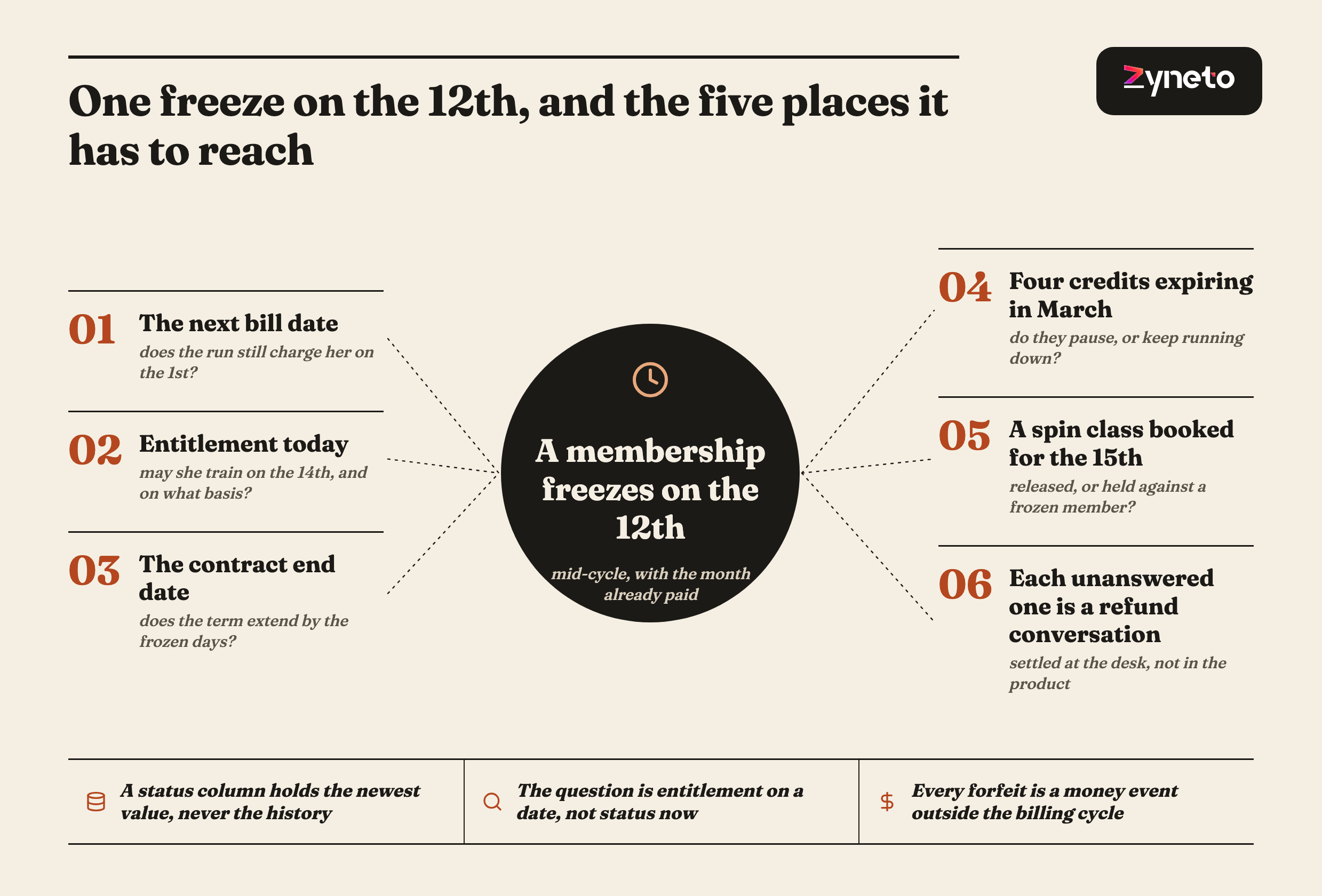
The seam between them is where the money goes wrong. A member freezes her membership on the 12th. She has a spin class booked for the 15th and four class credits that expire in March. Does the freeze release that booking? Does it stop the credits expiring? Does the billing run charge her on the 1st? Three parts of the system hold three answers and nobody wrote down the fourth.
Three questions set the price
- Do you sell classes, memberships, or both?
- Does anything in your rules forfeit money, meaning late cancellations, no-shows or expiring credits?
- How many sites and membership tiers share one rulebook?
Everything else, including a member app, a timetable screen and a dashboard, is ordinary work priced near the floor of our published band.
What actually sets the price of gym management software
Gym management software costs what it costs because it is two products. Class scheduling allocates finite capacity under cancellation rules. Membership billing runs recurring revenue through freezes, pro-rata and failed payments. A quote that prices one of those and then delivers both is the largest single source of overrun in this category.
The reason is not that either half is hard in isolation. A timetable with capacity is a week of work. A monthly charge against a saved card is less. Both are commodity, and you can buy either one from a dozen vendors.
What costs money is the rule that spans them. Attendance generates money events. Money position decides who may attend. Each half therefore needs to ask the other a question, continuously, and give the same answer twice.
Our fitness app development page publishes this as a three-way split rather than a two-way one: a member management platform, a subscription billing engine and an access control system are three products, and buying one does not give you the other two. The pair that collides first, for almost every operator, is scheduling against billing, because those two touch the same member every week. Door access collides later and more loudly.
If you want the build itself broken into modules with hour ranges attached, that arithmetic is published separately in our fitness app development cost breakdown. This post is about the decision you make before that: which of the two products you are actually commissioning, and what the boundary between them costs.
Class scheduling is a capacity problem with policy attached
A class has a room, a start time and a number. That part is a calendar, and a calendar is cheap.
Bookable capacity is not room capacity. The studio holds eighteen bikes. Two are out for repair, so sixteen are sellable. Three members hold confirmed places they have already cancelled inside the late window, which means they lost a credit and the place came back. Four people are on the waitlist. The number the booking screen should show is none of the above read directly; it is computed from the room, the confirmed bookings, the maintenance holds and whatever the cancellation rule has already released.
A screen that reads the room number oversells during a waitlist promotion window and undersells after a run of late cancellations. Both look like defects to a member and both are policy arriving in the wrong place.
Waitlist promotion is the part that gets built last and argued about first. Someone cancels forty minutes before a 07:00 class. The first person on the list is offered the place with a window to accept. If they do not answer, it passes on. If they accept at 06:50, do they get the same late cancellation window as the original booker, or a new one computed from the moment they were promoted? There is one correct answer for your business and it has to be written down, because a member who is charged a late cancellation fee ten minutes after being given a place will tell everyone.
Every one of those rules changes per site, per class type and per membership tier. Hard-code them and you are in the code every month. The teams that get this right put the rules in editable data early and accept that it looks overbuilt for one studio. It stops looking overbuilt at the fourth.
Membership billing is a revenue problem, and revenue has states
A subscription has two states. A gym membership has a position, and the position needs a date attached to it.
A member can be paid up, frozen, inside a grace period after a declined card, cancelled but entitled until the period ends, or locked inside a minimum term. A member can also be two of those at once. Frozen and still inside a minimum term. Cancelled with notice running and in arrears at the same time.
Failed payments are a process, not an error. A card declines on the 1st. You retry, but not immediately and not against a hard decline, because a hopeless retry costs a gateway fee for nothing. You notify. You decide what the member is entitled to while this runs, and most operators want full access for a week, because locking out someone whose card merely expired is how you lose a member who intended to pay. Then it escalates on a schedule, and at some point the membership suspends.
That ladder is covered in depth, with the market-by-market mandate and cancellation rules that shape it, in the fitness app development cost post. What matters here is simpler. Every rung on that ladder is a fact the timetable needs. A member in the first retry window should still be able to book Thursday's class. A suspended member should not. If the booking engine reads a single word off the member record, it will get one of those two wrong, and you will find out from the member rather than from the software.
Minimum terms and notice periods are contract data, not preferences. A twelve-month term with a thirty-day notice period means a cancellation on the 20th has an end date you compute rather than choose, and the member is entitled to train right up to it.
What breaks when a member freezes mid-cycle
Take a $80 monthly membership on a 30-day month, billed on the 1st, and a freeze starting on the 12th. Assume straight-line pro-rata and no freeze fee.
There are three defensible answers and they are not the same number. Refund the unused 18 days at 18/30 of $80, which is $48, and treat the cycle as closed. Or take no refund and extend the paid period by 18 days, which moves the next bill from the 1st to the 19th. Or charge a holding fee, commonly around $10 a month, to keep the place and the price.
Each of those produces a different next-bill date, a different contract end date and a different revenue figure for the month. Pick the second and your billing system now believes the member is paid until the 19th of next month, while a scheduler that still reads "cycle ends on the 1st" will quietly refuse a booking on the 5th.
The freeze also has to reach four places at once. Billing, because the next charge moves. Entitlement, because access changes today. The contract, because a twelve-month term now ends eighteen days later. And the retention denominator, because a frozen member is neither paying nor churned, and counting her as either makes your churn number wrong in a direction nobody notices for two quarters.
Class credits are the fourth thing and the one most often missed. Four credits expiring in March either pause with the membership or keep running. If they keep running, the member paid for a freeze and lost value, which is a refund conversation. If they pause, every credit now needs an expiry you can recompute rather than a date you stamped once.
Doing this by hand gets one of the five wrong every time, which is why our industry page names manual freeze handling as a failure mode rather than a workaround.
Why one membership_status column cannot carry it
The commonest shape in this category is a member row with a status word on it: active, frozen, cancelled, expired. It is readable, it is fast, and it cannot answer the question the business asks.
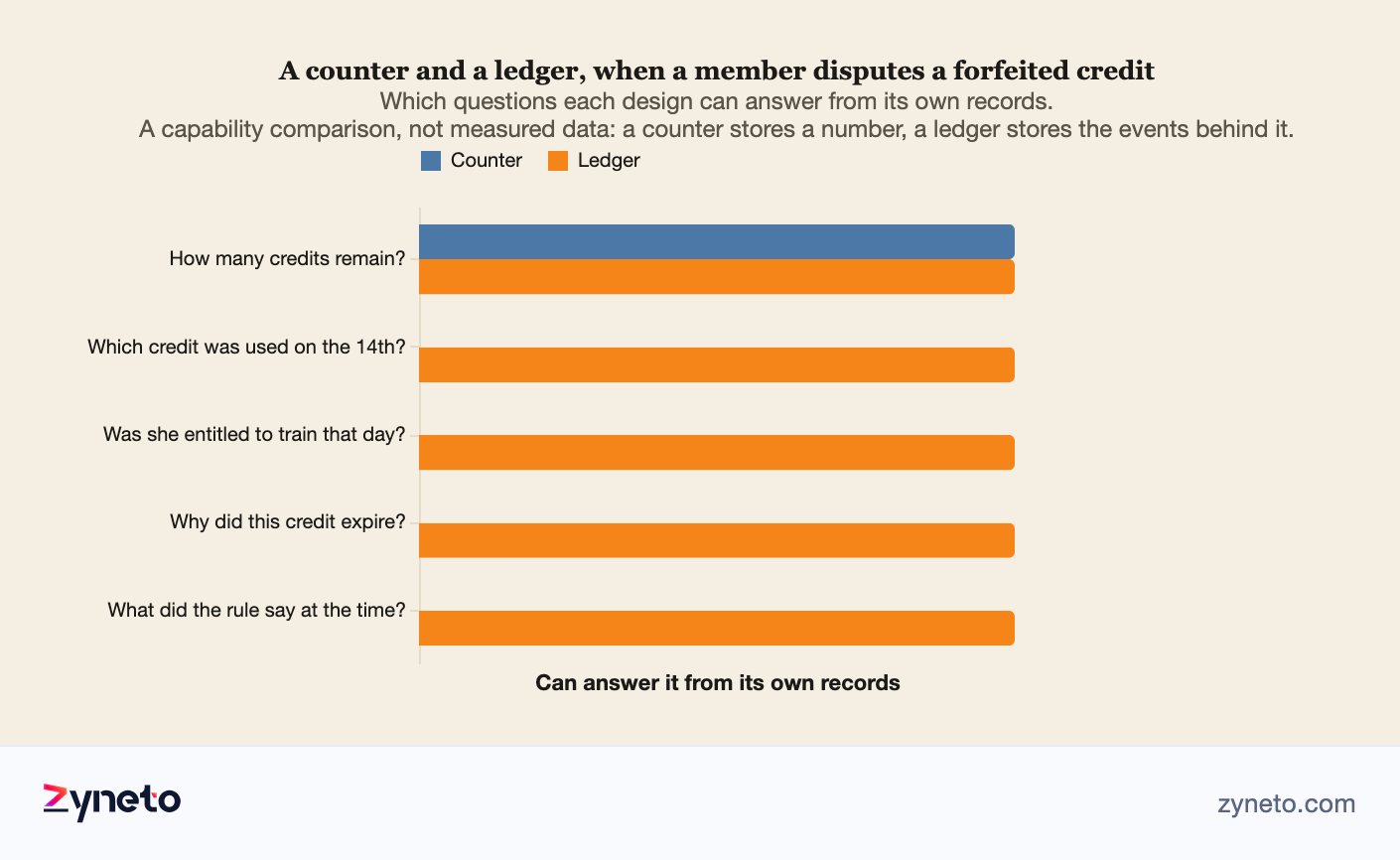
The question is never "what is this member's status". It is "was this member entitled to train on the 14th, and on what basis". A status word is the newest value of a field that has been overwritten repeatedly. It holds no history, no reason and no date, so the moment anyone disputes a charge or a lockout, there is nothing to read.
Overwriting also destroys the only retention data you will ever have. Churn and lifetime value are cohort questions: what happened, month by month, to everyone who joined in March. A table holding only current state cannot answer that, so somebody writes a monthly snapshot job instead, which is a reconstruction with every gap that implies.
The fix is boring. The membership becomes a contract plus a sequence of dated events: joins, freezes, upgrades, declines, grace days, cancellations, reinstatements. The position is computed when it is asked for, which means the door, the booking screen, the refund conversation and the churn report all read the same facts and cannot disagree. Our page names this as entitlement rather than status, and it is the single decision on which everything else in the build depends. Getting the database model right here costs nothing extra at the start and cannot be retrofitted once the field has been overwritten for a year.
This is engineering judgement rather than a measurement, and it is worth saying so plainly: we are describing the modelling decision we would make, not a benchmark we have run.
What a no-show policy does to your billing model
A no-show rule reads like a scheduling feature. It is a billing instruction issued by the timetable.
When the rule charges a fee, the scheduler has just created a money event outside the subscription cycle. That needs a payment attempt against a saved card, a receipt, a dispute path and a line in whatever your accountant reads. It is not a column on the booking.
When the rule forfeits a credit, you need a ledger rather than a counter. A number that gets decremented cannot say when a credit expired, why one was taken, or whether a refund is owed. Hold credits as entries, meaning grants, consumptions, expiries and forfeits each with a reason, and derive the balance. A counter is where studios end up refunding credits they never owed, because nobody can prove what happened.
Unlimited tiers break the whole mechanism. There is no credit to forfeit and no fee the member accepts, so operators reach for a ban: three no-shows in a month and you lose booking rights for two weeks. That is an entitlement change generated by attendance. The timetable now writes to the same entitlement record the front desk and the door read, which is exactly the boundary this post is about.
Policy needs effective dates, because the member will dispute it. If you shortened the late cancellation window from twelve hours to four last Tuesday, a booking made the previous Friday was made under the old rule. The evidence trail is the booking time, the cancellation time and the window that was in force at that moment. Systems that store only the current policy lose every argument of this kind, and the front desk waives the fee to end the conversation.
How much does gym management software cost per month?
Off-the-shelf gym management software is the cheap half of this decision. PushPress publishes a single-location range of $75 to $290 a month, and GymMaster publishes $89, $129 and $209 a month by member count, with 24/7 door access sold as a dearer version of each plan rather than as an add-on. Payment processing is frequently the larger number. The same PushPress guide publishes card rates of 4.99% plus $0.30 a transaction on its free tier, 2.89% plus $0.30 on its Pro tier and 2.75% plus $0.30 on its Max tier, and puts processing fees at $188 to $610 a month on $20,000 of member payments.
That arithmetic reproduces, at both ends. At 2.89% of $20,000 you get $578, and 100 transactions averaging $200 add $30 in fixed fees, which lands at $608. Run the same volume at the 2.75% Max rate and you get $580. Those are exactly the two numbers the page gives for its paid tiers. It is a vendor's estimate rather than an independent measurement, but the structure of it is right and the lesson holds: the subscription is rarely the expensive part of buying.
Compare that against building. A $45,000 build is about 692 hours at a $65 blended rate, assuming no door hardware and no data migration. Against a single site paying $2,400 a year for software, it never pays back, and anyone who tells you otherwise is selling hours. Across twenty sites paying $200 each, the subscription is $48,000 a year, and the question becomes a real one.
The honest answer for one gym is to buy. The platforms built around the timetable handle credits, waitlists and packs natively, and they have encoded a decade of policy arguments you would otherwise have at your own expense. Build when the rulebook is the business: a franchisor computing royalties from revenue definitions the platform will not share, a corporate tier billed quarterly to an employer, or a multi-brand group where one member belongs to an organisation rather than to a site.

How long does it take to develop gym management software?
Our published phase one timeline for a member platform is 14 to 22 weeks, run as a squad rather than a single developer. Two things move that date and neither of them sits on the engineering side: door access hardware, which is bought and installed rather than built, and payment gateway certification, which runs on somebody else's calendar.
What actually decides the finish date is how early you settle the rules. Teams that agree what a membership is, what a freeze does and what a no-show costs in the first fortnight land near the estimate. Teams that are still arguing about it in month three do not, because every answer arrived after the model was built around a different one.
A single studio starting from nothing sits below that range. A group running several brands with back office consolidation sits above it. If you want a shorter first step, scope a narrower phase one around the rulebook and nothing else, and leave the member app for later.
How to read the quote you are holding
You can tell which of the two products a quote has priced without knowing anything about software.
Search it for the word freeze. If freezing a membership is absent, or appears as a status, the quote has priced a subscription and not a gym. Then search for pro-rata, waitlist, no-show and credit expiry. Each absence is a conversation that will happen later at a worse price.
Ask what computes entitlement. If the answer is the billing system, the door will be wrong. If the answer is the booking system, the finances will be. If the answer is a service both of them call, the vendor has understood the problem. Our page is blunt about this: decide where entitlement is computed before anything else is bought, because that one decision determines whether the other pieces are integrations or arguments.
Ask which rules are data and which are code. A late cancellation window that requires a release to change is a window you will stop changing, and then the policy belongs to the software rather than to you.
Ask what moves across. Operators plan the build and forget the move. An incumbent platform will export a members table, and what you need is history: freezes, credits, contract dates and arrears positions. That gap is routinely a third of the hours nobody quoted, and it is cheap to ask for in week one and expensive in week twenty.

Where we would start
The rulebook first, on paper, before any screen. What a membership is, which positions it can hold, what a freeze does to each of them, what a late cancellation and a no-show cost, and whether credits expire. That is a week of conversation and it decides the next five months.
Then entitlement as one service with a dated question in it, computed from the contract and the event history rather than read off a field. Then the credit ledger, because it is small and it cannot be retrofitted. Then the timetable, with bookable capacity derived and the promotion window explicit. Billing policy after that, sitting on top of a gateway you bought rather than one you built.
The member app comes late and thinner than anyone wants, because most bookings are repeat bookings and the shortest path to one is the whole consumer experience. Reporting comes last and shorter still: utilisation by class, arrears recovered, and churn split into cards that failed against people who left. A dashboard with forty tiles is a dashboard nobody opens twice.
Staff cost sits outside all of it. Instructor pay driven by attendance, rotas and cover is a payroll problem with its own rules, and so is retail at the front desk, which is an ordinary point of sale question. On-demand video and coaching programmes behave like a learning platform rather than part of the timetable. Appointment-based services such as personal training share more with a salon booking model than with a class, because they reserve a person rather than a seat.
Our rate band is published: $40 to $100 an hour by role, blending to $60 to $70 for a mixed team, with member-facing screens near the floor and the entitlement model near the ceiling. Offshore and blended delivery changes that arithmetic and we publish how. We do not put a fixed total on this before a discovery that establishes your rulebook and your integration surface. What we will say for free is that if your quote treats a membership freeze as a status change, it has priced a subscription, and you are running a gym.
Frequently asked questions
Published vendor estimates run from $5,000 to $300,000: a basic membership, billing and attendance build at $5,000 to $10,000, an advanced build at $25,000 to $50,000 or more, a whole-category range of $25,000 to $250,000, and a studio platform at $65,000 to $175,000. Our published rate band is $40 to $100 an hour by role, blending to $60 to $70 for a mixed team. The real driver is whether you are buying class scheduling, membership billing, or both, because they are two products and most quotes price one.
Class scheduling is a capacity problem: finite places, waitlists, promotion windows and cancellation rules. Membership billing is a recurring revenue problem: freezes, pro-rata, minimum terms, declined cards and the escalation that follows. Each needs continuous answers from the other, because attendance creates money events and payment position decides who may attend. A quote that prices one half and then delivers both overruns at the boundary, which is where almost all of the unplanned cost in this category sits.
A freeze has to reach five places at once: the next billing date, access entitlement from today, the contract end date, the retention denominator and any class credits with an expiry. On an $80 monthly membership frozen on the 12th of a 30-day month, straight-line pro-rata gives three defensible answers: refund $48 and close the cycle, extend the paid period by 18 days so the next bill moves to the 19th, or charge a holding fee. Each produces a different end date and a different revenue figure.
Because the business never asks for a status, it asks whether a member was entitled to train on a given date and on what basis. A member can be frozen and inside a minimum term at once, or cancelled with notice running and in arrears. A status word is the newest value of an overwritten field with no date, reason or history, so disputes cannot be settled and cohort churn cannot be computed. Model the contract plus dated events and compute the position when asked.
A no-show rule issues billing instructions from the timetable. Charging a fee creates a payment event outside the subscription cycle, with its own receipt and dispute path. Forfeiting a credit requires a ledger of grants, consumptions, expiries and forfeits rather than a counter, because a counter cannot prove what happened when the member disputes it. On unlimited tiers there is nothing to forfeit, so operators suspend booking rights instead, which makes attendance a writer to the entitlement record.
Off-the-shelf platforms are cheap next to a build. PushPress publishes $75 to $290 a month for a single location and GymMaster publishes $89, $129 and $209 a month by member count, with free tiers below those. Payment processing is often the larger number: PushPress publishes card rates of 4.99% plus $0.30 a transaction on its free tier and 2.89% plus $0.30 on its paid one, and puts processing fees at $188 to $610 a month on $20,000 of member payments. For a single site, buying is almost always right. Building becomes a real question across many sites or an unusual rulebook.
Buy if your rules fit a platform's assumptions, because any platform is cheaper than any build and the timetable-first products handle credits, waitlists and packs natively. Build the layer a platform cannot express while keeping the platform underneath it: entitlement, the credit ledger, forfeit rules and your cancellation policy. Build fully when the rulebook is the business, which in practice means franchisors computing royalties, corporate tiers billed to employers, or groups where a member belongs to an organisation rather than a site.

Vikas Choudhary
Vikas has around fifteen years of experience building software and now builds generative AI systems at Zyneto. His work covers retrieval augmented generation, agentic AI, knowledge graphs, AI memory, and the evaluation and guardrails that decide whether any of it is safe to put in front of customers. He has shipped enterprise copilots, document AI, chatbots and predictive analytics for e-commerce, fintech and marketing teams, and works day to day in Python, JavaScript and SQL. He follows multimodal models, business process automation and enterprise AI security closely, and mentors engineers moving into AI. He writes about architecture, inference cost and the failure modes that only show up at production scale.
Zyneto builds custom software, AI and automation
Tell us what you are building and we will reply with a clear next step.