Legal Practice Management Software Cost: The Client Account Decides It



Search this and you get a tier table. Fifty thousand to two hundred and fifty thousand dollars, with the spread explained by "complexity". One agency publishes $85,000 to $230,000, another $160,000 to $250,000, a third a network of city pages quoting euros in Dublin, dollars in New York and contradicting itself between them.
None of them names the thing that sets the price. It is client money.
A practice management system that never touches a client account is an ordinary business application: records, documents, time, invoices, a calendar. Priced as that, the cheap quotes are roughly honest. Add client money and you have built a regulated ledger whose correctness is tested by an external inspection, and almost every expensive decision in the project follows from it.
Here is the specific obligation, from the rules rather than from a vendor's feature list. Under the SRA Accounts Rules in England and Wales, a firm must keep client money separate from its own (rule 4). It must keep accurate, contemporaneous and chronological records: client ledgers identified by the client's name and a description of the matter they relate to, a list of all the balances those ledgers show carrying a running total, and a cash book carrying a running total of its own (rule 8.1). It must complete a reconciliation at least every five weeks of three figures, the bank statement balance, the cash book balance and the client ledger total, with a record of it signed off by the compliance officer for finance and administration or a manager of the firm (rule 8.3). Accounting records are retained for at least six years (rule 13.1).
Read the third of those figures again, because it is where the money goes. The client ledger total is not a report you add later. It is a property the data model either has or does not, and bolting it on afterwards means rewriting how every transaction is stored.
Three questions set the cost
- Does the product hold client money at all?
- How many jurisdictions' rules must it satisfy at once?
- Can it reproduce a balance as it stood on a date two years ago?
Everything else is ordinary software.
How much does legal practice management software cost to build?
Published estimates run from $50,000 to $250,000 and the spread is almost entirely client money. A matters, documents, time and billing system is an ordinary business application. Add a regulated client account with matter-level ledgers, a running cash book, periodic three-way reconciliation and six-year retention, and you have added a second product with an external inspection attached.
Our rates are published: $40 to $100 an hour by role, blending to $60 to $70 for a mixed team. We do not put a fixed total on a build like this before a discovery that establishes whether client money is in scope, which jurisdictions' rules apply and whether historic balances must be reproducible. Those three answers move the work more than any feature list does.
The third figure, and the thing most systems do not produce
A three-way reconciliation compares the bank, the cash book and the sum of the individual client ledgers. The first two are easy. The third is the one that catches systems out.
There is a live disagreement here worth stating rather than smoothing over. Vendors advertise automated three-way reconciliation. Samantha Mason, writing in the Solicitors Journal in April 2017, argued that most software packages do not in fact complete the third step, because the matter balance listing will not normally be included in the electronic reconciliation process. Those two positions cannot both be right, and the question is not rhetorical: it is the single best thing to ask a vendor, or your own engineering team, before committing.
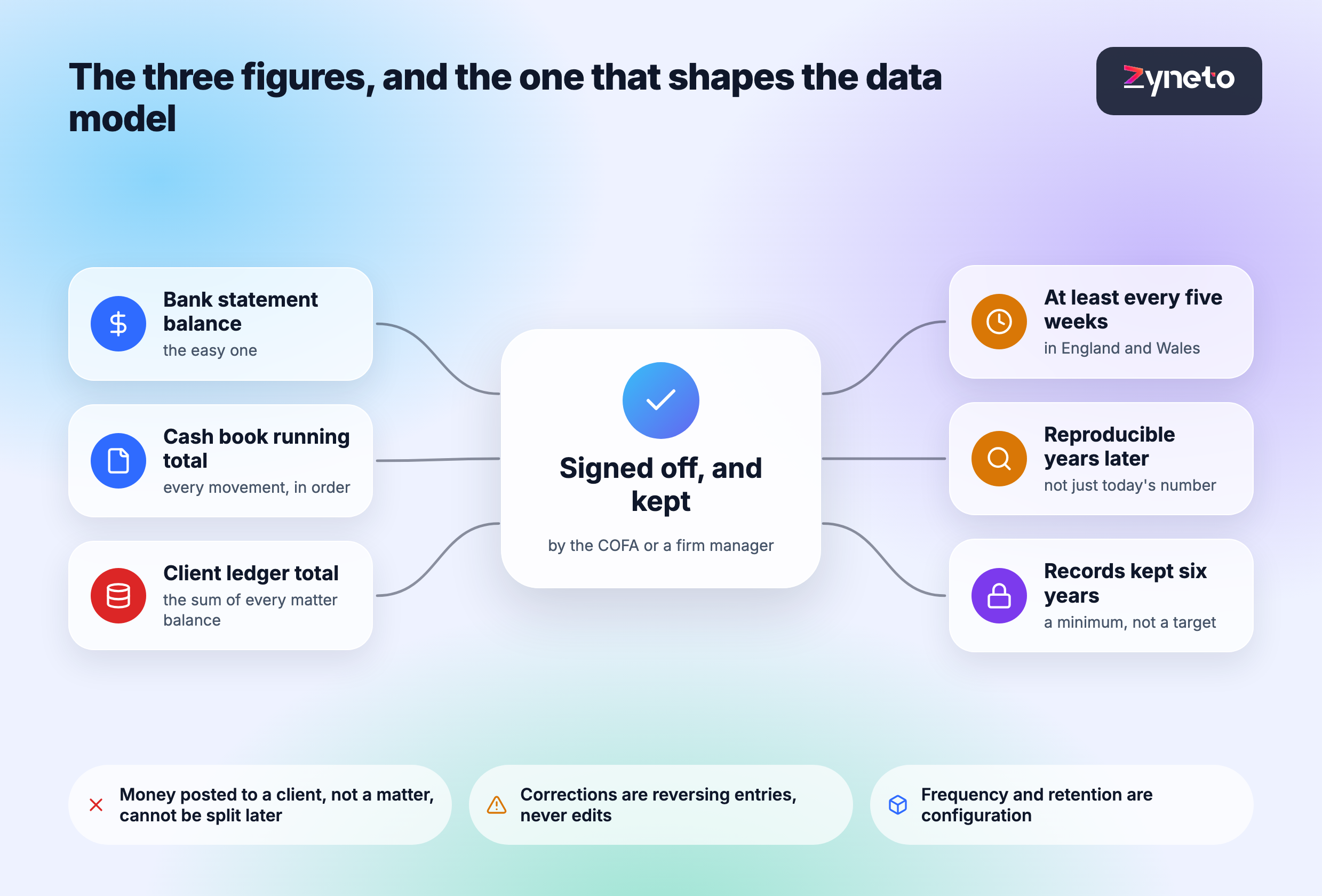
What the third figure requires of the data model, in plain terms:
Every movement of client money is posted to a specific matter, never to a client in general, because the rule names client *and* matter. A payment received without a matter is a suspense entry, not a shortcut.
The balance of every matter must be derivable for any date, not only for today. "What was this balance five weeks ago" is the reconciliation; "what was it two years ago" is the inspection. A system that stores only current balances can answer neither.
Nothing is ever edited. A correction is a reversing entry with its own date and author, because the rules ask for contemporaneous chronological records and an edited history is not chronological. This is the same discipline a royalty ledger needs for the same reason, and it is why both are more expensive than they look.
The list of balances is a first-class artefact, produced on demand and stored with the reconciliation that used it. Not a screen somebody can filter.
Frequency and retention are configuration, not code
This is where a build intended for one country quietly becomes a build intended for one firm.
England and Wales set five weeks for the reconciliation and six years for records. Across the United States the obligation is near-universal and the parameters are not: commentary on state bar rules describes California and Arizona requiring monthly reconciliation, Illinois at least quarterly, and retention commonly five to seven years, with the clock variously starting at the close of the matter, the end of the representation or the final distribution. The start point is genuinely disputed in the secondary literature, which is a reason to make it a setting rather than to pick one.
So the engineering conclusion is the same one a payroll system reaches. Frequency, retention period, retention start event and sign-off role are parameters with dates attached, held in a table, not constants in code. We have made this argument at length about statutory rates and thresholds in payroll, and the reasoning transfers exactly: a rule that changes on a date you do not control cannot live in a deployment.
The sign-off is part of the record, not part of the workflow. Rule 8.3 requires a record of the reconciliation signed off by the COFA or a manager of the firm. That means an approval with an identity and a timestamp, stored immutably alongside the three figures it approved, and reproducible years later. A workflow that emails somebody for approval and records a boolean has not met it.
Time recording is a capture problem, not a timer
Every quote includes time recording and almost every one prices a stopwatch. The stopwatch is an afternoon. The problem is that lawyers do not use it.
Time that is not captured within the day is reconstructed at the end of the week, and reconstructed time is both lower and less defensible. The features that move the number are passive: time inferred from calendar entries, email, documents opened and calls, presented as suggestions a person confirms rather than as entries created without them. That is an integration project across the tools the firm already uses, which is why it costs what it costs.
Narrative quality is a billing problem disguised as a text field. A client who rejects a line because its description is vague has not disputed the work, only the record of it. Systems that enforce a structure, and that let a supervisor review narratives before the bill goes out, recover money that the stopwatch never would.
And the billing arrangements are more varied than the software usually assumes. Hourly, fixed fee, capped fee, conditional, retainer drawn down against a balance, and several of those on one matter at once. Each is a different relationship between recorded time and invoiced value, and the ones that draw down against client money reach back into the ledger discussed above.
Conflict checking is a search problem with a consequence attached
Before a firm takes a matter it has to know whether acting creates a conflict, and the check has to cover entities the firm has never represented: the other side, their parent company, a former client, a director who appears under three spellings.
This is a fuzzy-matching problem over a graph of parties and relationships, not a lookup. Two properties decide whether it is useful. It must search across every matter the firm has ever had, including closed and migrated ones, which makes historic data migration part of the feature rather than a preliminary. And the result has to be recorded: who ran the check, when, what it returned and what was decided, because the value of the check at the point of a complaint is the evidence that it happened.
The expensive part is the party model, which is the same shape as the one in a rights and royalty system: a person or company is not a row on a matter, it is an entity with aliases, relationships and a history across matters, and deduplicating it is the work.
Do we need a separate ledger for every matter?
Yes, where client money is involved, and it is a data model decision rather than a reporting one. The SRA rule requires records identified by client and matter, and the reconciliation requires a list of all balances shown by those ledger accounts. A single client-level balance cannot be decomposed afterwards, so a system that records money against a client rather than a matter cannot produce the figure the rule asks for.
The practical consequence for a build is that matter has to exist before money can move, which affects onboarding more than anyone expects. A payment that arrives before the matter is opened needs somewhere legitimate to sit, and "we will allocate it later" is the beginning of most of the problems in this category.
Documents, deadlines and the parts that are ordinary
Not everything here is specialised, and a good quote separates the two.
Document management is ordinary with one exception. Storage, versioning, templates and assembly are well-understood work. The exception is that a document in a matter file may be privileged, and privilege is a property that has to survive export, search indexing and anything an AI feature does with the content. If you are adding AI to a product that already holds privileged material, the constraints are the ones we set out in retrofitting AI into an existing product, and they bite harder here than in most industries.
Deadlines are a diary with consequences. Limitation periods and court dates are calculated from events, differ by matter type and jurisdiction, and missing one is a negligence claim. The calculation rules belong in the same parameter tables as everything else above. The calendar itself is ordinary. This is the same statutory-clock pattern that decides a construction payment system: the deadline is set by legislation, the software's job is to make it impossible to miss quietly.
Retention is a deletion problem as much as a storage one. Six years is a minimum, not a target, and data kept past its purpose is its own exposure under ordinary data protection rules. A file that must be preserved for a dispute has to be held outside the normal lifecycle, which is the legal hold problem, and a system with no hold mechanism has only one setting: keep everything forever.
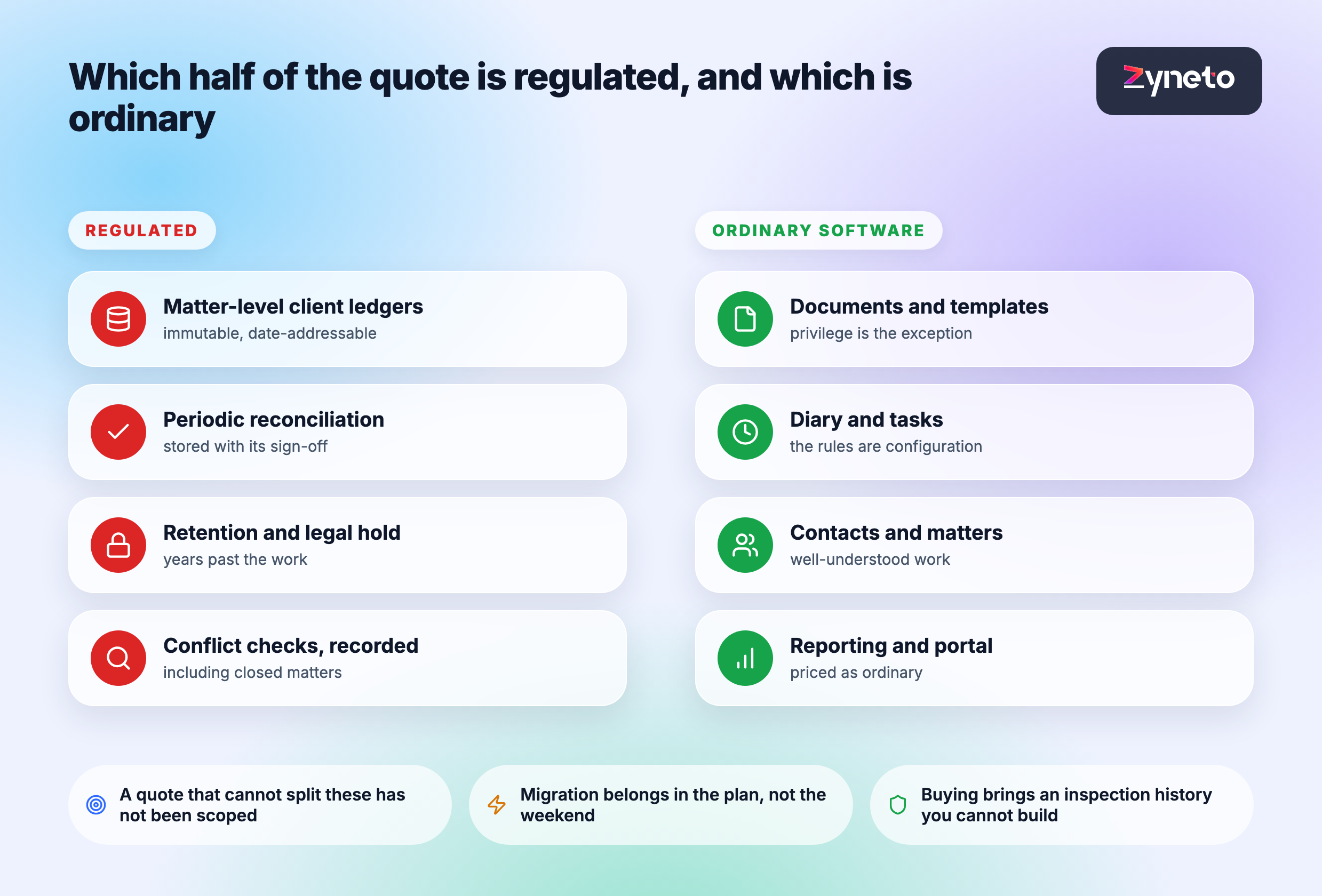
The rest is ordinary business software: contacts, matters, tasks, reporting, user management, a client portal. Priced as ordinary work it is a reasonable fraction of the build, and a quote that cannot tell you which half of the project is ordinary has not been scoped.
Migration is what decides whether anyone switches
The feature list gets the signature and the migration decides whether the system is used. It is also the line most often missing from the quote.
Open matters have to arrive with their balances intact. Not a snapshot of today's number, but enough history for the first reconciliation after go-live to reconcile. A firm that cannot reconcile in its first five weeks on a new system has a compliance problem caused by its software vendor, and the fix is expensive and public.
Closed matters have to arrive at all, because retention obligations run for years past the work and because conflict checking searches them. The volume is usually larger than anyone estimates, the source data is usually worse, and the mapping from the incumbent's party model to yours is handwork no tool does for you.
And both systems run in parallel for a period. Double entry during the overlap, a decided cut-off, and an agreed answer to which system is authoritative on any given day. Budget it as a phase rather than a weekend, the same way a royalty platform migration has to be budgeted, for the same reason: the history is the product.
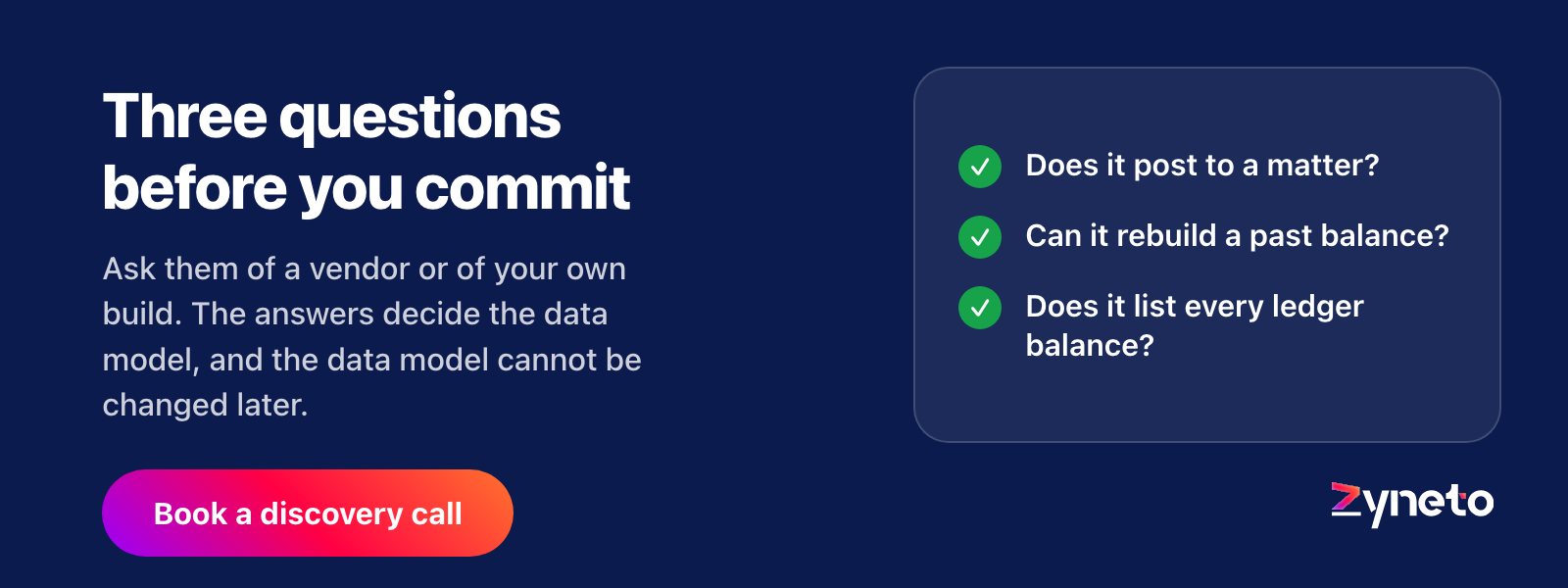
A reasonable test before committing to any build or purchase: ask how a balance from three years ago will be queried after the old system is switched off. If the answer is "we will keep the old system running", that is a cost, and it belongs in the comparison.
Should we build or buy?
Buy, for most firms, and the reason is the client account rather than the features. An established legal accounting product has been inspected, in your jurisdiction, many times, and that history is worth more than any functionality comparison. Building one means your firm's compliance rests on code nobody outside has examined.
Building earns its place in two situations. A firm whose work does not fit the shape the products assume, where the mismatch costs real money every month rather than being an irritation. And a software business selling to firms, where the product is the asset rather than a cost. The third case, which is the common one, is a hybrid: buy the legal accounting engine and build the parts specific to your practice around it. That decision belongs at the start, because an integration designed in is cheap and an integration retrofitted is not.
How we would sequence it
Two further pieces are worth naming because they are usually discovered rather than planned. Taking money from clients means a payment provider, card storage, failed payments and refunds, which carries the same work as any payments build plus the rule that client money cannot mix with the firm's. And the firm will be asked by its own clients how its data is protected, which for a product sold to other firms usually turns into a SOC 2 engagement with its own timetable.
The client ledger model first, with matter-level posting, immutable entries and date-addressable balances, before any screen. It cannot be corrected later without reprocessing every movement, which is the same reason a pharmacy system builds batch identity first.
The reconciliation second, including the list of balances as a stored artefact and the sign-off as an immutable record. The acceptance criterion is not that a report renders. It is that an accountant preparing the annual report can reproduce a reconciliation from two years ago and get the same three figures.
Time capture third, starting with the passive sources rather than the timer, because the timer is the part that does not get used.
Conflict checking fourth, once the party model has enough history in it to be worth searching. Documents, deadlines and the portal after that, in whatever order the firm wants them, because none of them changes the shape of anything built before.
What we will say without a discovery is that any quote describing a client account as "accounting integration" has priced a different product from the one the rules describe.
Frequently asked questions
Published estimates run from about $50,000 to $250,000, and the spread is set by whether the system holds client money. Without a client account it is an ordinary business application: matters, documents, time, billing. With one it is a regulated ledger requiring matter-level records, a running cash book, periodic three-way reconciliation and multi-year retention, inspected externally. Our published rates are $40 to $100 an hour by role, blending to $60 to $70.
It compares three figures: the client bank account balance, the cash book balance, and the total of all individual client ledger balances. Under the SRA Accounts Rules in England and Wales it must be completed at least every five weeks and signed off by the COFA or a firm manager. The third figure is the one that shapes the data model, because producing it requires every movement of client money to be posted to a specific matter and every matter balance to be derivable for any past date.
No, not if the rules apply to you. The SRA requires records identified by client name and matter, and the reconciliation requires a list of all the balances shown by the client ledger accounts. A client-level balance cannot be decomposed into matters afterwards, so the choice is made once, at the data model, and cannot be corrected later without reprocessing every transaction. It also means a matter has to exist before money can move against it.
The obligation is near-universal and the parameters vary. England and Wales require reconciliation at least every five weeks and six-year retention. Commentary on United States state bar rules describes monthly reconciliation in California and Arizona, at least quarterly in Illinois, and retention of commonly five to seven years, with sources disagreeing about whether the clock starts at the close of the matter, the end of representation or final distribution. Treat frequency, retention and the retention trigger as dated configuration, never as constants in code.
Buy, for most firms, because an established legal accounting product carries an inspection history in your jurisdiction that no new build has. Building makes sense when the firm's work genuinely does not fit the shape the products assume and the mismatch costs money monthly, or when you are a software business selling to firms. The common middle path is to buy the legal accounting engine and build the practice-specific parts around it, decided at the start rather than retrofitted.
Because the stopwatch is not the problem. Time reconstructed at the end of the week is lower and harder to defend than time captured as it happens, so the features that change the number are passive: suggestions drawn from calendar entries, email, documents and calls that a person confirms. That is an integration project across the tools the firm already uses. Narrative quality matters too, since a client rejecting a line usually disputes the description rather than the work.
A searchable graph of parties across every matter the firm has ever handled, including closed and migrated ones, with fuzzy matching over aliases, spellings and corporate relationships, not a lookup against current clients. The check has to cover entities the firm never represented, such as opposing parties and parent companies. And the run itself must be recorded with who ran it, when, what it returned and what was decided, because that record is the evidence if a complaint arrives.

Vikas Choudhary
Vikas has around fifteen years of experience building software and now builds generative AI systems at Zyneto. His work covers retrieval augmented generation, agentic AI, knowledge graphs, AI memory, and the evaluation and guardrails that decide whether any of it is safe to put in front of customers. He has shipped enterprise copilots, document AI, chatbots and predictive analytics for e-commerce, fintech and marketing teams, and works day to day in Python, JavaScript and SQL. He follows multimodal models, business process automation and enterprise AI security closely, and mentors engineers moving into AI. He writes about architecture, inference cost and the failure modes that only show up at production scale.
Zyneto builds custom software, AI and automation
Tell us what you are building and we will reply with a clear next step.