Salon Booking App Development Cost: The Calendar Is the Product


Published estimates for a salon booking app run from $5,000 to $100,000. Comfygen publishes $5,000 to $8,000 for a basic booking and payments app, Devtechnosys $8,000 to $12,000 for a basic MVP, and Apptunix $15,000 to $30,000 for an MVP rising above $80,000 to $100,000 for a full-scale platform. Every one of them prices "booking" as a single feature, which is why the range is meaningless and why so many of these products ship and then fail in use.
A salon booking is not a time slot. It is a stylist, a chair, a duration that varies by stylist, and frequently a gap in the middle where the stylist is free and the chair is not.
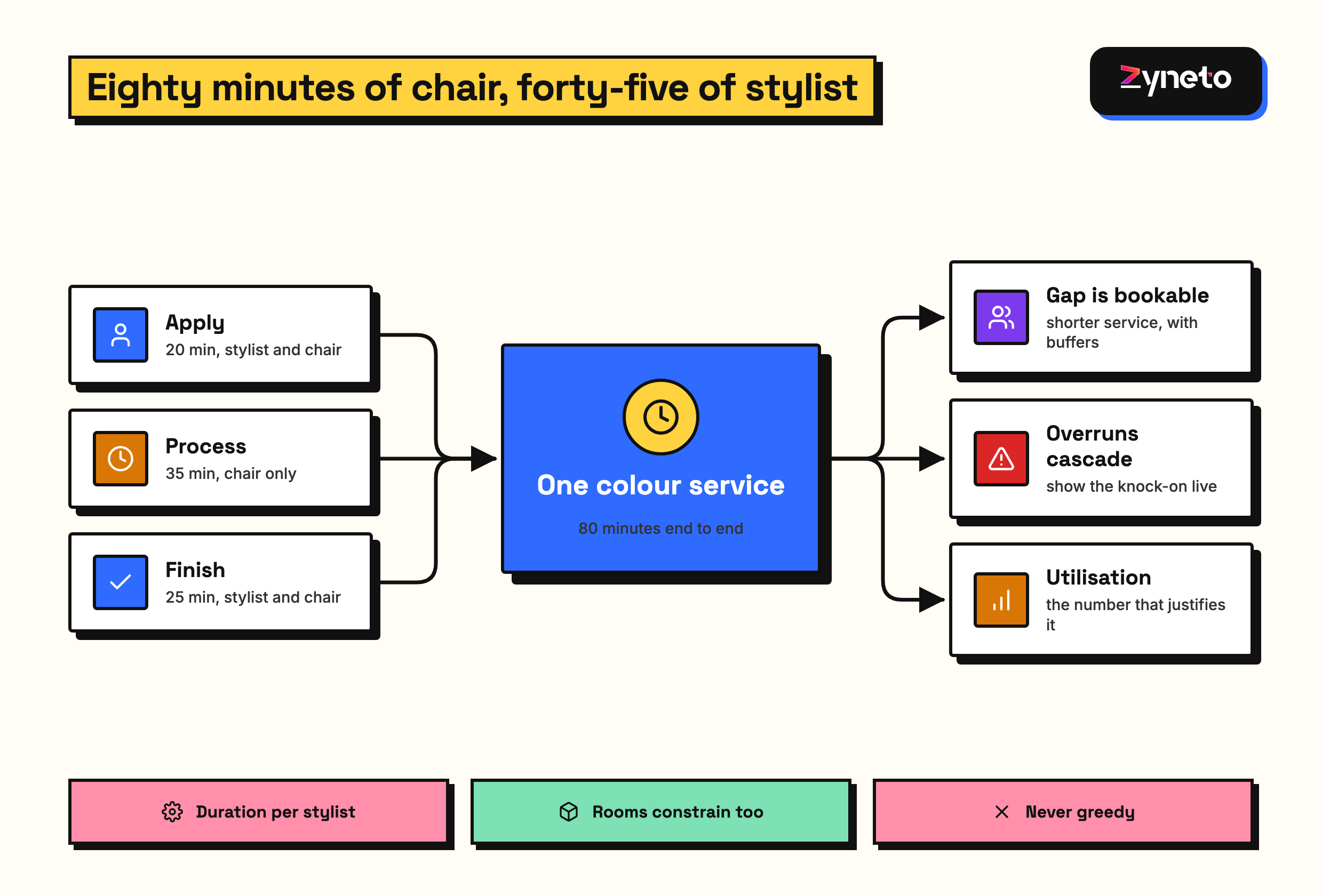
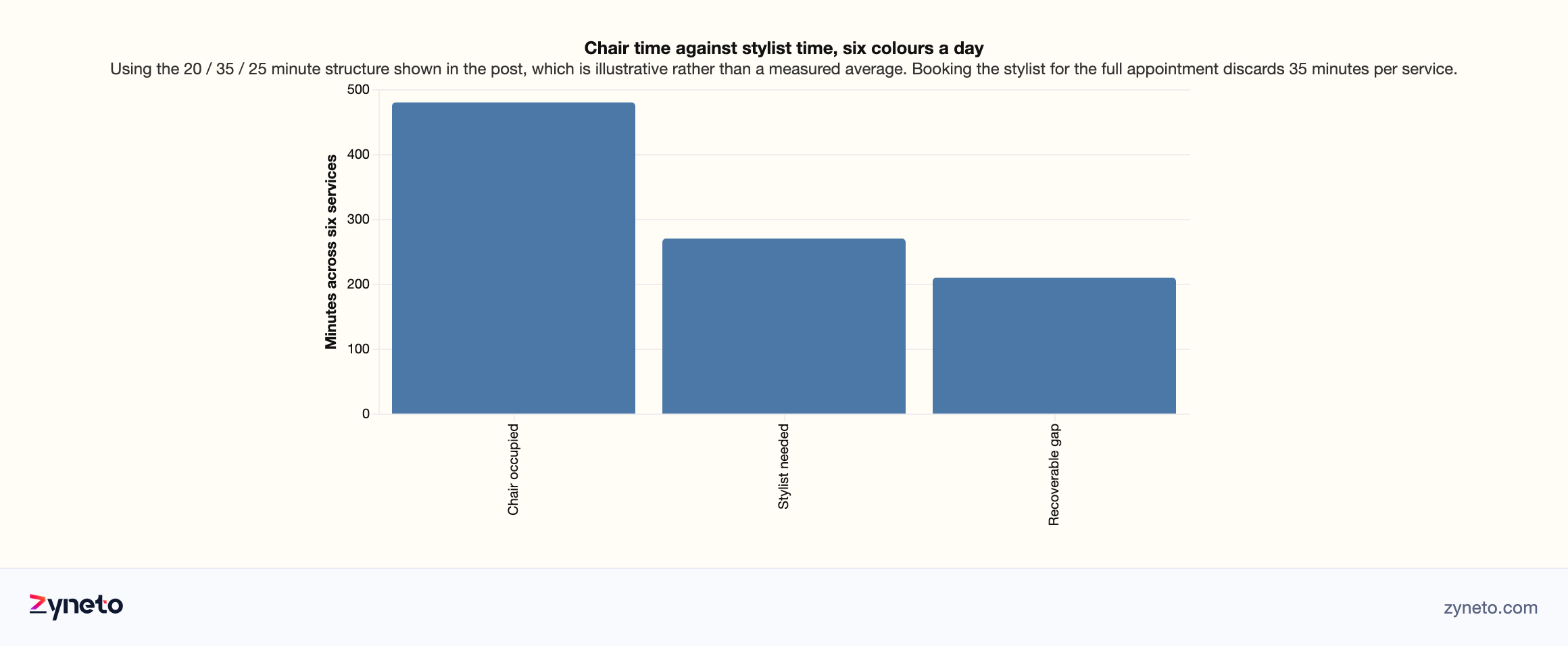
Take an ordinary colour service. The timings below are an illustration chosen to show the arithmetic, not a measured average from any salon. The stylist applies for 20 minutes. The colour then processes for 35 minutes, during which the client sits in the chair and the stylist does nothing. The stylist finishes for 25 minutes. That is an 80-minute appointment using 45 minutes of stylist time.
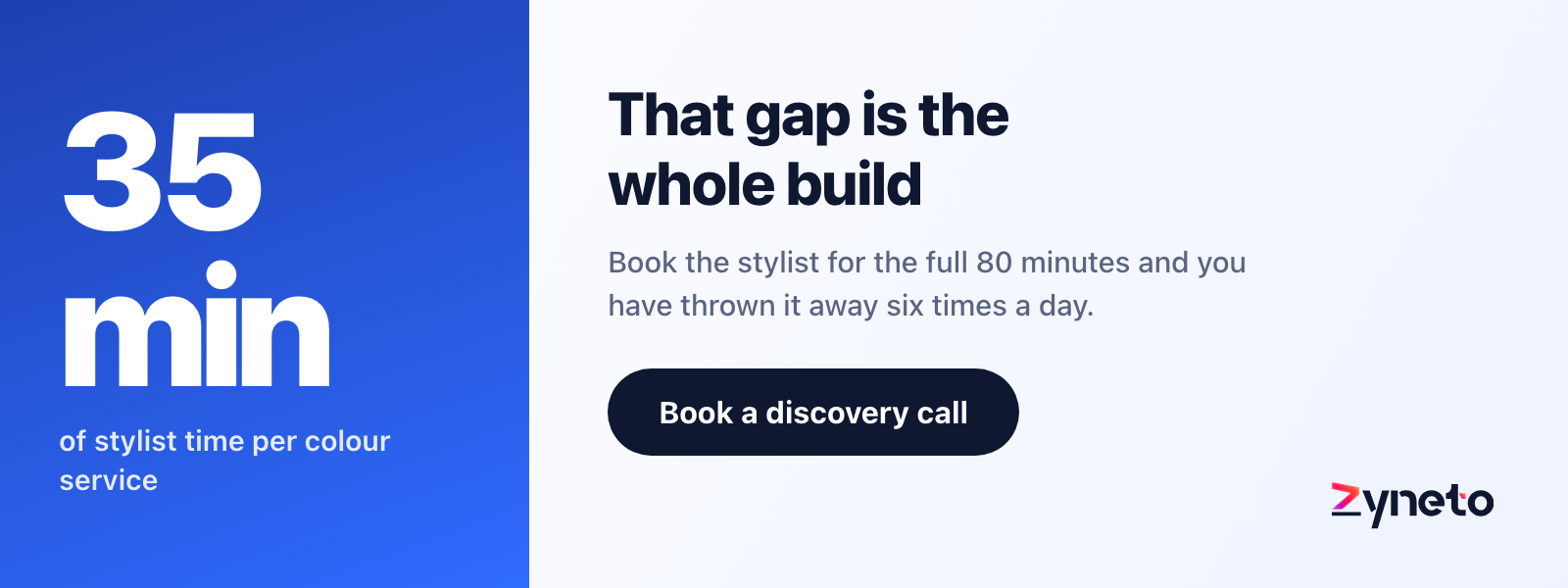
Book it as an 80-minute block against the stylist and you have thrown away 35 minutes of the most expensive resource in the business. A salon running six colours a day has lost three and a half hours of chargeable stylist time, every day, to a data model. That is the entire economics of this product, and no feature list mentions it.
The flip side is the failure mode. A system that books into the gap without also tracking the chair will seat two clients in one chair, and a system that lets the gap run over will leave someone sitting in colour while their stylist is mid-cut on someone else. Getting this right is what the build is for.
Three questions set the price. Do services have processing gaps? Is it one location or many? And does the product take payment and deposits? Everything else (profiles, notifications, a loyalty scheme) is ordinary app work.
Why is salon scheduling harder than normal appointment booking?
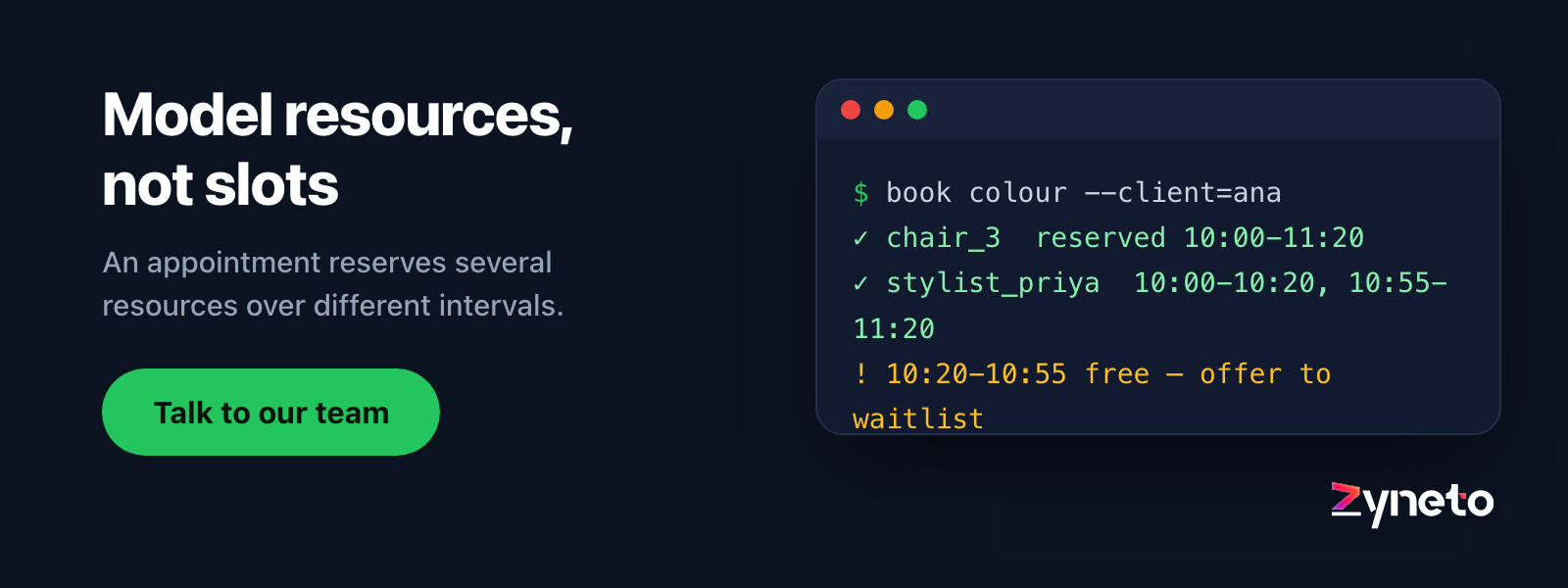
The data model that works treats an appointment as a reservation of several resources over different intervals. A stylist and a chair can each be held for a different part of the same booking, and the stylist is free in the middle while the chair is not. Model a single slot instead and you cannot represent that gap.
A service is a sequence of segments, each one declaring which resources it needs. Apply: stylist plus chair. Process: chair only. Finish: stylist plus chair. The appointment reserves the chair for the whole span and the stylist for two separate intervals.
Availability then becomes a question about every resource at once, which is more expensive to compute than a single calendar lookup and is the reason naive implementations get slow as soon as a salon has eight staff and four rooms.
Resources are not only people and chairs. A wash basin, a treatment room, a nail station, a specific piece of equipment there is only one of. Each is a bookable thing with its own calendar, and a salon that owns two of something needs the system to pick one rather than ask.
Durations vary by practitioner and should. A senior stylist cuts in 30 minutes what a junior takes 45 to do, and charging the same but booking the same wastes capacity at one end and overruns at the other. Service duration belongs to the pairing of service and staff member, not to the service.
Rooms and equipment constrain more than people realise. A salon with one treatment room cannot run two treatments at once however many therapists are free, and a product that models only staff availability will happily take the second booking. The constraint that bites is always the scarcest resource, and it is rarely the obvious one.
Build the segment model on day one even if you launch without using it. Retrofitting segments into an appointment table that assumed one continuous block means rewriting availability, booking, rescheduling and the calendar display at once.
What is double-booking into a processing gap?
Once segments exist, the system can offer the processing gap to another client, and that is where the return on this product actually comes from.
It has to be bounded, not greedy. Filling every gap with a 30-minute service produces a day where every overrun cascades, and salons that experience that once turn the feature off permanently. The rule that works in practice is to allow a shorter service into a gap with a buffer at each end, and to let the salon set how aggressive that is.
Overrun handling is the hard half. Real appointments run long. When they do, the system needs to show the knock-on immediately and let the front desk decide who waits, who is reassigned and who gets a call. That is a live view of the day, not a notification.
The buffer is a per-salon, per-service setting, because a barber running fifteen-minute cuts and a colourist running three-hour transformations need completely different tolerances.
Measure it or nobody will trust it. Utilisation of stylist time against chair time, before and after, is the number that justifies the whole product to the owner. Build the measurement alongside the feature, because an owner who cannot see the gain assumes there is none.
Some salons will refuse it, and the product has to work well with it switched off. A booking app that only makes sense with aggressive gap-filling has narrowed its own market.
How do salon apps reduce no-shows?
Ask any salon owner what their biggest operational loss is and they will not say software.
A no-show is a total loss of that capacity, and unlike a restaurant there is no walk-in to fill it at short notice. The two mechanisms that work are reminders and deposits, and they work differently.
Reminders are cheap and reduce forgetting, which is most casual no-shows. Timing matters more than channel: too early and it is forgotten again, too late and the slot cannot be refilled. A reminder with a one-tap confirm or cancel at roughly 24 to 48 hours out is our working default rather than a figure from a published study, so measure it against your own cancellations.
Deposits change behaviour and change the build. Taking a card at booking brings a payment provider, stored payment methods, a cancellation policy with time windows, partial charges, refunds and disputes. It is not a toggle, it is a section of the project.
The cancellation policy is business logic with money attached. Free cancellation up to a point, then a percentage, then full charge, with exceptions a manager can apply. Each boundary is a rule and each exception is an override that needs recording, because the client will dispute it.
Waitlists convert cancellations into revenue and are usually skipped. When someone cancels at short notice, notifying the right people quickly, meaning clients who wanted that stylist and that window, recovers slots that would otherwise be lost.
Memberships, packages and prepaid balances
A growing share of salons sell blocks of value rather than single visits, and that turns the product into a small ledger.
A package is a prepaid entitlement, six blow-dries bought at a discount and consumed over months. The system has to track what was bought, what has been used, what remains and when it expires, and it has to redeem against a specific appointment so the revenue recognises correctly.
That money is not yours yet. Cash taken for services not delivered is a liability, and an owner who spends it and then faces a run of redemptions has a problem the software helped create. Report deferred revenue separately from takings, and most owners will see the distinction for the first time.
Memberships are a different shape again: a monthly charge with an entitlement attached, which brings recurring billing, failed payments, dunning, pausing and cancellation. Every one of those is a state, and treating membership as a flag on a client record guarantees a rewrite.
Transfers and shared packages cause disputes. Can a client give a remaining blow-dry to a friend? Does a family share one balance? Decide and encode it, because the front desk will otherwise decide case by case and the balances will stop reconciling.
Expiry is a commercial and sometimes legal question. Prepaid balances that lapse are revenue for the salon and a grievance for the client, and in some jurisdictions there are rules about whether they may expire at all. Make the period configurable and surface it clearly at the point of sale.
Staff schedules are more complicated than opening hours
Availability is not the salon's hours minus the bookings.
Staff work patterns vary weekly, with rotas, split shifts, part-time days, and a stylist who does Saturdays alternate weeks. Holidays, sickness and training all remove availability at short notice, and when they do, the bookings already in those slots have to be surfaced for rebooking rather than silently orphaned.
Skills gate services. Not every stylist does extensions, colour correction or treatments, and booking a client with someone unqualified is worse than not taking the booking. The skill matrix is small data that prevents large problems.
Commission and chair rental change who owns the appointment. Many salons run self-employed stylists who rent a chair and keep their own clients, which means the appointment belongs to the stylist rather than the salon, with implications for the data, the payout and sometimes the client record. Decide which model you are serving before you build, because they are different products wearing the same interface.
Personal client relationships are the business. A client books a person, not a salon, and a system that reassigns them to whoever is free without asking will lose both. Rebooking with the same stylist by default, and asking before substituting, is a product rule rather than a nicety.
Back-to-back blocking is a real setting. Some stylists want a ten-minute gap between clients to reset the station and will quietly stop using a system that books them solid. Others want to be packed. Making that a per-person preference rather than a salon-wide rule is a small feature that decides whether staff cooperate with the software.
Walk-ins have to fit. A queue that the front desk can slot into the live day, with the same resource logic, or the system gets bypassed at the busiest moments and the data stops being true.
What the client sees, and why most of it does not matter
The consumer app is the part everyone wants to design and the part that moves the business least.
Most bookings are rebookings. A returning client wants the same service, the same stylist, at a similar time, and the fastest possible path to that is the whole consumer experience. A home screen offering "book again with Priya" converts better than any browse flow.
Discovery matters for a marketplace and not for a single salon. If you are building for one business, the client already chose you; a rich search experience is effort spent in the wrong place.
Notifications are the product for the client. Confirmation, reminder, a change if something moves, and a prompt to rebook at the right interval after the visit. That last one is the single highest-return message in the category, because hair and nails have natural cycles and a well-timed prompt catches a client who was about to go elsewhere.
Keep the booking flow to three decisions: what, who, when. Every extra question loses people, and anything else can be asked at the salon.
Native app or web is a real decision, not a default. For a single salon, a fast mobile web booking page with no install beats an app nobody downloads. For a chain with loyalty, an app earns its place.
Marketplace or single salon, and why the answer changes everything
The same screens can serve two completely different businesses, and the economics have almost nothing in common.
A single-salon product is a tool its owner pays for. Success is utilisation, rebooking and fewer phone calls. The buyer is the owner, the sale is straightforward, and the product can be opinionated because it serves one way of working.
A marketplace is a two-sided business where salons list and clients discover. Its hard problem is not software but liquidity: no clients without salons, no salons without clients. The booking engine is table stakes and the real build is supply acquisition, commission handling, payouts and dispute resolution.
Marketplaces also take the client relationship, which is exactly what salons most resist giving up. A product that intermediates the stylist relationship will face resistance from the people whose cooperation it needs, and the usual resolution is to let salons keep their own clients and charge only for new ones introduced.
The commission model decides your data requirements. Charging for introductions means attributing which client came from where, permanently, and disputes about attribution are the standard friction in this category.
Start as a single-salon tool even if you intend a marketplace. The tool is a complete product, it pays its own way, and it accumulates exactly the supply a marketplace needs later. Starting at the marketplace end means building a two-sided business before you have either side.
Where the rest of the money goes
Beyond the calendar, the parts that earn their place are modest and should be priced near the floor of our published band of $40 to $100 an hour by role, blending to $60 to $70 for a mixed team.
Point of sale at the end of the appointment closes the loop and is where retail products get sold, which for many salons is a meaningful share of revenue. Stock for retail products is ordinary inventory, not the batch problem a pharmacy has.
Client history is the quiet differentiator. Which colour formula, which developer, how long it processed, what the client said about it last time. A stylist who can look that up is a stylist the client does not leave, and it is a small table.
Reporting the owner actually uses is short: utilisation by stylist, revenue per hour, rebooking rate, no-show rate. Four numbers. Everything else is decoration.
Multi-location adds a layer rather than a dimension if you planned for it: resources belong to locations, staff may work across them, and reporting consolidates. Unplanned, it is a rewrite.
How we would sequence it
The resource and segment model first, with services defined as segments and durations attached to the staff-service pairing. It is a week of design and it determines whether the product can ever fill a processing gap.
The internal calendar second, because the front desk is the primary user whatever anyone says about the client app. It has to be fast, show the whole day across all resources, and allow drag-to-move with the conflict rules enforced.
Reminders and the rebooking prompt third. These are the cheapest revenue in the entire product.
The client booking flow fourth, deliberately thin, optimised for rebooking rather than discovery.
Deposits and the cancellation policy fifth, as their own phase, once there is enough booking volume to know whether no-shows are actually your problem.
We do not put a fixed total on this before a discovery that establishes whether your services have processing gaps, whether stylists are employed or renting chairs, and how many locations are in scope. What we will tell you free is that if the quote you are holding describes booking as one line item, it has not understood what a salon day looks like.
FAQs
Published vendor estimates run from $5,000 to $100,000. Comfygen publishes $5,000 to $8,000 for a basic booking and payments app, Devtechnosys $8,000 to $12,000 for a basic MVP, and Apptunix $15,000 to $30,000 for an MVP rising above $80,000 to $100,000 for a full-scale platform. Our published rate band is $40 to $100 an hour by role, blending to $60 to $70 for a mixed team. Most of the app is ordinary work near the floor of that band; the cost concentrates in the resource and availability model, which is the part the published estimates treat as a single feature.
Because a booking reserves several resources over different intervals rather than one resource over one interval. A colour service needs the stylist for application and finishing but not during processing, while the chair is occupied throughout. An 80-minute appointment may use only 45 minutes of stylist time, so a system that blocks the stylist for the full duration discards the difference. Availability has to be computed across every resource at once.
It is booking a second, shorter client into the window where a stylist is free while a first client's colour processes. Done with buffers and a per-salon aggressiveness setting, it recovers a substantial share of otherwise wasted stylist time and is where the return on this kind of product comes from. Done greedily it makes every overrun cascade, which is why overrun handling and a live view of the day are as important as the booking logic itself.
Two mechanisms, with different costs. Reminders are cheap and address forgetting, which covers most casual no-shows; a message at roughly 24 to 48 hours out with one-tap confirm or cancel is our working default rather than a figure from a published study, and it leaves time to refill the slot. Deposits change behaviour but bring a payment provider, stored cards, a time-windowed cancellation policy, partial charges and disputes, so they are a project phase rather than a setting.
Per pairing of service and staff member. A senior stylist may complete in 30 minutes what a junior takes 45 to do, and booking both at the same duration wastes capacity at one end and causes overruns at the other. Attaching duration to the service alone is one of the commonest modelling shortcuts in this category and it degrades the schedule for the whole salon.
For a single salon, a fast mobile web booking page usually beats an app, because clients will not install software to book a haircut and most bookings are repeat bookings that need a two-tap path rather than a storefront. An app earns its place for a chain with a loyalty programme, or for a marketplace where discovery across many salons is the product. Decide this on your business model, not on default assumptions.
Four: utilisation by stylist, revenue per hour, rebooking rate and no-show rate. Utilisation is the one that justifies the software, particularly if it shows stylist time recovered from processing gaps before and after. Most reporting modules built for this category go far beyond these and are not opened twice, so build the four properly and add others only when someone asks by name.

Vikas Choudhary
Vikas has around fifteen years of experience building software and now builds generative AI systems at Zyneto. His work covers retrieval augmented generation, agentic AI, knowledge graphs, AI memory, and the evaluation and guardrails that decide whether any of it is safe to put in front of customers. He has shipped enterprise copilots, document AI, chatbots and predictive analytics for e-commerce, fintech and marketing teams, and works day to day in Python, JavaScript and SQL. He follows multimodal models, business process automation and enterprise AI security closely, and mentors engineers moving into AI. He writes about architecture, inference cost and the failure modes that only show up at production scale.
Let's make the next big thing together!
Share your details and we will talk soon.