Multimodal AI for Business: What It Is and Where It Pays Off


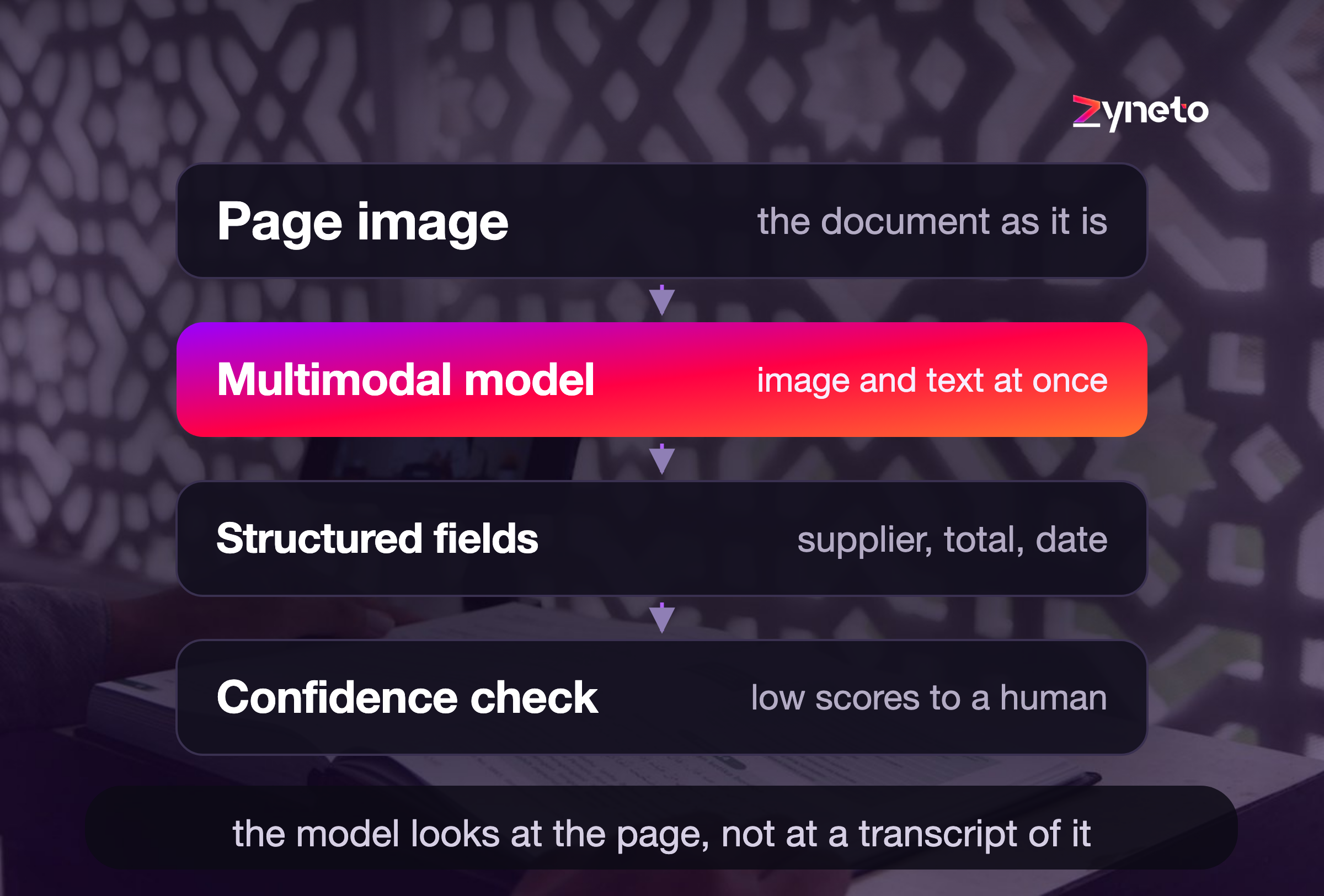
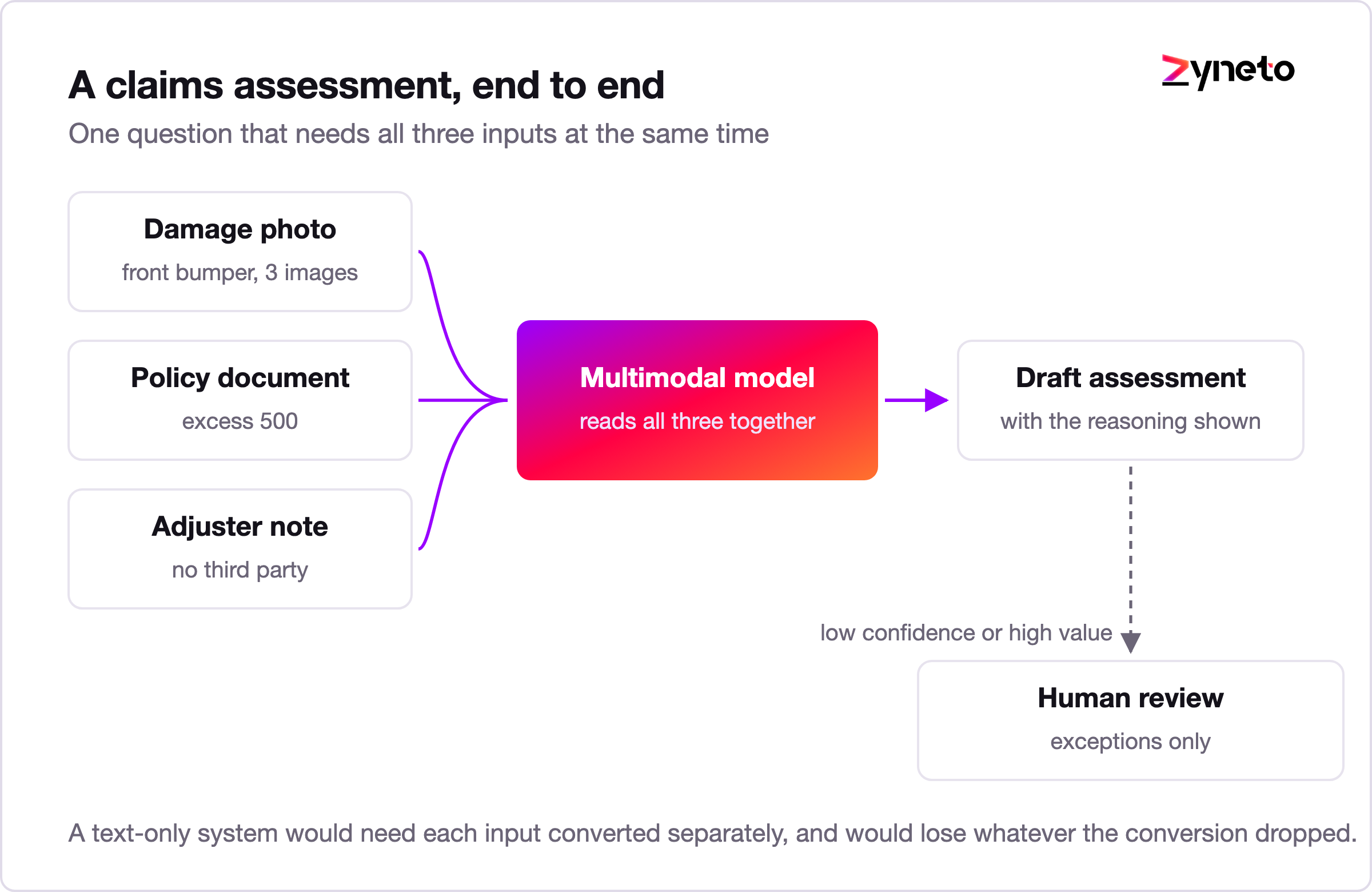
Multimodal AI describes models that accept more than one kind of input, usually text plus images, and sometimes audio, video or PDFs, and reason across all of them in a single request. You hand it a photograph of a damaged bumper and the policy wording, and ask one question that needs both.
That is the whole idea. The interesting part is not the capability. It is which existing pipelines it deletes.
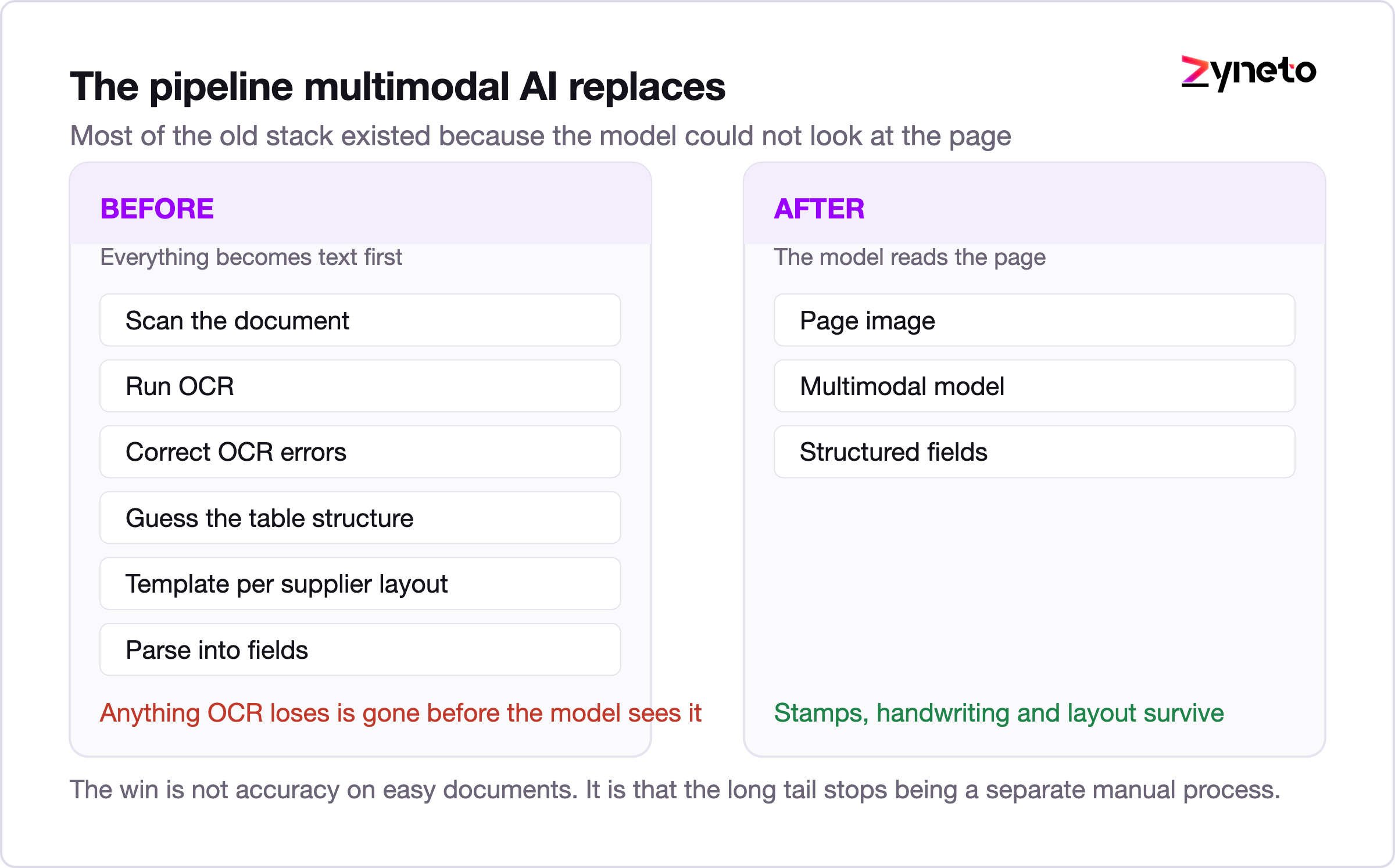
Most enterprise document workflows were built around a limitation that no longer holds. Because models only read text, everything had to become text first. Scan, OCR, clean up the OCR errors, guess at the table structure, hand the mess to a parser, write rules for the twelve invoice layouts you receive. Half that stack existed to work around the fact that the model could not simply look at the page.
A modality is a type of input. Text is one. An image is another. Audio, video and structured documents are others again. A multimodal model handles more than one, and more importantly, reasons across them together rather than processing each separately and stapling the results.
The distinction matters more than it sounds. An OCR tool plus a language model is two systems: one converts the picture to text, the other reads the text. Anything the OCR loses, layout, a stamp, a handwritten note in the margin, a tick in the wrong box, is gone before the model ever sees it. A multimodal model looks at the page.
Three capabilities follow from that, and they are worth separating because teams tend to buy one and expect all three:
serial number, a date on a receipt.
accessibility and tagging.
the document together. This is the one worth paying for, and the one demos rarely show.
You do not need the maths, but a rough mental model saves you from several expensive surprises later, so it is worth two minutes.
A language model works on tokens: text chopped into pieces and turned into numbers. A multimodal model does the same thing to an image. The picture is divided into a grid of small patches, usually 16 by 16 pixels since the 2020 Vision Transformer paper that made the approach standard, each patch is encoded into a vector, and those vectors are placed into the same sequence as the text ones. From the model's point of view there is no meaningful difference between "the word invoice" and "this patch of pixels". They are all just positions in one stream it can attend across.
That single design choice explains most of the practical behaviour.
Why cost scales with resolution. More pixels means more patches, and more patches means more tokens. Doubling the width and height of an image roughly quadruples the patch count, because 2 times the pixels across 2 dimensions is 4 times the area. This is why an innocent decision to upload originals at full camera resolution can multiply an inference bill without improving a single answer.
Why small text disappears. If a patch covers a region containing tiny print, the detail is compressed into one vector and much of it is simply not recoverable. A model failing to read six-point footnote text is not being careless. The information was gone before reasoning started.
Why it reasons across inputs rather than in sequence. Because the image patches and the text sit in one sequence, a question can genuinely depend on both at once. That is the difference between this and an OCR tool feeding a language model, where the two stages never see each other.
Why it does not know when it is unsure. The model produces the most plausible continuation given everything in the sequence. Plausibility and correctness usually agree. When they do not, nothing in the mechanism raises a flag, because there is no separate step that checks the answer against the picture.
Keep that last one in mind. It shapes almost every design decision further down.
If you have a chatbot answering questions from your knowledge base, that is retrieval over text. If you have a copilot drafting emails, that is generation from text. Both are single-modality, and both work well.
Multimodal changes what can enter the system. Suddenly the input can be the thing a person would actually have looked at: the photo, the scan, the screenshot, the form as it was filled in.
Here is the practical test. Ask whether the information you need currently survives the trip into your system. If your team routinely opens the original document because the extracted data is missing something, that gap is where multimodal helps. If the extracted data has always been fine, it will not.
It helps to see the three approaches side by side, because most teams are choosing between them without saying so out loud.
Rules and OCR pipeline | Multimodal model | Human keying | |
New layout arrives | Needs a new template | Usually handled | Handled |
Handwriting, stamps, ticks | Mostly lost | Usually read | Read |
Cost per page | Very low | Moderate to high | Highest |
Speed | Fastest | Slower | Slowest |
Confidence signal | Per field, reliable | Weak, do not trust it | Person can say "unclear" |
Behaviour when unsure | Fails visibly | Guesses fluently | Asks |
Look at the bottom two rows. They are the reason a sensible design keeps all three in play rather than replacing one with another.
The pattern is consistent across the deployments that survive contact with production: high volume, visual source material, and a human currently doing something mechanical with their eyes.
Invoices, claims forms, bills of lading, purchase orders, certificates, identity documents. All nominally text, all full of things OCR handles badly: merged table cells, stamps, signatures, handwriting in a margin, a total that is only identifiable by its position on the page.
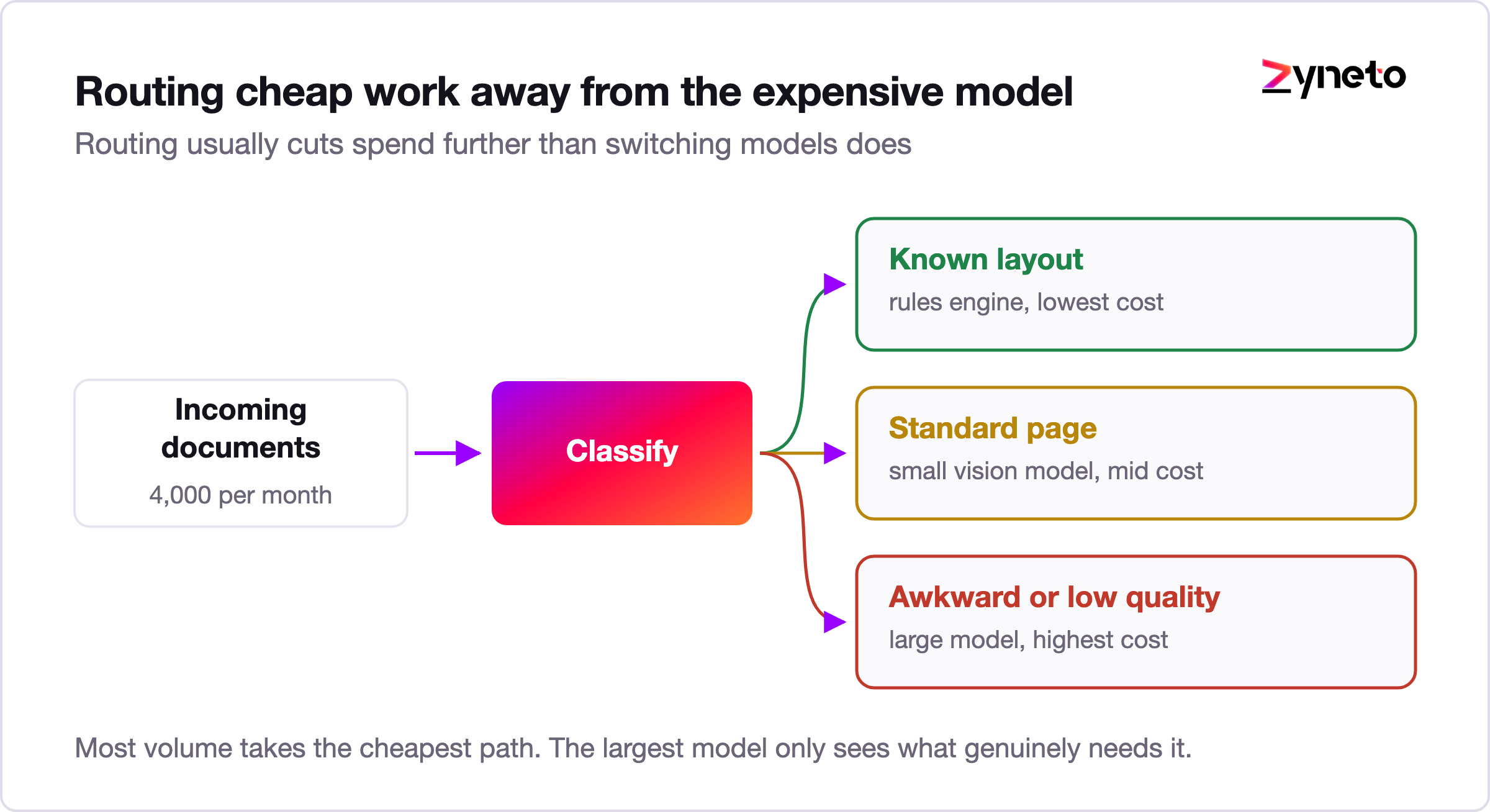
A concrete version. An accounts payable team receives around 4,000 supplier invoices a month across roughly 60 layouts. The rules-based extractor handles the top ten layouts and dumps the rest into a queue for manual keying. A multimodal model does not need a template per supplier, because it is reading the page the way a person does. The win is not accuracy on the easy invoices. It is that the long tail stops being a separate manual process.
Anyone running a support desk knows the shape of this. "It's broken" plus a screenshot. Today a human opens the image, works out which screen it is, reads the error, and only then starts helping.
A multimodal model can read the screenshot, identify the error, check it against your documentation and either answer or route with the right context attached. That is a genuine reduction in handling time, and it happens on the first touch rather than the third.
Insurance damage assessment, property surveys, equipment inspection, retail shelf compliance, delivery proof-of-condition. The common thread is a photograph plus a rulebook, and a person applying one to the other.
Worth flagging honestly: this category has the widest gap between demo and production. A model can tell a cracked screen from an intact one. Estimating repair cost from a photo, reliably, at scale, across lighting conditions and camera quality, is a much harder problem than it looks in a pitch.
The teams that make it work narrow the question. Not "what will this cost to repair", which needs judgement the model does not have. Instead: "is there visible damage to the rear panel, yes or no, and which of these six damage categories does it match". Narrow questions get answered well. Broad ones get answered confidently and wrongly.
Recommending against is worth as much as recommending for, and it saves expensive pilots.
Skip multimodal where the source is already clean structured data. If a supplier sends an EDI feed or a well-formed API response, adding a vision model to read a rendered version of that data is a step backwards. Skip it where a single wrong answer is unacceptable and there is no review capacity, because the model gives you no dependable warning. And skip it where volume is low. Twenty documents a month does not repay the evaluation and monitoring work that keeps a system honest, and a person will simply be better.
This is where projects quietly fail, and it is almost never covered in the explainers.
Images are expensive relative to text. The pricing details differ by provider and change, but the shape is consistent, and both OpenAI's vision guide and Anthropic's vision documentation publish the token maths. A single reasonably sized image typically consumes somewhere in the region of a thousand-plus tokens, and cost scales with resolution. A twelve-page scanned PDF is twelve images, not one.
Run the arithmetic before the pilot, not after it. Take your monthly document volume, multiply by pages per document, multiply by the per-image token cost, and compare it to what the manual process costs today. Some of the most enthusiastic multimodal projects die at exactly this calculation, and it is much cheaper to discover that on a spreadsheet.
Two levers matter more than model choice:
for no accuracy gain. Test where quality actually degrades rather than assuming bigger is safer.
that sends the eight straightforward layouts to a rules engine and only the awkward ones to the vision model often cuts spend substantially while improving average latency.
Latency is the other operational cost. Vision requests are slower than text requests. If the workflow is a person waiting on a screen, that matters. If it is a nightly batch, it does not.

Four failure modes show up repeatedly, and knowing them in advance changes how you scope the first project.
Dense tables. Financial statements, multi-column reports, anything with nested headers. Models get most of it right and occasionally align a value to the wrong row. Because the output is fluent, the error looks exactly like the correct answers.
Precise measurement. Counting many similar objects, reading small dial values, judging exact dimensions. A model may report eleven items where there are thirteen and express no doubt whatsoever.
No reliable uncertainty signal. This is the important one. A traditional OCR engine gives you a confidence score per field, and you can route anything below a threshold to a human. Ask a multimodal model to rate its own confidence and you get a plausible-sounding number that does not correlate well with whether it was actually right. Systems that assume otherwise route the wrong things to review.
Quiet drift in source material. A supplier changes their invoice template, a camera is replaced, a form gains a field. Nothing errors. Accuracy just declines, and unless you are measuring it continuously, you find out from a customer.
Nobody enjoys this part and it is what separates a pilot from a product.
Start by building a labelled set before you build anything else. Two hundred to five hundred real examples with known correct answers, chosen to include the awkward cases rather than the clean ones. If your team already keys documents by hand, you have a labelled set: last month's work.
Score field by field, not document by document. "This invoice was processed correctly" hides which field was wrong. "Supplier name 99%, line item total 94%, tax code 81%" tells you where to intervene, and the tax code number tells you to keep a human on tax codes.
Then keep measuring. Sample a small percentage into human review permanently. The cost is real and small; the alternative is discovering drift when it has already reached your ledger. The NIST AI Risk Management Framework, released in January 2023, is a reasonable structure for the governance side of this if you need something to point auditors at.
One more thing that gets skipped: decide what happens when the model is wrong, before launch. Who notices, how fast, and what is the correction path? A system with no defined failure path is not ready regardless of its accuracy score.
Five, roughly in the order teams hit them.
Piloting on clean data. The sample everyone reaches for is the tidy set, because it is easy to find. Accuracy looks excellent, the project gets approved, and then the real queue arrives with its faxed scans and its phone photographs taken at an angle.
Trusting self-reported confidence. Covered above, and worth repeating because it is the single most common design error. The number reads convincingly. It is not measuring what you think.
Replacing the whole pipeline at once. The rules engine handling your top ten invoice layouts is cheap, fast and predictable. Leave it. Point the model at the long tail, which is where the manual cost actually sits.
Sending everything at full resolution. Easy to do, invisible in testing, and it can double your bill for no measurable accuracy gain.
Treating launch as the finish. Source material drifts. Suppliers redesign forms, cameras get replaced, a scanner setting changes. Without sampling into review, accuracy declines quietly and you find out from a customer.
Four decisions shape everything downstream, and all four are cheaper to make now.
Which modality genuinely matters. Teams often say multimodal when they mean "reads PDFs". If images are the only non-text input, scope to that and skip the complexity of a general system.
Where the human sits. Full automation, human approval on everything, or human review on exceptions only. This decides your interface, your throughput and most of your risk posture. Exception-only is usually right, and it depends on being able to identify exceptions, which loops back to the uncertainty problem above.
What happens to the images. This one gets missed and it is a genuine compliance issue. Photographs carry far more incidental personal data than the text extracted from them: faces in the background of a damage photo, an address on a document edge, a name badge in a warehouse shot. Decide retention, redaction and whether images leave your environment at all before you send the first one to an API.
Hosted API or self-hosted model. Hosted is faster to start, cheaper below moderate volume, and means your data leaves your network. Self-hosted inverts all three. Volume and data policy decide this, not preference. Google's Gemini vision documentation is a fair reference point for what the hosted route involves in practice.
Multimodal AI is a model that reads more than text and reasons across those inputs together. Its value in a business is not novelty; it is the removal of pre-processing that only ever existed because models could not see.
It pays off where you have volume, visual source material, and people currently doing something mechanical with their eyes: invoices, claims, screenshots, inspections. It struggles with dense tables, precise counting, and above all with telling you when it is unsure, which is why exception routing needs designing rather than assuming.
Do the token arithmetic before the pilot. Build the labelled set before the system. Decide where the human sits and what happens to the images while those decisions are still cheap.
Thinking about where this fits in your operation? Zyneto builds production multimodal AI systems with the evaluation, routing and review paths that keep them accurate after launch. Book a free consultation and we will scope the first use case with you.
It is AI that accepts more than one kind of input, usually text plus images, and reasons across them in one request. Instead of converting a photo to text and then reading the text, the model looks at the picture and the words together and answers a question that needs both.
They describe different things. Generative AI refers to producing new output, such as text or images. Multimodal refers to what the model can take in. Most current multimodal models are also generative, which is why the terms get blurred, but a model can be one without being the other.
The consistent winners are document processing where the source was never clean text, such as invoices and claims forms; support tickets that arrive as screenshots; and physical inspection where a photograph is checked against a rulebook. The pattern is high volume plus visual source material plus a person currently doing mechanical visual work.
Images cost considerably more than text per request, and a multi-page scan is charged as multiple images. Cost scales with resolution, so sending unnecessarily large images inflates spend with no accuracy benefit. Do the volume arithmetic before piloting, and route straightforward documents to cheaper methods rather than sending everything to the largest model.
Good on ordinary layouts, noticeably weaker on dense tables with nested headers and on precise counting. The more important limitation is that it gives no reliable signal when it is unsure. A self-reported confidence score sounds convincing but does not correlate well with correctness, so exception routing needs designing rather than assuming.
Usually not at the start. Hosted models handle common document and image tasks without tuning, and prompt design plus routing gets most teams where they need to be. Fine-tuning becomes worth considering when you have a narrow, repetitive task, a labelled dataset, and measured evidence that the general model plateaus below your accuracy requirement.
Images carry more incidental personal data than the text pulled out of them. Faces in the background, addresses at the edge of a scan, name badges in a warehouse photo. Decide retention, redaction and whether images leave your environment before sending the first request, because those are much harder to retrofit than to plan.

Vikas has around fifteen years of experience building software and now builds generative AI systems at Zyneto. His work covers retrieval augmented generation, agentic AI, knowledge graphs, AI memory, and the evaluation and guardrails that decide whether any of it is safe to put in front of customers. He has shipped enterprise copilots, document AI, chatbots and predictive analytics for e-commerce, fintech and marketing teams, and works day to day in Python, JavaScript and SQL. He follows multimodal models, business process automation and enterprise AI security closely, and mentors engineers moving into AI. He writes about architecture, inference cost and the failure modes that only show up at production scale.
Share your details and we will talk soon.
Be the first to access expert strategies, actionable tips, and the trends actually shaping the digital world. No fluff - just practical insights delivered straight to your inbox.
Dive into our blog and stay ahead of the curve with expert perspectives, future-ready trends, and tech tips written for decision-makers and doers alike.