iOS vs Android App Development Cost: Which First, or Both?


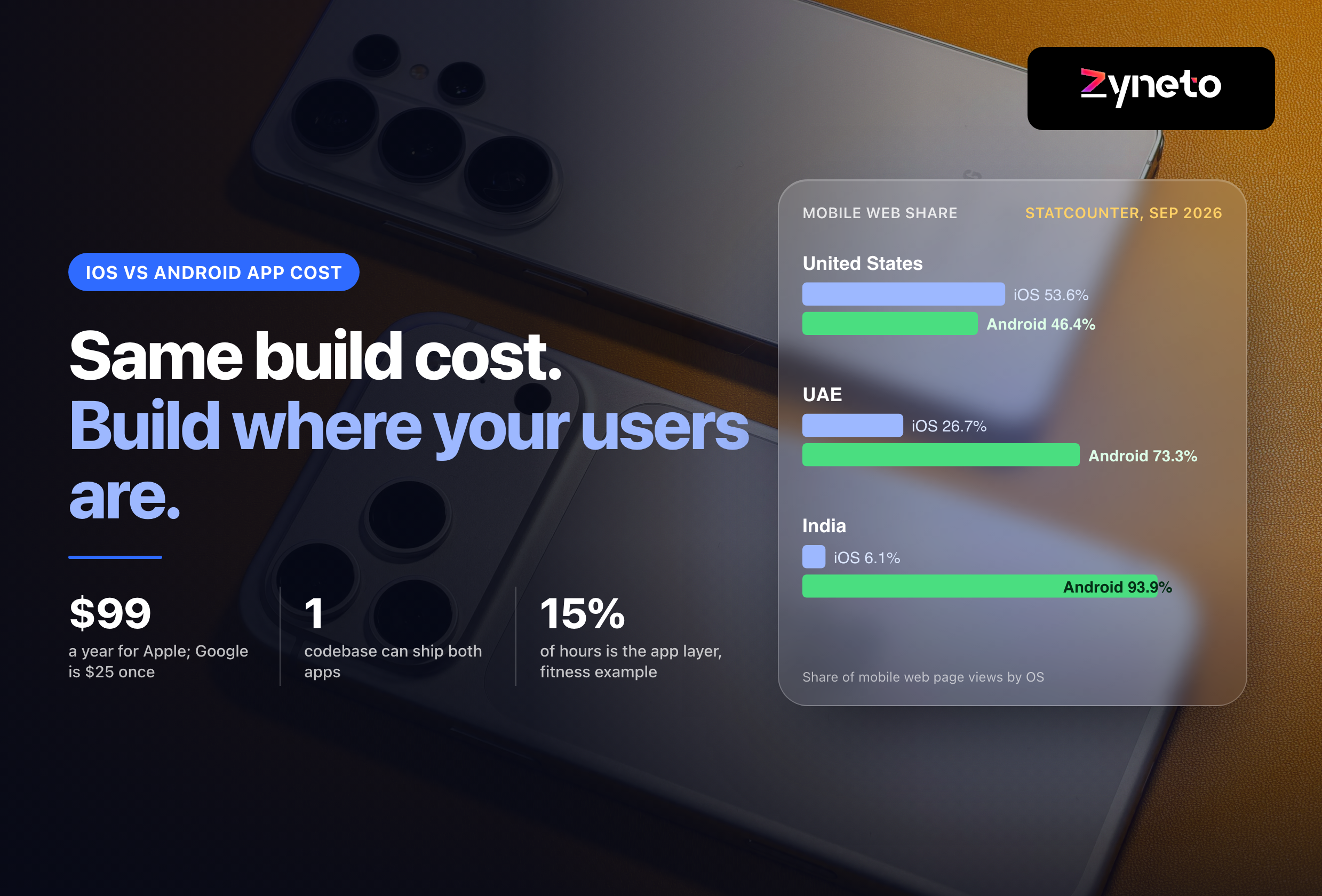
Neither iOS nor Android is meaningfully cheaper to build for. The backend, the design and the business logic are the same work on both, and they are most of the hours. What differs is small and fixed: Apple charges $99 a year for a developer account and Google $25 once, each store sets its own build rules and commission, and Android needs testing on a wider spread of devices. The decision that matters is where your users are. In September 2026, StatCounter's web traffic data put iOS at 53.6 per cent of mobile use in the US and Android at 93.9 per cent in India. With a cross-platform framework, launching on both usually costs far less than 2 separate apps.
Most founders frame this as a cost question because it feels like one. It is a market question. The ordinary failure is a team in India that builds iOS first because the founders use iPhones, then learns that fewer than 1 in 15 of its target users can install the app.
The backend is shared. Accounts, orders, payments, notifications, the admin console and every integration with your other systems sit on a server, not in the app. They are built once whichever platforms the app runs on.
The design is shared, with platform details. Screens, flows and the design system are designed once. Each platform has its own conventions for navigation, back buttons and system controls, and a good app respects them, but that is adjustment, not a second design.
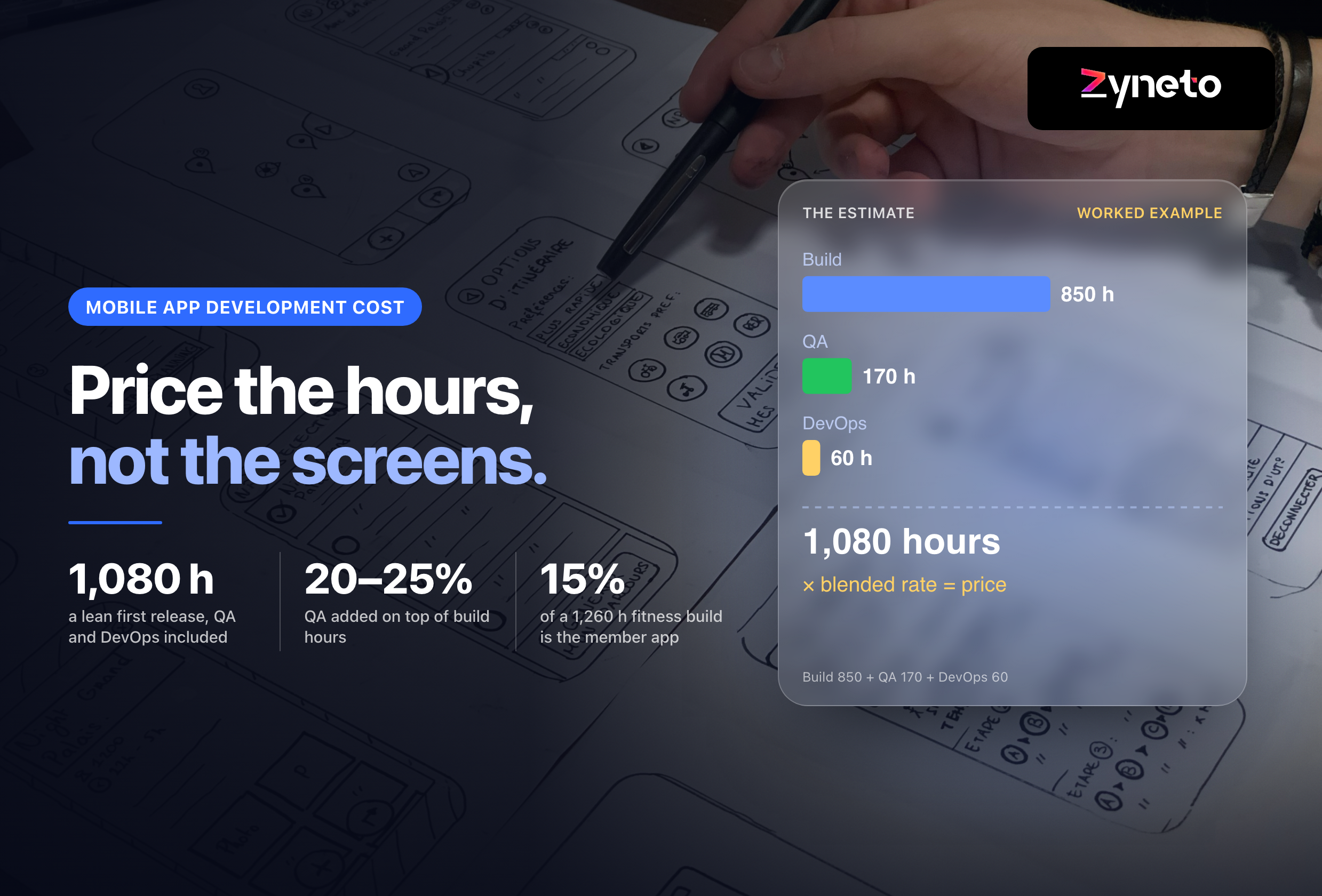
The app layer is a minority of the hours. In Zyneto's published worked example for a gym membership platform, the member app is 190 of 1,260 hours. The membership rules, billing, scheduling, door access, integrations and analytics behind it are the rest. Our mobile app development cost guide shows how those hours are built up.
So platform choice moves a minority of the budget. With 1 cross-platform codebase, the app layer is written once for both. With native apps, it is written twice, once in Swift for iOS and once in Kotlin for Android, while the backend is still shared. Either way, the platform decision does not double the cost of the product.
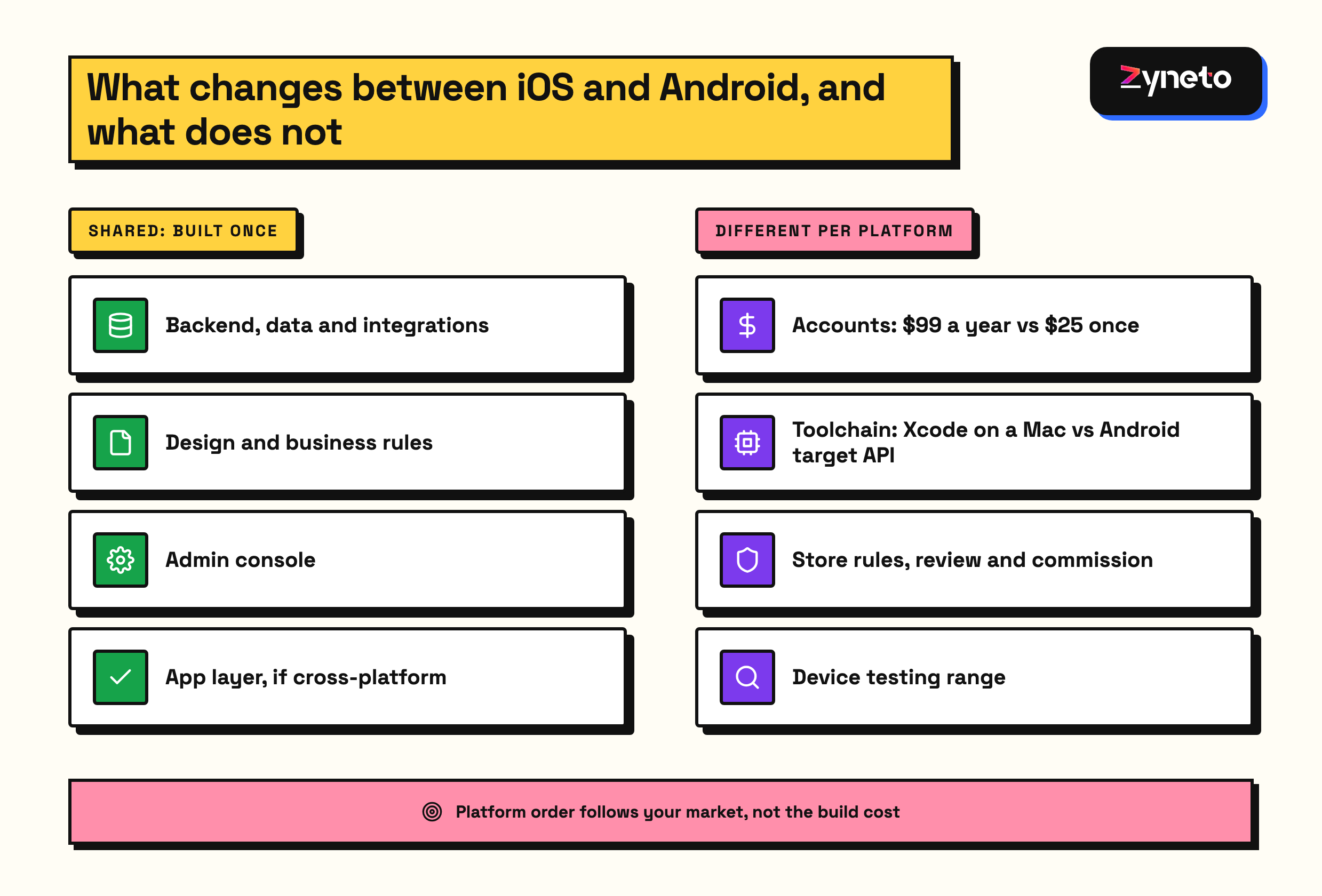
iOS apps are built on a Mac. Apple's Xcode, the toolchain every App Store app must be built with, runs only on macOS. A team building for iOS needs Mac hardware or a cloud build service, whichever framework it uses.
Apple sets the toolchain version. Since 28 April 2026, every app uploaded to App Store Connect must be built with Xcode 26 and the iOS 26 SDK. Since 9 September 2026, iOS uploads must support iOS 13 or later. Both requirements change every year.
Google sets the Android target. From 31 August 2026, new apps and updates on Google Play must target Android 16, API level 36, with an extension to 1 November available on request. Existing apps that target below Android 15 stop being visible to new users on newer Android versions.
Android needs a wider test matrix. Apple makes every iPhone; Android phones come from many manufacturers, at many price points, with different screen sizes and different versions of the operating system in use at once. Testing on real devices across that range is the main extra cost of Android, and it is a testing cost rather than a development one.
Both stores ask for privacy declarations. Since 1 May 2024, Apple requires a privacy manifest that declares why the app, and every third-party SDK in it, uses certain sensitive system APIs. Google Play requires a Data safety form for almost every app, even one that collects no data. Each is a small piece of work per platform, repeated whenever an SDK changes.
Review works differently. Every iOS app and update is reviewed by Apple before release, under its App Review Guidelines. Google Play also reviews apps and enforces its policies, including the Data safety form that almost every app must complete. Plan both into the release schedule; neither is a reason to choose a platform.
Developer accounts are cheap. Apple's Developer Program costs $99 a year, with fee waivers for eligible nonprofits, schools and government bodies. Google Play charges $25 once.
Commission applies only to digital goods. If your app sells physical goods or real-world services, such as groceries, rides, bookings or consultations in person, you use an ordinary payment gateway on both platforms. Store commission applies to digital content, subscriptions and in-app features.
Apple's rates are simpler. The standard commission is 30 per cent. Developers who earned under $1 million in the previous year qualify for the Small Business Program at 15 per cent. Auto-renewing subscriptions drop to 15 per cent after a subscriber's first paid year.
Google's rates now depend on the market. In India, the UAE, Saudi Arabia and most markets, Google Play charges 15 per cent on the first $1 million a year and on all auto-renewing subscriptions, and 30 per cent above $1 million. Since 30 June 2026 in the US, UK and EEA, the service fee on that first tier and on subscriptions is 10 per cent, plus 5 points when Google's own billing is used.
Cost | Apple App Store | Google Play |
Developer account | $99 a year | $25 once |
Commission, first $1M a year (most markets) | 15% if under $1M last year, else 30% | 15% |
Commission, US, UK and EEA from 30 Jun 2026 | as above | 10% service fee, plus 5% with Google billing |
Auto-renewing subscriptions | 30% in year 1, 15% after | 15% (10% + billing in US, UK, EEA) |
Physical goods and real-world services | Payment gateway, no store commission | Payment gateway, no store commission |
The US link-out rules are still moving. On the US storefront, Apple's guidelines now let apps link to an outside payment page. A US appeals court ruled in December 2025 that Apple may charge a commission on those purchases only to cover its genuine costs, and the Supreme Court agreed in June 2026 to hear Apple's appeal. Until that settles, do not build a business plan that depends on a particular link-out fee.
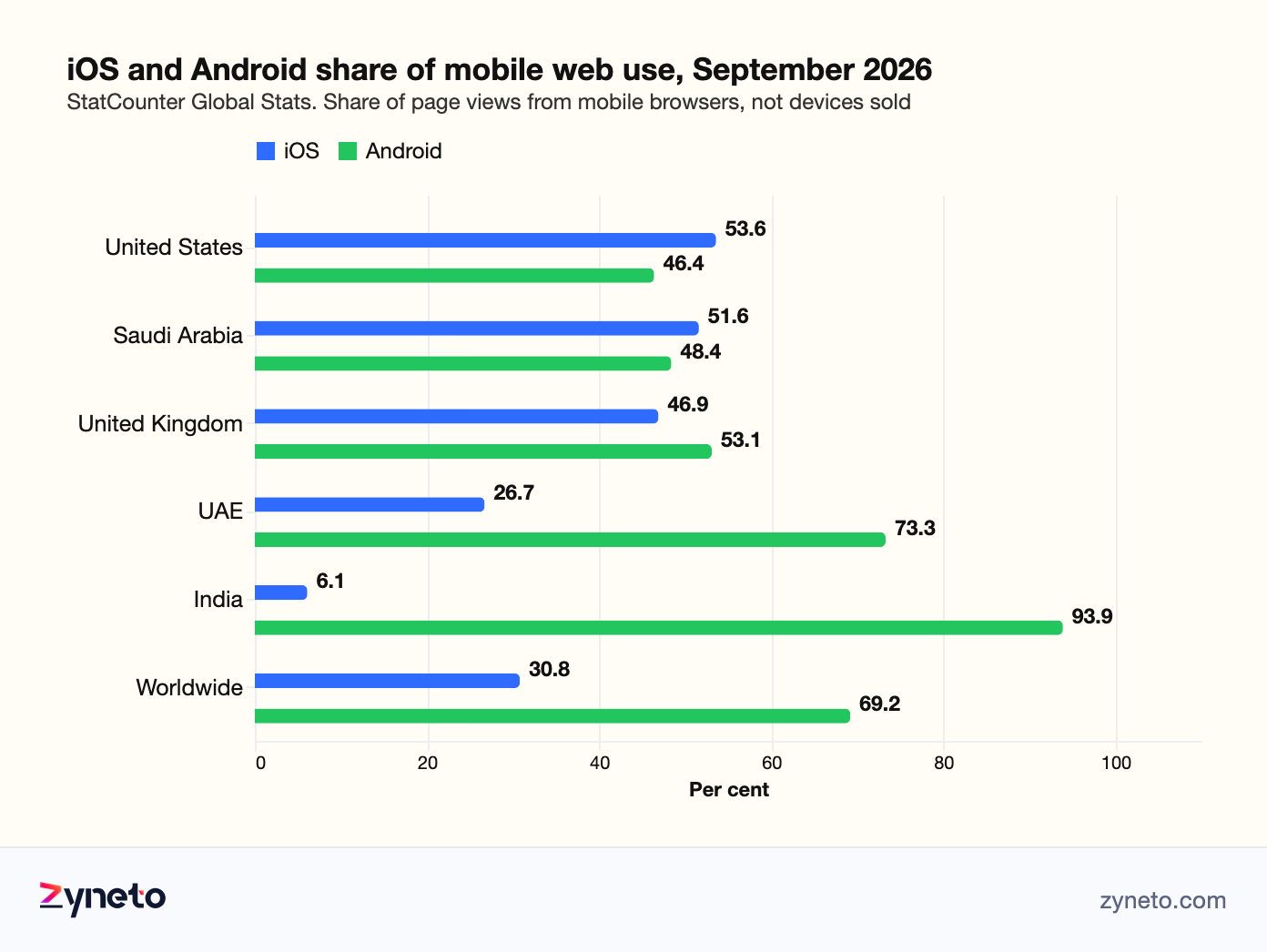
Market share decides the order, not cost. StatCounter measures the share of mobile web page views by operating system. It is a measure of use rather than of devices sold, but it is the most consistent public comparison across countries.
Market, September 2026 | iOS | Android |
United States | 53.6% | 46.4% |
Saudi Arabia | 51.6% | 48.4% |
United Kingdom | 46.9% | 53.1% |
United Arab Emirates | 26.7% | 73.3% |
India | 6.1% | 93.9% |
Worldwide | 30.8% | 69.2% |
In the US, UK and Saudi Arabia, it is close to even. Launching on only one platform leaves roughly half your market unable to install the app. In these markets, the question is not which platform but whether to build both at once with a cross-platform framework.
In India, Android is the market. Android accounted for 93.9 per cent of mobile web use in September 2026. An Indian consumer app that launches on iOS only is building for about 1 user in 16.
In the UAE, Android leads by nearly 3 to 1. Android had 73.3 per cent of mobile web use, so a UAE launch on one platform should usually be Android, unless your customers are a premium segment you have evidence about.
Spending is concentrated in a few markets. Sensor Tower estimates that consumers spent $167 billion on in-app purchases worldwide in 2025, across both stores, and nearly $60 billion of it in the US. If your revenue depends on digital sales rather than physical goods, where that money is spent matters as much as where the devices are.
Your own customers beat national averages. A staff app for a company that issues Android handsets, a premium service whose buyers carry iPhones, or a B2B tool used on company-managed devices all override the country figures. Look at the devices in your website analytics and your customer list before you decide.
Physical goods and real-world services never use store billing. Groceries, deliveries, rides, hotel bookings and tickets to a physical event are paid through a payment gateway on both iOS and Android. Your fees there are the gateway's, typically a few per cent, and they are the same whichever platform the customer uses.
Digital goods always do, with narrow exceptions. Subscriptions to content, premium features, in-app currency and downloadable reports go through Apple's in-app purchase and Google Play's billing, or Google's alternatives where they are offered. That is where the commission tables above apply.
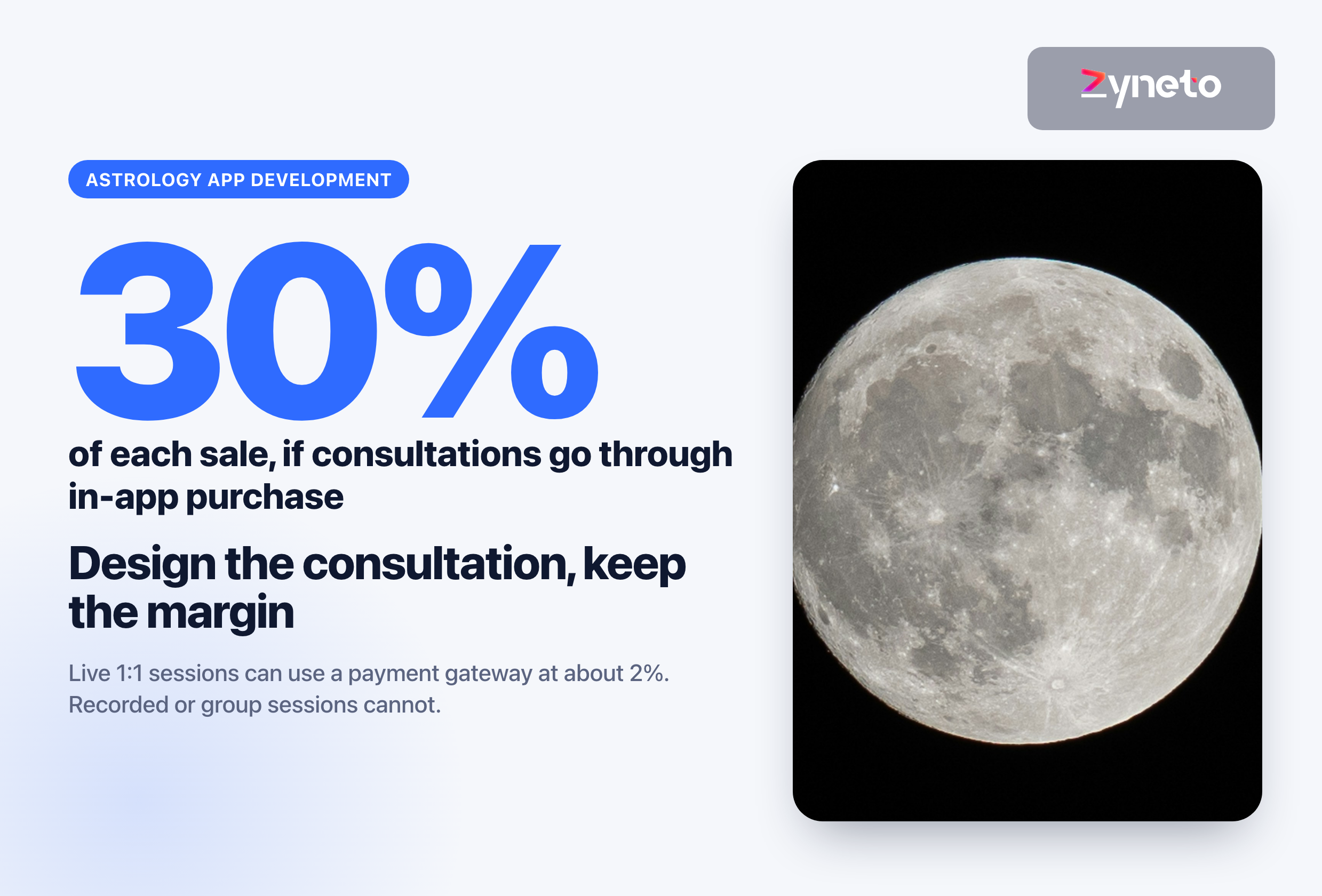
Live 1:1 services can qualify for an exemption on both stores. Apple's App Review Guidelines, section 3.1.3(d), let apps that sell real-time services between 2 individuals, such as tutoring or medical consultations, use payment methods other than in-app purchase. Google exempts 1:1 online paid services from Play billing as long as the session is not available to replay afterwards in a Play-distributed app. Our astrology app development guide shows how designing a consultation to fit those rules decides a business's margin.
Group sessions and recordings fall back into store billing. Apple puts one-to-few and one-to-many real-time services on in-app purchase, and a recording a user can replay breaks Google's condition. A feature request such as "let users rewatch the session" can change the commission on every sale, so check it against both stores' rules before it is built.
Design payments per platform, but once. The product decision about what is sold as what is made once. The code then calls Apple's or Google's billing for digital items and your gateway for everything else, on each platform.
Cross-platform frameworks ship both apps from 1 codebase. React Native and Flutter are the 2 most widely used: in Stack Overflow's 2024 developer survey, the last to ask about them, 9.4 per cent of respondents used Flutter and 8.4 per cent React Native. The app layer is written once, the backend is shared, and most of the platform-specific work is in setup, native integrations and testing.
They have their own release clocks. We measured both on 6 October 2026: React Native minor releases arrived every 59.7 days on average and Flutter stable releases every 91.2 days. Our React Native and Flutter guides cover what that means for upkeep.
Native code does not disappear. A fresh React Native app from Expo's default template already carries 28 packages with native code, and in our Flutter test 26 common plugins pulled in 43 native packages. Payments, maps, cameras and Bluetooth hardware are usually handled by those packages, and occasionally need native code written for each platform.
Go fully native when the app is the device. Apps built around the newest platform features, heavy real-time graphics, deep hardware integration or platform-specific widgets can justify 2 native codebases. For most business apps, a cross-platform build of both is cheaper than 1 native app followed by another.
Real-device testing costs a few hundred dollars a month at most. On 7 October 2026, BrowserStack's App Live, for manual testing on real iOS and Android devices, ran from $39 to $249 a month billed annually, and App Automate from $199 to $249. Firebase Test Lab charged $1 per virtual and $5 per physical device-hour beyond a daily free allowance.
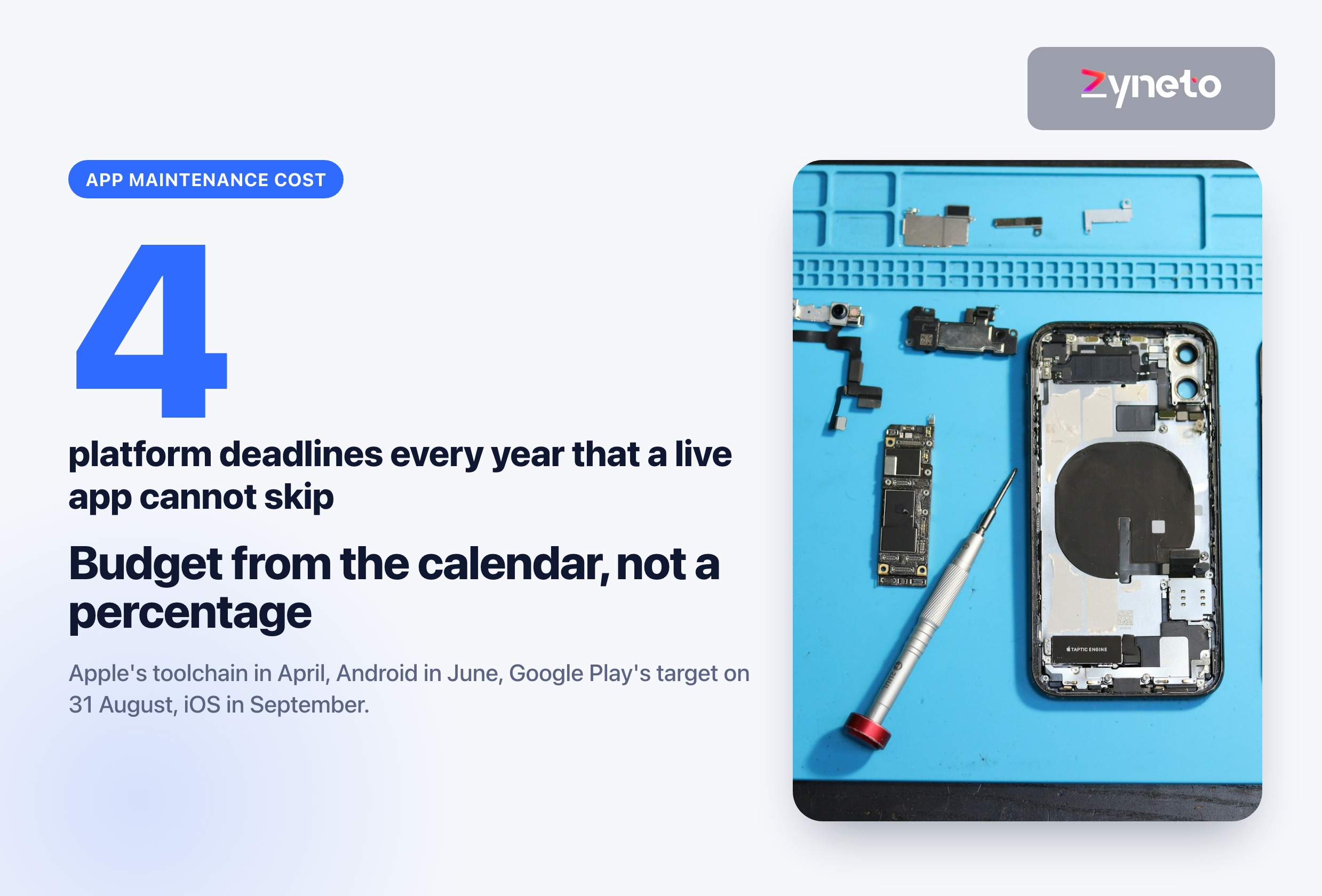
Both platforms impose a yearly calendar. Apple's new build requirement arrives in late April and a new iOS in mid-September. Google ships a new Android in June and its target deadline falls on 31 August. Our app maintenance cost guide turns that calendar into a budget.
Choose the oldest OS versions you will support. Apple now requires iOS uploads to support iOS 13 or later, but your app can set a higher minimum. Every older iOS or Android version you keep supporting is another set of devices to test and another set of workarounds. Set the floor from your analytics, and raise it each year as usage moves.
Both stores let you release gradually. Google Play's staged rollouts send an update to a percentage of users first, and Apple's phased release spreads automatic updates over 7 days. Use both: a crash caught at 5 per cent of users is a bug report, not a wave of 1-star reviews.
Supporting both doubles the release steps, not the work. Each update goes through 2 store submissions and 2 sets of release notes. With a shared codebase, the code change itself is made once.
Take Zyneto's published gym membership example. 1,260 hours across 7 modules, of which the member app is 190, at $40 to $100 an hour by role and about $81,900 at a $65 blend. That example prices 1 member app; it does not say whether it is native or cross-platform.
Choosing a platform order changes 1 line of that table. iOS first or Android first leaves the other 1,070 hours where they are. Building 2 native apps means writing the member app layer twice and testing it twice. A cross-platform build writes it once and tests it on both.
The fixed costs are a rounding error. $99 a year for Apple and $25 once for Google do not change the decision. Store commission matters only if you sell digital goods, and then it is a revenue question for your business plan, not a build cost.
Ask for the estimate split by layer. A quote that separates the backend, the app layer and testing per platform shows exactly what adding the second platform costs. A quote that only gives a total for "iOS and Android" hides it, and makes the platform decision impossible to price.
Choice | What changes in the estimate |
iOS only or Android only | Nothing in the backend; 1 app layer; tests on 1 platform |
Both, cross-platform | 1 app layer; platform setup and native modules; tests on both |
Both, native | 2 app layers in 2 languages; tests on both |
Start from your market's share, then your customers' devices. If one platform has 3 in 4 of your users, launch there first. If the split is close, build both with 1 codebase. If your customers are a segment you can measure, measure them.
Then check what you sell. Digital subscriptions and in-app content bring store commission into the business plan on both platforms. Physical goods and real-world services do not.
Your situation | Launch order |
One platform has 3 in 4 of your market (India, UAE) | That platform first |
Split close to even (US, UK, Saudi Arabia) | Both at once, 1 cross-platform codebase |
Customers on company-issued devices | The platform they are issued |
App built around new platform hardware or features | Native, platform of that feature first |
Then pick the framework, not the platform. For most business apps the real choice is cross-platform or native, and the platform question answers itself once you know where your users are. iOS and Android cost about the same to build. They do not cost the same to ignore.
Neither is meaningfully cheaper. The backend, design and business logic are the same work on both and make up most of the hours. Apple's developer account costs $99 a year and Google's $25 once. Android needs testing on more devices, which adds testing time, and iOS builds need a Mac. The decision should follow where your users are.
Follow your market. StatCounter's September 2026 data shows iOS at 53.6 per cent of mobile web use in the US and 51.6 per cent in Saudi Arabia, Android at 53.1 per cent in the UK, 73.3 per cent in the UAE and 93.9 per cent in India. Where the split is close, build both at once with a cross-platform framework.
With a cross-platform framework such as React Native or Flutter, the app layer is written once and the backend is shared, so both platforms cost far less than 2 separate apps. In Zyneto's published gym membership example, the member app is 190 of 1,260 hours; the platform choice changes that line, not the whole budget.
Apple charges 30 per cent, or 15 per cent for developers who earned under $1 million last year and for subscriptions after year 1. Google Play charges 15 per cent on the first $1 million a year in most markets. In the US, UK and EEA since 30 June 2026, Google's fee on that tier is 10 per cent plus 5 points if Google billing is used.
Yes, or a cloud build service that provides one. Apple's Xcode, which every App Store app must be built with, runs only on macOS. Since 28 April 2026, uploads must be built with Xcode 26 and the iOS 26 SDK, whichever framework the app uses.
Because Android phones come from many manufacturers, with different screen sizes, hardware and operating system versions in use at the same time, so real-device testing needs a wider range. Services such as BrowserStack App Live, from $39 a month, and Firebase Test Lab, at $5 per physical device-hour beyond a free allowance, cover it without buying devices.
No. They apply to digital goods such as subscriptions, in-app content and premium features. Apps that sell physical goods or real-world services, such as groceries, deliveries, rides or bookings, take payment through an ordinary payment gateway on both iOS and Android and pay no store commission.

Vikas has around fifteen years of experience building software and now builds generative AI systems at Zyneto. His work covers retrieval augmented generation, agentic AI, knowledge graphs, AI memory, and the evaluation and guardrails that decide whether any of it is safe to put in front of customers. He has shipped enterprise copilots, document AI, chatbots and predictive analytics for e-commerce, fintech and marketing teams, and works day to day in Python, JavaScript and SQL. He follows multimodal models, business process automation and enterprise AI security closely, and mentors engineers moving into AI. He writes about architecture, inference cost and the failure modes that only show up at production scale.
Share your details and we will talk soon.
Be the first to access expert strategies, actionable tips, and the trends actually shaping the digital world. No fluff - just practical insights delivered straight to your inbox.
Dive into our blog and stay ahead of the curve with expert perspectives, future-ready trends, and tech tips written for decision-makers and doers alike.