Music Recommendation System: How to Build & Cost


Every time a streaming app plays a song you have never heard but instantly love, a music recommendation system is working quietly in the background.
These systems have become the backbone of modern audio platforms, turning huge catalogs into personal listening experiences for each user.
This guide explains how they work, why they matter for your business, and how you can build one of your own.
A music recommendation system is a software solution that analyzes listening behavior, song attributes, and user preferences to suggest tracks, albums, artists, or playlists that a listener is likely to enjoy.
Instead of forcing people to scroll through millions of songs, the system surfaces a small, relevant selection that feels personal and timely.
It is the technology behind features such as personalized playlists, "radio" stations built from a single song, and the "you might also like" rows you see in most audio apps.
The need for this technology is easy to understand when you look at the scale of modern catalogs.
Many top music streaming apps host over a hundred million tracks, and tens of thousands of new songs are uploaded every day.
No listener can explore that volume on their own, and a simple search bar only helps people who already know what they want to hear.
A well-built song recommendation engine solves the discovery problem by matching the right track to the right person at the right moment.
It helps to think of these systems as a digital version of the friend who always knows what you should listen to next.
A music recommendation app does the same thing at scale, using data instead of memory and machine learning instead of intuition.
Most systems rely on a handful of core music recommendation approaches, and the strongest products usually combine several of them.
It is based on the idea that people who agreed in the past will likely agree in the future.
If two users have many songs in common in their libraries, the system will recommend to each of them the tracks that only the other has played.
This approach is powerful because it does not need to understand the music itself, although it struggles when there is little data about a new user or a new song.
It looks at the attributes of the songs a person already likes and finds other songs with similar traits.
These traits can include tempo, key, energy, mood, genre, instrumentation, and even lyrical themes.
It works well for new songs because it depends on the audio and metadata rather than on listening history.
It adds information about the situation in which someone listens, such as the time of day, the device, the location, or the activity.
Suppose someone listens to calming music in the morning and high-energy pop in the evening. A context-aware system recognizes both moments and adjusts its suggestions to match each one.
It blends the methods above, and it is the most common setup in production because each technique covers the weaknesses of the others.
Most modern AI recommendation systems for music fall into this category, adding deep learning on top to capture patterns that simpler models miss.
If you have ever wondered how AI music recommendation systems work behind the scenes, the process can be understood as a loop with four stages: collecting data, building profiles, generating predictions, and learning from feedback.
Each stage feeds the next, which is why the quality of recommendations improves the more people use the product.
Let’s get to know them in detail:
The system begins by gathering signals from three main sources.
User behavior data includes plays, skips, repeats, likes, playlist additions, searches, and how long someone listens before moving on.
Implicit signals such as a skip within ten seconds are often more honest than explicit ratings, because they reflect what people actually do rather than what they say.
Song and audio data cover metadata such as artist, album, genre, release year, and language, along with features extracted directly from the audio, including tempo, loudness, timbre, and danceability.
Contextual data captures when and where the listening happens, the type of device, and sometimes the activity a person selected, such as commuting or exercising.
Raw data is not useful until it is converted into something a model can process.
Songs are transformed into numerical representations called embeddings, which place similar tracks close together in a mathematical space.
Users receive their own embeddings built from their history, so that the distance between a listener and a song reflects how likely the listener is to enjoy it.
Audio analysis plays a large role here.
Neural networks can process spectrograms, which are visual representations of sound, to learn patterns related to rhythm, texture, and mood without any human tagging.
Natural language processing adds another layer by reading lyrics, playlist titles, blog posts, and reviews to understand how people describe the music.
Once profiles exist, the music recommendation algorithm ranks candidate songs for each user.
Large platforms typically do this in two phases.
The first phase, called candidate generation, quickly narrows millions of tracks down to a few hundred that could plausibly fit.
The second phase, called ranking, scores those candidates more carefully using richer features and predicts which ones the listener is most likely to play and enjoy.
Some models also apply a re-ranking step to balance relevance with variety, so that a listener does not see ten songs from the same artist in a row.
This balance is important because a system that only repeats the familiar leads to boredom, while a system that only explores can feel random and unfamiliar.
Every action a listener takes becomes new training data.
A completed song strengthens the connection between that user and similar tracks, while a quick skip weakens it.
Over time, the system adapts to changes in taste, seasons, moods, and life events, which keeps recommendations fresh.
Many platforms also run continuous experiments, showing different versions of a recommendation to different groups and measuring which one leads to more listening.
This constant testing is a major reason why AI music recommendation systems explained in technical papers feel less like a single algorithm and more like a living product that improves every week.
One challenge every team encounters is the cold start problem, which happens when the system has no history for a new user or a new song.
Teams usually solve it by asking new listeners to pick favorite artists or genres during onboarding, by relying on content-based features for new songs, and by using popularity and regional trends as a temporary fallback until enough behavior has been collected.
A music recommendation system is not only for global streaming giants.
Any business working with audio content can use one to increase engagement, improve retention, and support plans to start an online music business.
Here are the most important benefits:
When people find music they enjoy without effort, they stay longer and return more often.
Personalized playlists and radio-style experiences keep listeners inside your app instead of sending them to a competitor after a few songs.
Longer sessions also mean more opportunities to show premium offers, promote new releases, or serve advertising.
Subscription businesses live or die on retention, and personalization is one of the strongest levers available.
Listeners who feel that a service understands their taste build a habit around it, and the cost of leaving grows because their recommendations, playlists, and history live there.
A strong music recommendation service therefore protects your revenue as well as improving the experience.
A recommendation engine gives lesser-known songs a chance to reach the right audience, which is difficult to achieve through charts and search alone.
This benefits independent artists, labels, and platforms with large back catalogs, because content that would otherwise stay buried begins to generate plays.
It also helps you get more value from the licensing investments you have already made.
Personalization opens several revenue paths and can become an important part of your music app monetization strategy.
Free-tier users who receive excellent discovery features are more likely to upgrade to a paid plan, and advertisers pay more for placements that match listener mood and interests.
Businesses can also use recommendations to promote concerts, merchandise, and exclusive content to the fans most likely to buy.
The same data that powers recommendations also reveals what your audience wants.
You can see which genres are growing in specific regions, which moods dominate at certain times of day, and which new releases are gaining traction early.
These insights guide licensing decisions, marketing campaigns, and product roadmaps.
The value of a music recommendation system extends well beyond traditional streaming platforms.
Fitness apps can match playlists to workout intensity and heart rate, while retail stores and restaurants can use background music that suits their brand and the time of day.
Video games, meditation apps, social platforms, and podcast networks can all improve engagement by integrating recommendations tailored to their audience.
If you plan to create a music streaming app with personalized recommendations, the implementation can be broken into a clear sequence.
Following these steps helps you avoid expensive rework and launch with a solution that delivers value from the start.
Start by deciding what you want the system to achieve.
Some businesses focus on increasing listening time, others on converting free users to paid subscribers, and others on helping new artists get discovered.
Clear goals shape every technical decision that follows, from the data you collect to the metrics you track.
You should also define your target listeners and the situations in which they will use the product.
A workout app, a children's music platform, and a general streaming service each require different recommendation logic.
Data is the foundation of any music recommendation system, so it is worth investing time here.
You will need a catalog with clean metadata, user interaction logs, and ideally audio files from which features can be extracted.
If you are launching without much user data, you can begin with public datasets such as the Million Song Dataset or Last.fm listening histories to train and test early models.
Make sure your data is stored in a consistent structure and that you have a plan for handling duplicates, missing values, and privacy requirements.
Regulations such as GDPR and similar laws mean that you must collect consent and give users control over their information.
Next, select the approach that fits your stage, resources, and plans for using AI in music app experiences.
For an early-stage product, a hybrid method that combines collaborative filtering with content-based features usually delivers the best balance, because it handles both established users and brand-new ones.
As your dataset grows, you can introduce deep learning models such as neural collaborative filtering, sequence models that predict the next song in a session, and transformer-based architectures.
Choosing well at this stage will determine how easily your music recommendation algorithm scales as your audience expands.
A typical stack for building this kind of product includes the following components.
With your data and stack ready, you can start building the model.
Begin with a simple baseline, such as recommending popular songs within a genre, so that you have something to measure improvements against.
Then train your collaborative and content-based models, generate embeddings, and combine their outputs in a ranking layer that scores each candidate song for each user.
During training, split your data into training, validation, and test sets so that you can measure how well the model performs on listening behavior it has never seen.
Metrics such as precision, recall, mean average precision, and normalized discounted cumulative gain show how accurately the model ranks songs that users actually enjoyed.
Even an excellent model will fail if users cannot see or trust its suggestions.
Create clear places in your music recommendation app where personalized content appears, such as tailored home rows, auto-generated playlists, and radio features that can become a top music app feature for discovery.
Give listeners simple ways to provide feedback, including like and dislike buttons and options to hide an artist, because this feedback improves the model and makes users feel in control.
Explaining why a song was recommended, for example by noting that it is similar to a track the user recently played, also builds trust and encourages exploration.
Before a full release, run A/B tests that compare your recommendation logic with a simpler baseline.
Before a full release, run A/B tests to understand where a music app fails to engage users and compare your recommendation logic with a simpler baseline.
Track business metrics such as listening time, skip rate, session frequency, and retention alongside model metrics, since a technically accurate model that does not change behavior offers little value.
Launch gradually to a subset of users, gather feedback, and fix issues before rolling out to everyone.
A recommendation system is never truly finished.
Listener tastes change, new music arrives every day, and competitors keep raising expectations.
Set up monitoring to detect drops in quality, retrain your models regularly with fresh data, and keep experimenting with new features such as voice-based requests, mood detection, and generative playlists.
Working with an experienced music app development company like Zyneto can shorten this journey considerably, because a team that has built similar solutions already knows the pitfalls around data pipelines, model performance, and scaling.
No discussion of this topic is complete without looking at Spotify, which is widely regarded as the benchmark for personalization in music.
Understanding how AI music recommendation systems work at Spotify and Apple Music also shows how the same core ideas can produce different product experiences.
Here is a visual overview of how Spotify’s music recommendation algorithm works:
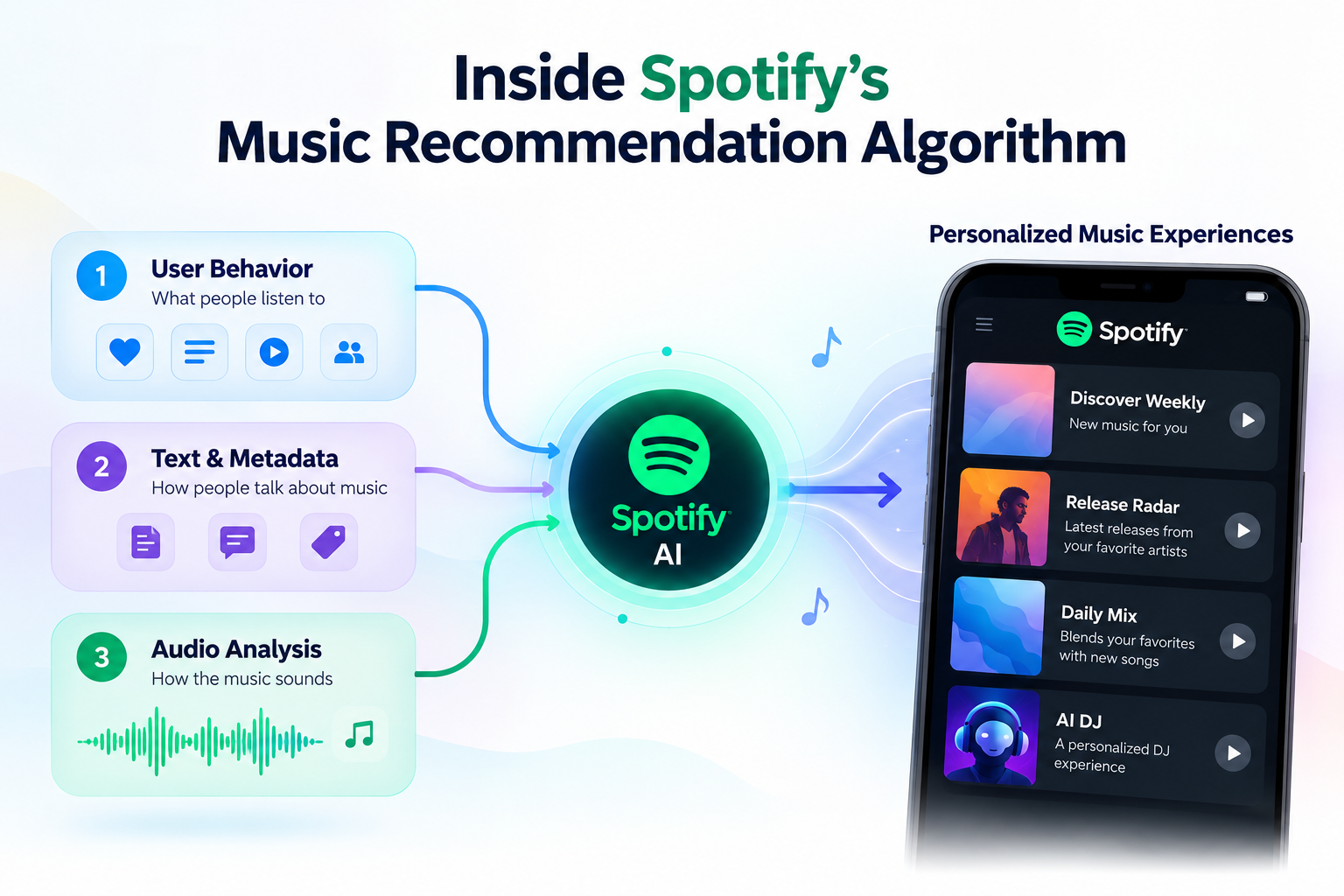
Now, let’s get to know them one by one:
Spotify’s recommendation system brings together three key types of information to understand what listeners enjoy and suggest music that matches their preferences.
The first is user behavior, which looks at how people interact with music on Spotify.
Signals such as songs they play repeatedly, save, skip, add to playlists, or listen to alongside other tracks help the system understand individual preferences and identify patterns among listeners with similar tastes.
The second is text and metadata, which helps Spotify understand the context around songs and artists.
Information associated with tracks, playlists, genres, and other music-related text can help the system identify relationships between different songs and understand how they may fit a listener’s interests.
The third is audio analysis, which examines characteristics of the music itself.
By analyzing elements of a track’s sound, Spotify can identify similarities between songs and recommend music that fits a listener’s preferences, including tracks they may not have discovered before.
Together, these signals help Spotify create personalized experiences across Discover Weekly, Release Radar, Daily Mix, and AI DJ.
These techniques power the personalized features that many listeners rely on every week.
One of the most interesting aspects of Spotify's approach is how it manages the tension between playing what a listener already loves and introducing something new.
The company has described using contextual bandit methods, sometimes referred to as BaRT, which decide when to show a safe, familiar recommendation and when to try an experimental one.
By treating each suggestion as a small experiment and learning from the result, the system improves its understanding of taste without overwhelming users with unfamiliar music.
Apple Music takes a slightly different path by placing more emphasis on human curation alongside its algorithms.
Editors and specialists build playlists and highlight new releases, while machine learning personalizes the order and selection for each subscriber based on their history.
The result is a product where editorial voice and algorithmic personalization work together, which some listeners prefer when they want context and storytelling in addition to suggestions.
Both platforms show that the best music recommendation systems rarely depend on a single technique and instead combine data, machine learning, and thoughtful product design.
The cost of building a music recommendation system depends on the scope of the project, the complexity of the models, the size of your catalog, and the team you choose.
The figures below are general estimates, and actual quotes will vary by region, vendor, and requirements.
Estimated Cost by Project Scale
|
Project Type |
Description |
Estimated Cost (USD) |
Typical Timeline |
|
Basic MVP |
Simple collaborative or content-based recommendations with core app features |
$20,000 to $50,000 |
2 to 4 months |
|
Mid-level solution |
Hybrid model, audio feature extraction, personalized playlists, and analytics dashboard |
$50,000 to $120,000 |
4 to 8 months |
|
Advanced platform |
Deep learning models, real-time recommendations, context awareness, and large-scale infrastructure |
$120,000 to $300,000 or more |
8 to 14 months |
Here are the key factors that influence the cost of developing a music app with an AI-powered recommendation system:
► Model Complexity is one of the largest drivers.
A straightforward collaborative filtering model requires far less effort than a hybrid system with deep learning and real-time personalization.
► Data Preparation can consume a surprising share of the budget.
Cleaning metadata, building pipelines, extracting audio features, and labeling data all take time, especially when your catalog is large or inconsistent.
► Infrastructure and Cloud Costs grow with your audience.
Training models, storing embeddings, and serving recommendations in real time require computing resources that must scale as traffic increases.
► Design and Platform Choices also matter, since building for iOS, Android, and web at the same time costs more than starting with a single platform.
► Licensing and Integrations should be included in your plan if you intend to use third-party music catalogs, APIs, or payment systems.
► Team Location and Structure affect your rates, with development costs varying significantly between North America, Western Europe, Eastern Europe, and Asia.
A music recommendation system has become a core part of how people discover and enjoy audio, and the businesses that invest in it gain a clear advantage in engagement, retention, and revenue.
The technology combines collaborative filtering, content analysis, context awareness, and continuous learning to turn enormous catalogs into experiences that feel personal to every listener.
By studying how leaders such as Spotify and Apple Music balance data with human insight, you can design a product that earns trust while still helping people find something new.
If you decide to create a music recommendation system, the path is easier when you start with clear goals, reliable data, a hybrid approach, and a plan for ongoing improvement.
Costs vary widely, but a focused MVP gives you a practical way to validate the idea before scaling into a full platform.
With the right strategy and development partner, your product can deliver the kind of personalized listening experience that keeps users coming back.
AI music recommendation systems analyze listening behavior, song information, audio characteristics, and user preferences to identify patterns. These insights help platforms predict which songs, artists, playlists, or genres a listener may enjoy and personalize recommendations accordingly.
Spotify uses multiple signals to personalize music recommendations, including listening activity, saves, skips, playlist interactions, track information, and similarities between music and listener preferences. These signals contribute to personalized experiences across features such as Discover Weekly, Daily Mix, Release Radar, and AI DJ.
AI helps music streaming apps personalize recommendations, improve music discovery, understand listening patterns, organize large music libraries, and create more relevant user experiences. It can also support features such as personalized playlists, intelligent search, contextual recommendations, and automated content discovery.
Yes. A custom music streaming app can integrate an AI-powered recommendation engine based on its available user and content data. The approach may use behavioral signals, metadata, audio characteristics, or machine learning models, although the complexity and accuracy depend on the platform’s data, technology, and scale.
AI-powered recommendations can make music discovery faster and more personalized by helping listeners find relevant songs without searching manually. For music platforms, effective recommendations can support greater content discovery, longer listening sessions, stronger engagement, and improved user retention.
Sudhanshi has several years of experience in digital marketing and now works on growth at Zyneto. Her work covers SEO, content strategy, organic lead generation, social media and paid campaigns across Google, LinkedIn, Instagram and Facebook. She has run B2B technology and SaaS campaigns for international audiences, helping brands get found in search and stay found, and works day to day in Google Analytics, Search Console, Ahrefs, SEMrush, Screaming Frog and Canva. She follows AI driven marketing, changing search behaviour, content automation and social growth closely, and turns audience and search data into plans a team can actually run. She writes about SEO, content strategy and the tactics that still earn traffic as search keeps shifting.
Share your details and we will talk soon.
Be the first to access expert strategies, actionable tips, and the trends actually shaping the digital world. No fluff - just practical insights delivered straight to your inbox.
Dive into our blog and stay ahead of the curve with expert perspectives, future-ready trends, and tech tips written for decision-makers and doers alike.