Your Model Has a Retirement Date and You Cannot Extend It


The model your product runs on has a retirement date, somebody else set it, and you cannot have it moved.
Microsoft's own documentation answers the question in a single word. Asked whether a customer can get an exception to extend a model's retirement date, the Foundry lifecycle policy says: "No. Retirement dates aren't extendable." After retirement, every inference request returns 410 Gone.
This makes a hosted model unlike any other dependency you have. A library you can pin forever. A database version you can run until you choose otherwise. A model is a service with a published end date, and your only options are to migrate or to stop working.
Two numbers set the planning horizon, and both are published. Anthropic commits to at least 60 days' notice before retiring a publicly released model. Microsoft commits to at least 60 days for generally available models and 30 for preview. So the worst realistic case is that you learn in sixty days that the model behind your product is going away, and the migration has to be designed, tested and released inside that window alongside whatever else you were doing.
Sixty days used to be the floor and not the norm. It is now both. The arithmetic on Anthropic's own published deprecation table is below, and it has been converging on the minimum for a year.
How long does an LLM model actually last?
About twelve to eighteen months in general availability, depending on platform. Microsoft sets an 18-month lifecycle for most generally available models, with the retirement date assigned programmatically at launch, but 12 months for Anthropic, DeepSeek, Fireworks and Mistral models in its catalogue. Anthropic's own retired models have mostly run twelve to sixteen months.
Treat an annual migration as the base case, not an incident. A product that is three years old will have changed models two or three times, and the teams who find this uneventful are the ones who built for it on day one.
Sixty days is the commitment, and lately it is also the practice
Anthropic publishes every deprecation it has made, with the announcement date and the retirement date. Subtracting one from the other gives the notice window each cohort actually received, re-read on 13 November 2026:
Deprecation announced | Models | Days to retirement |
|---|---|---|
4 September 2024 | Claude 1 and Instant | 63 |
21 January 2025 | Claude 2, 2.1, Sonnet 3 | 181 |
30 June 2025 | Opus 3 | 189 |
13 August 2025 | Sonnet 3.5 | 76 |
28 October 2025 | Sonnet 3.7 | 114 |
19 December 2025 | Haiku 3.5 | 62 |
19 February 2026 | Haiku 3 | 60 |
14 April 2026 | Sonnet 4 and Opus 4 | 62 |
5 June 2026 | Opus 4.1 | 61 |
30 September 2026 | Sonnet 4.5 | 61 |
The last five cohorts received 60, 61, 61, 62 and 62 days. The two longest windows in the table, 181 and 189 days, are both from the first half of 2025.
Nothing improper has happened here. The published commitment is "at least 60 days" and every one of those windows honours it. But a plan built on the generous historical average is a plan built on a number that stopped being true in late 2025. If your migration runbook assumes six months because that is what Opus 3 got, it assumes three times the time you will actually have.
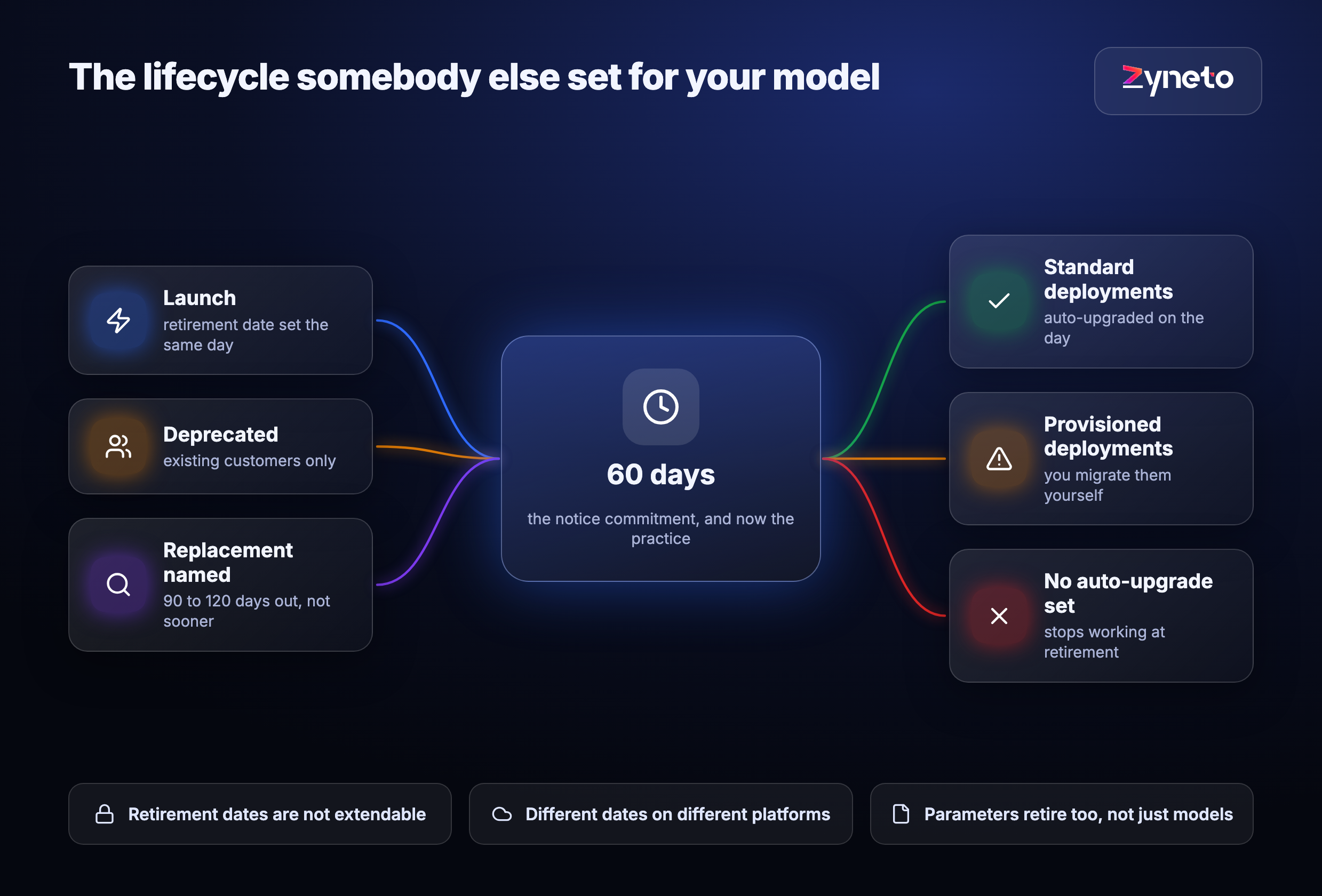
Microsoft's structure says the same thing from the other direction. A replacement model is deliberately not declared until roughly 90 to 120 days before retirement, and the documentation explains why: naming a successor earlier risks pointing customers at a model that is no longer the best option by the time they migrate. Sensible for them. For you it means the target of your migration may not be announced when you start planning it.
The same model retires on different dates on different platforms
This one catches teams running on more than one cloud, and both vendors state it plainly.
Anthropic's dates apply to its own platforms: the Claude API, Claude Platform on AWS, Anthropic-managed Claude models on Google Cloud, and Microsoft Foundry. Amazon Bedrock and Google-managed Claude models on Google Cloud set their own retirement schedules, so the same model can be active on one and retired on another.
Microsoft adds a second axis. Its standard lifecycle is 18 months, but models from Anthropic, DeepSeek, Fireworks and Mistral follow 12, and Grok models from 4.7 onward are guaranteed a minimum of six. Three different clocks in one catalogue.
And a third, quieter one: in Azure Government clouds only one version of a model is typically supported at a time, with a 30-day overlap when a new version appears. If part of your deployment is in a government cloud, that is the window you are actually planning against, not sixty days.
The practical consequence is that "which model are we on" is not a complete answer. The answer has to name the platform. A multi-cloud deployment needs one retirement calendar per platform, not one per model.
There is exactly one way out of the schedule, and it has its own bill. A model you host yourself has no vendor-set retirement date, because you are the vendor. That is the real argument for running a small model on your own hardware for a narrow task: not cost, and not latency, but that nobody can withdraw it. You trade a retirement date for the work of serving, patching and capacity-planning it, which is a bad trade for a general assistant and sometimes a good one for a classifier that has to keep running for five years.
"Deprecated" means four different things
The words are shared and the definitions are not, which matters the moment anyone writes automation against them.
Anthropic uses four states: Active, Legacy (no longer updated, might be deprecated later), Deprecated (still functional, not recommended, has a replacement and a retirement date) and Retired (requests fail).
Microsoft uses five: Preview, Generally Available, Legacy (optional stage; models may skip it), Deprecated and Retired. But Microsoft's "Deprecated" is a different thing: the model still works for existing customers and is blocked for new ones, where existing is determined at the Azure subscription level. The documentation is specific that a new subscription under the same tenant does not inherit access.
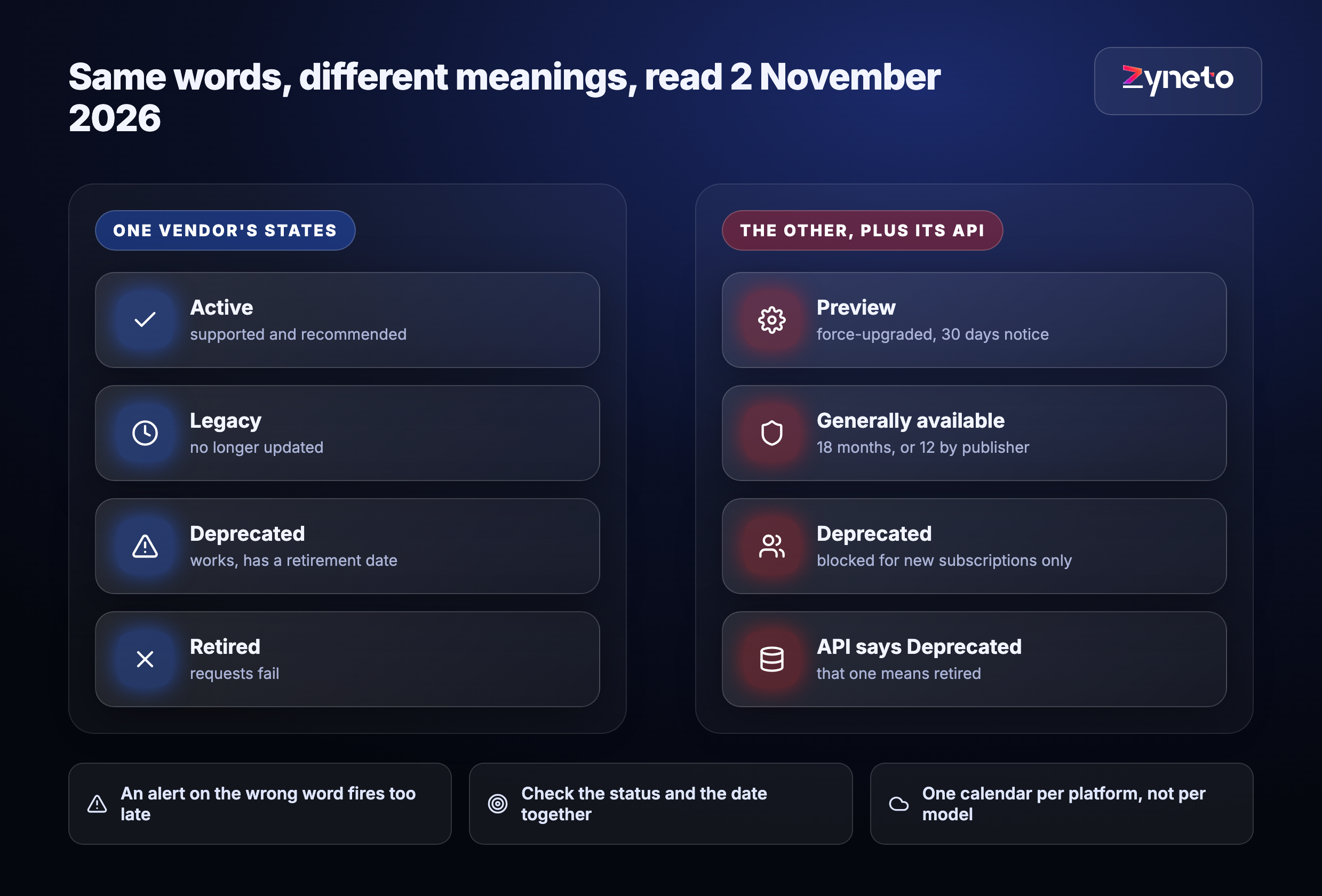
Then the trap. Microsoft's own API uses the same words with shifted meanings. A model the docs and portal call Deprecated appears in the API as lifecycleStatus: "Deprecating". The API value "Deprecated" means the model is retired and no longer serves inference at all.
So a monitoring script that alerts on lifecycleStatus == "Deprecated" does not warn you that a retirement is coming. It tells you one already happened. The documented way to read it is to check both the status and deprecation.inference, and treat any past date as retired regardless of what the status field says.
What happens on the day
Not the same thing to every deployment, and the difference is a configuration setting most teams have never looked at.
On Microsoft's Global Standard, Data Zone Standard and Standard deployment types, retirement triggers an automatic upgrade to the replacement model, scheduled region by region. Provisioned deployments are not auto-upgraded; those customers migrate manually, and the replacement only becomes available to test in provisioned regions roughly 30 days before retirement.
Each standard deployment also carries a versionUpgradeOption with three settings: upgrade when a new default version appears, upgrade only when the current version expires, or NoAutoUpgrade, which the documentation describes without euphemism as never auto-upgrading, where the deployment stops working at retirement.
That setting is worth auditing today. It is the sort of flag set during an early incident, for a good reason, by someone who has since left.
Preview models work differently again. They launch with a "not sooner than" date, typically 90 days out, and at the end they are force-upgraded to a newer preview or to the generally available version with at least 30 days' notice, or retired outright. There is no option to stay on a retiring preview model, which is the clearest possible argument against running one in production.
One more clause belongs in the risk register: Microsoft reserves the right to an emergency retirement with shortened notice where a model is found to have compliance or security problems. Sixty days is the planned case, not the guaranteed one.
Can I keep paying to stay on an old model?
No. Microsoft's lifecycle FAQ answers it directly and without conditions: retirement dates are not extendable, and no exception process exists. Anthropic's position is the same in effect, since requests to a retired model fail. Being a large customer does not buy an extension, and neither does a support contract.
Anthropic does explain the reason, which is worth knowing because it tells you the pressure is structural rather than commercial. Models are retired to free capacity for new releases. The company names the downsides itself, including that researchers lose access for comparative work, and has committed to preserving model weights long term with the hope of making past models available again. None of that helps your production deployment in sixty days.
So the planning assumption is simple and slightly uncomfortable. Every model you depend on will be withdrawn, on a date you do not control, with about two months' warning, and there is no version of your contract that changes it.
It is not only models that retire
Parameters go too, and this is the one almost nobody has in their upgrade plan.
Anthropic removed temperature, top_p and top_k in API version 2026-10-21. Requests that set them now return a 400 error, and before that version they were already rejected when set to a non-default value on Claude 4.7 and later. The recommended replacement is not another parameter: it is to omit them and steer behaviour through the prompt.
Read what that does to a codebase. Sampling parameters are usually set once, early, in a wrapper nobody has opened since. They are in configuration files, in saved presets, in the request builder of every service that calls the model. A model migration that only swaps a model identifier will fail on a request body that has been correct for two years.
The general rule this points at: the contract between you and the vendor includes the request shape, the parameter set and the API version, not just the model name. All four can change, on their own schedules. The same applies in the other direction if you expose your product to somebody else's agent, where the interface you publish becomes a compatibility commitment of your own.
The eval suite is the migration plan
If a migration is a 60-day event that recurs annually, the question is what makes it cheap. The answer is not an abstraction layer, though you want one. It is knowing whether the new model is as good as the old one on your work.
You cannot answer that from benchmarks. Microsoft's own migration guidance says to evaluate candidates against your own application, prompts and representative data, and to compare quality, latency and cost together rather than relying on public benchmarks. A leaderboard tells you about somebody else's tasks.
So the asset that makes migration routine is a set of real inputs from your product with known-good outputs, stored where you control them, runnable on demand. We have written separately about what a real evaluation set looks like and about evaluating retrieval specifically, and a model retirement is the moment that work pays for itself. Without it, "is the new model as good?" is answered by whoever shouts loudest in the release meeting.
And be precise about what "as good as" means, because a replacement is usually better on average and worse somewhere specific. Average quality is the number that gets quoted in the release meeting; the one that matters is how the new model does on the cases your old one had been quietly handling, the odd formats and the awkward phrasings somebody patched a prompt for eighteen months ago. Those belong in the evaluation set as named regression cases with the reason recorded, or the next migration rediscovers each of them through a support ticket.
Two supporting pieces make the day easier. Tracing, so you can compare behaviour before and after on real traffic rather than on opinions; observability for AI features is the same tooling you need for ordinary support. And the ability to run both models side by side on a slice of traffic, which is a routing decision to make early, because retrofitting it during a 60-day window is the worst possible timing.
What should I build so a model swap is routine?
Four things, none of them expensive if done at the start.
One place that names the model. Not a constant scattered across services. A configuration value, per environment, changeable without a deploy, so a swap is a setting rather than a release.
An evaluation set from real usage, with expected outputs, kept in your own storage. Run it against the candidate model before anyone argues about quality. This is also why the stateful conveniences a vendor offers deserve a second look: a product carrying strict retention commitments already has to keep its own evaluation records, and that constraint turns out to help here.
Traffic splitting, so a percentage can run on the candidate while the rest stays put, with the comparison visible in the same dashboard.
A retirement calendar, per platform, checked quarterly. Microsoft exposes lifecycle status and the deprecation date through its Models API, so this can be a scheduled job rather than a diary note. Anthropic publishes a usage export by API key and model, which answers the related question of where a deprecated model is still being called from.
What this means for a budget
Put a line in the annual plan for a model migration, because there will be one.
A migration on a product with a model abstraction, an evaluation set and traffic splitting is a week or two of engineering on our planning judgement rather than a measured figure, most of it spent reading the evaluation results and adjusting prompts. The same migration without those is a scramble: finding every call site, discovering the parameters have moved too, arguing about quality without evidence, and shipping under a deadline that cannot move. At our published rates of $40 to $100 an hour by role, blending to $60 to $70 for a mixed team, the difference between those two is larger than the cost of building the three things in the first place.
It also belongs in the running cost. A replacement model rarely costs the same as the one it replaces, and its token use on the same task can move in either direction, so the running cost of the feature is re-set at every migration and so, potentially, is whatever you charge for it. Measure it on your own prompts rather than assuming the direction.
The uncomfortable version, stated plainly: you are building on an API whose provider has told you in writing when it will stop answering. That is a fine thing to build on. It is only a problem when the schedule is a surprise, and it has been published the whole time.
FAQs
At least 60 days from both Anthropic and Microsoft for generally available models, and 30 days for preview models on Microsoft Foundry. Anthropic's published deprecation history shows its last five cohorts received 60, 61, 61, 62 and 62 days, so the stated minimum is now also the practice; earlier cohorts in 2025 received 181 and 189 days. Microsoft also reserves the right to an emergency retirement with shortened notice where a model has compliance or security problems.
Requests stop working. On Microsoft Foundry every inference request to a retired model returns `410 Gone`, and Anthropic states that requests to retired models fail. What happens to a deployment depends on its type: Microsoft auto-upgrades Global Standard, Data Zone Standard and Standard deployments to the replacement, while provisioned deployments are not auto-upgraded and must be migrated manually. A deployment set to `NoAutoUpgrade` simply stops working at retirement.
No. Microsoft's lifecycle FAQ states that retirement dates are not extendable and offers no exception process, and a retired model on Anthropic's platforms fails requests regardless of plan. Anthropic explains the reason as capacity for new releases rather than commercial pressure, and has committed to preserving model weights long term, but neither that nor a support contract keeps a retired model serving your production traffic.
Microsoft sets an 18-month lifecycle for most generally available models, with the retirement date assigned at launch and visible through its Models API, but 12 months for Anthropic, DeepSeek, Fireworks and Mistral models, and a minimum of six for Grok models from 4.7. Anthropic's retired models have mostly run twelve to sixteen months from release. Plan for an annual migration rather than treating one as an incident.
No, and this catches multi-cloud deployments. Anthropic's published dates apply to the Claude API, Claude Platform on AWS, Anthropic-managed models on Google Cloud and Microsoft Foundry. Amazon Bedrock and Google-managed Claude models on Google Cloud set their own schedules, so a model can be active on one platform and retired on another. Keep one retirement calendar per platform rather than one per model.
Because the vendors define it differently and one of them uses the word twice. For Anthropic, deprecated means functional but not recommended, with a replacement and a retirement date. For Microsoft, it means existing customers can still deploy while new ones are blocked, with existing determined per Azure subscription. Microsoft's API then inverts it: the docs' "Deprecated" appears as `lifecycleStatus: "Deprecating"`, while the API value `"Deprecated"` means fully retired.
Yes, and this is the step most migration plans miss. Anthropic removed `temperature`, `top_p` and `top_k` in API version `2026-10-21`, and requests setting them now return a 400 error; before that version they were already rejected at non-default values on Claude 4.7 and later. The recommended approach is to omit them and steer behaviour through prompting. A migration that swaps only the model name will fail on a request body that has been valid for years.

Vikas Choudhary
Vikas has around fifteen years of experience building software and now builds generative AI systems at Zyneto. His work covers retrieval augmented generation, agentic AI, knowledge graphs, AI memory, and the evaluation and guardrails that decide whether any of it is safe to put in front of customers. He has shipped enterprise copilots, document AI, chatbots and predictive analytics for e-commerce, fintech and marketing teams, and works day to day in Python, JavaScript and SQL. He follows multimodal models, business process automation and enterprise AI security closely, and mentors engineers moving into AI. He writes about architecture, inference cost and the failure modes that only show up at production scale.
Let's make the next big thing together!
Share your details and we will talk soon.