Web Scraping for Business: Use Cases, Legality, and How to Do It Right


The web is the largest pool of business data on the planet, and most of it sits in plain sight on pages nobody has bothered to structure. Web scraping is how businesses collect that public data automatically, turning scattered pages into a clean spreadsheet or a live feed. Done right, web scraping for business powers price monitoring, lead lists, market research, and the datasets behind modern AI. Done carelessly, it burns engineering time or wanders into legal and ethical trouble. This guide covers what scraping actually delivers, whether it is legal, the parts that are genuinely hard, and how to do it properly and at scale.
Web scraping is the automated collection of data from websites. Instead of a person copying figures off a page into a spreadsheet, a program visits the pages, reads the content, and pulls out the specific pieces you asked for, at a speed and scale no human could match.
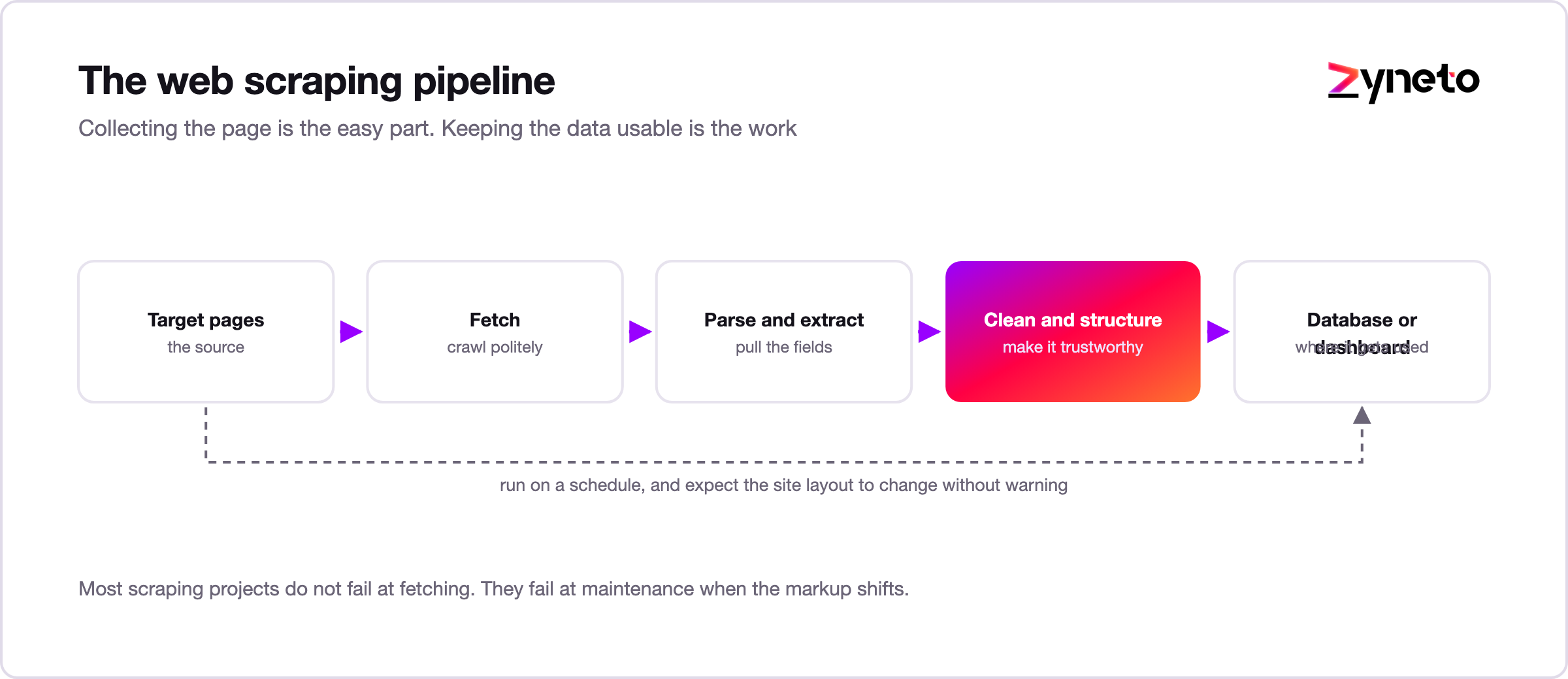
That is the whole idea, and it is not new. What changed is the scale and the stakes. A business can now watch thousands of competitor prices at once, gather millions of records, or feed a steady stream of fresh data into a model. The web quietly became a giant database. Scraping is how you query it.
The use cases are concrete, and they turn up across nearly every industry.
Retailers and brands track competitor prices, stock levels, and promotions across the web, so they can react to a rival's price drop in hours instead of noticing it a week later. For anyone in ecommerce, this is one of the clearest wins there is.
Sales teams build targeted lists from public business directories, marketplaces, and professional sites, gathering the companies and contacts that fit their profile far faster than anyone could by hand.
Pull together reviews, listings, and product details from across the web and you get a real picture of a market: what people are buying, what they complain about, where the gaps sit, drawn from thousands of sources instead of a hopeful handful.
News, job listings, real estate, travel, financial data. A surprising number of comparison sites and aggregators are, under the hood, scraping engines that gather from many sources and present them in one tidy place.
Modern AI runs on data, and a great deal of it begins as scraped web content, cleaned and structured into training sets. As more companies build their own models, this use has grown quickly, and with it the value of clean, well-sourced data.
Recruiters and talent teams gather public job postings, salary ranges, and professional profiles to map who is hiring, which roles are heating up, and what the market actually pays, turning a fuzzy sense of the talent landscape into numbers you can plan around.
Investors and analysts pull public signals, product prices, job openings, review counts, app rankings, as alternative data that hints at how a company is really doing ahead of the official reports. It has grown into a whole industry, built almost entirely on structured web data.
The thread through all of it is the same. There is valuable, public information scattered across pages that were built for people to read, and scraping turns it into something a business can actually use.
The honest answer is that it depends, and this is not legal advice, but a few principles keep you on solid ground.
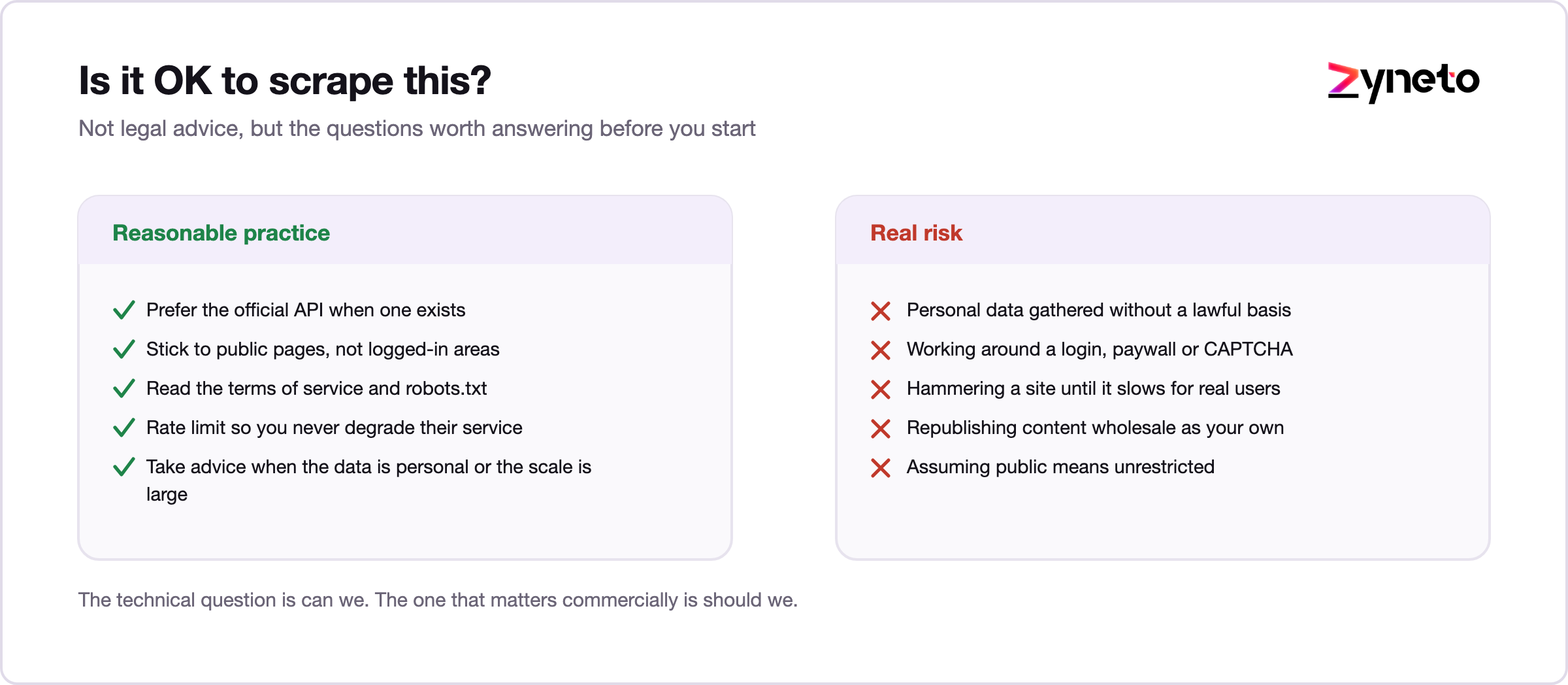
Scraping publicly available data is, broadly, legal in many places, and courts have generally been more comfortable with public data than with private. In the United States the reference point is hiQ Labs v. LinkedIn. The Ninth Circuit held in 2022 that collecting data already visible to the public is not unauthorised access under the Computer Fraud and Abuse Act. That is a 1986 statute, written long before anyone was arguing about crawlers. But it is not a free-for-all, and the details are where projects get into trouble.
Respect the terms of service. Many sites spell out what automated access they allow, and ignoring that can breach a contract even when the data itself is public. Check robots.txt, the file that signals what a site prefers bots to leave alone. It began as an informal convention in 1994 and only became a published standard in 2022, as RFC 9309. That is why honouring it has always been a matter of etiquette and contract rather than criminal law. Be genuinely careful with personal data, because collecting information about people carries real duties under rules like GDPR and CCPA, the latter in force since 1 January 2020, and this is where a lot of scraping crosses a line. Do not reproduce copyrighted content wholesale. And do not hammer a site so hard that you disrupt it for everyone else. Pull at a reasonable pace, like a considerate guest.
The safest posture is simple. Prefer an official API when one exists. Scrape public, non-personal data. Respect the site's stated boundaries. And when a project is large or sensitive, get legal advice before you start, not after a letter arrives.
The law sets the floor. Good practice sits above it, and it is both the decent thing and the practical one, because sites treat considerate scrapers very differently from rude ones.
Pull at a gentle rate, so you never strain the site you depend on. 1 request per second per domain is a defensible default, and robots.txt may name a crawl-delay you should honour instead. Cache what you already have instead of re-fetching the same page again and again, and send conditional requests so an unchanged page comes back as a 304 instead of a full download. Scrape during quiet hours where you can. Identify your scraper honestly rather than dressing it up as a browser it is not. And leave login-walled and personal data alone unless you clearly have the right to it. None of this is legally required in every case, but a scraper that behaves like a considerate guest lasts longer, breaks less, and keeps you out of the fights that end scraping programs. Aggression gets you blocked. Restraint keeps the data flowing.
This is where do-it-yourself scraping meets reality, because the modern web is built to be read by people, not harvested by programs.
Many sites load their content with JavaScript, so the data is not in the raw page and a naive scraper comes back with nothing. Content spreads across pagination and infinite scroll, so you have to follow it patiently. Layouts change without warning, and a scraper that ran perfectly yesterday breaks today. Sites use measures to detect and block automated access. A well-behaved scraper reads what the server is telling it. A 429 means you are asking too fast. A 403 means you are not welcome on that path. A 503 often means you are part of the reason the site is struggling. And once you are at scale, you are juggling many requests, proxies, and error handling, keeping a pipeline alive while a hundred small things go wrong at once.
None of these are reasons to avoid scraping. They are the reason a serious scraping operation is real engineering, not a weekend script, and why the maintenance usually turns out bigger than the build.
If you have never run one, here is the shape of a real project, because it is rarely a single script.
It starts with discovery. Check for a sitemap first: the protocol caps each file at 50,000 URLs and 50 MB, so a site that publishes one has effectively handed you an index. Then figuring out where the data lives, how the pages are structured, and whether the site serves its content up front or paints it in with JavaScript. Then the build, writing the scraper to pull the right fields and follow the pagination. Then testing, because the first version always misses the edge cases, the odd layout, the missing field, the page that looks different on a Tuesday. Then scheduling, so it runs on its own at the cadence you need, daily, hourly, or live. And then, forever, monitoring, because the target site will change and your scraper will break, and the only real question is whether you notice before the data goes stale or after. That last phase is where do-it-yourself projects quietly die. The build is a sprint. The upkeep is the marathon.
There are a few ways to get scraped data, and the right one depends on scale and how much you want to own.
Do it yourself with tools. For small, occasional jobs, no-code scrapers and even a spreadsheet can pull public data with no engineering at all. We walk through that route in the guide to extracting data from a website to Excel.
Build it in-house. For ongoing, custom needs, a team writes and maintains scrapers, usually in Python. This gives you full control and costs the most in engineering time, especially the maintenance as target sites keep changing under you.
Use a scraping service or a partner. For scale without the headache, a dedicated provider handles the hard parts, dynamic pages, blocking, proxies, and delivers clean data on a schedule. This is often cheaper than fighting it in-house once you count the maintenance, and it is where an experienced partner earns its cost.
The rule is the same as everywhere. Start with the simplest thing that answers the question, and move up only when the data you need outgrows it.
The quote for a scraper is almost never the real cost. The build is a one-time number. The maintenance is a bill that never stops, because the web does not hold still. Sites redesign, rename fields, add anti-bot measures, and shuffle things around, and every change can break your scraper without a sound. A do-it-yourself project that looked cheap in month one becomes an engineer's recurring chore by month six. The arithmetic scales badly: 100 scrapers that each break twice a year is 200 repair jobs, a full-time role nobody put in the budget. And the day everyone is slammed is the exact day the data quietly goes stale and someone makes a call on numbers from three weeks ago. This is the single biggest reason companies move from in-house scripts to a service or a partner. Not because they cannot build a scraper. Because they would rather not spend their engineers' lives keeping a hundred of them breathing.
The gap between a scraping project that helps and one that becomes a quiet liability is discipline.
Good scraping is reliable, so the data arrives on schedule and you can build on it without checking whether today's run even worked. It is clean, because raw scraped data is a mess and the value is in the structuring, not the grabbing. It is respectful, pulling at a sane rate and staying inside the site's boundaries and the law. And it is maintained, because target sites change and a scraper is never truly finished; it is a system somebody has to tend. A one-time scrape that rots within a month is not much of an asset. A reliable feed you can actually trust is a real one.
The scrape is the easy half. The value is in what comes after, and it is worth understanding before you budget a project.
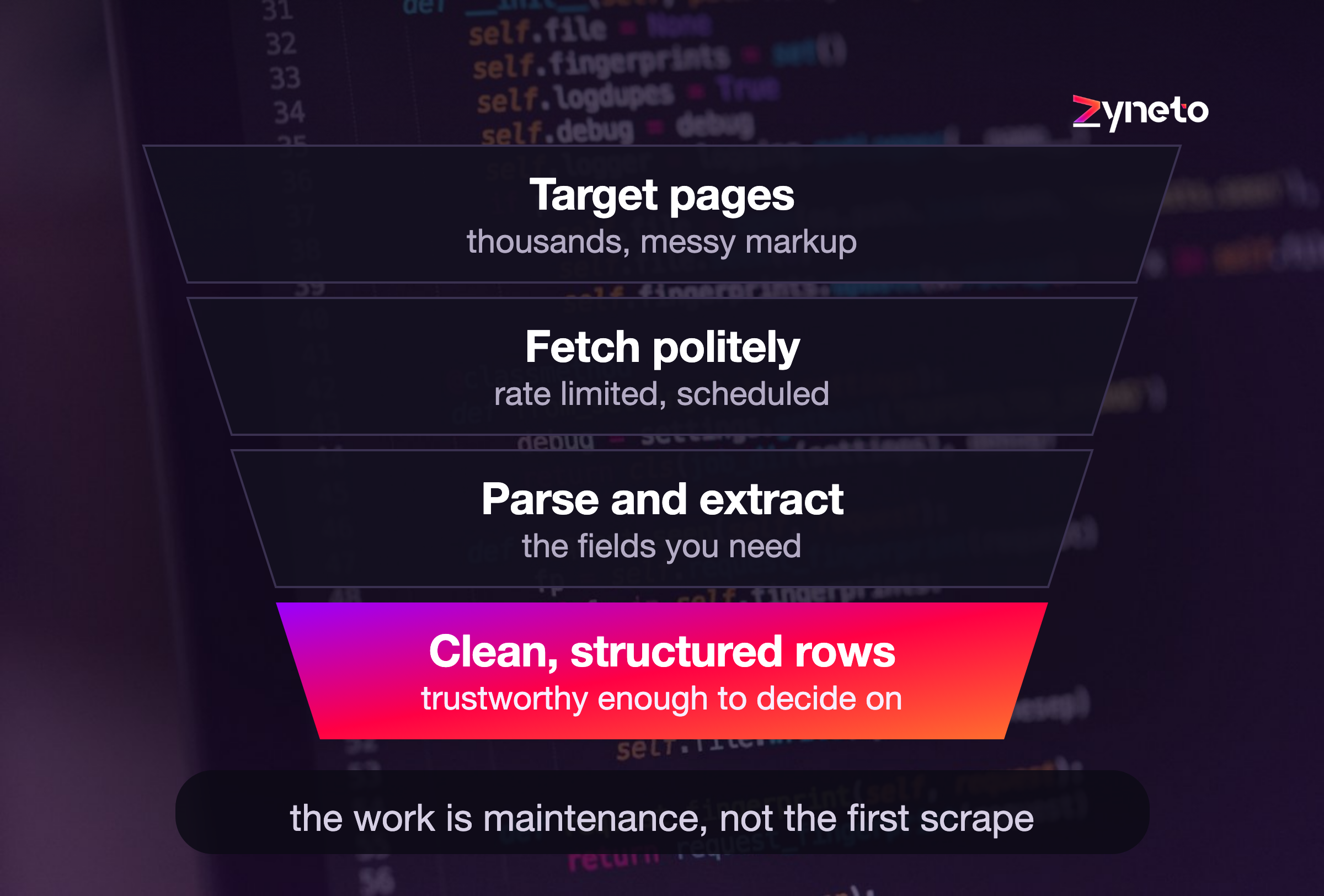
A page built for people is full of noise: inconsistent formats, missing fields, duplicates, prices written five different ways, the same product named three. Raw scraped data reflects all of that faithfully. So a real chunk of the work is cleaning and structuring it, normalizing the formats, removing the duplicates, filling or flagging the gaps, and shaping it into tidy rows a system can actually use. Skip this and you have a large pile of data nobody trusts. The teams that get value budget for the cleanup as seriously as the scrape, because a clean dataset is the actual product. The scraping was only how you got the raw material.
Scraping is the first step, not the point. The value shows up further down the pipeline.
You collect the data, then clean and structure it, because a page built for humans does not hand you tidy fields. You store it somewhere you can query. And then you actually use it, in a dashboard, a model, a decision. Scraped competitor prices only matter if they change what you charge. Scraped market data only matters if it shapes a plan. The teams that get value treat scraping as the front of a pipeline that ends in a decision, feeding it into something like predictive analytics or a live report, rather than letting the data pile up in a folder nobody opens.
The failures rhyme. Ignoring the legal and terms questions until they turn into a real problem. Building a scraper and forgetting it needs maintenance, so it quietly breaks and nobody notices until the data is weeks stale. Scraping so aggressively you get blocked, or worse, disrupt the site you were pulling from. Collecting personal data without a thought for the rules. And grabbing a heap of data with no clear decision it will inform, which is effort with no payoff attached.
Sometimes there is a better door, and it is worth checking for it first. If the site offers an official API, use it, because structured data made for machines beats parsing a page built for people, and it stays inside the rules by design. If the data you need is small and one-off, a manual copy or a no-code tool is cheaper than standing up a scraper. And if the information is private, personal, or clearly off-limits, do not scrape it at all; find a licensed source or simply ask for access. Scraping shines on public, large-scale, ongoing data needs where no clean API exists.
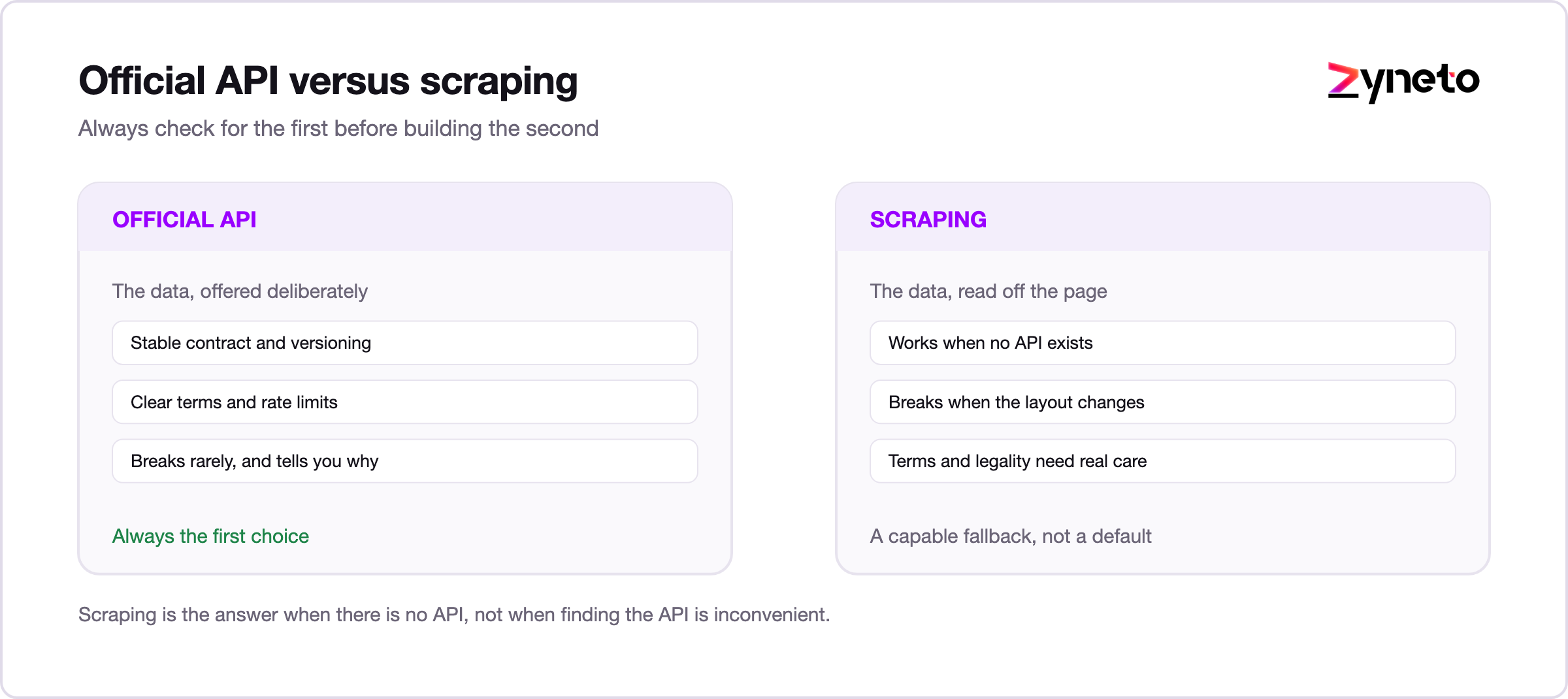
It is also worth remembering that scraping is not the only way to get outside data. For plenty of needs, a licensed data provider or a direct partnership hands you the same information already cleaned, already permitted, and without the maintenance. Sometimes buying the data is cheaper than harvesting it, once you count the engineers you would otherwise spend keeping the scrapers alive. The point is to get the data you need, reliably and within the rules. Scraping is one good tool for that, not the whole toolbox.
Two things are shifting at once. Anti-bot measures are getting more sophisticated, which raises the bar for doing scraping well and pushes more companies toward specialists and official data sources. And AI is changing both sides of the table: models make it easier to pull meaning out of messy pages, while the hunger for training data has made clean, well-sourced web data more valuable than it has ever been. The direction is toward more data, gathered more carefully, with a sharper eye on where it came from and whether you had the right to take it in the first place.
Web scraping turns the public web into structured data your business can use, and it powers price monitoring, lead generation, research, aggregation, and the datasets behind AI. The value is real, and so are the responsibilities: respect terms and robots.txt, tread carefully with personal data, prefer an official API when one exists, and never disrupt the sites you pull from. The hard part is rarely the first scrape. It is doing it reliably, cleanly, and at scale over time. Start with the simplest tool that answers your question, wire the data to a real decision, and bring in a partner when the need outgrows a script.
If you need reliable, compliant web data at scale, Zyneto builds web scraping and data extraction services that handle the hard parts and deliver clean data you can build on. Book a free consultation and we will look at the sources you need and what breaks on them.
Web scraping is the automated collection of data from websites. A program visits pages, reads them, and pulls out the specific information you want, at a scale no person could match, turning scattered pages into structured data.
Broadly, scraping public data is legal in many places, but it depends on the jurisdiction, the site's terms of service, and the data type. Personal data carries extra duties under laws like GDPR. Respect terms and robots.txt, avoid personal data, prefer official APIs, and get legal advice for anything large or sensitive.
Price and competitor monitoring, lead generation, market and product research, aggregating content like listings and news, and gathering training data for AI. Anywhere valuable public information is spread across many pages.
An API is a structured, official way a site offers its data to machines. Scraping extracts data from pages built for people, when no suitable API exists. If an official API is available, it is almost always the better and safer choice.
Technically most public pages can be, but that does not mean you should. Terms of service, personal-data rules, copyright, and anti-bot measures all set limits. Scrape public, non-personal data within the site's boundaries and the law.
Small, occasional jobs suit no-code tools. Ongoing custom needs can be built in-house if you can carry the maintenance. For scale without the headache, a dedicated service or partner handles the hard parts and is often cheaper once maintenance is counted.

Vikas has around fifteen years of experience building software and now builds generative AI systems at Zyneto. His work covers retrieval augmented generation, agentic AI, knowledge graphs, AI memory, and the evaluation and guardrails that decide whether any of it is safe to put in front of customers. He has shipped enterprise copilots, document AI, chatbots and predictive analytics for e-commerce, fintech and marketing teams, and works day to day in Python, JavaScript and SQL. He follows multimodal models, business process automation and enterprise AI security closely, and mentors engineers moving into AI. He writes about architecture, inference cost and the failure modes that only show up at production scale.
Share your details and we will talk soon.
Be the first to access expert strategies, actionable tips, and the trends actually shaping the digital world. No fluff - just practical insights delivered straight to your inbox.
Dive into our blog and stay ahead of the curve with expert perspectives, future-ready trends, and tech tips written for decision-makers and doers alike.