Parking Management Software Cost: The Hardware Decides It


Published estimates for parking management software run from $30,000 to $210,000. Richestsoft puts a smart parking build at $30,000 to $120,000 on average. RaftLabs publishes an MVP at $80,000 to $110,000 over 10 to 12 weeks, a full platform at $140,000 to $175,000 over 14 to 18 weeks and a scale build at $175,000 to $210,000 over 18 to 24 weeks.
Every one of those is a software number. The software number is not the estimate.
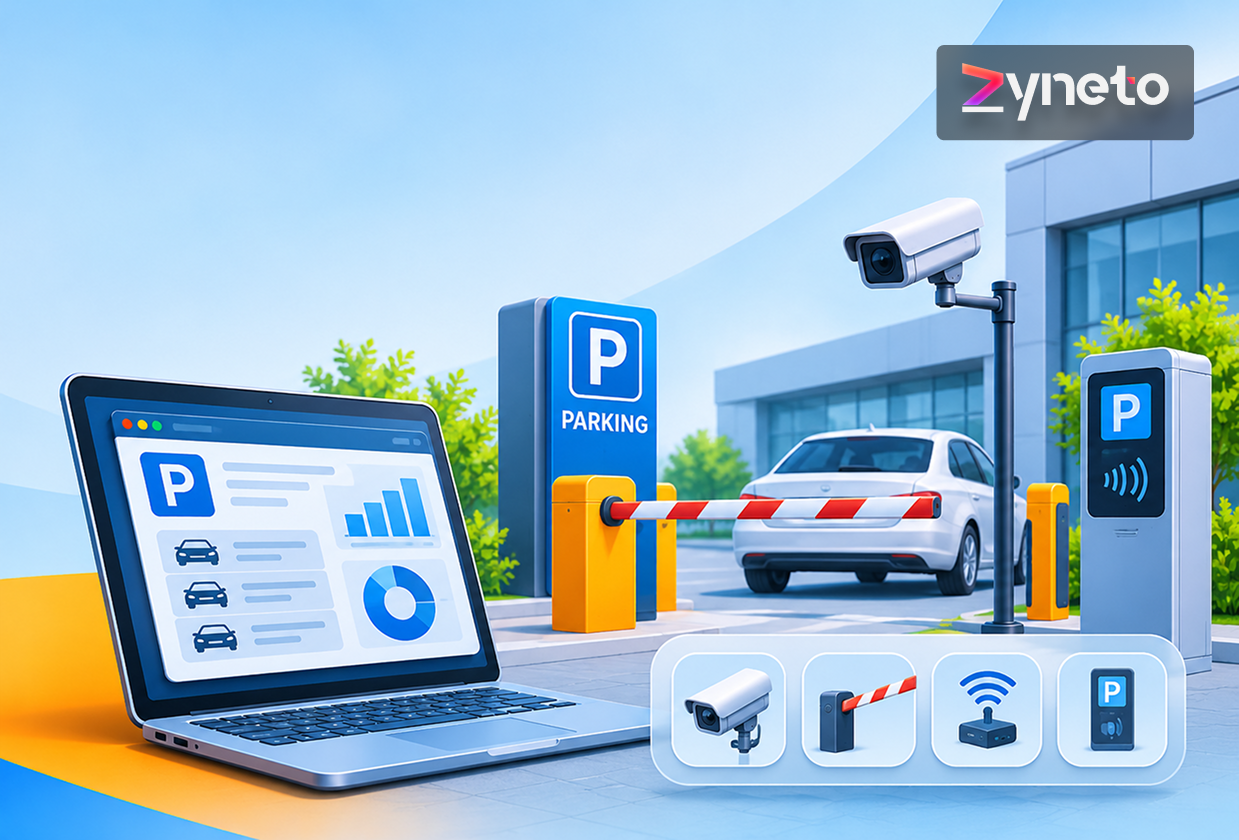
Hardware integration is where a parking quote stops being a quote. A barrier, a plate camera, a payment terminal and a gate controller are four devices from four manufacturers, each with its own protocol, its own idea of what an error is, and a physical location that somebody has to drive to. A quote for "parking software" written without knowing which barrier controller is bolted to the wall at your site is a quote for a different building.
This is not a line item you can discover in month three. The controller's command set determines what your software can even ask for. The camera determines whether you receive a plate string or a video stream you then have to read. The terminal determines whether a payment is confirmed before or after the barrier lifts. Each of those decisions changes the data model, and the data model is the part that cannot be corrected cheaply.
Three questions set your price. What is already installed at every site, by make and model? What happens when the camera reads the plate wrongly, and who absorbs that? And what does the barrier do when the network is gone? Everything else, meaning the app, the dashboards, the tariff engine, is ordinary software work.
Where the software estimate stops being the estimate
Hardware integration sets the price of parking management software. Barriers, plate cameras, payment terminals and gate controllers each carry their own protocol, their own failure mode and a site visit. A quote that has not asked which barrier controller is on site is pricing a different system from the one you own.
The published guides are not silent about hardware. They are vague about it in a specific and expensive way. Richestsoft treats it as a single line called IoT sensors at $20,000 to $50,000, with ticketless parking as a second at $15,000 to $30,000. Another lists hardware, installation, on-site wiring, annual maintenance contracts, cloud hosting and payment gateway charges as items "often billed separately", which is true and tells you nothing about your own site. A third, the most careful of them, names hardware compatibility as a risk to clear in a scoping sprint and prices a field test with your actual cameras.
None of them makes the point that matters: the hardware changes the software, not just the invoice. Integration is treated as a connector you attach at the end. It is not. It is a set of constraints you discover at the beginning and then design around for the rest of the project.
An example of the difference. If your plate camera does recognition on the device and pushes a plate string with a confidence score, your software receives a short message and decides. If it only streams video, your software now owns an inference pipeline, a GPU bill or a per-request fee to a recognition service, frame selection, and a whole class of failure the first option never has. Same feature name on the quote. Different product.
Our IoT and connected device work starts from the device sheet rather than the screen designs for this reason, and the same habit runs through our automotive software projects, where the protocol on the wire is the first thing anyone asks about.
How much does an automatic parking system cost?
An automatic parking system is two budgets that get quoted as one. The hardware budget covers barriers, cameras, loop detectors, pay stations, readers and the installation labour, and it is bought per lane. The software budget covers the platform that drives them. At a small site the hardware is usually the larger of the two, and at a large multi-site operation the software overtakes it.
Published software figures cluster between $30,000 and $210,000, as above. We publish no figure for the hardware. Every number we could find for a barrier or a pay station is one vendor's list price in one market, and quoting it to a reader in another country would mislead. Those figures are recorded in this post's sources as rejected, with reasons.
What we will give you is the rate band and the assumption behind it. Ours is published: $40 to $100 an hour by role, blending to $60 to $70 for a mixed team of a backend engineer, a mobile engineer, a designer and a lead, working remotely. That is the same assumption behind every figure on our engagement model page.
For a budget of $10,000 to $50,000, the honest scope is one site, one lane type, one payment path. Entry, exit, a tariff, a payment, a permit list, an operator screen and a reconciliation report, against the controller you already own. That is a real product. What it is not is a multi-site platform with ANPR enforcement, dynamic pricing and a consumer app, and any quote that offers all of that inside that budget has not read the site survey, because there was no site survey.
Four devices, four protocols, four failure modes
The devices in a car park were not designed to work together, and the software is where that becomes your problem.
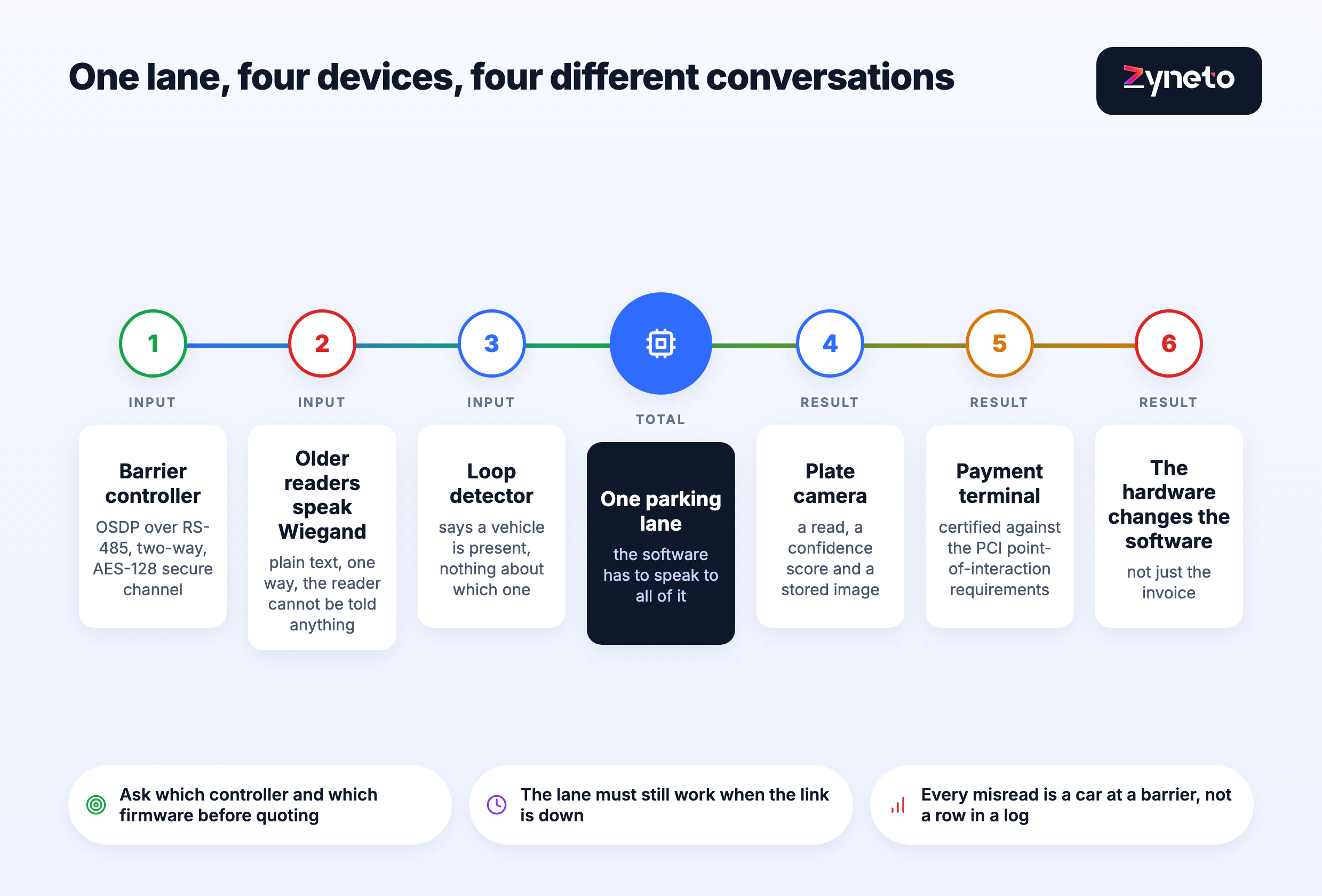
The barrier controller is the oldest and the simplest. Many accept nothing more than a volt-free contact closure: a relay pulse that means "open". That is reassuringly simple and gives you almost no information back, so your software cannot tell whether the arm actually lifted, whether a car passed, or whether somebody is standing under it. Better controllers speak a serial protocol over RS-485 with a vendor-specific command set, and newer ones expose a network interface. Three generations, three integration efforts, all called "barrier integration" on a quote.
The reader and credential path is where a security standard matters. Wiegand is still everywhere, and Axis Communications' own standards note calls its security "poor", because it sends credential data unencrypted and in one direction only: "The controller can't send commands back to the reader." The Security Industry Association's Open Supervised Device Protocol replaces it over RS-485 wiring with two-way communication and an AES-128 secure channel. Which one is on your wall decides whether your software can ask a reader anything or merely listen to it.
The plate camera has the widest spread of all. On-camera recognition with a plate string and a confidence score, versus a video stream you process yourself, versus a hosted recognition service you pay per request. Pick one deliberately, because the choice sets your running cost and your failure handling for the life of the system.
The payment terminal brings a compliance perimeter with it. An unattended terminal in a car park is a card-present device nobody is watching. The PCI Security Standards Council folded its separate evaluation programmes for PIN entry devices, encrypting PIN pads and unattended payment terminals into one modular set of point of interaction requirements, the standard the box in your lane is certified against. The Council published revision 7.0 of those requirements in May 2025. In practice you integrate with a certified terminal rather than handling card data yourself, and the surface you build is the request, the confirmation, the timeout and the reconciliation. The payment side of a build has its own scoping questions, worth asking early.
Add EV charging and you add a fifth protocol. Chargers speak OCPP, which is a different standard with its own sessions, tariffs and failure states, and it drags energy pricing into a parking product. That belongs with energy software rather than inside the parking core, and it should be a later phase.
The site visit is a line item, not a courtesy
Somebody has to stand in the car park. If your quote does not contain that, it contains an assumption instead.
What a survey establishes, each item a scope input rather than a detail: the controller's make, model and firmware version; whether mains power and a network reach the barrier or only the office; the cable runs and whether anyone may dig; camera mounting height, angle and lane width; where the vehicle loops sit and whether they still work; lighting at night and glare at dawn; the safety photocells and who signed them off; and who holds the keys to the cabinet.
Firmware version matters more than people expect. Two controllers with the same model number and different firmware answer the same command differently, and the one on your wall was installed by a contractor who has since changed company. Reading the version off the device is a five-minute job that removes a week of guessing.
Multi-site multiplies the survey, not the software. The platform is written once. Every site is its own survey, its own install visit, its own commissioning day and its own list of things that are not like the last one. A ten-site rollout priced as one integration plus nine copies is the most common way this project overruns, and it has nothing to do with code.
Commissioning is a day in the diary with a vehicle in it. Driving a real car at a real barrier, at night, with a wet plate, with a motorcycle, with a van that blocks the camera, with a tailgater following through. None of that can be tested from a desk, and the first time anyone does it, something will be wrong. Price it.
For car parks that sit inside a building, the survey usually belongs to whoever already manages the asset, which is why this work tends to arrive alongside real estate and facilities systems and overlaps with property management software.
When the camera misreads a plate, who eats the cost?
This is the question the published guides do not ask, and the answer decides who is angry.
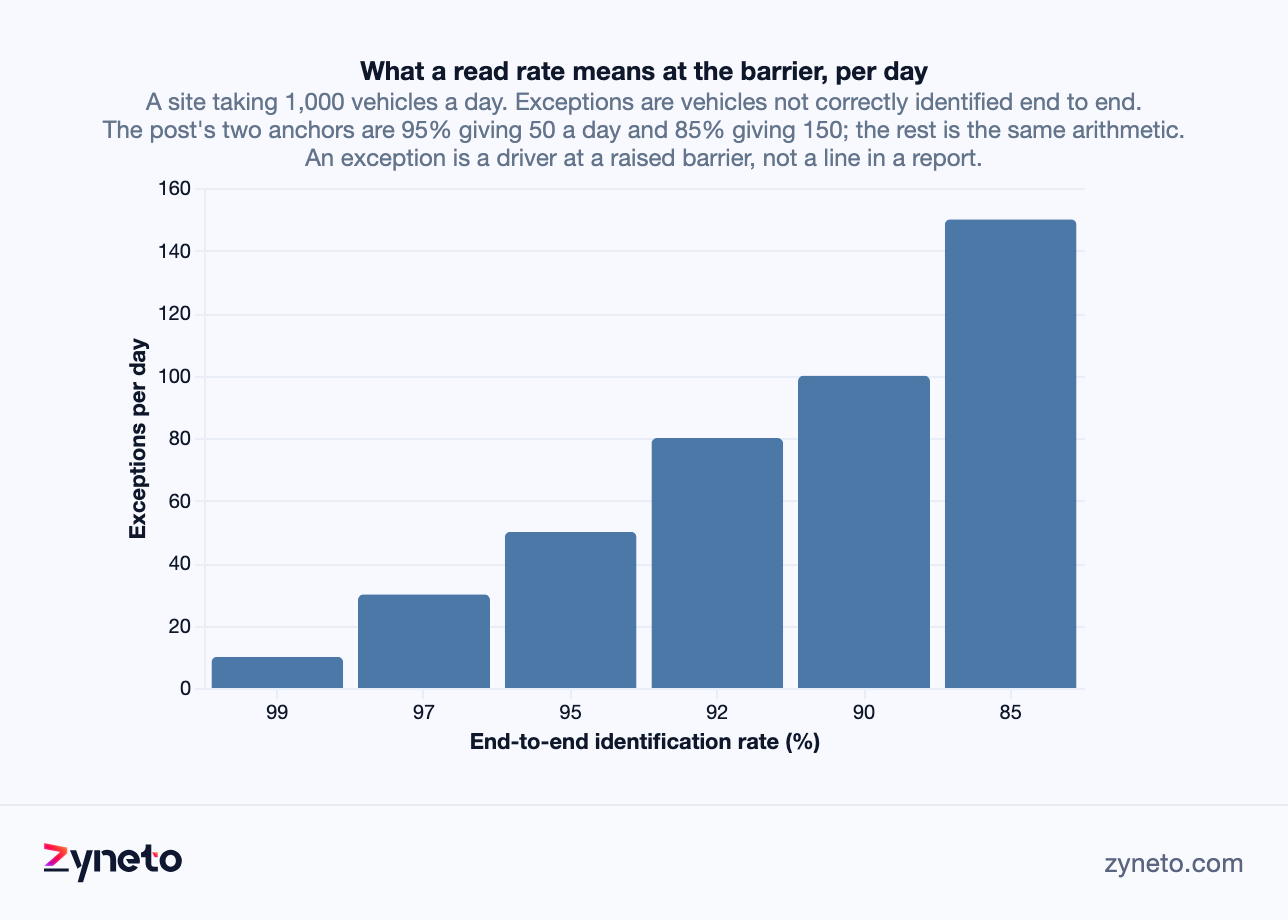
Start with the read rate, and treat every quoted figure with suspicion. Manufacturers claim accuracy in the high nineties. In a trade interview published by John Van Horn of Parking Today in February 2021, a UK vendor representative gave "Better than 99%" for the UK, and the same representative put the United States at "Maybe in the mid 80%, on a good day." Both come from the same conversation, which is how much the operating conditions matter: plate format, plate condition, mounting, weather, light and lane geometry.
A read rate quoted without a capture rate is not a number at all. A system can read 99% of the plates it managed to photograph while photographing only 85% of the vehicles. The figure that matters to you is end to end: vehicles through the lane against vehicles correctly identified. Ask for that one, and if the vendor cannot give it, you have learned something.
Now the arithmetic, in exceptions per day. A site taking 1,000 vehicles a day at 95% end to end produces 50 exceptions a day. At 85% it produces 150. Each exception is a car at a barrier with a driver who cannot get out, or a session that cannot be matched to a payment. That number, not the accuracy percentage, is the thing your software is being built to handle, and it is why an exception workflow is core scope rather than a later refinement.
Then decide who absorbs each kind of error, because there are two and they cost different people. A plate read as unknown lets a car in or out unbilled, and the operator loses the fee. A plate read as the wrong vehicle bills a stranger, which costs the operator a refund, a complaint, possibly a regulator and certainly a reputation. The second is much worse than the first, which is why the honest default is to fail towards no charge rather than towards a confident wrong charge.
The software decides which happens, through one design choice: whether it stores the confidence score. A system that records only the plate string cannot distinguish a certain read from a guess, so it treats both the same and charges both. A system that records the score, the image and the camera can hold low-confidence reads for review, auto-match them against permits and bookings, and only charge when it is sure. That is a day of schema and a week of workflow, and it is the difference between an enforcement product and a complaints department.
Who pays is a contract question, and your software provides the evidence. Integrators will not generally warrant a read rate when they do not control the conditions. Operators end up carrying it. Either way, the argument is settled by the stored image, the confidence score and the timestamp, which is the same lesson the parcel world learned about proof of delivery.
Offline at the barrier is mandatory, not nice to have
A car park is a building with cars in it and a network connection that will fail. The barrier still has to decide.
There are only three things a barrier can do without a server, and two of them are bad. Fail open, and everybody parks free until someone notices. Fail closed, and you have trapped vehicles, a queue on a public road and a safety problem. Decide locally, which means the edge holds a cached permit list, a local tariff, a local transaction log and enough logic to answer on its own.
Entry and exit are not symmetrical, and conflating them is the common mistake. A car refused entry is annoyed. A car refused exit is trapped, with a human being inside it, possibly at midnight. The defensible default is to fail open on exit and log everything for later billing, while entry can tolerate a brief refusal. That is engineering judgement rather than a measured rule, and it is the judgement we would argue for in a scoping session.
Local decisions create reconciliation work, which is the part that gets missed. When the link returns, the server receives a batch of sessions it knew nothing about, some contradicting what it did know: a permit revoked while the gate was offline, a booking cancelled, a vehicle that exited twice because a retry was not recognised as a repeat. Every write from the edge needs an identifier generated at the edge, so a replay cannot create a second session. The same discipline that makes an offline driver app work makes an offline barrier work.
Offline is also a hardware question you must ask at survey. Some controllers hold a credential list and act alone. Some are dumb relays that cannot. If yours is the second kind, offline operation needs an on-site device to make decisions, and that is hardware you did not budget for, discovered in week ten unless somebody asked in week one.
How much does a parking ticket machine cost?
A pay station or ticket machine is a capital purchase from a hardware supplier, not a line in a software quote, and the figures circulating online are single-vendor list prices in one market. We will not repeat them as though they were global, and the sources section explains why each was rejected.
What the software project pays for is the integration, and that is quotable. The protocol the machine speaks, the handshake that confirms a payment before the barrier moves, the behaviour when the terminal times out mid-transaction, the daily cash and card reconciliation, and the receipt format. That work is largely independent of what the machine cost.
Three questions get you a real hardware price from a supplier. How many lanes, and is each one entry, exit or both? Does the machine take cash, which means a safe and two people to open it, or cards only? And is it outdoors in your weather, which changes the enclosure rating and the price more than any feature does?
The strategic answer is often to buy fewer machines. Pay on exit at the barrier, pay in the app before leaving, or pay by plate after the fact all reduce the number of physical terminals, and terminals are the most expensive and most failure-prone objects in the car park. Shifting payment into a mobile app is usually cheaper than another pay station, and it is the one place where software genuinely replaces hardware.
What sits outside the software number
The build is once. These are not, and a budget without them is not a budget.
Annual maintenance on the hardware. Barrier arms get snapped by vans. Cameras get knocked out of alignment. Card readers fail. One published cost summary for this category lists hardware, installation, on-site wiring, annual maintenance contracts, cloud hosting and payment gateway charges as separately billed, and that is the right shape even where the figures are not.
Connectivity per lane, meaning a SIM or a line at each barrier, every month, at every site. Payment processing, a percentage plus a fixed fee on every transaction, which in a business of small payments is a material share of revenue rather than a rounding error. Spares on a shelf, because a car park with a broken barrier and a four-week lead time on the part is a car park that is not earning.
Hosting and storage. Plate images are the heavy part. Keeping an image for every vehicle across a dispute window of months is storage that only grows, plus the deletion job that has to actually remove them when the period expires. Plate data is personal data in most markets, and in the European Union and the United Kingdom that is a storage limitation duty under the GDPR, which is a worked example rather than the whole rule.
The engineer who attends. Somebody drives out when a barrier sticks, and that is a running cost with a response time written into it.
What we would build first, and what we would buy
The device layer first, before a single screen that matters. One well-defined internal interface for "a vehicle presented itself", "open the barrier", "a payment succeeded", with one adapter per make of controller behind it. Get that boundary right and a new site is an adapter. Get it wrong and every new site is a new product.
The session and exception model second. A parking session with its entry evidence, its exit evidence, its confidence scores and its reason codes, plus the queue of reads that need a human. Build the exception queue before you need it, because without one the exceptions fail silently and somebody finds out at month end.
The tariff engine third, and expect it to be harder than it looks: free periods, rounding up to the next hour, daily maximums, overnight rates, permit holders, validation by a retailer, and a change of price that must not re-rate yesterday. Tariffs are where a bought product usually fails to match what the operator actually sells, and they are a good reason to build.
The operator screen fourth, thin, with the dashboard showing occupancy, exception count by camera and revenue against capacity. The consumer app comes after, and for a single site it can often wait, which is what a deliberately small first release is for.
What we would not build is plate recognition, the payment rails, the mapping or the hardware firmware. Recognition in particular is bought: hosted services and on-camera options outperform anything a project of this size will train, and the money is better spent on the exception workflow that handles the reads they get wrong. For shopping centre car parks, validation and loyalty tie-ins matter more than recognition accuracy, and those sit closer to retail systems than to parking hardware.
This post stays inside the car park. Fleet routing, vehicle telematics and depot planning are a different problem, covered in logistics software development cost and on the logistics industry page. Tenant billing, leases and facilities workflow belong to property management.
Our rate band is published: $40 to $100 an hour by role, blending to $60 to $70 for a mixed team, with the device integration layer at the top of that band because it needs senior time and a site visit. We do not quote a fixed total before somebody has stood in the car park and read the model number off the controller. What we will say for free is that a parking quote which does not name your barrier controller has priced a photograph of a car park rather than yours.
Frequently asked questions
Published estimates run from about $30,000 to $210,000. Richestsoft gives $30,000 to $120,000 on average for a smart parking build, and RaftLabs publishes an MVP at $80,000 to $110,000 over 10 to 12 weeks, a full platform at $140,000 to $175,000 over 14 to 18 weeks and a scale build at $175,000 to $210,000 over 18 to 24 weeks. Our published rate band is $40 to $100 an hour by role, blending to $60 to $70 for a mixed team. The figure that actually moves is hardware integration, which is why no honest total exists before a site survey.
Because the devices decide what the software can do. A barrier that accepts only a relay pulse cannot tell your system whether the arm lifted or a car passed, so the whole session model has to work without that confirmation. A camera that streams video instead of sending a plate string means you own a recognition pipeline and its running cost. A terminal determines whether payment is confirmed before or after the barrier moves. Each of those reaches into the data model, and the data model is the expensive thing to change later.
One of two things, and they cost different people. An unreadable plate lets a vehicle through unbilled, and the operator loses the fee. A plate read as the wrong vehicle bills a stranger, which costs a refund, a complaint and the operator's reputation. The design choice that separates the two is whether the software stores the confidence score alongside the plate. If it does, low-confidence reads can be held for review and matched against permits and bookings. If it does not, a guess and a certainty are treated identically and both get charged.
Yes, and it is a requirement rather than a refinement. A barrier with no server can fail open, which means free parking, fail closed, which means trapped vehicles and a queue on a public road, or decide locally from a cached permit list and tariff. Only the third is acceptable at any scale. Entry and exit are not symmetrical: refusing exit traps a person in a car, so the defensible default is to fail open on exit and log for later billing. Ask at survey whether your controller can hold a credential list at all, because some cannot.
Four things. Which barrier controller, by make, model and firmware version, is installed at every site. Whether the plate camera does recognition on the device or streams video. What the end-to-end identification rate is, meaning vehicles through the lane against vehicles correctly identified, rather than a read rate quoted on its own. And what the barrier does when the network fails. A quote produced without answers to those is pricing an imagined car park, and the gap shows up as a change request.
Buy, if your site is ordinary: standard barriers, a standard tariff, one or two lanes, no unusual permit rules. The products in this category already encode a lot of practice. Build when the tariff or the permit model is the business, when you operate many sites with mismatched hardware that no single product supports, or when parking is a feature of a larger property or retail system you already own. The underused middle option is to buy the core and build only the device adapter and the exception workflow against its interfaces.
Yes. An unattended payment terminal is a card-present device with nobody watching it, and the PCI Security Standards Council consolidated its separate evaluation programmes for PIN entry devices, encrypting PIN pads and unattended payment terminals into one modular set of point of interaction security requirements. In practice you integrate with a terminal that is already certified rather than handling card data in your own software, which keeps the compliance perimeter around the device. What your build owns is the payment request, the confirmation, the timeout behaviour and the daily reconciliation.

Vikas Choudhary
Vikas has around fifteen years of experience building software and now builds generative AI systems at Zyneto. His work covers retrieval augmented generation, agentic AI, knowledge graphs, AI memory, and the evaluation and guardrails that decide whether any of it is safe to put in front of customers. He has shipped enterprise copilots, document AI, chatbots and predictive analytics for e-commerce, fintech and marketing teams, and works day to day in Python, JavaScript and SQL. He follows multimodal models, business process automation and enterprise AI security closely, and mentors engineers moving into AI. He writes about architecture, inference cost and the failure modes that only show up at production scale.
Zyneto builds custom software, AI and automation
Tell us what you are building and we will reply with a clear next step.