AI Proof of Concept Cost: The Answer Key Nobody Quotes


Read the published guides and an AI proof of concept costs $10,000 to $80,000, most of them clustering at $25,000 to $80,000 over four to eight weeks. Those are agency ranges, published by BrainX Technologies, Master of Code Global and Azilen and re-read on 2026-11-13, and they agree closely enough to plan against. Our own published engineering band is $40 to $100 an hour, blending around $65, so if you assume a 160 hour proof of concept, that is $6,400 to $16,000 across the band and $10,400 at the blend. Assume 320 hours and it is $12,800 to $32,000.
Every one of those numbers prices the build. None of them prices the answer.
A proof of concept exists to produce one number that decides something: can this thing read your documents well enough, answer your customers accurately enough, classify your tickets correctly enough. To read that number you need a set of cases where the right answer is already known, and somebody has to write the right answers down. On a worked example below, 875 cases at four minutes each is 58.3 hours, or $3,792 at the $65 blend. That is a tenth of a mid range proof of concept budget, it is almost never a line in the quote, and without it the expensive part produces a figure you cannot act on.
The build is the part you will be sold. The answer key is the part that decides whether the build told you anything.
How much does an AI proof of concept cost?
Published agency ranges put an AI proof of concept at $10,000 to $80,000, most often $25,000 to $80,000 over four to eight weeks, read 2026-11-11. On our published band of $40 to $100 an hour, 160 assumed hours is $6,400 to $16,000, or $10,400 at the $65 blend. The number nobody itemises is the answer key.
Three things about those published ranges are worth knowing before you use one.
They are vendor self description, not benchmarks. BrainX Technologies says so in as many words: its figures are market ranges from other companies, not a BrainX quote. Azilen describes its band as reflecting engineering led development in mature markets, which is a statement about who it sells to, and it contradicts itself on the same page, giving a $15,000 floor in its summary and a $25,000 floor in its table. Master of Code Global gives $25,000 to $80,000 over four to eight weeks. Treat the agreement between them as evidence that $25,000 to $80,000 is a normal asking price, and not as evidence about what the work costs.
The hours are the cost, so hours are the honest unit. At our published band, the arithmetic is linear and you can do it yourself: assume the hours, multiply by the rate, read the answer. We are not going to publish a module hour table for a proof of concept, because a proof of concept is not a product with modules. It is one question with a measurement attached, and its size is set by how hard that question is to answer rather than by a feature list.
None of the ranges tells you what you get. This is the real problem with the published figures. A $30,000 proof of concept and a $30,000 proof of concept can differ by everything that matters: whether the test ran on your real data or a curated extract, whether anyone wrote down the threshold it had to beat, and whether the result came with enough cases behind it to mean anything. Two of those three are covered in why AI pilots do not reach production, and this post is about the third.
A result with no interval is not a result
Here is the failure that costs the most and gets named the least.
Your proof of concept runs 50 documents through an extraction and gets 46 of them right. The deck says 92% accuracy, the room nods, and somebody writes "exceeds our 90% bar" on a slide.
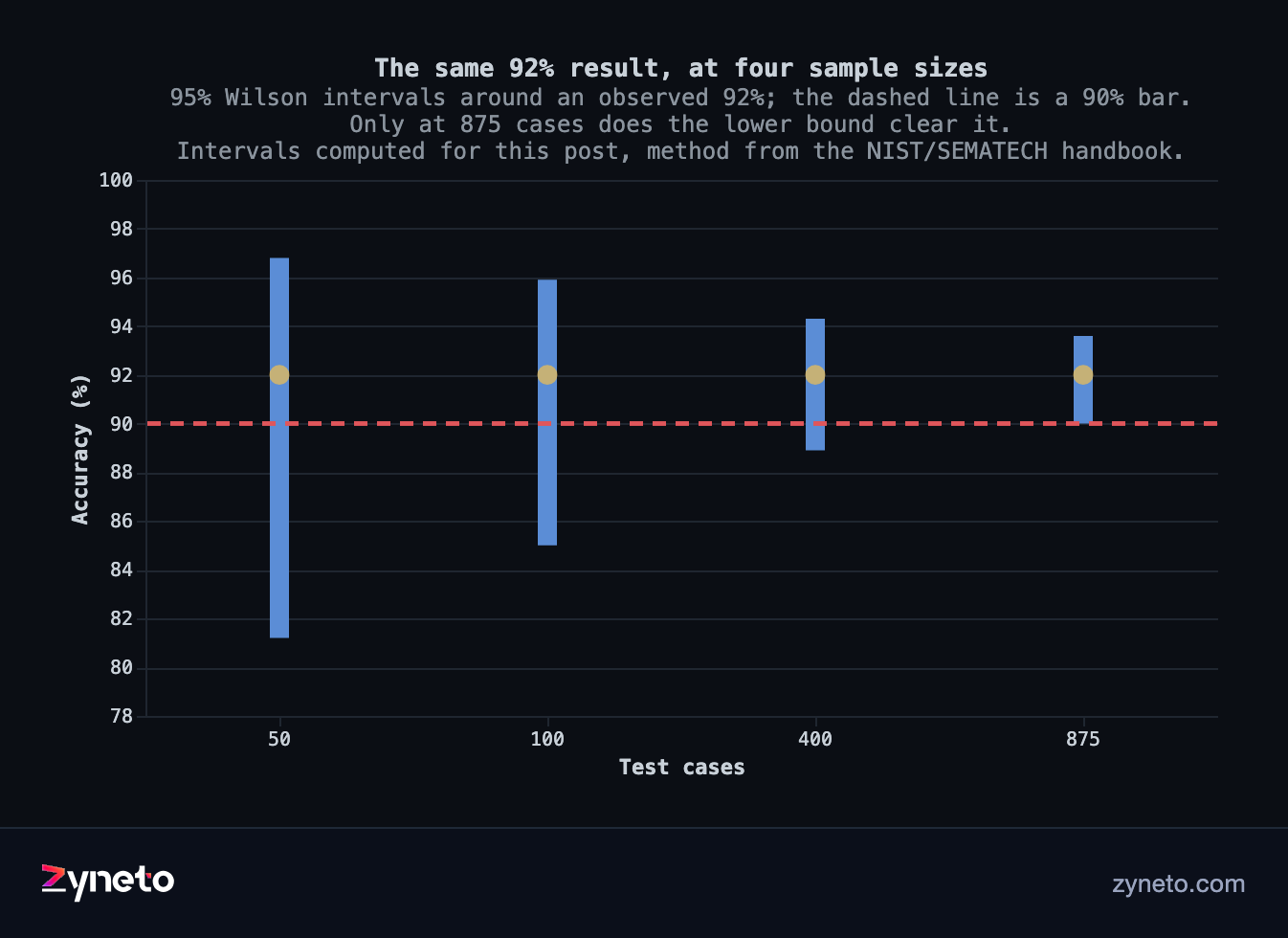
That result cannot distinguish 92% from 84%. Forty six correct out of fifty, with the Wilson method the NIST statistics handbook recommends for exactly this, gives a 95% confidence interval of 81.2% to 96.8%. Your 90% bar sits comfortably inside that range. The honest reading of the test is that the true accuracy is probably somewhere between four errors in five and one error in three, and you have no idea which.
NIST's own worked example makes the point harder than any explanation can. Four defects in twenty units gives a 90% confidence interval for the defect rate of 0.071 to 0.400. Four bad results in twenty tries tells you the true failure rate is somewhere between seven per cent and forty per cent. That is the precision of a twenty case test, and twenty cases is more than some proofs of concept run.
Run 400 cases instead and 368 correct is still 92%, but the interval tightens to 88.9% to 94.3%. Better, and still straddling a 90% bar.
|
Cases, all at 92% observed |
95% confidence interval |
Clears a 90% bar? |
|
50 |
81.2% to 96.8% |
No |
|
100 |
85.0% to 95.9% |
No |
|
400 |
88.9% to 94.3% |
No |
|
875 |
90.0% to 93.6% |
Yes, just |
To show that 92% beats 90%, you need about 875 cases. Not 50. The number comes from the width of the interval you need, and the width you need comes from how close your bar is to the result you expect. That relationship is the whole design problem of a proof of concept, and it is almost never discussed in a proposal.
A note on what this is and is not. The interval above describes sampling error only: the luck of which 50 documents you happened to pick. It says nothing about whether those 50 resemble the documents you will actually receive, which is a separate and usually larger problem. A test built from a curated extract can be both precise and wrong.
The answer key is the line item nobody quotes
You cannot score 875 cases without 875 known correct answers, and someone with the knowledge to produce them has to sit down and produce them.
Price it. Assume four minutes per case to find the right answer, record it in a usable format and check it. At our published rate band:
|
Cases |
Hours |
At $40 |
At $65 |
At $100 |
|
50 |
3.3 |
$133 |
$217 |
$333 |
|
100 |
6.7 |
$267 |
$433 |
$667 |
|
400 |
26.7 |
$1,067 |
$1,733 |
$2,667 |
|
875 |
58.3 |
$2,333 |
$3,792 |
$5,833 |
The four minutes is a stated assumption and the one most worth replacing with your own measurement, because it varies enormously by task. A sentiment label on a support ticket takes seconds. Deciding the correct extracted value from a 40 page contract can take twenty minutes and a second opinion, and at twenty minutes those 875 cases become 291 hours.
Against a build quoted at $25,000 to $80,000, a $3,792 answer key is a rounding error that determines whether the rest of the money bought you anything. That is the asymmetry this post exists to point at.
Two practical things follow. The first is that the answer key is usually built by your people, not by the vendor, because the knowledge of what is correct lives in your business. That makes it a cost in your budget that does not show up in any proposal, and the commonest reason a proof of concept slips is that nobody on the client side was given the time to do it.
The second is that the answer key outlives the proof of concept. It becomes the regression test for every model change, prompt revision and provider switch afterwards, which is the only reason anyone will ever be able to tell you whether an upgrade helped. Treated that way it is infrastructure rather than overhead, and what to measure before you ship an agent covers how it gets held, versioned and kept honest once the proof of concept is over.
How many cases you need is set by the gap you are testing
This is the lever, and it is free.
The sample size you need depends on the distance between the bar and the result. A narrow gap needs a lot of cases. A wide gap needs very few.
Keep the observed result at 92% and move the bar:
- Against a 90% bar, a two point gap, you need roughly 875 cases.
- Against an 80% bar, a twelve point gap, you need about 40 cases.
Forty. The same test, the same model, the same prompt, and the cost of the answer key falls from $3,792 to $173 at the $65 blend, because the question got easier to answer rather than because the work got cheaper.
NIST gives the formal version with its own numbers: to detect a ten point move from a baseline rate of 10%, at 5% significance and 90% power, needs about 102 samples, or 112 with the continuity correction. Ten point gaps are cheap to prove. Two point gaps are not.
So the first design question in a proof of concept is not technical, it is: what is the current rate, and how much better does this have to be? If today's manual process is right 80% of the time and the AI has to beat it, you have a wide gap and a cheap test. If you have declared a 95% requirement and you expect 96%, you have a one point gap and you are looking at thousands of labelled cases, which may cost more than the build.
That is a legitimate finding and you can act on it before spending anything. Either widen the gap by being honest about what the current process actually achieves, which almost nobody has measured, or accept that this particular question cannot be settled by a cheap test and plan a staged rollout with monitoring instead. Both are better than paying for a precise looking number produced by 50 cases.
How long does an AI proof of concept take?
Four to eight weeks is the figure most published guides give, with a wider spread of two to ten weeks across the pages read on 2026-11-11 and longer for computer vision or multi system work. The delays are rarely modelling. They are data access, legal approval, security review and waiting on the subject matter expert who has to produce the answer key.
Notice that three of those four are on your side of the table. A vendor can control how long the build takes and cannot control how long it takes your legal team to approve a data extract, which is why calendar estimates for a proof of concept are so much less reliable than cost estimates. The work that unblocks the timeline is the work nobody schedules, and what AI ready data actually demands covers the access and quality questions that turn into four week waits.
The security review is the one most often underestimated, because the questions it asks are specific to systems that read text somebody else wrote. If your test involves documents or customer messages, read what prompt injection does to a system reading untrusted input before that meeting rather than after it.
Two things shorten this reliably. Get a real data extract approved before the engagement starts rather than in week one. And name the person who will produce the answer key, with their hours blocked, before anyone writes code. Both are unglamorous and both are worth more than any choice of model or framework.
What is the difference between a proof of concept and a pilot?
A proof of concept answers one question in controlled conditions, usually offline, against a known answer key, and nobody's real work depends on it. A pilot puts a working system in front of real users doing real work at small scale. The first tests whether the thing can work. The second tests whether anyone will use it and whether it survives contact with your actual process.
The cost shapes differ accordingly. A proof of concept is a short engagement and an answer key. A pilot adds error handling, access control, monitoring, support and the process change around it, which is where the months and the majority of the money go. If what you are heading towards is a first shippable version rather than a controlled test, what a minimum viable product costs is the more useful budget to start from.
Run them in that order and do not skip the first one. Putting an unproven idea in front of real users is expensive to walk back, and the damage is reputational as much as financial: the next proposal has to overcome the last attempt. We have written the pilot side of this at length in why AI pilots do not reach production, including how to write the success criterion, who has to own it and what production adds to a working demo. This post deliberately stops at the money and the measurement.
The cheapest proof of concept is the one you do not run
Before approving the spend, write down both outcomes and what you would do about each. Two sentences, before anyone is invested.
If the answer comes back good, what happens? If the honest answer is "we would think about it" or "we would need budget we do not have", the proof of concept is not a decision input. It is reassurance, and it is being priced as engineering.
If the answer comes back bad, what happens? If the honest answer is "we would try again with a better prompt", there is no bad branch, and a test with no failing branch cannot tell you anything. That does not mean do not experiment. It means do not pay proof of concept prices for an experiment and then describe the result as evidence.
A surprising number of these questions can be answered for a fraction of the quote. Fifty cases run by hand through a provider's own interface, with somebody sensible reading the outputs, will tell you in an afternoon whether a task is in the right ballpark or hopeless, and it costs a few dollars of tokens plus half a day of attention. It will not give you a defensible number, for every reason in the interval table above, but it will stop you buying a measurement of something that was obviously going to work or obviously was not.
Spend the money where the answer is genuinely uncertain and the decision is genuinely large. That is the only configuration where a proof of concept is good value, and recognising the other configurations is the cheapest skill in this whole subject.
The token bill is not the proof of concept budget
Founders ask about API cost first and it is almost never the answer.
Running 875 documents through a current model with a shared prompt prefix is a few dollars of tokens. We publish the full arithmetic for a run like that, at list prices with their read date, in what an AI agent costs per document: 2,000 documents at 2.6 cents each is $52.00, and a cached version of the same run is $35.34. A proof of concept over a few hundred cases is a smaller number than that.
So the inference cost of a proof of concept rounds to nothing, and the inference cost of the production system does not. Those are different questions with different answers, and conflating them is how a cheap pilot turns into an unaffordable rollout. The volume arithmetic belongs in its own exercise, which token economics for a product that ships sets out properly, and the honest version of it has to be done before you commit to a build rather than after.
One thing the proof of concept should produce, though, is the inputs to that arithmetic: tokens in and out per case, measured rather than guessed, and the latency you actually saw. Ask for those as deliverables. They cost nothing to capture while the test is running and they are expensive to reconstruct later, and they are what turns the cost of building an agent into a number with a running cost attached.
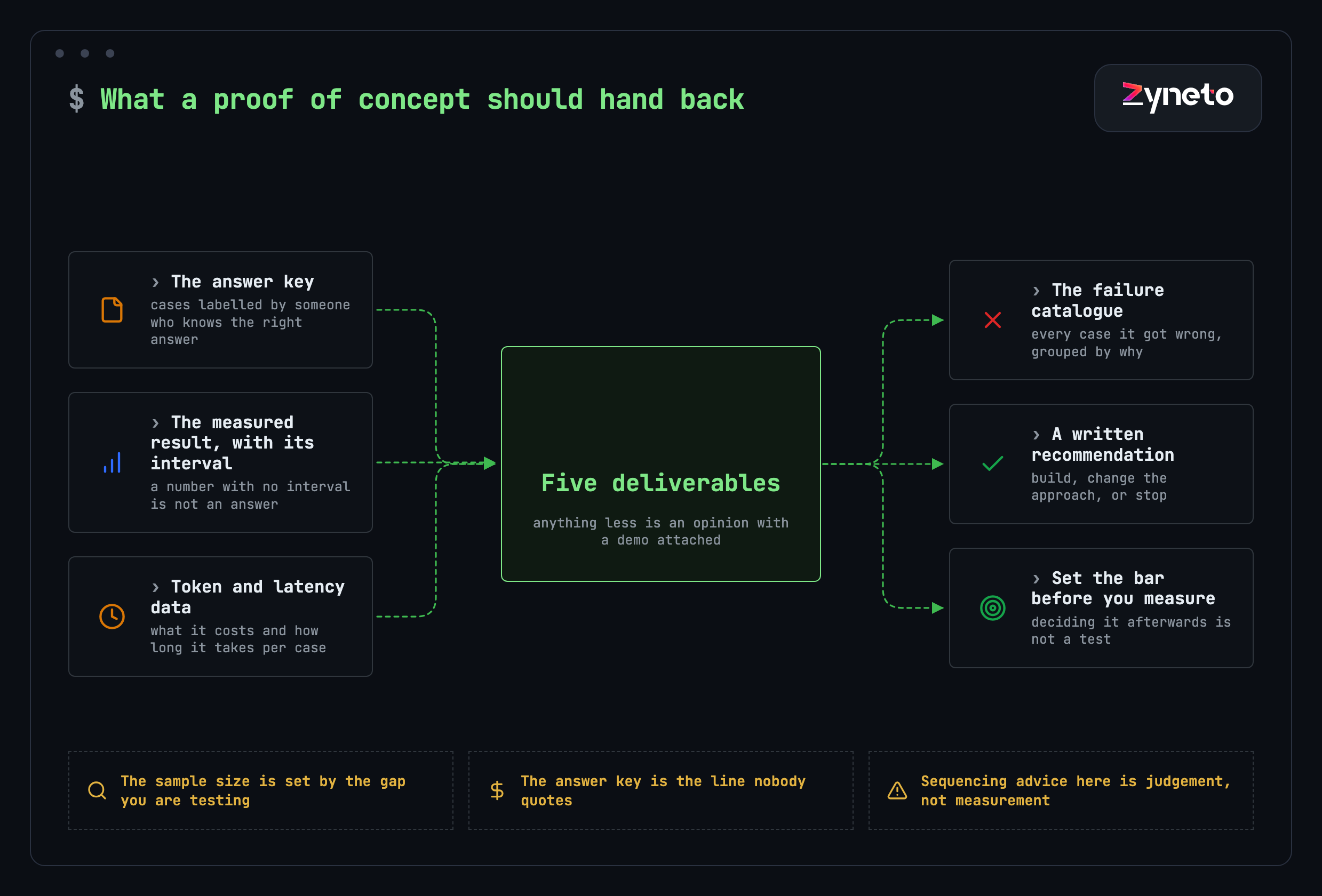
What the quote should itemise
Ask for these five lines separately. A quote that bundles them into one figure is hiding the only things worth comparing.
The question, in one sentence, with a threshold and a baseline. What is being tested, what it has to beat, and what the current process achieves today.
The number of test cases, and who produces the answer key. With the hours for it, on whichever side of the table they fall. If this line is missing, the quote does not include a measurement.
The data, and how it is obtained. Real extract or curated sample, how it is approved, and where it will sit. If your documents or customer records are involved, this is also a compliance question and it will take longer than the engineering. Where the files live afterwards is a decision of its own, covered in how an AI document management system is put together.
The result format. A number with an interval and a breakdown by case type, not a percentage on a slide. Ask explicitly for the failures, catalogued, because the list of what it got wrong is more useful than the score and is the thing that shapes the production design.
A written recommendation with a stop option. Including the circumstances under which the recommendation is not to proceed. A vendor who cannot write that sentence is selling you the next phase.
What we would do before paying for a build
This is judgement rather than measurement, and it is the sequence we would follow on a first AI project.
Measure the current process. How often is it wrong, how long does it take, what does it cost. Days of work, no engineering, and it sets the gap that determines the price of every test afterwards. Skipping it is the single most expensive habit in this whole area, because without it the bar gets set from a round number rather than from reality.
Write the question and the bar, then size the test. Once you have a baseline and a threshold, the number of cases is arithmetic rather than opinion, and the cost of the answer key follows from it. If that cost is absurd, you have learned that this question is not cheaply answerable, which is itself worth knowing on day two instead of week eight.
Build the answer key before the model. It is the deliverable that survives, and it is the one you can produce without a vendor. Several of the most useful engagements we are asked about could have started a month earlier if this had been underway in parallel.
Run the smallest honest test. Real data, real distribution, enough cases for the gap you declared, failures catalogued rather than summarised.
Then price the production system separately, with the measured token and latency figures from the test, and decide. A proof of concept that ends in a decision is the only kind that was worth paying for, and the decision is allowed to be no. A first AI project is also a product decision rather than only a technical one, which is why what belongs in version one and our AI agent development work are both worth reading alongside the arithmetic above.
Frequently asked questions
Published agency ranges put it at $10,000 to $80,000, with most clustering at $25,000 to $80,000 over four to eight weeks, read from three vendor pages on 2026-11-11. Those are asking prices rather than benchmarks, and one of the pages says so. On our published band of $40 to $100 an hour, 160 assumed hours is $6,400 to $16,000 and 320 assumed hours is $12,800 to $32,000, blending at $65 to $10,400 and $20,800.
Because a result without an interval around it is not a result. Forty six correct answers out of fifty is 92%, and the 95% confidence interval on that is 81.2% to 96.8%, which straddles a 90% bar. At 400 cases the same 92% narrows to 88.9% to 94.3%, still straddling it. To show that 92% beats 90% takes roughly 875 cases. A proof of concept that runs 50 cases cannot settle a two point question, however well it is built.
It is the set of cases where the correct answer is already known and written down, and it is what the proof of concept is scored against. It is usually missing from quotes because the knowledge of what is correct lives inside your business rather than with the vendor, so the hours land on your side. At four minutes a case and $65 an hour, 875 cases is 58.3 hours and $3,792. That is a tenth of a mid range build budget and it decides whether the build told you anything.
Widen the gap you are testing. The sample size you need is set by the distance between your threshold and the expected result, so a twelve point gap needs about 40 cases where a two point gap needs about 875. Measuring what your current process actually achieves usually widens the gap, because real baselines are lower than assumed ones. The other reliable saving is to answer obvious questions informally first, with fifty cases run by hand, before paying for a measurement.
Four to eight weeks in most published guides, with a spread of two to ten weeks across the pages read on 2026-11-11. The delays are usually not technical: data access, legal approval, security review and waiting on the expert who has to produce the answer key. Three of those four sit on the client side, which is why getting a data extract approved and an expert's hours blocked before the engagement starts shortens the calendar more than any technology choice.
A proof of concept answers one question in controlled conditions against a known answer key, with nobody's real work depending on it. A pilot puts a working system in front of real users at small scale and tests adoption as well as accuracy. The pilot is the expensive one, because it adds error handling, access control, monitoring, support and process change. Run the proof of concept first: testing an unproven idea on real users is costly to walk back.
Five things. The question with its threshold and measured baseline. The number of test cases and the answer key itself. The result expressed as a number with a confidence interval and a breakdown by case type. The measured tokens in and out per case plus observed latency, which you need to price the production system. And a written recommendation that includes the circumstances under which the recommendation is not to proceed.

Vikas Choudhary
Vikas has around fifteen years of experience building software and now builds generative AI systems at Zyneto. His work covers retrieval augmented generation, agentic AI, knowledge graphs, AI memory, and the evaluation and guardrails that decide whether any of it is safe to put in front of customers. He has shipped enterprise copilots, document AI, chatbots and predictive analytics for e-commerce, fintech and marketing teams, and works day to day in Python, JavaScript and SQL. He follows multimodal models, business process automation and enterprise AI security closely, and mentors engineers moving into AI. He writes about architecture, inference cost and the failure modes that only show up at production scale.
Zyneto builds custom software, AI and automation
Tell us what you are building and we will reply with a clear next step.