Restaurant Allergen Management Systems: Ingredient Data, Menu Sync & Safer Ordering


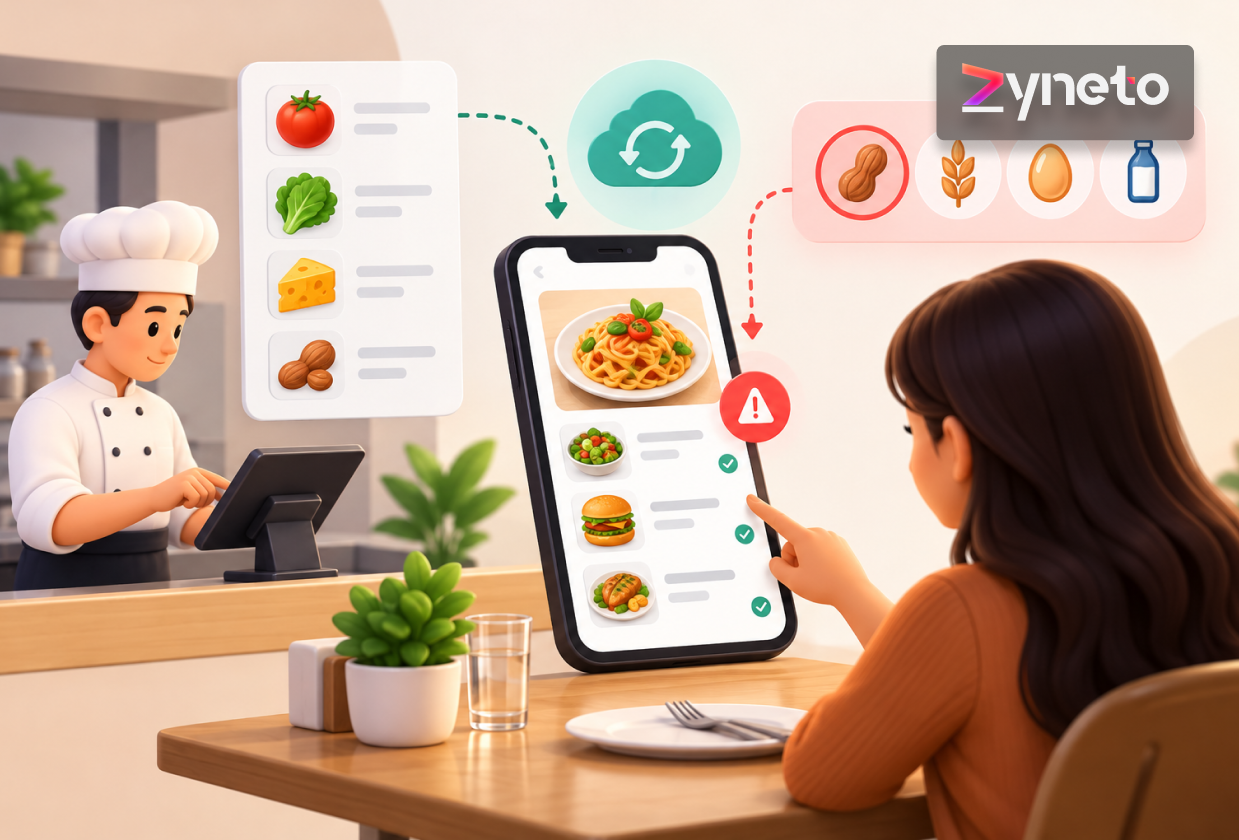
A supplier is out of stock, so the kitchen swaps in a different brand of mayonnaise. The new one contains mustard. The old one did not.
Nothing else changes. The recipe card still says chicken, bread, lettuce, mayonnaise. The online menu still lists egg and wheat. Mustard appears nowhere, on any screen.
That gap can stay open for weeks. Not through carelessness, but because the swap happened in a stockroom while the allergen data sits in four other systems.
This is what a restaurant allergen management system exists to prevent. Not a label generator, but a pipeline connecting what is actually in a dish to what every customer and staff member is told about it.
This guide covers the data model behind that pipeline, where it breaks, how allergen information moves between your POS, menus and ordering apps, and how to make uncertainty visible rather than hidden.
A restaurant allergen management system is the set of data structures and workflows that track which allergens are present in each ingredient, derive that information up to recipes and menu items, and publish it consistently across every channel where a customer can order.
It is an information system, not a safety guarantee.
That distinction matters more than anything else here. The system can tell a customer a dish is made without peanuts. It cannot tell them it was prepared in a kitchen where no peanut ever travelled. Conflating those two claims is how digital allergen tools create risk rather than reduce it.
A well-built system does three jobs:
Customer expectations have moved faster than most systems have. Diners increasingly filter and check before they arrive, part of the broader shift in restaurant app trends toward deciding before any staff contact happens.
The failures are rarely dramatic. They are small gaps between systems that were never designed to talk to each other.
A single menu item often lives in five places: the printed menu, the website, your ordering app, one or more delivery aggregators, and the POS staff read from.
Each of those usually holds its own copy of the allergen text. Update one and the others keep serving the old answer until somebody remembers them.
When allergen data is typed directly onto a menu item, it immediately begins drifting from the ingredients beneath it. The dish changes, the typed list does not, and there is no mechanism that notices.
Manufacturers reformulate. A product you have bought for two years can gain an allergen with no visible change to the packaging. Unless somebody re-reads the specification, that change enters your kitchen invisibly.
A customer removes an item or asks for a substitution. Most ordering systems treat that as a free-text note attached to an order rather than a change to the dish’s composition, so the allergen picture for what is actually being made is never recalculated.
These are integration and data-ownership problems rather than food safety problems, and they sit alongside the wider restaurant app development challenges of keeping several systems in agreement. Allergen data differs in one way. Being wrong has consequences that a stale price does not.
Get the model right and most of the problems above disappear by design. Get it wrong and no amount of interface polish will save it. The structure runs in four layers.
|
Layer |
What it holds |
Where allergen data comes from |
|
Ingredient |
A purchased product, tied to a supplier and specification |
Entered and verified from supplier documentation |
|
Recipe |
A set of ingredients, including sub-recipes |
Derived from its ingredients |
|
Menu item |
A sellable dish built from one or more recipes |
Derived from its recipes |
|
Channel listing |
How that dish appears on web, app, kiosk or aggregator |
Published from the menu item |
This is the single most important rule. Allergen data is entered once, at the ingredient layer, against a real supplier specification. Every layer above computes its own set from what sits beneath.
If anyone can type allergens directly onto a menu item, the system will go wrong. A hand-typed list cannot stay in step with a recipe that changes.
A burger sauce is a recipe. It is also an ingredient in the burger. Model that as real nesting rather than flattening it, because a change to the sauce must reach every dish using it, not just the one somebody remembers.
Your tomato soup uses a bought-in vegetable stock base. That base is one ingredient record, used in one recipe, sold as one menu item, published to four channels.
The supplier reformulates it to include celery. One record changes, the recipe and menu item recalculate, and all four channels update from the same source.
Without that chain, the same change needs four manual edits nobody has been told to make.
Most systems store allergen presence as yes or no. That is the dangerous simplification.
The state you actually need is three-way: present, absent, or not yet verified. A new supplier product with no allergen documentation is not allergen-free. It is unknown, and the system must be able to say so rather than defaulting to a reassuring blank.
Beyond the data model, a working system needs five operational capabilities.
A grid of menu items against the allergen list, generated from ingredient data rather than maintained by hand. This is what staff consult and what you export when somebody asks how a dish is classified.
Make the allergen list itself configurable. The United Kingdom requires information on 14 major allergens. United States federal law names nine. A system that hardcodes one list cannot operate in both markets.
Every change to allergen-relevant data needs a record of what changed, who changed it, when, and against which supplier document.
This is not bureaucracy. If a customer reports a reaction, the question you will be asked is what the data said on the day they ordered. Without versioning, you cannot answer it.
Allergen changes should not publish straight to customers on one person’s keystroke. Route them through a named approver, particularly when a change removes an allergen from a dish.
When an ingredient changes, the people affected need to know. Kitchen managers for preparation, front-of-house for customer conversations, and marketing if the dish is promoted as suitable for a particular diet.
The customer view needs to state what the data covers and what it does not, in plain language, close to the information itself rather than buried in a footer.
Keep this capability separate from algorithmic suggestions. Recommendation engines of the kind described in AI in restaurant apps are useful for discovery and entirely wrong for safety-relevant filtering. A dish should appear in an allergen-filtered view because its ingredient data says so, never because a model inferred it.
One system must own allergen data. Everything else subscribes to it.
Usually that owner is the recipe or menu management platform, because that is where ingredients already live. The POS, the website, the app and the aggregator feeds all become consumers of that source rather than parallel copies of it.
When allergen data changes, downstream systems should be told immediately through webhooks or an equivalent event. Nightly batch synchronisation means a dish can carry wrong allergen information for most of a day.
Third-party delivery platforms have their own menu structures, their own field limits and their own update latency. Some will not accept the full detail you hold.
Decide deliberately what happens when a platform cannot represent your data properly. Publishing a partial allergen list there is worse than publishing none, because it looks complete.
This is where most integrations are thin. Three cases need an explicit answer before launch:
A filter that silently returns fewer dishes because data failed to load is the worst outcome available, because it looks like a confident answer.

Allergen data decays. Managing that decay is most of the ongoing work.
Every ingredient record should link to the supplier document it was derived from, with the date it was checked. A specification from four years ago is not evidence of anything today.
Build a re-verification cycle. Products that change formulation often, or come from suppliers who notify poorly, need checking more frequently than a bag of plain flour.
The mayonnaise example at the start is the common case. A kitchen swaps a product during a stockout and the swap never reaches the data.
Give staff a fast way to record a substitution, and flag when the replacement introduces an allergen the original did not carry. If that takes more than a few seconds, nobody will use it during service.
This deserves separate treatment, because it is not an ingredient property.
An ingredient list tells you what is deliberately in a dish. It says nothing about shared fryers, preparation surfaces, airborne flour or a utensil used twice.
Model cross-contact risk separately, at the level of the kitchen and its equipment rather than the recipe. Then be honest in the interface about which question you are answering. US regulators are explicit that advisory “may contain” statements are not required by law and must be truthful rather than used as a substitute for good practice, and the same logic applies to anything you display digitally.
The interface decides whether good data actually protects anyone.
Capture allergen requirements at the start of the session, not at checkout. Filtering a menu after someone has chosen is both a worse experience and a worse outcome.
Store the declaration against the order so it travels with the ticket to the kitchen, rather than living only in the customer’s screen state.
Three states need visibly different treatment: contains the allergen, does not contain it according to current ingredient data, and cannot be confirmed.
The third must never look like the second. A greyed-out badge or a blank field reads as safe to a worried customer.
For any order carrying an allergen declaration, staff should see it prominently and confirm they have seen it. That acknowledgement belongs in the order record.
Give staff an escalation path too. When they cannot confirm a dish is suitable, they need a clear way to say so rather than guessing under time pressure.
Some kitchens cannot exclude cross-contact for some allergens. The right interface response is to say that directly, not to hide the dish or let silence imply safety.
The ordering surface carries most of this burden, which is why the customer-facing build deserves the same engineering attention as the data layer behind it, and why a mobile app development company working on this should be designing both together.
Phase the work. Attempting all of it at once is how these projects stall. This is a focused data project rather than a general build, so treat it separately from your broader restaurant app development process even when both run together.
Expect this phase to be slower than planned. It is also where most of the value is.
Create the ingredient, recipe and menu structures, migrate verified data, and mark everything else unverified rather than guessing.
Integrate a single channel end to end before adding others. Your own app or website is usually right, because you control both ends.
A narrow first release is the same principle that applies whenever you create a mobile app, and it matters more here because a wrong answer costs more.
Verify that a recipe change propagates everywhere, that unverified data displays correctly, that a failed sync raises an alert, and that declarations reach real tickets.
The system only works if staff use the substitution and escalation paths during service, so train on those two first.
Effort scales with channel count and the state of your existing ingredient data rather than with features, which is worth weighing alongside general restaurant app development cost planning.

Three things sit around the system rather than inside it.
Treat this article as engineering guidance. Confirm your obligations with your local food authority and your own legal advisers in each market you operate in.
Most operators do not have an allergen data problem so much as a disconnection problem. The information exists somewhere, and it does not reach the screen the customer is reading.
The engineering that closes that gap is specific. An ingredient-level data model with real recipe nesting, derived allergen sets that cannot be overwritten by hand, event-driven sync to every channel, and interfaces that show uncertainty instead of hiding it.
That integration work is what a restaurant app development company like Zyneto builds, across POS systems, ordering apps and the platforms in between. We design to the obligations your advisers set rather than advising on them.
If your allergen information lives in more than one place today, mapping where it diverges is a sensible first step.
Hold allergen data at the ingredient level, derive everything above it, and publish from one source to every channel.
Then make uncertainty visible and keep a human confirmation step in the loop. A system that admits what it does not know is safer than one that always has an answer.
Allergen presence at ingredient level, linked to the supplier specification and the date it was checked. Recipes, menu items and channel listings should all derive from those records rather than keeping copies.
By deriving it rather than typing it. Changing one ingredient recalculates every recipe and menu item using it, then pushes that to each channel. Service-time substitutions need a fast route into the same system.
Usually yes, where the POS exposes a menu API or accepts structured import. What matters is that one system owns the data and the POS consumes it, rather than both holding copies that drift.
No. Ingredient data describes what is deliberately in a dish, not cross-contact from shared equipment or surfaces. Say so plainly in the interface and keep a staff confirmation step on any declared order.
That an ingredient change reaches every channel, that unverified data shows as unverified rather than safe, that a failed sync alerts someone, and that staff see declarations on live tickets.
Sudhanshi has several years of experience in digital marketing and now works on growth at Zyneto. Her work covers SEO, content strategy, organic lead generation, social media and paid campaigns across Google, LinkedIn, Instagram and Facebook. She has run B2B technology and SaaS campaigns for international audiences, helping brands get found in search and stay found, and works day to day in Google Analytics, Search Console, Ahrefs, SEMrush, Screaming Frog and Canva. She follows AI driven marketing, changing search behaviour, content automation and social growth closely, and turns audience and search data into plans a team can actually run. She writes about SEO, content strategy and the tactics that still earn traffic as search keeps shifting.
Share your details and we will talk soon.
Be the first to access expert strategies, actionable tips, and the trends actually shaping the digital world. No fluff - just practical insights delivered straight to your inbox.
Dive into our blog and stay ahead of the curve with expert perspectives, future-ready trends, and tech tips written for decision-makers and doers alike.